A Saturday custody exchange in Bear Branch can turn into an assault family violence case in Kingwood, TX before either person understands what's happening. One person calls 911, deputies arrive, both sides give different accounts, and someone may leave the home in handcuffs. The legal consequences can reach criminal court, protective-order proceedings, divorce, child custody, housing, employment, and firearm rights.
If you're the person who called, you need a safety plan and a way to preserve evidence. If you're the person arrested, you need to protect your rights immediately and follow every bond condition. Texas family-violence cases move quickly, often before either side speaks with a lawyer, so your early decisions matter.
When a Kingwood Family Argument Becomes a Legal Case
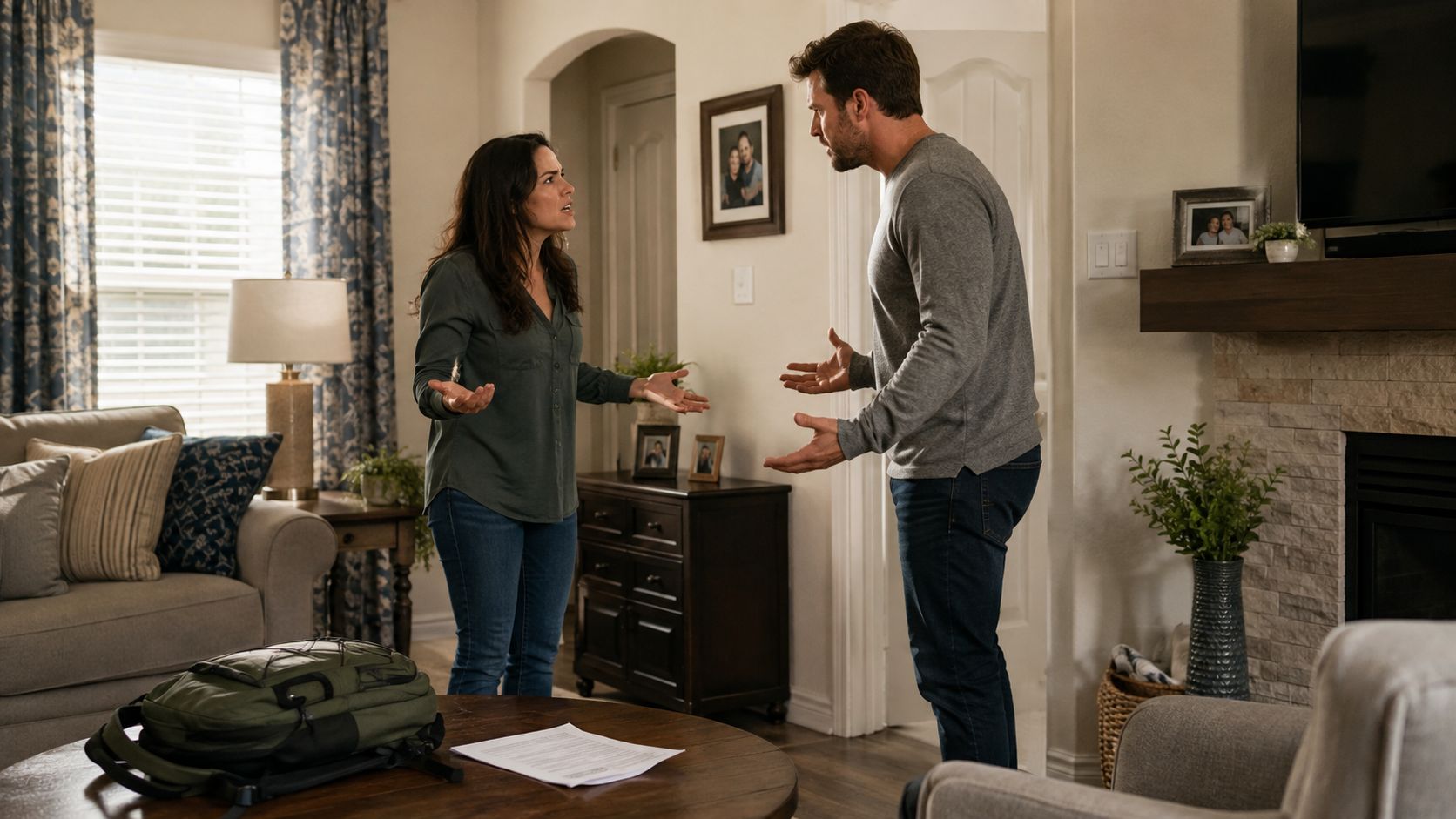
The argument started over a custody exchange near Mills Branch Drive. One parent said the other blocked the doorway and grabbed a phone. The other said the contact happened while trying to stop someone from leaving with the child. A neighbor heard shouting, a 911 call was placed, and deputies from the Harris County Precinct 4 Constable's office arrived while both people were still upset.
That moment changes the situation. Officers may separate the parties, inspect the home, speak with witnesses, review visible injuries, and decide whether probable cause supports an arrest. The person who called may expect the other party to be warned and sent away. The person accused may expect to explain the misunderstanding and go home. Neither expectation controls what happens next.
Why the first police response matters
A family-violence call creates an official record. That record may include the 911 audio, body-camera footage, photographs, statements from the people involved, and observations made by the responding officers. Even if the parties later reconcile, the Harris County District Attorney's Office may continue evaluating the case based on the available evidence.
Texas data shows why Harris County treats these calls as a serious public-safety issue. Harris County reported 46,059 family-violence incidents in 2022, an 8% decrease from 2021, or 961.4 incidents per 100,000 residents. The county also reported that intimate-partner homicides increased from 60 in 2021 to 64 in 2022, a 7% increase, and warned that underreporting means reported incidents are a documented floor rather than a complete count. See the Harris County family-violence report.
Practical rule: Once police arrive, stop trying to win the argument. Create physical safety, speak truthfully, and avoid statements or contact that can make the legal situation worse.
The rest of the process depends on which side of the call you're on. A reporting person should preserve evidence, obtain medical care when needed, and consider protective-order options. An arrested person should remain silent about the incident until consulting defense counsel, comply with release conditions, and preserve favorable evidence without contacting the complainant.
What Texas Law Calls Family Violence and Assault
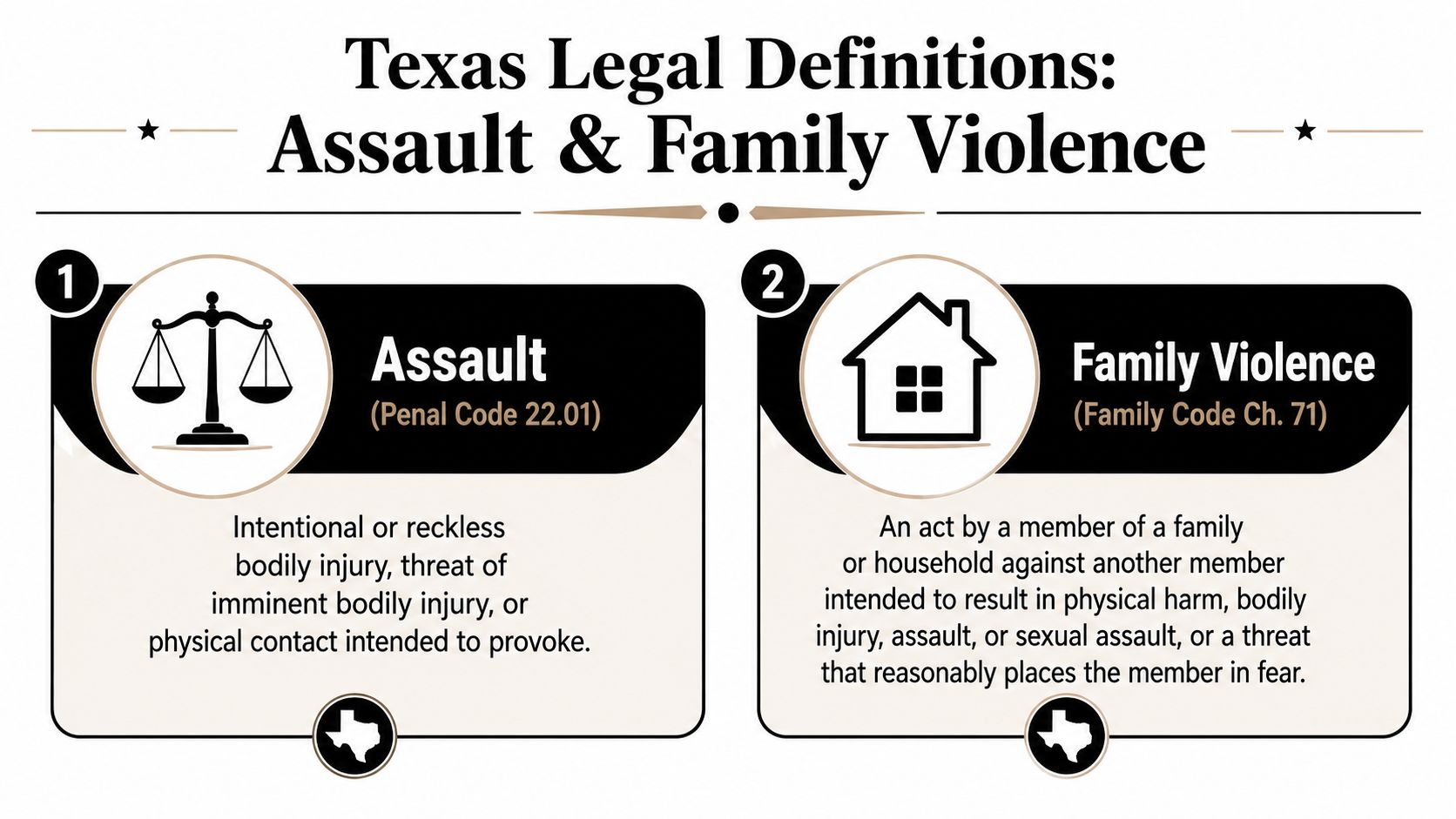
Texas separates the conduct from the relationship. Assault is generally prosecuted under Texas Penal Code § 22.01. Family violence describes the relationship and circumstances that place the alleged assault within Texas Family Code Chapter 71.
Under Texas Penal Code § 22.01, the state may allege assault when a person intentionally, knowingly, or recklessly:
- Causes bodily injury to another person.
- Threatens another person with imminent bodily injury.
- Makes offensive or provocative physical contact.
A Kingwood Place argument involving a thrown phone can raise questions about bodily injury, offensive contact, intent, and who initiated the physical conduct. A shove during pickup near Kingwood Park High School may support an assault allegation even if the injury appears minor. A threat must involve imminent bodily injury. Words alone generally aren't enough unless the surrounding conduct makes the threat immediate and legally significant.
The relationship changes the case
Texas Family Code Chapter 71 defines family violence as conduct by a family or household member intended to cause physical harm, bodily injury, assault, or sexual assault, or a threat that reasonably places another person in fear of imminent harm. The definition excludes defensive measures used to protect oneself. Review the Texas Family Code Chapter 71 provisions.
The relationship can include:
- Current or former spouses.
- Dating partners.
- Co-parents.
- Family members.
- People who share or previously shared a household.
- Certain relatives, step-relatives, and in-laws covered by the statutory definitions.
That means an alleged incident in Humble can become a family-violence matter even when the parties aren't married. The prosecution must still prove the alleged assault and the qualifying relationship. A defense lawyer should examine both elements separately rather than treating the police label as proof of guilt.
The Houston Police Department's explanation of Texas assault law and family-violence relationships confirms that spouses fall within the statute and that threats and offensive contact can support an assault allegation without dramatic visible injuries.
Degrees and Penalties for Assault in Kingwood
A Kingwood arrest can begin as a misdemeanor and become a felony when the alleged conduct, injury, relationship, weapon, or prior record meets additional statutory requirements. A first-time assault causing bodily injury against a family member is generally a Class A misdemeanor, with exposure of up to one year in county jail and a fine of up to $4,000. A prior family-violence conviction or deferred adjudication can raise a later offense to a third-degree felony.
The Texas practitioners' guide to family-member offenses explains this misdemeanor-to-felony escalation. Treat an older case as relevant until counsel reviews it. The state may rely on qualifying Texas records from another county or a Harris County justice court, so the review should cover the person's full criminal history.
| Offense Degree | Statutory Range | Typical Consequences |
|---|---|---|
| Class C misdemeanor | Applies to certain assault allegations without bodily injury | Fine exposure, court supervision, and a record that may affect later proceedings |
| Class A misdemeanor | Up to one year in county jail and a fine up to $4,000 | Jail exposure, probation, counseling conditions, no-contact restrictions, and family-court consequences |
| Third-degree felony | Two to ten years in prison and a fine up to $10,000 | Felony record, prison exposure, probation conditions, firearm consequences, and custody concerns |
| Higher felony allegations | Depends on serious injury, weapon allegations, or other statutory factors | Possible state-prison exposure and substantially greater collateral consequences |
A prior conviction is only one factor. Serious injury, a deadly weapon, or conduct charged under another felony statute can move an allegation beyond ordinary misdemeanor assault. The charge should be tested against the police report, medical records, photographs, video, witness accounts, and charging instrument.
The number on the booking sheet isn't the whole case. Relationship history, prior records, injury proof, and admissible evidence can change the legal path.
A conviction may affect employment checks around Lake Houston, housing applications, professional opportunities, family relationships, probation obligations, and firearm possession. Address those risks before entering a plea. The person who called 911 and the person arrested both need a clear record of what happened, because the criminal case can influence later family-court decisions in Harris County and Northeast Houston.
If You Are the Victim Reporting in Kingwood or Humble
If you're in immediate danger, call 911 and give the dispatcher your exact location. Ask for a Harris County Sheriff's Office deputy or the appropriate local law-enforcement response, and move to a safer location if you can do so without increasing the danger.
What to do after officers arrive
Officers commonly separate the people involved so each person can speak without pressure. They may photograph injuries, document the condition of the home, collect statements, and identify witnesses. They may also review whether probable cause supports an arrest under the circumstances.
Take these steps:
- Get medical care. A visit to Memorial Hermann Northeast or a Kingwood emergency room can address your health and create medical documentation. Tell medical staff how the injury occurred.
- Preserve digital evidence. Save text messages, call logs, emails, social-media messages, and doorbell-camera footage from your Lake Houston neighborhood.
- Write a dated timeline. Record what happened, who was present, what was said, where each person stood, and when injuries or symptoms appeared.
- Keep the report information. Ask for the offense-report number and keep copies of photographs, medical records, and related communications.
- Ask about safety planning. A victim advocate can help identify shelter, transportation, communication, and child-safety options.
Protective-order choices
After an arrest, a Harris County magistrate may consider an emergency protective order. You may also pursue a broader protective-order application under Texas Family Code procedures. A protective order can address contact, residence, communication, and safety conditions, so read every page before relying on an informal agreement with the other person.
Follow-up may involve HCSO detectives and the Harris County District Attorney's Office. The case can continue even if you later feel conflicted or want to withdraw the report. Early, accurate documentation helps prosecutors, advocates, family-law counsel, and any civil court understand what happened.
If You Are the Person Arrested in Harris County
An arrest at a Kingwood or Atascocita address can begin with a deputy deciding that probable cause exists under Penal Code § 22.01. You may then be taken for booking at the Harris County Joint Processing Center, where authorities process identification and the arrest record before a magistrate reviews release conditions.
Don't explain the incident in the patrol car, at booking, or by telephone to the alleged victim. Say that you want a lawyer, then stop discussing the facts. A calm request for counsel protects you far better than an emotional explanation that investigators later interpret against you.
Bond conditions can control your daily life
A magistrate may impose no-contact conditions, prohibit a return to the shared Kingwood home, restrict communication through friends or relatives, require monitoring, or impose other release terms. Read the written order carefully. Contact that feels harmless, including a message about children or property, can create a new legal problem if the order forbids it.
For practical information about the release process, people may review bail assistance for domestic charges while arranging counsel. Your lawyer should examine the bond paperwork, the arrest affidavit, and any emergency protective-order language before you make plans to return home or communicate with family.
Defense work should start immediately
During the first days, preserve texts, security footage, photographs, location information, and names of witnesses. Ask neighbors or businesses to preserve relevant video before it is overwritten. Don't delete messages, alter photographs, or ask anyone to change their account.
Texas Code of Criminal Procedure Article 38.371 permits relevant facts and circumstances, including prior incidents between the parties or members of the same family or household, to be presented in family-violence assault or aggravated-assault cases. That broader evidentiary record makes relationship history important. The Texas courts' discussion of family-violence evidence explains why a defense cannot focus only on the single event described in the charge.
A lawyer can evaluate whether a dismissal request, evidence challenge, negotiated resolution, trial strategy, or an appropriate educational or intervention program makes sense. For a focused discussion of possible dismissal paths, review how assault charges may be dropped in Texas, but don't assume any course or request guarantees a result.
Protective Orders, Firearms, and Family Law Consequences
A criminal assault case is only one part of the problem. A protective order can control where you live, who you contact, how you communicate about children, and whether you can possess firearms. A family court may also consider the allegations when deciding temporary orders, custody, and visitation.
Texas law allows a temporary ex parte protective order without notice or a hearing when the court finds a clear and present danger of family violence. A final protective order generally may last up to two years, as described in Texas Family Code § 83.001. The duration and restrictions depend on the order entered, so never rely on a verbal promise that contact is acceptable.
| Order Type | Duration | Firearm Restriction | Family Court Impact |
|---|---|---|---|
| Temporary ex parte protective order | Short-term emergency relief, as ordered by the court | May impose immediate restrictions stated in the order | Can affect residence, communication, and temporary parenting arrangements |
| Magistrate's emergency protection order | Emergency period set by the magistrate, potentially extending to 61 days in qualifying cases | May restrict possession under the order and applicable law | Can shape emergency safety and child-contact decisions |
| Final protective order | Generally up to two years | Federal and Texas restrictions may apply, including firearm surrender requirements | May influence custody, visitation, relocation, and later enforcement proceedings |
Federal law can prohibit firearm possession in circumstances involving qualifying protective orders and domestic-violence convictions. That can affect firearms kept in a Kingwood home shared with a spouse and may create problems for a concealed-carry license. Get specific advice before transferring, storing, or retrieving a firearm.
A divorce or SAPCR case in the 757, 758, or 759 North Houston area may proceed alongside the criminal case. Allegations can affect supervised visitation, temporary conservatorship, and exchanges. A deferred adjudication or acquittal may have different effects in later civil proceedings, so don't assume that a criminal outcome automatically erases the family-law impact.
For a plain-language comparison of the two court remedies, see protective orders versus restraining orders in Kingwood. Families seeking information about Protective Orders in Kingwood can use that resource for domestic-violence and family-safety matters.
Kingwood, Humble, and Harris County Resources and Courts
Kingwood residents may interact with different agencies depending on where the incident occurred, who responded, and whether the allegation is a misdemeanor or felony. A 77339, 77345, or 77346 address doesn't determine every court assignment by itself, but it helps identify the local law-enforcement and community network that may become involved.
Start with the responding agency and obtain the report number. Misdemeanor matters may move through local municipal or justice-court channels, while felony cases are handled through the Harris County criminal-court system and the District Attorney's Office. Protective-order filings generally go through the Harris County Family Law Center on Caroline Street, subject to the court's filing procedures and jurisdictional requirements.
Local support can address more than the criminal charge
A survivor may need emergency shelter, counseling, transportation, child-care planning, or help preparing for a protective-order hearing. A family facing a sudden separation may also need referrals through Humble ISD or Lone Star College-Kingwood when children are affected.
Relevant categories include:
- Emergency response: 911 and the responding Harris County law-enforcement agency.
- Advocacy: The Houston Area Women's Center 24-hour hotline and victim-advocacy services.
- Prosecution support: The Family Violence Unit at the Harris County District Attorney's Office.
- Shelter and counseling: NWHC and Interfaith Caring Ministries.
- Family referrals: Humble ISD and Lone Star College-Kingwood counseling resources.
The court path can become confusing when criminal charges, protective orders, divorce, and custody overlap. A local lawyer can help identify which filing or hearing needs attention first. The Law Office of Bryan Fagan's Harris County family court guidance for Kingwood residents addresses the family-court side of that process.
Common Questions and When to Call a Kingwood Lawyer
Must police arrest someone
No automatic rule guarantees an arrest in every family argument. Officers evaluate probable cause, statements, visible evidence, safety concerns, and the alleged offense. Once an arrest occurs, the complainant can't cancel it by asking the officer to undo the process, and the prosecutor may continue with other evidence.
How long does a protective order last
A temporary order lasts for the period stated by the court. A final protective order generally may last up to two years, under the Texas law discussed earlier. Read the exact order because restrictions can apply immediately and may cover contact, residence, communication, children, and firearms.
What happens at the magistrate hearing
The magistrate reviews the arrest and release conditions, addresses probable cause and bond, and may impose no-contact or residence restrictions. The hearing isn't a trial, and you shouldn't use it to give a long explanation of the incident. Ask counsel to review the conditions before you communicate with the other party.
Does a second offense become a felony
A prior family-violence conviction or deferred adjudication can increase a later bodily-injury assault against a family member to a third-degree felony. The state must establish that the prior history qualifies, so obtain and review the actual records rather than relying on memory.
Can a dismissed charge affect custody
A dismissal isn't a conviction, but family courts may evaluate broader evidence relevant to a child's safety and best interests. Police reports, protective-order records, messages, and witness testimony may still matter. A criminal defense strategy should therefore account for any pending divorce or custody case.
If you're preparing for a consultation, organizing the timeline, court orders, children's information, and communication history can make the first meeting more productive. A resource covering sample family law intake questions can help you collect the basic information counsel will need. If an existing custody or divorce order is being violated, Enforcement of Court Orders in Kingwood addresses enforcement of divorce-decree and custody-order provisions in Harris County.
Call a Kingwood lawyer promptly if there's an active protective-order violation, a new arrest while you're on bond, CPS involvement, or a divorce that intersects with the criminal case. Contact the Law Office of Bryan Fagan – Kingwood TX Lawyers for a free consultation about evidence, bond conditions, protective orders, custody, and the next court deadline.
The Law Office of Bryan Fagan – Kingwood TX Lawyers provides local guidance for assault family-violence charges, protective orders, custody disputes, divorce, and related family-law consequences in Kingwood, Humble, Porter, and Northeast Houston. Schedule a free consultation at the Kingwood office so you can address the immediate legal risks and choose your next step with a clear plan.