You're engaged, planning a life in Kingwood, and trying to handle practical issues before the wedding. One of you may be carrying student loans, the other may have an interest in a family business near Porter, or an inheritance may be expected by a family in Northeast Houston. A prenuptial agreement can bring clarity to those concerns, but only if the process supports enforcement later.
For Kingwood couples, Texas law generally presumes a properly executed premarital agreement is valid and enforceable. The spouse seeking to avoid the agreement usually carries the burden of proving a statutory defect. That makes the signing process, financial records, and timing just as important as the language in the document.

A prenup isn't a prediction that a marriage will fail. It's a written plan for property, debts, and financial responsibilities if circumstances later change. For readers researching how to make legal information easier to find and evaluate, CitationOS on AI citations for law firms offers useful background on citation practices. The legal priority, however, remains straightforward: create a record showing that both people understood the agreement and signed it voluntarily.
Introduction – Why Enforceability Matters for Kingwood Couples
A document can look polished and still become difficult to enforce if one spouse says it was presented under pressure, important assets were omitted, or the signing process was rushed. Harris County courts don't just ask whether a couple signed a paper. They can examine the circumstances surrounding the agreement and the statutory defenses raised against it.
The practical question for a Kingwood couple is therefore not just, “Do we have a prenup?” It is, “Can we show how this prenup was prepared, reviewed, disclosed, negotiated, and signed?” That record can matter years later, when memories differ and financial circumstances have changed.
The working rule for local couples
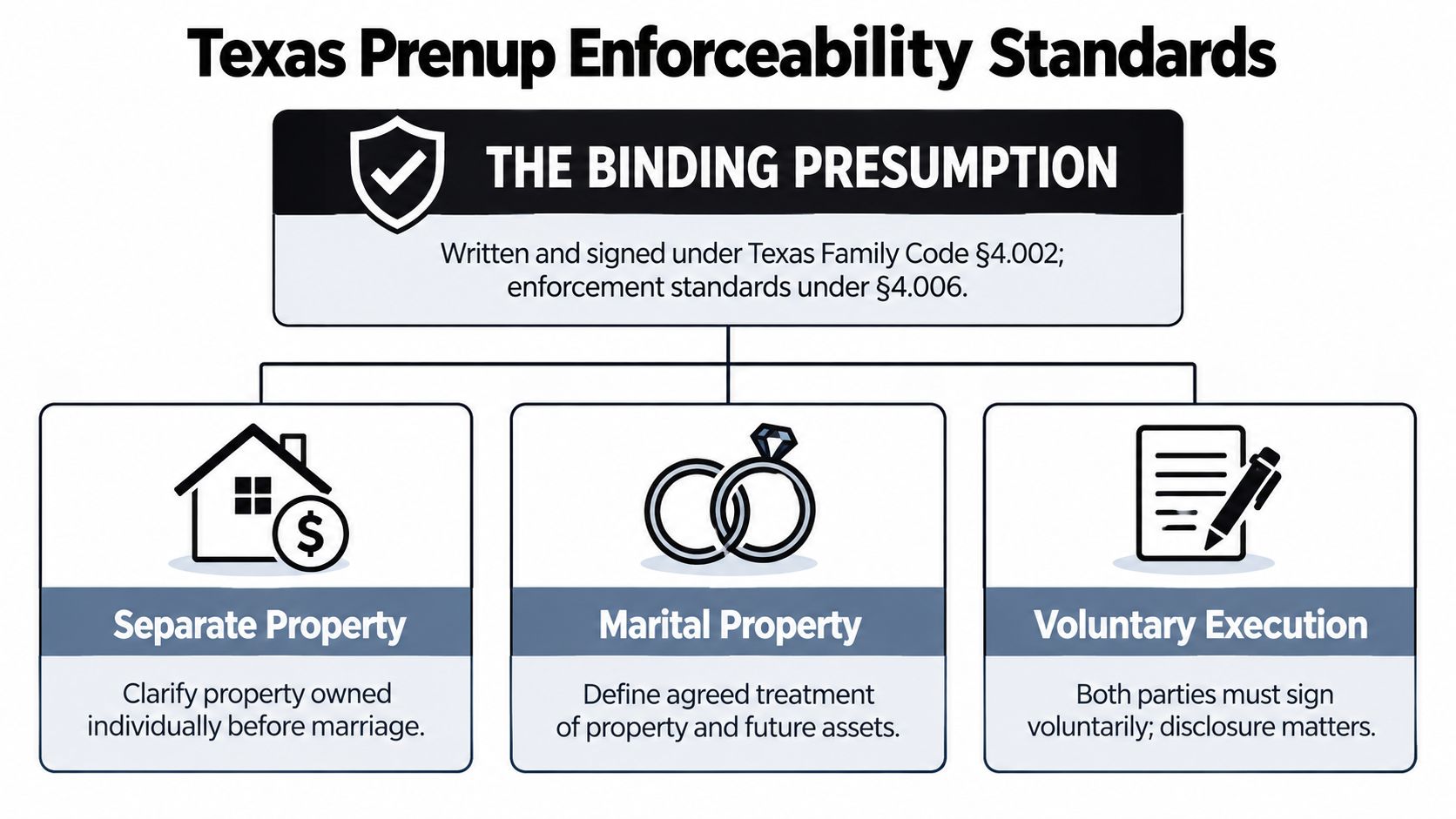
Texas Family Code Chapter 4 provides the framework. Under Texas Family Code § 4.002, a premarital agreement must be in writing and signed by both parties. It becomes effective when the parties marry, and the statute doesn't require separate consideration, such as a payment or another exchange of value. Texas Family Code Chapter 4 contains the controlling statutory framework.
A challenge generally follows one of two paths. The spouse opposing enforcement must show that the agreement wasn't signed voluntarily, or that it was unconscionable when signed and that the required disclosure, waiver, or knowledge protections were absent.
Practical rule: Treat the prenup process as evidence preparation. Every disclosure schedule, email, draft, and review appointment can help explain what happened when the agreement was signed.
Kingwood, Humble, and Northeast Houston couples often have blended financial lives before marriage. Separate real estate, business interests, family gifts, investment accounts, and existing debts can all create questions about ownership. A carefully prepared agreement can reduce uncertainty, while a rushed template can leave both spouses arguing about what they intended.
Texas Prenup Basics and the Binding Presumption
Texas starts from a position that favors contractual certainty. A premarital agreement that meets the statutory requirements is generally treated as presumptively valid and enforceable, and the person challenging it ordinarily must prove a recognized defect. That burden matters because a court doesn't begin by rewriting an agreement just because one spouse later dislikes the bargain.
What Texas law requires
The foundation is formal but simple:
- Written agreement: An oral promise about premarital property isn't enough under the statute.
- Both signatures: Each party must sign the document.
- Marriage: The agreement becomes effective when the parties marry.
- No consideration: Neither party must provide separate payment or another exchange of value for the prenup to take effect.
A Kingwood couple can use a premarital agreement to define financial rights and responsibilities, subject to statutory and public-policy limits. The document might address separate property, marital property, debts, management rights, or financial arrangements connected with divorce or death. It can't be used to predetermine matters that Texas law reserves for a court, such as a child's right to support.
The Texas prenuptial agreement resource can help Kingwood readers understand the basic purpose of these contracts before they begin drafting or reviewing one. For clients seeking drafting and review of marital property agreements, Prenuptial & Postnuptial Agreements in Kingwood is a related local service page.
The two routes to a challenge
Texas Family Code § 4.006 creates a focused enforcement analysis. A spouse challenging the agreement must prove either:
- The agreement wasn't signed voluntarily; or
- The agreement was unconscionable when signed, and the challenging spouse also lacked fair and reasonable disclosure, didn't voluntarily waive additional disclosure in writing, and lacked adequate knowledge of the other spouse's assets or financial obligations.
That second route is cumulative. An allegation that disclosure was incomplete doesn't automatically end the inquiry. The challenger must also establish the required unconscionability and knowledge-related elements.
For Kingwood clients, this means the best protection is not just adding more aggressive language. It is preserving a credible process. A complete financial schedule, clear explanations, written waivers where appropriate, and time for independent review give the agreement a stronger foundation if the marriage later ends in Harris County.
How Kingwood Courts Evaluate Prenuptial Agreements
A Kingwood couple may sign an agreement at a home in Kingwood, a law office near Humble, or elsewhere in the Houston area. If enforcement is later contested, the location matters less than the surrounding facts. Texas courts apply a strong freedom-of-contract policy, but they also examine whether the statutory requirements and meaningful consent were present.
Consider a couple where one person owns a business connected to Porter and the other has limited knowledge of its finances. A document that identifies the business, explains its ownership, attaches useful financial information, and gives the other person time to obtain advice creates a different record from a document handed over shortly before the ceremony with a broad statement that “everything has been disclosed.”
Context can shape the court's analysis
A Harris County appellate decision explains that the court may consider the entire setting in which the agreement was made, including available alternatives, the parties' relative bargaining ability, public-policy concerns, and whether the terms are oppressive or unreasonable. The Fourteenth Court of Appeals decision provides that local appellate perspective.
That doesn't mean a court will decide whether the agreement was financially wise. It means the circumstances can help determine whether the agreement reflects voluntary, informed contracting or a process that created serious factual questions.
Turning legal standards into proof
A useful Kingwood file should answer practical questions:
- When did each person first receive the draft?
- What financial information accompanied it?
- Did each person have an opportunity to consult a separate attorney?
- Were revisions discussed and preserved?
- Did either party express confusion, pressure, or objections?
- Were final schedules and signature pages kept with the executed agreement?
A written waiver can be important, but it shouldn't replace honest disclosure when meaningful information is available. Similarly, independent counsel isn't the only factor in enforcement, yet separate advice can show that the signing spouse had an opportunity to understand the rights being affected.
Good drafting protects the agreement. Good process explains why a court should trust it.
The strongest approach balances both sides' interests. A document that protects one spouse while concealing the financial picture may create avoidable risk. A document that clearly identifies property, debts, and intended treatment gives both spouses a more reliable basis for decision-making.
Common Grounds for Challenging a Texas Prenup
Texas law gives premarital agreements a strong starting position, but enforceability can still fail when the agreement produces an unconscionable result under the applicable statutory defenses. For Kingwood couples, the key question is often substantive: what rights were changed, what financial facts were known, and whether the agreement left one spouse without a fair understanding of the bargain?
Unconscionability and financial imbalance
An agreement may draw a challenge when its terms are so one-sided that enforcing them would be unjust under the governing statute. A spouse might receive little or no claim to valuable business interests, separate property growth, retirement benefits, or real estate while assuming significant obligations. A court does not rewrite a poor financial bargain just because one party later regrets it, but extreme terms combined with inadequate financial information can create a serious enforcement issue.
The agreement should identify assets, debts, ownership interests, and intended treatment with enough detail to make the bargain understandable. Vague descriptions can create disputes over whether a spouse knew what property was affected. A general acknowledgment that disclosure occurred may not resolve a challenge if material information was omitted or presented unclearly.
For example, listing a company without describing the ownership interest, related liabilities, or intended treatment of future appreciation may leave important questions unanswered. The same concern applies to real estate, investment accounts, trusts, loans, and other obligations that could materially affect the marital estate.
Statutory transition and older agreements
The date of execution can change the legal analysis. Texas adopted the Uniform Premarital Agreement Act framework in 1987, and a significant enforcement amendment took effect on September 1, 1993. A prenup signed before or after that transition may face different statutory defenses, so an older agreement requires a date-specific review rather than comparison with a current template.
The Texas Supreme Court's discussion of premarital agreements and freedom of contract provides historical context for that development in Texas Supreme Court history and premarital agreement authority.
Older language can also create substantive uncertainty. Terms may refer to property categories, support rights, or statutory concepts that later changed. If the agreement does not clearly address those issues, the court may need to determine what the parties intended and whether the relevant provisions remain enforceable.
A careful review should therefore focus on the agreement's actual terms, the financial rights it removes or limits, the information incorporated into it, and the statutory rules in effect when the parties signed.
Timing, Disclosure, and Drafting Safeguards in Kingwood
Enforceability is easier to protect before the wedding than to repair during a divorce. Kingwood couples should treat the process as a sequence of decisions, not as a signature appointment at the end of wedding planning.
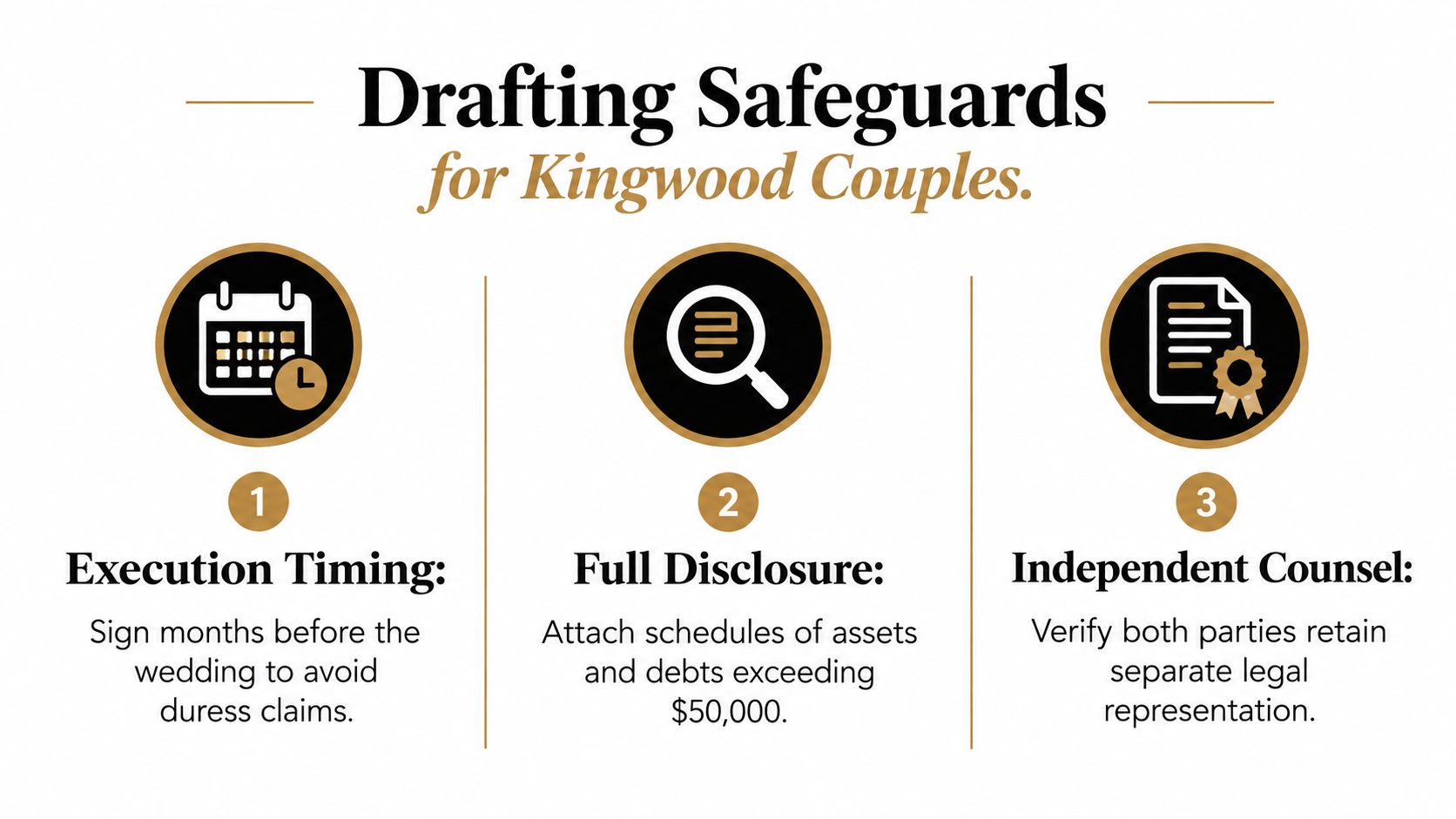
Build time into the process
Start early enough for each person to read the draft, collect records, ask questions, negotiate terms, and obtain separate legal advice. There isn't a single safe calendar rule that replaces judgment. The concern is whether the signing spouse had a meaningful opportunity to decide freely, rather than feeling that the wedding would be jeopardized by refusing.
A strong file should preserve draft history and communications without turning every conversation into a confrontation. If terms change, keep the revised version and explain the reason for material changes.
Assemble a usable disclosure file
Useful records may include:
- Balance sheets: Identify assets and liabilities in an organized format.
- Business information: Describe ownership interests and relevant valuation information.
- Real-estate records: Identify properties and the intended treatment of equity.
- Tax and account records: Support the financial schedules and clarify ownership.
- Written waivers: If additional disclosure is voluntarily waived, preserve the signed waiver and the circumstances surrounding it.
Do not attach records merely to create volume. The schedules should be readable, consistent, and specific enough to show what each person understood. For broader recordkeeping practices, a legal documents management guide can help couples think about secure storage, version control, and access to executed documents.
Draft for clarity, not punishment
Identify separate property, expected inheritances, family business interests, debts, and property acquired during marriage in language ordinary readers can understand. Avoid provisions that appear designed to penalize a spouse for seeking legal relief or that conflict with public policy.
The agreement should also fit with estate planning documents. A Kingwood family working on wills, trusts, or probate planning should review how the prenup interacts with those documents rather than treating each document as an isolated project.
A practical checklist is helpful, but it isn't a substitute for legal advice. Couples should confirm that the final agreement says what they intend, that the disclosure materials match the language, and that both parties understand the consequences before signing.
Confirming Enforceability Before and After Marriage
A prenup's reliability depends on what happens before signing and how the couple implements it afterward. Before marriage, each person should review the final financial schedules, confirm that questions were answered, and preserve the fully executed document with its supporting records.
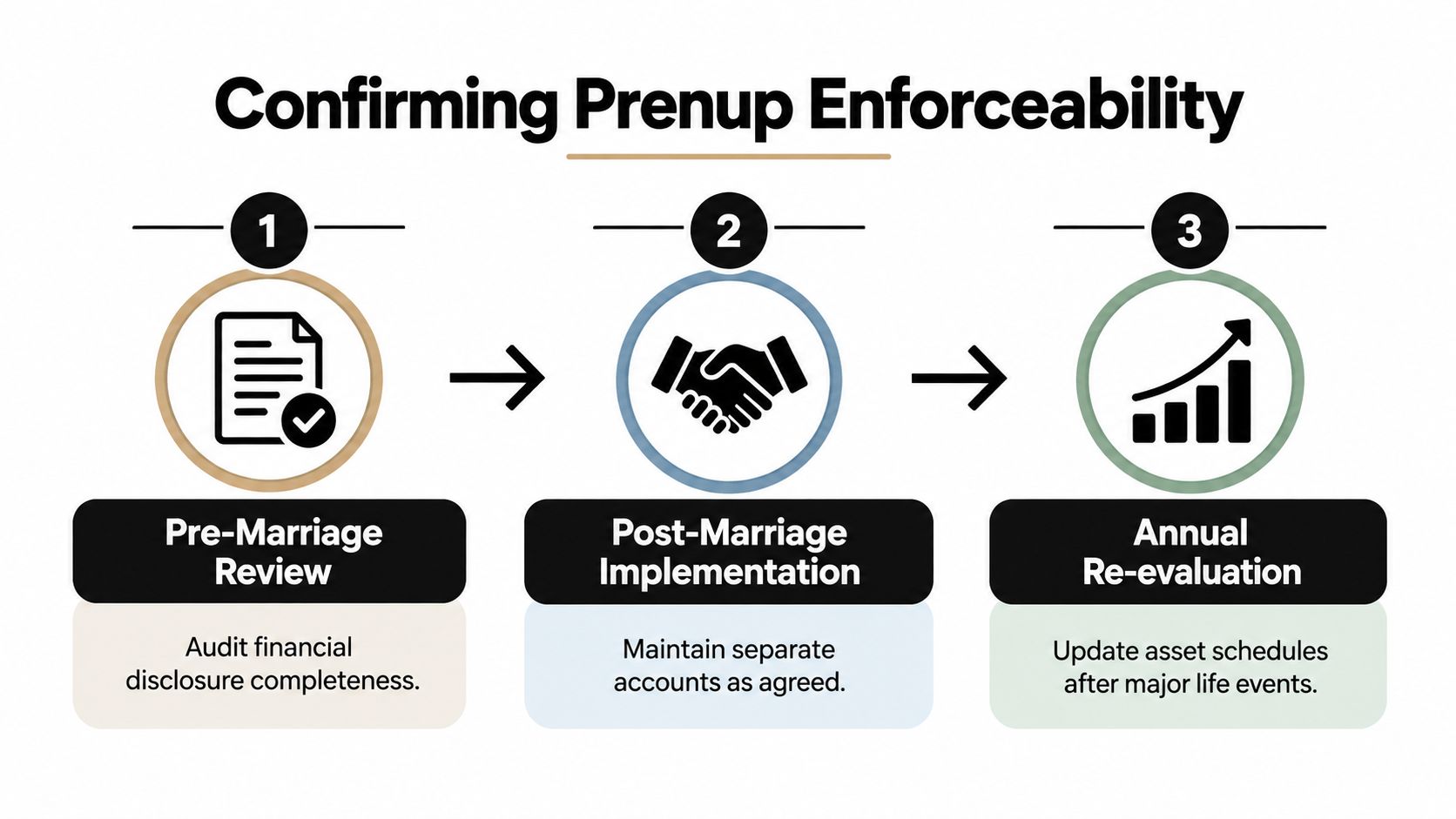
Before the ceremony
A careful final review asks whether:
- The agreement is complete and signed by both parties.
- The disclosure schedules match the assets and obligations discussed.
- Any written waiver is clear and voluntary.
- Each party had separate advice or a meaningful opportunity to obtain it.
- The final version, rather than an earlier draft, is the one being executed.
After marriage, follow the agreement consistently where practical. If the document treats certain property as separate, mixing accounts or changing ownership without advice can create later questions about characterization and intent.
When a postnuptial agreement fits
A postnuptial agreement is made after the parties are already married. It may be appropriate when a couple wants to clarify property treatment after receiving an inheritance, developing a business, changing financial responsibilities, or discovering that earlier arrangements no longer reflect their goals.
A postnuptial agreement isn't just a prenup signed late. The parties are already married, so the legal and practical context differs. Any couple considering one in Kingwood should obtain advice about the applicable Texas rules, the property involved, and whether the agreement is consistent with estate planning.
Do not revise a premarital agreement informally through text messages or verbal promises. Changes and revocations should be handled through a properly prepared written agreement signed by both spouses. Keep the executed document, financial schedules, amendments, and related correspondence together so the history remains understandable.
Why a Kingwood Attorney Matters for Prenup Enforceability
Online forms can provide vocabulary, but they rarely identify the financial details that make a Kingwood couple's agreement defensible. A standard template may not account for a family business near Porter, a home in Northeast Houston, inherited property, blended-family concerns, or the relationship between a prenup and estate planning.
Notarization alone doesn't establish voluntariness, fair disclosure, or informed consent. The better process includes a review of the proposed terms, a careful financial inventory, separate advice for each spouse, and documentation showing that neither person was pushed into signing.
Local review can expose practical gaps
A Kingwood attorney can help distinguish between:
- An asset that should remain separate property
- An asset that may become mixed with marital funds
- A debt that needs clear allocation
- A business interest requiring more precise treatment
- An estate-planning provision that needs coordination
- A term that may create public-policy or unconscionability concerns
The Kingwood prenuptial agreement lawyer page provides a local starting point for couples seeking counsel about drafting or reviewing an agreement. Attorneys and law firms also benefit from understanding how digital information supports client education, and SimpleLab Digital on law firm growth offers related professional background.
The central lesson is practical. Texas law gives properly prepared agreements meaningful protection, but the presumption doesn't excuse careless timing, vague disclosure, or incomplete records. Whether you're in Kingwood, Humble, or elsewhere in Northeast Houston, a focused review before signing can help both spouses understand the bargain and reduce the chance of a difficult enforcement dispute later.
The Law Office of Bryan Fagan – Kingwood TX Lawyers offers local guidance for drafting, reviewing, and evaluating prenuptial agreements, with attention to Texas law, financial disclosure, and Harris County practice. Schedule a free consultation at the Kingwood office to discuss your agreement, your assets, and the safeguards that can help protect your plans. Visit Law Office of Bryan Fagan – Kingwood TX Lawyers to get started.