You're in Kingwood, and the situation is moving faster than you can control. A spouse may be shifting money from a joint account. A parent may be threatening to take a child out of Texas. A former partner may be showing up at the house, sending threatening messages, or interfering with property. You need to know whether a temporary restraining order in Texas can stop the immediate conduct, how quickly you must act, and what happens after a judge signs the order.
A Texas TRO is emergency relief, not a final decision. It can preserve property, protect children from immediate disruption, or restrict specific conduct while the court prepares for a fuller hearing. It usually operates for a short period, and the applicant must support the request with concrete sworn facts. For families in Kingwood, Humble, Porter, and Northeast Houston, local filing procedures, service, judicial availability, and hearing scheduling can affect what happens in practice.
When a Kingwood Family Turns to a Temporary Restraining Order
A Kingwood spouse discovers that money is leaving a marital account. The other spouse has mentioned selling a vehicle, transferring property, or moving funds before the divorce petition is served. Waiting for a normal hearing may give the other person time to make the very move the court later has to untangle. A TRO may temporarily restrict transfers, concealment, or other specified conduct while the divorce case moves forward.
A different emergency involves a child. One parent says the child is leaving Texas, changing schools, or being taken somewhere without agreement. A TRO may prevent a specifically identified action until the court can hold a temporary-orders hearing. It doesn't decide permanent custody, and it doesn't create a final parenting plan.
The short-term purpose
Texas treats a TRO as an extraordinary, short-term remedy. Its job is to preserve the status quo while the judge considers temporary injunctive relief or temporary orders. That means the order should target an immediate problem, not serve as a way to punish the other party or gain an advantage on every disagreement.
A former partner who repeatedly appears at a home or sends threats may need a different emergency tool, particularly if the issue is family violence or personal safety. A divorce-related TRO generally protects property, children, or the orderly handling of an existing case. It isn't automatically a substitute for a protective order.
Practical rule: Ask what specific action must stop before a hearing can occur. If you can't identify that action and explain the immediate harm, a TRO may not be the right request.
The experience of families in similar disputes can help you understand how legal strategy develops across a case. Law firm case study examples can provide broader context, but they can't replace advice about your facts, your county, or the wording of a proposed order.
For a Kingwood or Northeast Houston resident, the immediate priorities are simple. Preserve the evidence, identify the threatened conduct, confirm whether a lawsuit already exists, and speak with counsel before sending messages or moving property. The rest of the process depends on getting those first decisions right.
What a Texas TRO Does Under Rule 680
A no-notice TRO under Texas Rule of Civil Procedure 680 is a tightly limited emergency order. The judge needs specific facts showing that immediate and irreparable injury, loss, or damage could occur before the opposing party can be served and heard. “I'm afraid something bad will happen” does not explain the threatened harm well enough.
The proposed order must identify the injury, explain why notice was not given, and describe the prohibited conduct with enough precision to give the respondent fair notice. For a Kingwood applicant, the practical questions are direct: what exactly will happen, why can't money fix it, and why must the court act before the other side is heard?
The Rule 680 clock
A no-notice TRO generally lasts no more than 14 days. The judge sets the expiration period within that limit. For good cause, the court may extend the order for another period of up to 14 days. A longer extension is available if the restrained party consents. The application for a temporary injunction must also be set for hearing at the earliest possible date. Texas Rule of Civil Procedure 680 and related Texas family-law guidance explains the rules governing this short emergency period.
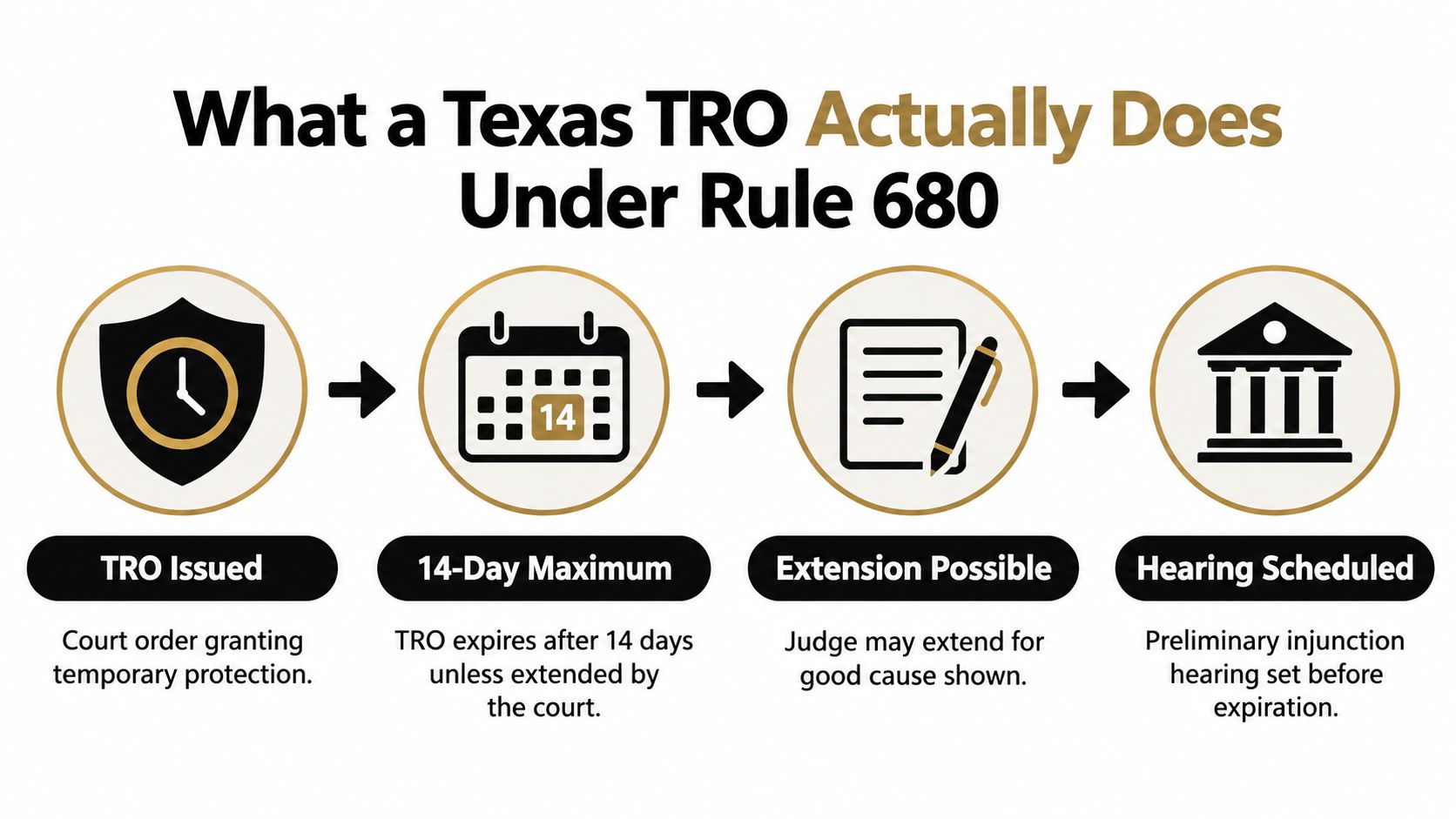
The respondent can challenge the order. After at least 2 days' notice to the applicant, the respondent may appear and ask the court to dissolve or modify the TRO, unless the judge permits shorter notice. After hearing both sides, the judge can change the restrictions or end the order.
A TRO usually belongs within an underlying civil or family lawsuit. In a divorce, Texas Family Code §6.501 allows the court to issue a TRO after filing to preserve marital property or protect the parties. In a custody emergency, the request generally accompanies an original SAPCR, modification, enforcement action, or an active case. The Harris County Family Courts: A Kingwood Resident's Guide addresses how family-law cases proceed in the Harris County courts serving Kingwood.
For a Northeast Houston resident, filing strategy matters. Harris County court procedures, available hearing settings, service, and the proposed order can affect whether emergency relief moves quickly. Prepare evidence that identifies the conduct, the timing, and the specific harm.
Texas State Law Library guidance recognizes that TROs can restrict harassment, threats, harm to children, or interference with property. The order remains temporary. It is not a final judgment, and it cannot replace a full evidentiary hearing.
TRO vs Temporary Injunction vs Protective Order
People often use “restraining order” as a catch-all phrase. Texas courts don't. A TRO, temporary injunction, and protective order serve different purposes, and choosing the wrong vehicle can delay meaningful relief.
| Feature | Temporary Restraining Order | Temporary Injunction | Protective Order |
|---|---|---|---|
| Primary purpose | Preserve the status quo during an emergency | Continue restrictions after a hearing | Address family violence, dating violence, stalking, sexual assault, or related safety threats |
| Notice | May be issued without advance notice when Rule 680 supports emergency action | Requires an opportunity for the parties to present evidence | A temporary ex parte protective order may be issued without advance notice when sworn facts support the statutory standard |
| Typical setting | Existing divorce, custody, property, or civil case | The same underlying case after the emergency stage | A family-violence or personal-safety proceeding |
| Duration | Short-lived, generally tied to the 14-day Rule 680 limit | Continues according to the court's order | The order specifies its duration and may be extended under applicable procedures |
| What it decides | Immediate restrictions only | Temporary rights and obligations after a hearing | Safety restrictions, contact limits, residence access, and other protective terms |
| Final result | Doesn't resolve the lawsuit | Doesn't resolve the final case | Doesn't replace final custody, divorce, or criminal proceedings |
Match the tool to the danger
A TRO fits a situation such as threatened dissipation of marital property, interference with a child before a custody hearing, or conduct that could damage the status quo during an existing case. A temporary injunction is the next step when the applicant wants restrictions to continue after both sides have an opportunity to present evidence.
A protective order is different. Texas standardized materials allow an applicant to seek a temporary ex parte protective order when sworn information supports a finding of a clear and present danger involving family violence, sexual assault or abuse, indecent assault, stalking, trafficking, or other listed harm. The request may also ask that the respondent vacate a shared residence immediately. If you face immediate danger in Kingwood or Northeast Houston, contact law enforcement when appropriate and seek advice about the safety-focused process.
The Protective Orders in Kingwood resource addresses protective orders in domestic violence and family safety matters. For a focused comparison of the two concepts, review protective orders versus restraining orders in Kingwood.
Don't assume a custody TRO will protect you from stalking or violence. Don't assume a protective order will decide property or establish a lasting parenting schedule. A Kingwood attorney may recommend filing a TRO with the underlying divorce or SAPCR, while pursuing a protective order separately when the facts support both forms of relief.
Who Qualifies and What the Sworn Application Must Show
A Texas TRO applicant usually needs an underlying case or must file one with the emergency request. In a divorce, Family Code §6.501 authorizes the court to issue a TRO without notice after the suit is filed when necessary to preserve marital property or protect the parties. In a custody matter, the request commonly accompanies a SAPCR, modification, enforcement action, or an existing case.
The application generally includes a motion and an affidavit or statement made under penalty of perjury. The sworn material must explain why waiting for an ordinary hearing would cause immediate and irreparable harm. The Texas Supreme Court has emphasized that a failure to make this evidentiary showing can support rescinding the TRO. The Texas Supreme Court's decision addressing the required evidentiary showing is a useful reminder that conclusory allegations are vulnerable.

Build the facts before you file
A strong application answers practical questions in a clear sequence:
- What happened? Identify dates, messages, transactions, threats, trips, or attempted transfers.
- Who is at risk? Name the children, property, account, residence, or other interest involved.
- What will happen if the court waits? Explain the specific immediate consequence.
- Why isn't later compensation enough? Describe why money, a later hearing, or a final judgment won't repair the harm.
- What should the order prohibit? Draft precise language tied to the conduct, not a vague demand to “leave me alone.”
Preserve texts, emails, photographs, school or medical records, police reports, account information, and witness details. Keep original files where possible, and don't edit messages to make them more dramatic. Exaggeration can damage credibility at the emergency review and at the later hearing.
A judge doesn't need your entire relationship history in an emergency application. The judge needs reliable facts tied to a specific threatened act.
The same discipline applies to online legal content. Broader SEO insights from Netco Design LLC may help law firms communicate clearly, but your TRO application needs evidence, not marketing language. A Kingwood or Humble applicant should have counsel review the proposed order line by line before filing.
Filing a TRO in Harris County Step by Step
A statewide guide can make filing sound automatic. Harris County practice is more practical and less predictable. Electronic filing, clerk processing, judicial availability, emergency review procedures, service, and hearing scheduling all affect the timeline for a Kingwood resident.
Start with the underlying case
First, determine whether a divorce, SAPCR, modification, enforcement action, or civil lawsuit already exists. If it doesn't, the emergency filing may need to include the underlying petition. A TRO generally can't operate as a free-standing substitute for the case that gives the court authority to address the dispute.
Next, prepare the motion, sworn affidavit or verified complaint, proposed TRO, and any supporting records. The proposed order should identify the specific conduct to be restrained. It should also state the injury, explain the lack of notice, and provide workable terms.
File, obtain review, and serve
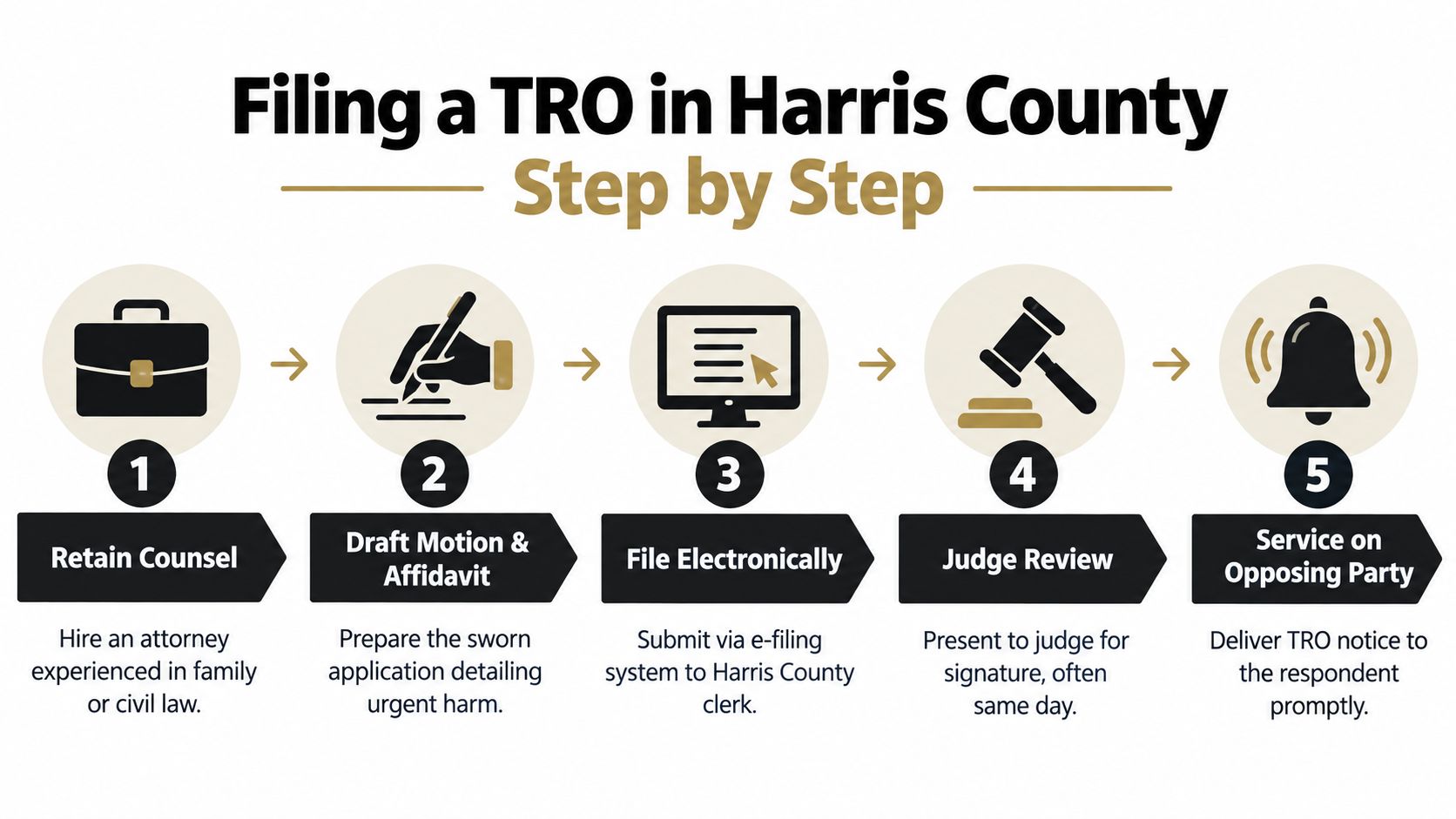
The usual sequence looks like this:
- Prepare the pleading: Connect each requested restriction to a concrete emergency fact.
- Submit through electronic filing: File with the appropriate Harris County clerk and confirm that the documents were accepted.
- Request prompt judicial review: Rule 680 requires the temporary-injunction application to be set at the earliest possible date.
- Track the signed order: The 14-day period runs from the order's issuance under the applicable terms, so don't assume the clock starts when you first learn about it.
- Arrange service: A signed order still requires careful delivery and documentation. Confirm what was served, when it was served, and on whom.
- Prepare for the hearing: Gather exhibits, witnesses, a proposed temporary order, and a clear explanation of what relief should continue.
Harris County judicial calendars and emergency procedures may affect when a judge reviews the papers and when the parties can be heard. Those practical realities make same-day assumptions dangerous. Confirm the assigned court's requirements rather than relying on an older form or a statewide summary.
For context on a related family-law filing, The Divorce Process in Kingwood: What to Expect provides a step-by-step look at filing for divorce in Kingwood and Harris County.
A short video can also help you understand the general legal process, but it can't tell you which court, form, or emergency procedure applies to your facts.
What the Signed Order Says and What Happens at the Hearing
The signed order controls. Not the conversation that led to it, not an assumption about what the judge “must have meant,” and not a text message from the other party. Read every paragraph before you transfer property, contact the other parent, arrange an exchange, or take any action that could fall within the order's language.
A family-law TRO may restrict intentional telephone or electronic communications, protect marital property, regulate conduct around children, or prohibit interference with property. The order should describe the restrained conduct with enough specificity to give fair notice. If a term is unclear, ask counsel or the court for clarification instead of guessing.
The respondent gets a chance to challenge it
An ex parte order is issued before the other side has presented evidence. That doesn't mean the respondent has lost the case. Under Rule 680, the respondent may seek dissolution or modification after giving the applicant at least 2 days' notice, unless the court orders shorter notice.
At the temporary-injunction or temporary-orders hearing, both sides may present documents, testimony, and legal arguments. The judge may keep the restrictions, modify them, dissolve them, or replace them with temporary orders governing custody, visitation, support, property use, or communication.
A Kingwood parent should prepare as if the hearing is a focused trial about the emergency, not a chance to tell every painful detail of the relationship. Bring organized exhibits, identify witnesses who have firsthand knowledge, and separate what you personally saw from what someone else told you.
Hearing-day advice: Bring a proposed order that says exactly what you want the judge to sign after hearing both sides. Vague relief creates avoidable disputes.
A TRO may expire when its permitted period ends or when the court conducts the next hearing, depending on the order and applicable procedure. In child-custody emergencies, Texas Law Help explains that the order commonly directs parents or conservators not to take specified actions for 14 days and requires a second hearing. If the order isn't extended or converted into a temporary injunction, it expires at midnight on the 14th calendar day after signing or on the date of the second hearing, whichever comes first.
The court's later ruling should be memorialized in a signed order. Don't rely on an oral statement alone. Keep the signed version, proof of service, hearing notices, and any later modification together.
Enforcement and Penalties for Violating a Texas TRO
A TRO is a court order, not a suggestion. In a Texas divorce, Family Code §6.501 recognizes that violations of a TRO or other temporary order may be punished as contempt. The practical consequence is serious: a person who knowingly violates a clear restriction can face a separate enforcement proceeding and damage their position in the underlying divorce, custody, property, or civil dispute.
Examples include transferring property when the order prohibits it, making communications the order forbids, interfering with a child-related restriction, or contacting a protected person in violation of the signed terms. The court will focus on the wording of the order, proof of service, the respondent's conduct, and whether the alleged violation can be established with admissible evidence.

Document the breach without escalating it
If you believe the other party violated a TRO, preserve the evidence and avoid retaliating. Save messages in their original form, record dates and times, keep delivery information, identify witnesses, and preserve photographs or account records. If the conduct involves immediate danger, contact law enforcement and follow your safety plan. A court filing should explain what happened and connect it to a specific paragraph of the order.
If you're the restrained party, stop the disputed conduct until counsel reviews the order. Don't assume that an ex parte order is optional because you weren't heard before it was signed. If a term is unclear or impossible to follow, seek clarification or modification promptly rather than creating a record of intentional noncompliance.
Contempt consequences depend on the proceeding and the court's findings. The court may impose sanctions authorized by law, order corrective relief, address financial consequences, or modify future orders. A violation can also affect credibility when the judge considers custody, property division, or temporary arrangements.
Protective-order enforcement may involve a separate case and different safety-focused terms. Keep the proceedings coordinated, but don't merge them into one vague complaint. A TRO addressing property or custody isn't the same instrument as a protective order addressing family violence.
Practical Next Steps and Common Mistakes to Avoid
Start with the threatened act, not the label. Preserve evidence, file the underlying case when required, use a sworn statement with dates and concrete facts, and request only workable restrictions. Serve the signed order promptly and confirm the hearing date.
The most common mistakes are vague affidavits, unsupported accusations, late service, missed hearings, and confusing a TRO with a protective order. Don't contact the other party in a way the order prohibits, even if you believe the order is unfair. A Kingwood restraining-order lawyer can help you prepare the filing, respond to service, seek modification, or address an alleged violation.
The Law Office of Bryan Fagan – Kingwood TX Lawyers helps Kingwood, Humble, Porter, and Northeast Houston clients evaluate emergency family and civil relief, prepare focused filings, and respond to TRO or protective-order proceedings. Visit Law Office of Bryan Fagan – Kingwood TX Lawyers to schedule a free consultation at the Kingwood office and discuss the next step with a local, client-focused legal team.