You're in Kingwood, and a notice to vacate is sitting on your kitchen counter. Maybe it arrived on a Friday afternoon. Maybe you're a landlord who has waited through missed payments and now needs the property returned lawfully. Either way, the next move matters. A defective notice, a missed hearing, or an answer filed in the wrong Harris County Justice of the Peace court can change the case before anyone discusses the underlying dispute.
Texas eviction cases move quickly, and generic online advice often describes an older process. The rules applying to eviction suits filed on or after January 1, 2026, include changes under SB 38 and new Texas Supreme Court rules. Kingwood, Humble, Porter, and Northeast Houston clients need advice tied to the property's location, the lease, the notices, and the local court handling the case.
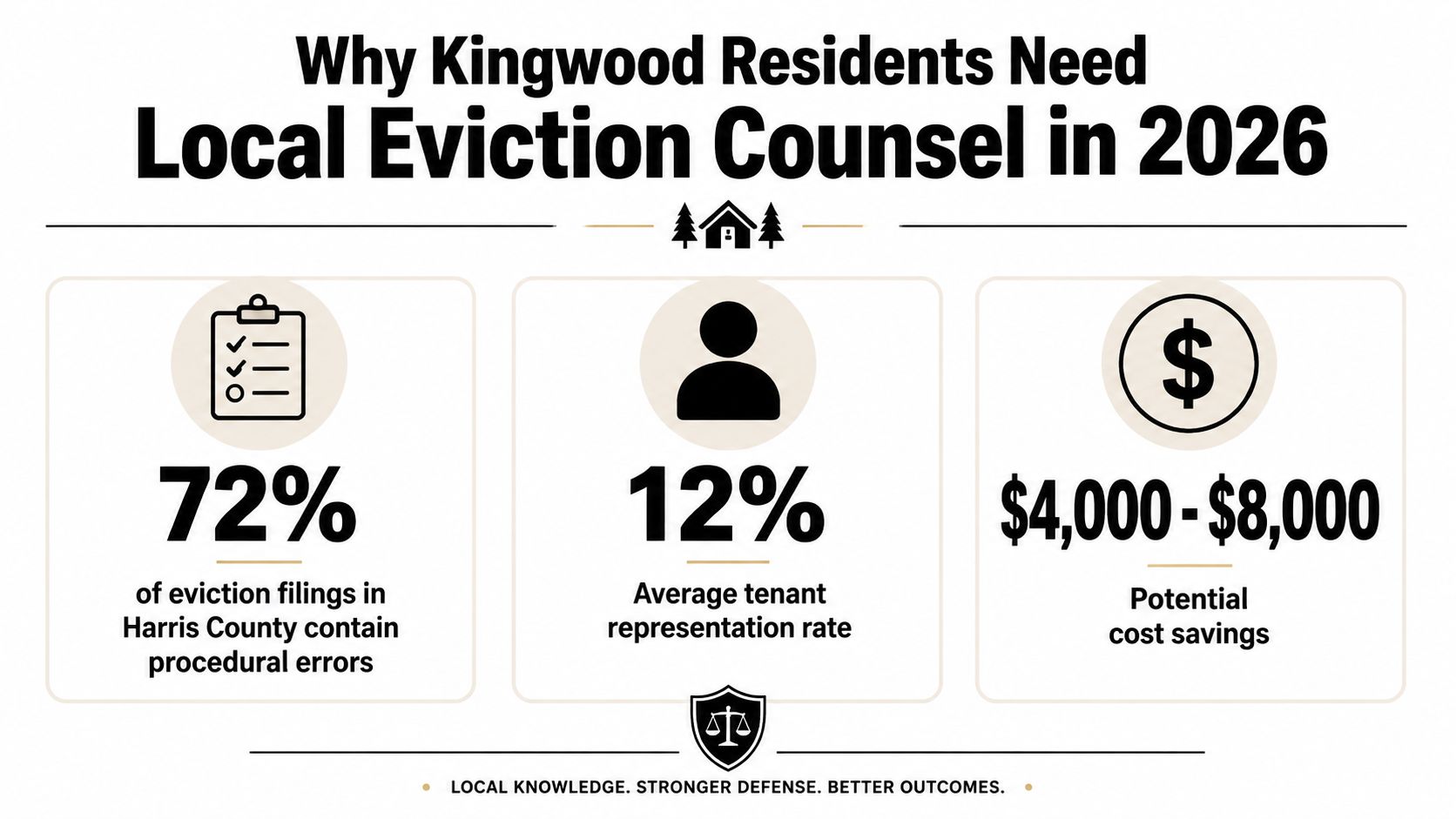
Why Kingwood Residents Need Local Eviction Counsel in 2026
A Kingwood tenant receives a three-day notice to vacate on Friday afternoon. The tenant believes the rent was paid, but the landlord's ledger says otherwise. The notice may not match the lease, the delivery method may be disputed, and the tenant may not know which Harris County court will hear the case. Waiting for a form downloaded from another Texas county can leave important questions unanswered.
The volume of cases makes that risk more serious. Landlords filed more than 177,000 eviction cases in the Houston, Dallas, Austin, and Fort Worth areas in 2023, an increase from 2022 after the United States Supreme Court ended the federal eviction moratorium. Houston remains part of a broader Texas pattern in which eviction filings have stayed above pre-pandemic levels for nearly two years, according to Texas Tribune reporting on Texas evictions and housing affordability.
What changed for cases filed in 2026
Official Texas court guidance explains that SB 38 applies to eviction suits filed on or after January 1, 2026, and that new Supreme Court rules also apply to those cases. The practical effect is that notice language, filing requirements, response deadlines, and appeal-bond procedures must be checked under the rules governing the filing date, not copied from an older blog post. The Texas Justice Court Training Center plaintiff guidance is useful background, but a live case still requires careful application to the actual papers.
Kingwood falls within the Harris County justice-court system. The Harris County Justice of the Peace eviction filing information matters because the court location and local filing process depend on where the property sits. Filing location, service by a constable, scheduling, and courtroom procedure can affect how quickly a tenant or landlord must act.
Practical rule: Local counsel doesn't promise a particular result. Local counsel makes sure the right court, current rules, valid documents, and available defenses are addressed before a preventable default occurs.
For a Kingwood civil dispute involving a lease or related contract issue, clients can review the firm's civil law services. The important point is simple: in a fast Harris County eviction case, local representation is a practical safeguard, not a luxury.
The Texas Eviction Timeline From Notice to Writ of Possession
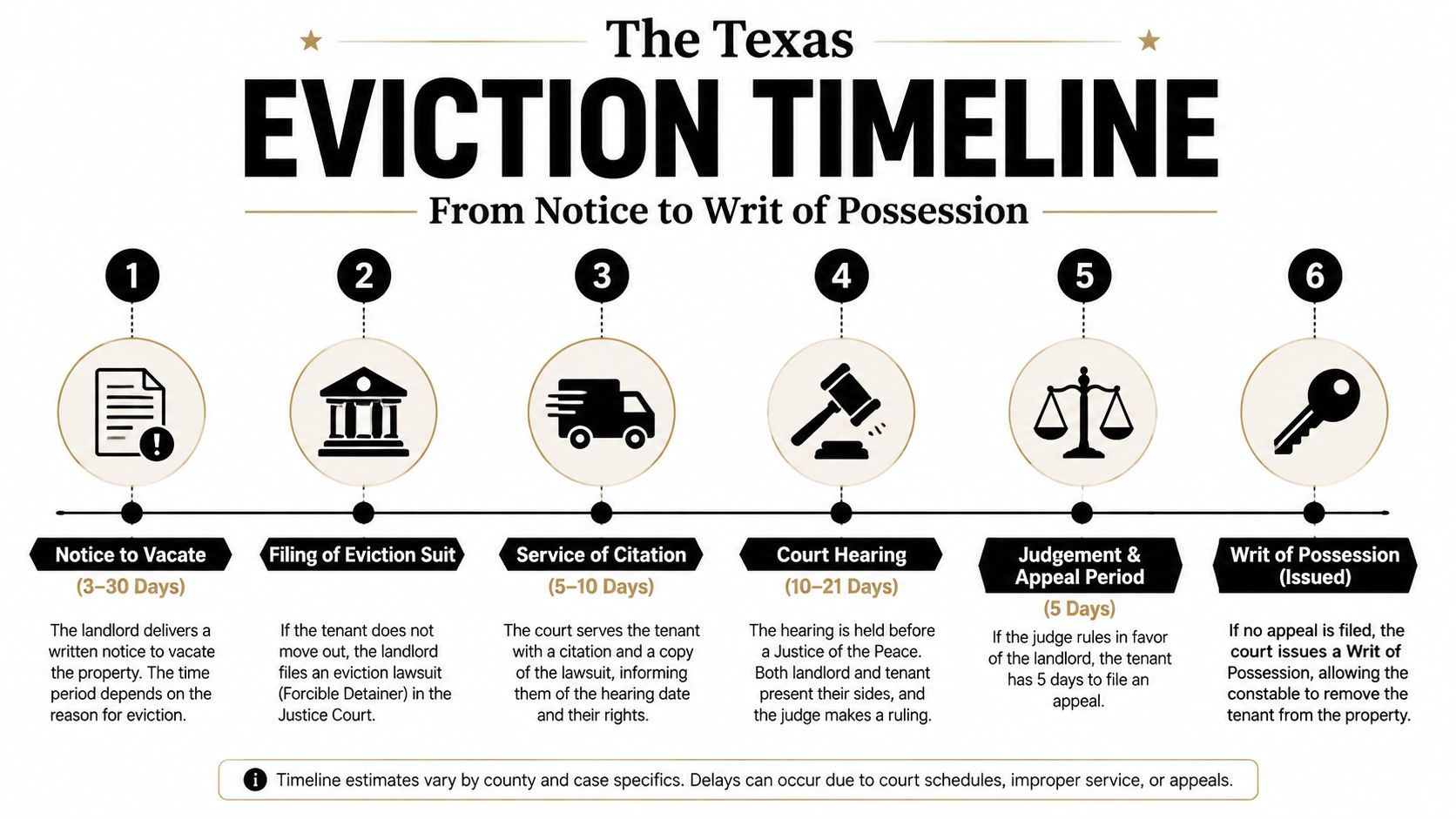
Texas eviction cases generally follow a sequence. The details depend on the lease, the reason for removal, the service record, and the filing date.
Step one begins with notice
A landlord generally must serve a written notice to vacate before filing an eviction suit. The standard notice period is three days unless the lease says otherwise, as explained by the Texas State Law Library eviction process guide. A lease may contain a different notice provision, so the tenant and landlord should compare the notice with the signed agreement rather than assume the standard period controls.
The notice should be preserved exactly as received. Keep the envelope, photograph any posting, save electronic communications, and record the delivery date. A dispute about notice can affect whether the landlord was entitled to file.
Filing and service follow
The landlord files a forcible detainer, commonly called an eviction case, in the Harris County Justice of the Peace court serving the property's location. Kingwood residents should confirm the correct precinct and place before traveling or submitting documents. After filing, the tenant must receive formal citation service, ordinarily through the constable or another authorized process.
Most hearings are set 10 to 21 days after filing, so the case can move from notice to a decision quickly. The tenant may file a written answer, but failing to file one doesn't automatically eliminate every defense. Failing to appear, however, can expose the tenant to a default judgment when service and the petition support that result.
Hearing, judgment, and appeal
At the hearing, the judge considers possession, the lease, notice, payment history, service, and any defenses or counterarguments properly presented. A tenant should bring documents and arrive prepared to explain the dispute clearly. A landlord needs proof that the contractual and procedural steps were completed.
If the tenant loses, Texas generally allows only five days after the judgment is signed to appeal in justice court. During that window, the court can't issue a writ of possession based on that judgment, as described by the Texas State Law Library appeal guidance. Appeal requirements can include a bond, cash deposit, or a statement of inability to afford court costs. SB 38 and the 2026 rules make current advice especially important when calculating what must be filed and when.
For background on how eviction information may appear in housing screening, readers can find eviction records through a records-search resource. That search isn't a substitute for reviewing the court file or obtaining legal advice.
After the appeal period, if the tenant remains, the landlord may request a writ of possession. That order authorizes the constable to remove the tenant and belongings. The difference between a judgment and a writ is significant. A judgment decides the case, while the writ authorizes physical enforcement.
The embedded video below provides general visual context for the process.
A family dealing with overlapping financial obligations may also need a Child Support Attorney in Kingwood for establishing, modifying, or enforcing child support in Harris County. That issue is separate from possession of a rental home, but both matters require attention to court deadlines and complete financial records.
When to Hire an Eviction Lawyer Versus Handling It Yourself
Self-representation can make sense in a narrow situation. A landlord with a clear lease, complete payment records, properly served notice, and no anticipated defense may be able to present the case without counsel. A tenant who has secured funds and needs only to negotiate a documented move-out date may also decide that a lawyer isn't necessary.
That isn't the same as saying the case is simple. Harris County recorded 13,210 eviction filings in 2024, described as a record high and a 26% increase from 2023. The same snapshot reported 1,404 filings in January 2025, a median judgment amount of $2,984, and a typical case duration of 20 days from filing to hearing and ruling. Those figures appear in the Harris County eviction snapshot.
The same source reported that 43% of Harris County eviction cases filed resulted in dismissal. Dismissal doesn't necessarily mean the tenant wins permanently, and it doesn't prevent a landlord from correcting a defect and filing again. It does show why notice, filing, service, and courtroom presentation deserve careful review.
| Factor | Self-Representation | With Eviction Lawyer |
|---|---|---|
| Documents | You identify defects and organize proof yourself. | Counsel reviews the lease, notice, ledger, and service record together. |
| Court procedure | You must track the Harris County court and deadlines. | The attorney manages filings and explains the next required step. |
| Negotiation | You negotiate directly, often under pressure. | Counsel can structure a payment, surrender, or settlement agreement. |
| Defenses | You decide which arguments matter and how to present them. | Counsel separates legally useful defenses from distractions. |
| Long-term impact | You may focus only on the hearing date. | Counsel considers possession, money claims, screening, and appeal options. |
A landlord or tenant facing habitability allegations, retaliation, discrimination, conflicting lease terms, disputed payments, or a counterclaim should hire counsel early. For related lease disputes, the firm's guide on how to sue for breach of contract may help explain why the possession case and a separate contract claim should not be treated as identical.
Landlords also need accurate housing-management information, including resources such as Towne and Country Property Management's discussion of renting out a condo. Property-management guidance can help with operational questions, but it doesn't replace advice about a pending Harris County eviction.
How to Choose and Vet a Kingwood Eviction Attorney
Choose a lawyer who can explain your actual court path, not someone who promises a result before reviewing the lease and notice. Start by confirming that the attorney is licensed through the State Bar of Texas and reviewing available disciplinary information. Then ask whether the lawyer regularly handles Harris County Justice of the Peace eviction cases affecting Kingwood, Humble, and Northeast Houston.
Questions worth asking before signing
Ask who will appear at the hearing. A firm may assign a senior attorney, another lawyer, or a different representative, and you should know that before paying or signing an agreement. Request a plain explanation of the fee structure, what the fee includes, what events create additional charges, and how settlement discussions are handled.
You should also ask the lawyer to identify the immediate deadline. A strong initial consultation should produce a short action list, such as preserving evidence, responding to the citation, confirming the court, or negotiating with the opposing side.
A lawyer who guarantees dismissal, promises a specific result, or pressures you to sign immediately is giving you a reason to slow down.
Local familiarity matters because Harris County courts have their own filing locations, scheduling practices, and service logistics. An attorney who regularly works in the area may identify a practical issue that a remote, high-volume firm misses. That doesn't mean every out-of-area lawyer is ineffective. It means you should verify actual experience instead of assuming a statewide template is enough.
| Factor | Local Kingwood Attorney | High-Volume Remote Firm |
|---|---|---|
| Court familiarity | Direct knowledge of Harris County filing and hearing logistics. | May rely on centralized procedures and general Texas forms. |
| Communication | Often tied to a local office and assigned team. | May route questions through intake staff or rotating lawyers. |
| Hearing coverage | You can confirm who appears and where. | The assigned courtroom lawyer may change. |
| Strategy | Advice can account for Kingwood and Northeast Houston circumstances. | Strategy may be standardized across counties. |
| Vetting | Ask for local courtroom experience and representative matters. | Ask how often the firm handles your specific Harris County court. |
The Law Office of Bryan Fagan – Kingwood TX Lawyers is one local option for clients seeking a Kingwood office and practical legal guidance. Whether you choose that firm or another attorney, evaluate communication, current rule knowledge, courtroom experience, and honesty about what representation can accomplish.
Common Eviction Defenses and Practical Alternatives in Texas
The strongest defense is the one supported by documents and tied to the landlord's legal burden. A tenant shouldn't rely on a general complaint that the eviction feels unfair. The tenant should identify the specific notice, lease, payment, condition, or conduct issue that affects possession.
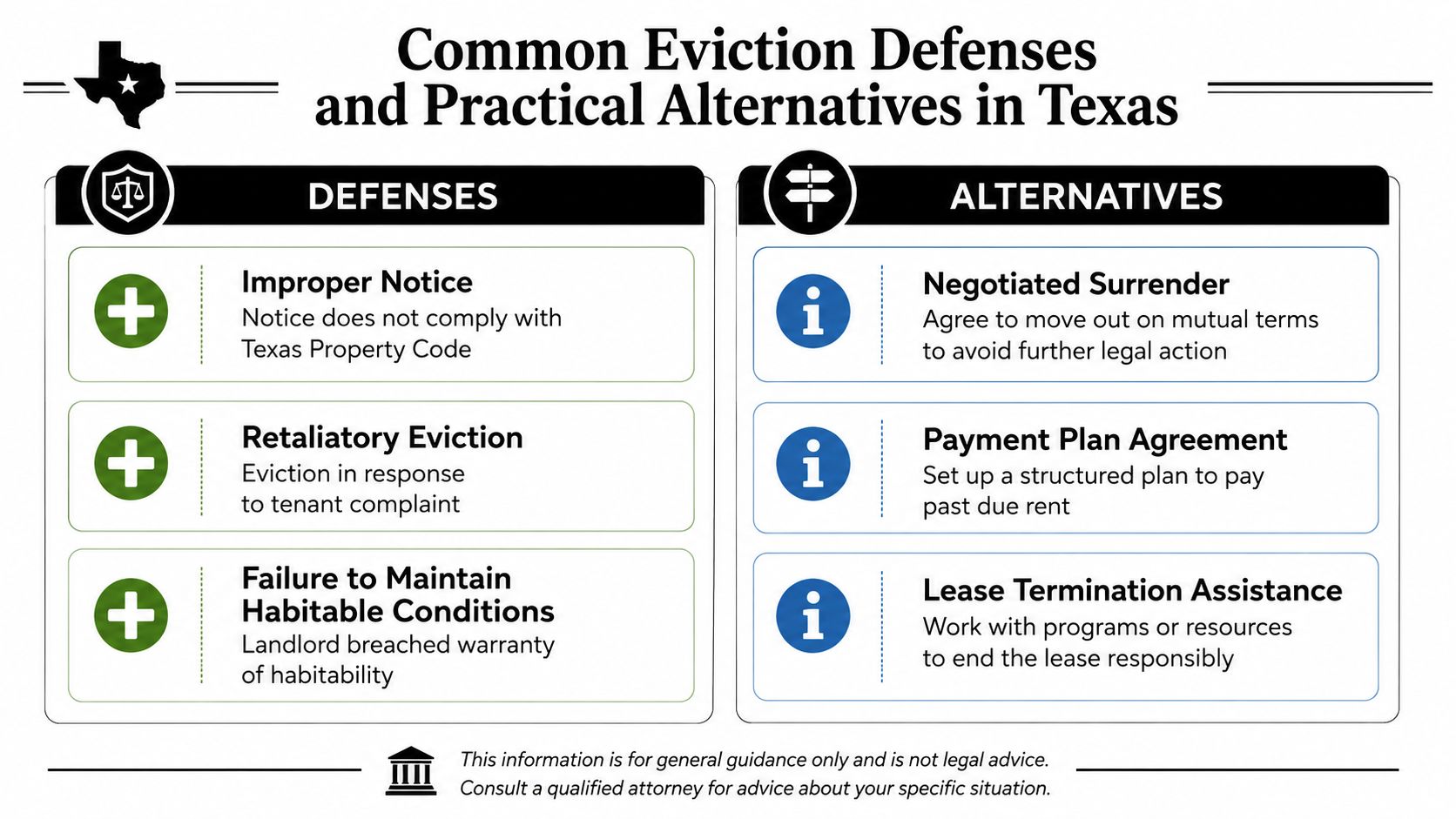
Improper notice is often the first place to look. Texas generally uses a three-day notice period unless the lease provides another period. If the notice doesn't comply with the lease or applicable law, the filing may be premature or defective. That doesn't automatically erase the landlord's underlying claim, but it can affect the current case.
Retaliation may matter when a landlord files after a tenant made a protected repair complaint or exercised a legal right. The tenant needs dates, written requests, inspection records, and evidence connecting the complaint to the eviction effort. A tenant also may raise discrimination concerns where the facts support a violation of fair-housing protections.
Habitability disputes require more than dissatisfaction with a property. Gather photographs, videos, repair requests, dates, responses, and any inspection information. A landlord who understands these issues can often avoid preventable procedural mistakes, while a tenant can present a focused record instead of a scattered narrative.
A negotiated solution may protect both sides
Court isn't always the best first objective. A written move-out agreement can establish a date, payment terms, possession conditions, and how the parties will handle remaining property. A documented payment plan may resolve arrears if the landlord agrees and the tenant can perform. Lease-termination assistance can also reduce confusion when the parties know the tenancy should end but disagree about timing or money.
Better objective: Don't ask only whether you can win the eviction. Ask whether the proposed outcome protects housing stability, limits unnecessary money claims, and gives both sides a reliable written agreement.
Early legal review is especially useful before a citation or hearing date. For a related contract issue, clients can review Kingwood breach of contract legal help. The same documents that clarify a lease dispute can also determine whether a notice or payment claim is defensible.
Your First Meeting Checklist and Required Documents
Your first consultation should answer three questions: What happened, what deadline controls, and what outcome do you want? Bring the complete record, not just the most recent text message. A lawyer can give more useful advice when the timeline and documents are available at the start.
Tenant documents
Bring these materials in paper or organized digital form:
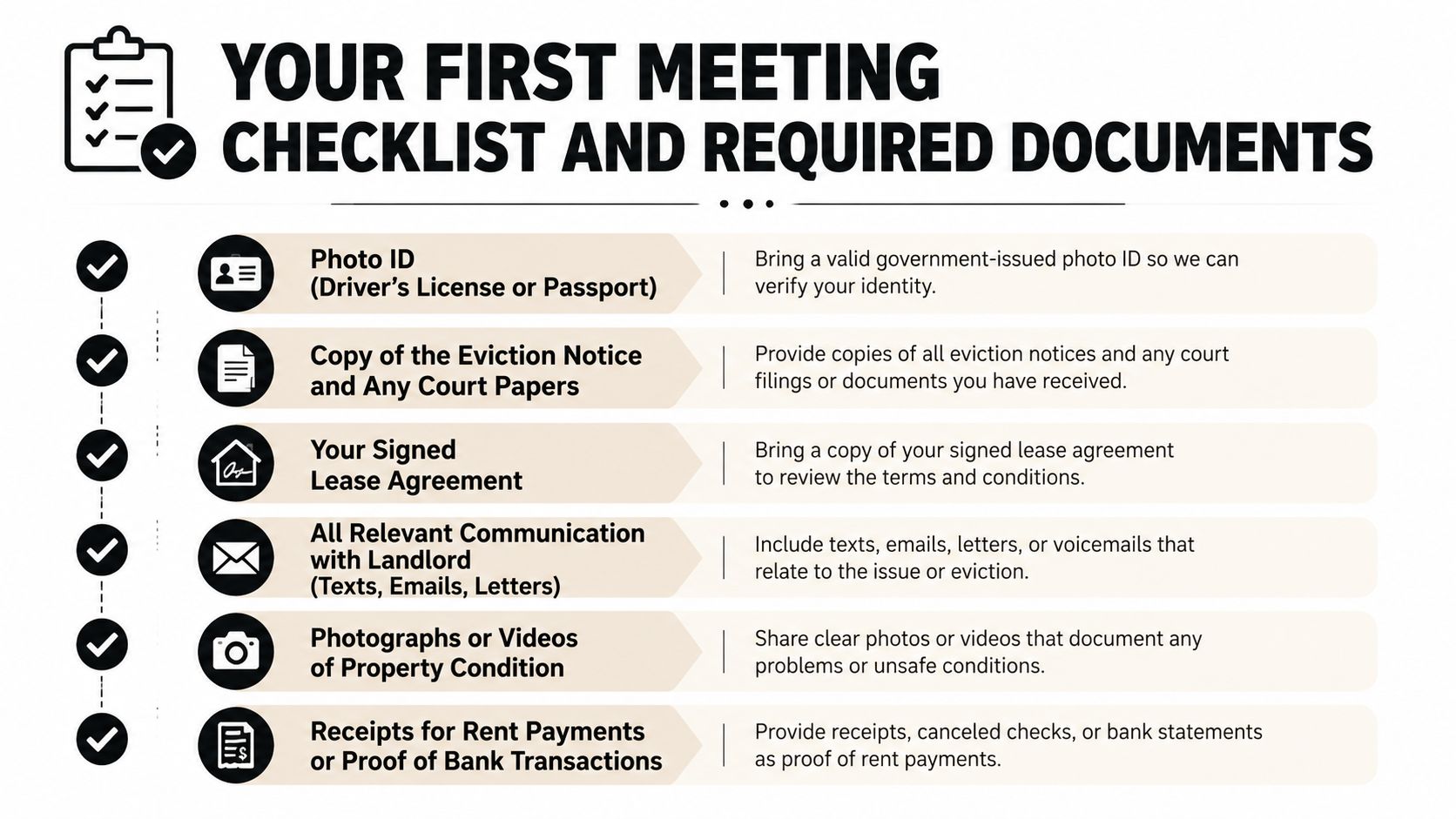
- Photo identification: Bring a driver's license or passport so the firm can confirm your identity.
- Lease and addenda: Include every signed page, renewal, rule sheet, pet agreement, and payment provision.
- Notice and court papers: Bring the notice to vacate, notice to cure, citation, petition, and any hearing information.
- Communications: Save texts, emails, letters, portal messages, and voicemail records involving rent, repairs, threats, or move-out discussions.
- Payment proof: Gather rent receipts, bank records, money-order information, and payment-portal confirmations.
- Condition evidence: Organize photographs, videos, repair requests, work orders, and responses by date.
Landlords should also bring the tenant ledger, inspection reports, the lease file, copies of every notice, and proof of how and when each notice was delivered. If a property manager handled communications, include the manager's name and records.
Write a one-page timeline before the meeting. List the date the tenancy began, payment events, complaints, notices, service, and court dates. Then state your primary goal: staying in the home, negotiating an orderly exit, recovering possession, collecting money, or limiting damage to your rental history.
A consultation should produce an action plan, not just a summary of the crisis. If papers are missing, tell the attorney that immediately. Don't recreate evidence from memory when a text, ledger entry, photograph, or court document may provide the exact answer.
Frequently Asked Questions About Eviction in Kingwood
Can moving out stop the case?
Moving out may resolve possession, but it doesn't automatically resolve unpaid rent, court costs, attorney fees, or the landlord's decision to continue the case. Ask whether the landlord will dismiss the suit and document any agreement before surrendering possession.
What's the difference between dismissal and judgment?
A dismissal ends the filed case without the court entering the requested judgment for possession. A judgment is the court's ruling, which may award possession and money. Because Harris County has reported a substantial share of filings ending in dismissal, reviewing the reason for dismissal matters. A dismissal based on defective notice may not prevent a corrected filing.
Can a landlord change the locks or shut off utilities?
A landlord generally can't use lock changes or utility shutoffs as a substitute for the judicial process. Exceptions and notice requirements can be technical, so document the conduct and seek immediate legal advice rather than forcing entry or removing property yourself.
Can a tenant appeal?
A tenant who loses generally has five days after the judgment is signed to appeal, and the court can't issue a writ of possession during that appeal window, according to the Texas State Law Library appeal resource. An appeal may require a bond, cash deposit, or a statement of inability to afford court costs. The appeal moves the dispute into county court, and the required filing must be handled quickly.
How do eviction records affect future housing?
A filing, dismissal, judgment, or related money claim may affect how future landlords evaluate an application. The effect depends on the record and the screening company, so tenants should keep dismissal orders, settlement documents, payment proof, and explanations that accurately describe what happened. Don't assume moving out erases the court history.
Texas law also limits what a landlord can do after judgment. If the tenant doesn't appeal and remains, the landlord may request a writ of possession, the court order that authorizes the constable to remove the tenant and belongings, as explained by TexasLawHelp's eviction appeal information. Waiting until the constable arrives leaves fewer choices than calling a Kingwood eviction lawyer when the first notice or citation appears.
The Law Office of Bryan Fagan – Kingwood TX Lawyers helps Kingwood, Humble, Porter, and Northeast Houston clients review eviction notices, prepare for Harris County Justice of the Peace proceedings, negotiate practical resolutions, and evaluate appeals. Visit Law Office of Bryan Fagan – Kingwood TX Lawyers to schedule a free consultation at the Kingwood office before a deadline passes.