You get a call from a family member after an arrest in Kingwood. Or a letter arrives about an investigation, and the words misdemeanor and felony suddenly stop sounding like legal vocabulary. You start thinking about work, housing, family, immigration, and whether you'll spend time in jail.
Texas law doesn't treat those labels as interchangeable. The classification can affect the court process, the possible sentence, where confinement occurs, negotiating advantage, and what may remain on your record. For residents of Kingwood, Humble, Porter, and Northeast Houston, the right question isn't, "Which is worse?" It's, "What exactly is charged, what can change it, and what should I do before the case gets harder to defend?"
A Real Call From a Kingwood Client
A Kingwood resident calls after being released from custody. The arrest involved an argument at home, but the paperwork uses a legal term the caller doesn't understand. A spouse is worried about the children. An employer has questions. The caller wants to know whether the charge is “just” a misdemeanor or whether it could become a felony.
That concern is common. People often focus on the label first, but the label may not tell the whole story. The exact statute, alleged facts, prior convictions, injury findings, property value, and enhancement allegations can all change the legal exposure.
A different call comes from Humble after a shoplifting allegation. The item itself didn't seem valuable, yet the caller has been told the offense could be more serious because prosecutors may consider the value of the property or combine allegations under a specialized statute. Another caller from Northeast Houston is facing a DWI allegation and believes a first charge automatically means a minor court problem. That assumption can create avoidable mistakes.
Practical rule: Don't make decisions based only on the word printed next to the charge. Get the exact offense subsection and review the facts that determine the grade.
This guide gives you a practical way to evaluate a Texas criminal case. You'll see how misdemeanor and felony classifications work, how charges move up or down, why a misdemeanor can still damage employment or housing opportunities, and how record-clearing remedies may fit after a dismissal, deferred outcome, or other resolution.
What Makes a Charge a Misdemeanor or Felony in Texas
The basic dividing line is the maximum authorized punishment. Under the federal classification framework in 18 U.S.C. § 3559, a felony is generally punishable by more than one year of imprisonment, while a misdemeanor carries a maximum sentence of one year or less. Federal felony classes run from Class E, punishable by more than one year but less than five years, through Class A, which covers offenses punishable by life imprisonment or death. Misdemeanors are divided into Class A, B, and C categories under that framework. The Bureau of Justice Statistics explains the federal classification structure.
Texas uses its own grading system. Texas misdemeanors are Class A, Class B, or Class C. Texas felonies include state-jail, third-degree, second-degree, first-degree, and capital felonies. The sentence may be served in a county jail for a misdemeanor or in the Texas Department of Criminal Justice for a felony, depending on the offense and sentence.
Start with the statute, not the nickname
A charge such as theft, assault, DWI, or family violence is only a starting point. The offense subsection matters. So do prior convictions, alleged bodily injury, weapon allegations, family violence findings, and other enhancement provisions. Those details can increase the grade or change the punishment range.
The original charge also isn't necessarily the final result. A prosecutor may reduce a felony to a misdemeanor after reviewing evidence, or the case may be dismissed, resolved through a diversion option, or taken to trial. A conviction isn't automatic just because an arrest occurred.
For a Kingwood resident reviewing a criminal matter, pull together:
- The charging document: Identify the exact statute and subsection.
- The alleged facts: Review what conduct, property, injury, or value the prosecution claims.
- The criminal history: Prior convictions can affect the classification or punishment.
- The custody information: Confirm bond conditions, court dates, and release restrictions.
- The collateral risks: Consider employment, housing, licensing, immigration, and firearm consequences.
The same discipline applies in other areas of legal planning. For example, Prenuptial & Postnuptial Agreements in Kingwood involves drafting and reviewing marital property agreements for Kingwood clients. In criminal law, the equivalent first step is identifying the exact legal document and the specific language that controls your exposure.
If the allegation involves DWI and the charge is filed as a felony, reviewing Texas-specific consequences early is important. A resource on felony DWI in Kingwood can help explain why prior convictions and other facts change the analysis.
Texas Classes and Grades Side by Side
Texas misdemeanors and felonies sit on different sentencing ladders. The table below gives you the basic map, but it doesn't predict what a judge will impose. The actual outcome depends on the offense, evidence, criminal history, enhancements, plea negotiations, supervision eligibility, and sentencing findings.
Texas Misdemeanor vs Felony Classes at a Glance
| Classification | Maximum Jail or Prison Time | Maximum Fine | Where Served |
|---|---|---|---|
| Class C misdemeanor | No jail. Fine-only offense | $500 | No jail sentence |
| Class B misdemeanor | 180 days in county jail | $2,000 | County jail |
| Class A misdemeanor | 1 year in county jail | $4,000 | County jail |
| State-jail felony | Punishment depends on the statute and applicable range | Fine may apply under Texas law | Texas Department of Criminal Justice or another authorized setting, depending on sentence |
| Third-degree felony | Punishment depends on the statute and applicable range | Fine may apply under Texas law | Texas Department of Criminal Justice |
| Second-degree felony | Punishment depends on the statute and applicable range | Fine may apply under Texas law | Texas Department of Criminal Justice |
| First-degree felony | 5–99 years or life | Up to $10,000 | Texas Department of Criminal Justice |
| Capital felony | Life or death, subject to governing law | Fine depends on the statute | Texas Department of Criminal Justice or other lawful custody |
Texas misdemeanor classifications and felony grades are set out in the state Penal Code. Texas Penal Code Chapter 12 provides the punishment framework, including the first-degree felony range and the maximums for Class A, B, and C misdemeanors.
A helpful plain-language resource is felony vs misdemeanor explained, especially if you're trying to understand the general vocabulary before speaking with counsel. Use it as a starting point, not as a substitute for reviewing the Texas statute charged in your case.
Why the maximum isn't the forecast
A statutory maximum tells you the outer legal boundary. It doesn't tell you what will happen in Harris County. Prosecutors consider the evidence and the defendant's history. Defense counsel may challenge the charge, seek a reduction, pursue a diversion path where available, or prepare the case for trial.
A Class A misdemeanor can still mean county-jail exposure, supervision conditions, court costs, and a record problem. A felony can create more severe exposure, but the final result may be a reduction or dismissal rather than a felony conviction.
Classification also matters outside criminal court. A family may need advice about Grandparents' Rights in Kingwood when custody and visitation rights for grandparents in Harris County are at issue. The legal category in any case matters, but the practical result depends on the exact facts and the remedy being pursued.
How Charges Get Upgraded or Reduced
Charges cross the misdemeanor-felony line for identifiable reasons. The most common are property value, prior convictions, injury allegations, family violence findings, and facts that support a specialized offense. The reverse is also true. Weak proof, disputed value, unreliable witnesses, constitutional problems, or successful negotiations can support a reduction or dismissal.
Theft value can change the charge
Texas theft grading shows why you can't assess a case from the conduct alone. Under Texas Penal Code §31.03, theft valued below $100 is generally a Class C misdemeanor, $100 to under $750 is a Class B misdemeanor, and $750 to under $2,500 is a Class A misdemeanor. Theft valued at $2,500 to under $30,000 is generally a state-jail felony. Texas Penal Code §31.03 contains the governing theft classifications.
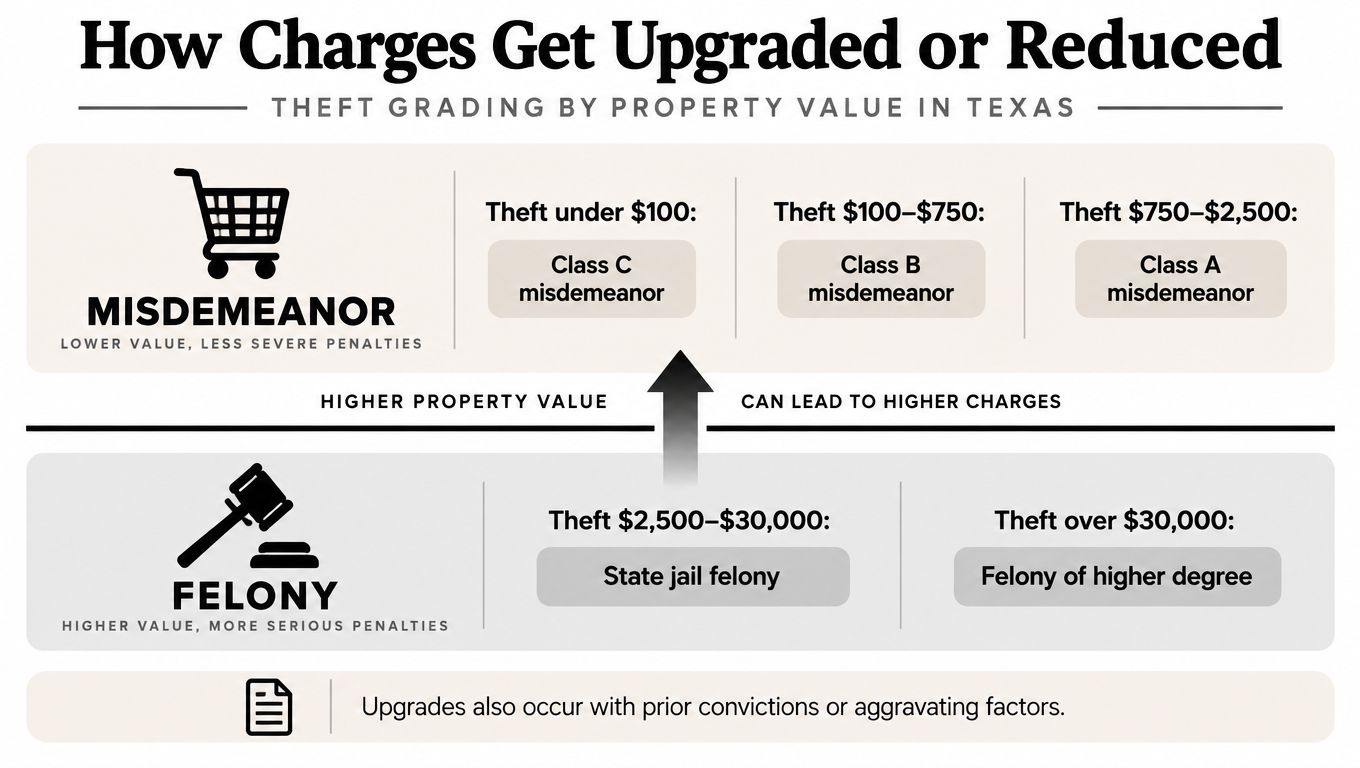
The alleged value isn't always the original purchase price. Texas Penal Code §31.08 generally looks to fair market value at the time and place of the offense. If that value can't be determined, the statute uses reasonable replacement cost, with special rules for documents and other property. Texas Penal Code §31.08 explains the valuation rules.
For a Kingwood or Humble theft allegation, preserve receipts, ownership records, appraisals, payment records, market comparisons, repair estimates, and communications. Those materials may affect both the value and the defense.
Services and telecommunications have their own rules
Theft of service uses a similar value ladder. Under Texas Penal Code §31.04, service valued below $100 is generally a Class C misdemeanor, $100 to under $750 is a Class B misdemeanor, and $750 to under $2,500 is a Class A misdemeanor. The allegation becomes a state-jail felony at $2,500 to under $30,000, with higher felony classifications at higher values. Texas Penal Code §31.04 is the relevant statute.
Telecommunications theft follows a different threshold structure. It is generally a Class B misdemeanor below $500, a Class A misdemeanor from $500 to under $1,500, and a state-jail felony from $1,500 to under $20,000. The statute also allows aggregation from one scheme or continuing course of conduct. Texas Penal Code §33A.04 shows why separate small allegations may not always remain separate for grading purposes.
Prior convictions and aggravating facts matter
DWI and assault cases require the same careful review. Prior DWI convictions can change the exposure. Bodily injury allegations can move an assault case into a more serious category. Family violence findings can affect future charging decisions and other rights. The important question is not whether the case sounds low-level. It's whether the facts support an enhancement and whether the prosecution can prove it.
For practical information about bond issues in domestic-violence cases, readers sometimes consult material on how to find domestic violence bond amounts. Bond information doesn't answer the merits of a Texas case, so have counsel review the actual affidavit, conditions, and charging documents.
Your immediate task is simple: don't discuss disputed facts with investigators or the alleged victim, don't delete messages, and don't assume the initial charge is permanent. A defense lawyer needs the records before anyone makes an avoidable admission.
Plea Options and Defense Strategy in a Texas Case
A Texas criminal case usually develops through stages. Each stage gives the defense a chance to protect options, test the prosecution's proof, and argue for a result that doesn't create unnecessary long-term damage.
The early decisions
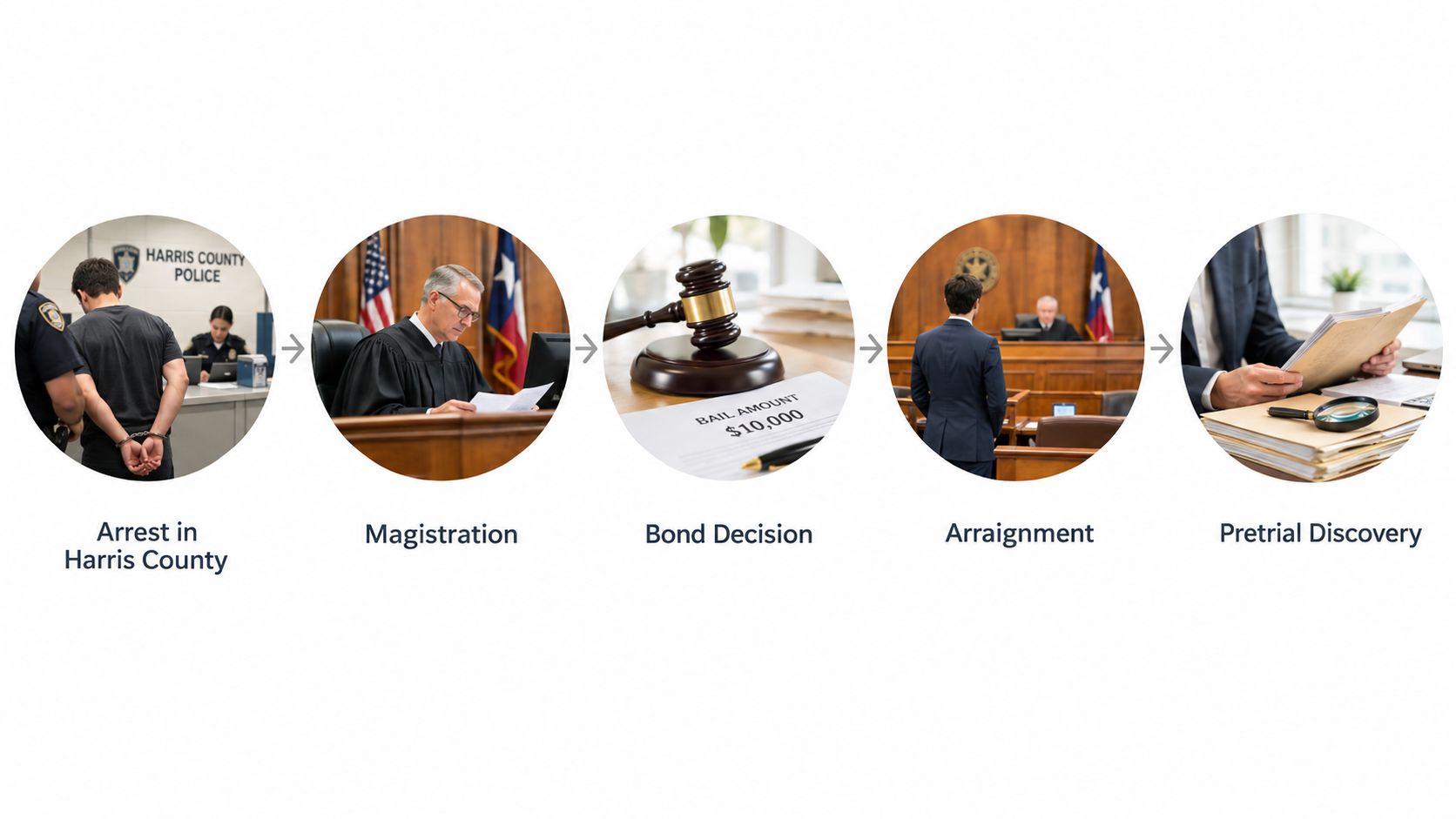
After an arrest in Harris County, the defendant may go through magistration and receive bond conditions. Those conditions can address contact with an alleged victim, travel, testing, weapons, or other restrictions. Violating them can create a separate problem and weaken the defense position.
At the first court settings, counsel should confirm the charge, review probable-cause materials, identify discovery, and assess whether the case belongs at the filed level. A felony allegation deserves immediate attention because the defense may need to challenge the evidence supporting the more serious classification.
The practical sequence often looks like this:
- Protect communication: Don't give a statement or try to negotiate directly with the complainant.
- Review the evidence: Obtain reports, recordings, photographs, messages, witness information, and relevant records.
- Test the charge: Examine value, injury, intent, prior convictions, and enhancement allegations.
- File appropriate motions: Suppression, discovery, evidentiary, and constitutional issues may affect the case.
- Evaluate resolution: Consider dismissal, diversion where eligible, deferred adjudication, a misdemeanor reduction, or a negotiated felony outcome.
- Prepare for trial: If the evidence doesn't support a fair resolution, counsel should build the defense for a jury or bench trial.
Deferred adjudication in Texas can be relevant in some cases, but eligibility and consequences depend on the offense, facts, prior history, and the terms offered. It isn't a universal solution, and a defendant should understand the record implications before accepting it.
Local representation changes the preparation
Kingwood cases may involve courts and prosecutors serving Harris County and nearby communities. A local attorney can help a client understand where the case is pending, what settings are coming next, and what information the court needs. That local focus is especially important when a defendant lives in Porter, works in Northeast Houston, or has family responsibilities in Humble.
A plea agreement should be measured against more than immediate jail exposure. Compare the proposed classification, supervision terms, fine, record consequences, immigration risks, licensing concerns, firearm consequences, and possible eligibility for later relief. If a felony can be reduced to a misdemeanor without sacrificing a stronger defense, that difference may matter for years.
Collateral Consequences Beyond the Sentence
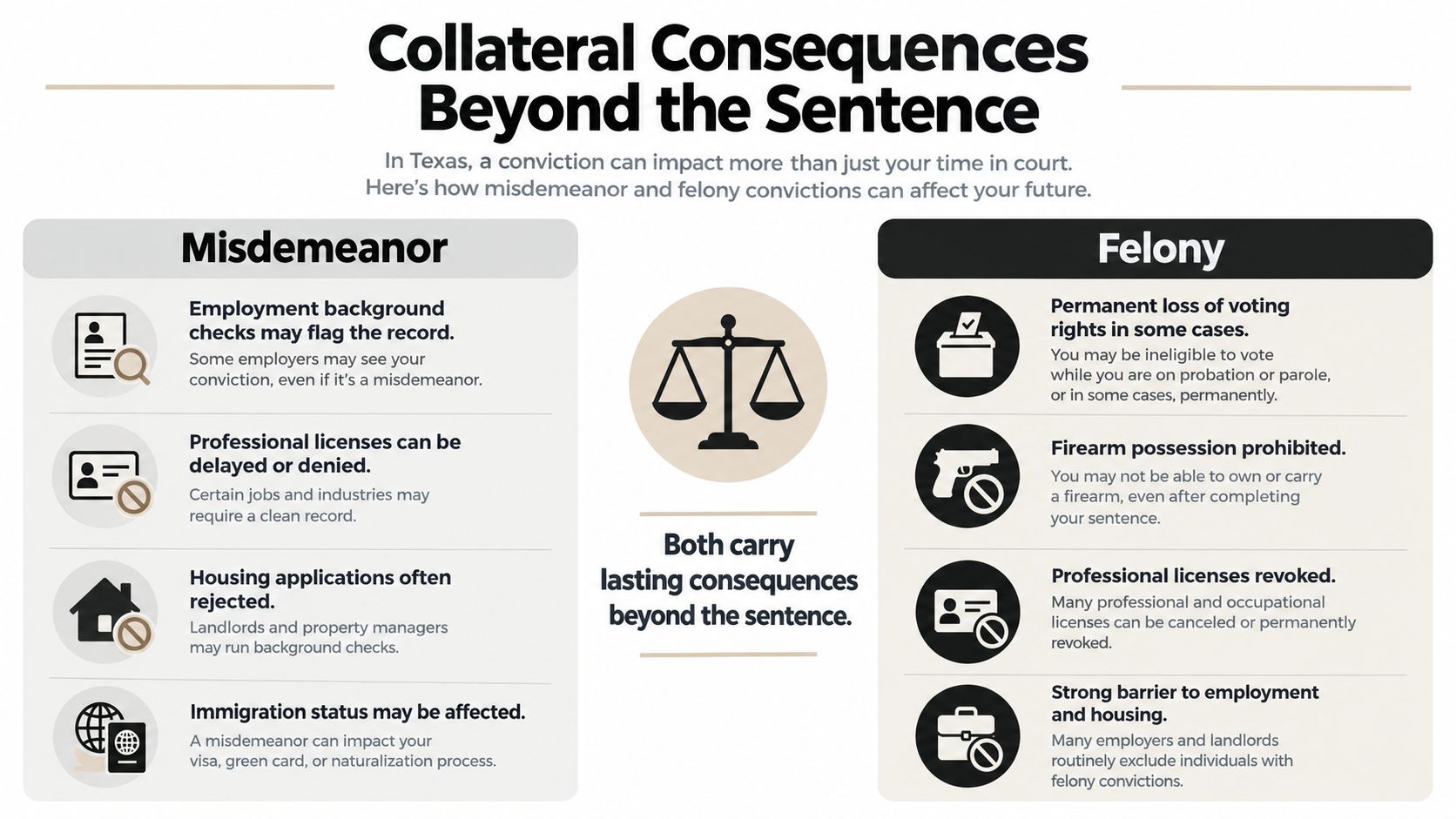
A misdemeanor charge can disrupt your life before a judge imposes any sentence. A Class B misdemeanor may carry county-jail exposure and prompt questions from an employer, landlord, licensing board, or government agency. A felony brings greater legal exposure, but the practical harm can begin with the arrest or pending charge. For residents of Kingwood, Humble, and Northeast Houston, the local question is not only “misdemeanor or felony?” It is how the charge, facts, and final disposition will affect work, housing, licensing, and family responsibilities.
The record can matter before conviction
An arrest record or pending charge may appear in a background check before the case ends. A Humble employer may ask about an open case. A Porter landlord may view an application differently after seeing an arrest. A professional licensing board may request records that a private employer never sees.
The disposition matters, but it is only one part of the record. Dismissal, acquittal, deferred adjudication, probation, and conviction produce different consequences. The file may also contain the arrest, booking information, court filings, and final disposition. Defense counsel should address those issues at the start of the case, not after sentencing.
Common practical consequences
Review these consequences before accepting a plea or agreeing to a resolution:
- Employment: A background check may reveal an arrest, pending charge, or conviction. Explain the situation accurately and never make a false statement.
- Housing: Landlords may consider criminal history. A dismissed case may still require separate record-clearing analysis.
- Professional licensing: A licensing board may delay, deny, restrict, or investigate an application based on the offense and its disposition.
- Immigration: Noncitizens should consult an immigration lawyer before accepting a plea. A misdemeanor disposition can still create immigration consequences.
- Firearm rights: Certain convictions and case facts can restrict possession. The misdemeanor label does not settle that question.
- Voting: A person incarcerated for a felony conviction may lose voting rights while incarcerated. Restoration depends on legal status and applicable law.
A short sentence can create a long problem. The record, disposition, and collateral consequences may outlast court supervision.
For a Kingwood family, the effects may reach beyond the defendant. A spouse may worry about household income. Parents may face concerns about school activities or custody questions. A business owner may worry about licensing or contracts. The defense strategy should account for those risks while staying focused on the criminal case. Do not assume that a dismissed case means every record disappears automatically. Background checks, housing, licensing, immigration, and firearm concerns may continue after the courtroom case ends.
Clearing Your Record Under Texas Law
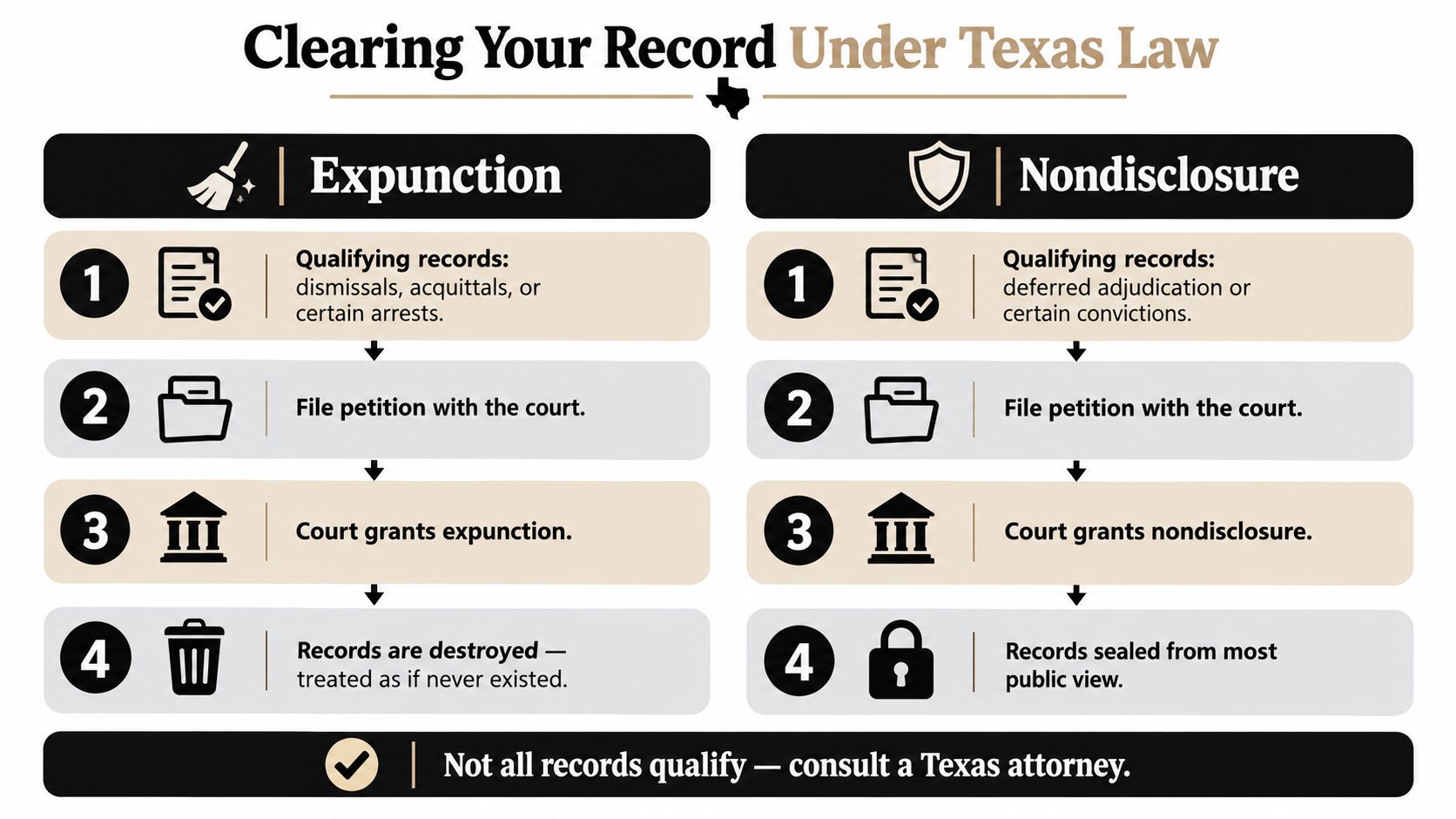
A Kingwood arrest can create a record problem even after the criminal case ends. Texas offers two separate remedies. Expunction can remove qualifying records, while nondisclosure generally limits public access but may leave records available to specified government agencies. Eligibility depends on the case outcome and statutory conditions, not merely on whether the charge was a misdemeanor or felony.
Texas's revised expunction framework took effect on January 1, 2025. For qualifying arrests, the waiting period may be 180 days for a Class C misdemeanor, one year for a Class A or B misdemeanor, or three years for a felony or an arrest involving a felony charge. Review Article 55A.052 of the Texas Code of Criminal Procedure alongside the eligibility rules. Charges filed, a pending case, or court-ordered community supervision can change the analysis.
Choose the remedy based on the outcome
Expunction may fit a qualifying arrest that ended without a conviction, subject to statutory exceptions. Nondisclosure may fit a qualifying deferred outcome or another eligible disposition, but it usually does not erase every government record.
Start with the paperwork. A Kingwood resident should collect the final disposition, charging documents, bond information, supervision terms, and arrest details before selecting a remedy. An incorrect date, omitted agency, or ineligible disposition can delay the process or lead to denial.
The decision often begins before the case ends. Before accepting a plea, ask whether the proposed result preserves, limits, or eliminates future expunction or nondisclosure options. A lower immediate penalty can produce a harder record problem later.
For a practical comparison, read expunction vs nondisclosure in Kingwood. Then have a Texas attorney apply the rules to the actual disposition, rather than relying on a generic online checklist.
When to Call a Kingwood Criminal Defense Attorney
Call a Kingwood criminal defense attorney promptly if police or prosecutors are investigating you, or you face a felony, a misdemeanor with possible jail time, a prior record, or a suspected enhancement. Call before giving a statement, signing plea papers, contacting an alleged victim, or accepting supervision terms.
In Kingwood, Humble, and Northeast Houston, the first question is how Harris County prosecutors may classify and pursue the case. Counsel should test the charge against the alleged value, injury facts, prior convictions, and enhancement language, then assess bond conditions, evidence, and whether reduction or dismissal is realistic. That review can prevent a rushed plea that creates a harder record problem later.
Early representation matters. A lawyer can preserve evidence, challenge an unsupported allegation, and identify options before the prosecution gains a head start. Bring charging documents, bond papers, court notices, and relevant records.
The Law Office of Bryan Fagan serves Kingwood and nearby Humble, Porter, and Northeast Houston residents with criminal defense and related legal services. For a free consultation about a misdemeanor or felony case, visit Law Office of Bryan Fagan – Kingwood TX Lawyers with every relevant document.
The Law Office of Bryan Fagan – Kingwood TX Lawyers provides local guidance for DWI, assault, theft, and other criminal matters. Schedule a free consultation with the firm before making a decision that affects your freedom or record.