You're in Kingwood, and the situation has moved past uncomfortable texts or repeated arguments. Someone is threatening to come to your home, contacting you through friends, or making you afraid to return to your normal routine. If children, a pending divorce, or a criminal investigation are involved, waiting to “see what happens” can make the next legal step harder.
A protective order can create enforceable boundaries, but the right filing depends on the relationship, the location of the conduct, the immediate danger, and the evidence available. A Kingwood resident may need emergency relief first, a final order after a hearing, or coordinated action with an existing divorce, custody, or criminal case. The practical priority is simple: preserve evidence, choose the correct Harris County venue, and avoid any contact that could worsen the situation.
Understanding Protective Orders for Kingwood Residents
A Texas protective order is a court order designed to prevent family violence, stalking, sexual assault, or other qualifying conduct. Depending on the order, it can prohibit contact, require someone to stay away from a home, workplace, school, or childcare location, and create consequences for violating those restrictions. It isn't merely a written warning. Once issued and properly served, it carries enforceable legal terms.
Kingwood residents generally encounter three protective-order paths:
- Temporary ex parte order: A judge may issue short-term relief without first hearing from the respondent when the application shows a clear and present danger. Under Texas law, this order can last up to 20 days, and the court may extend it for additional 20-day periods on request or on its own motion. See the Texas Family Code provisions on temporary ex parte orders.
- Final protective order: After notice and a hearing, the applicant must prove by a preponderance of the evidence that family violence occurred and is likely to happen again. The final order can include broader, longer-lasting restrictions.
- Magistrate's Order of Emergency Protection: A magistrate may issue emergency protection in connection with certain criminal allegations, including situations involving family violence, stalking, or sexual assault. It follows a criminal-law emergency process rather than the ordinary standalone civil filing.
Why venue matters locally
Harris County courts can address a protective order as a standalone civil case or coordinate it with an existing divorce, custody, or SAPCR matter. If a divorce or custody case is already pending, filing strategy should account for that case instead of treating the protective-order request as unrelated.
Texas court data show the scale of this system. A Texas State University presentation reported 217,608 protective orders on record as of July 24, 2024, including 163,695 emergency protective orders, 28,763 Texas protective orders, and 25,150 protective orders. The same framework notes limited public access to registry information when the protected person authorizes access, an issue that can matter for service, verification, and enforcement. Review the Texas judicial presentation.

The law also changed effective September 1, 2025. Certain victims of home burglaries may now qualify for a protective order, and standardized forms were updated to address new TCIC data-entry requirements. Texas guidance also reflects expanded eligibility involving certain dating relationships and non-spousal cohabitants. If a Kingwood neighbor has experienced repeated threats, violence, or qualifying conduct from a former partner or household member, the facts may support a final order rather than only an emergency request. A useful comparison is the protective order versus restraining order guide for Kingwood.
Who Qualifies and Where to File in Harris County
Eligibility turns on the relationship and the conduct. Chapter 7B of the Texas Family Code addresses protective orders for qualifying violence and related circumstances. Depending on the facts, an applicant may include a current or former spouse, a parent of a shared child, a blood relative, a household member, a foster parent, or a qualifying dating partner who interacted with the respondent within the applicable period. The 2025 changes also require lawyers to look beyond the traditional spouse-versus-spouse pattern.
Venue gives a Kingwood filer several choices. An application may generally be filed in the county where the applicant lives, where the respondent lives, or where the violence occurred. If a divorce or custody case is already pending, coordinate the request with that court. Filing in the wrong place can create delay and confusion at the moment speed matters most.
Local filing choices
| Situation | Where to File | Typical Speed |
|---|---|---|
| Standalone application by a Kingwood resident | Harris County Family Law Center, 1115 Congress | Often the most direct route for emergency ex parte review |
| Emergency protection connected to an arrest or after-hours emergency | Appropriate local precinct courthouse or magistrate process | Depends on the immediate circumstances and magistrate availability |
| Pending divorce, SAPCR, or related family case | Court handling the existing matter | Coordination may affect scheduling and service |
| Conduct occurring outside Harris County | County where the applicant or respondent lives, or where the conduct occurred | Depends on venue, court assignment, and service |
A magistrate's process may be especially relevant for a Humble or Northeast Houston resident who needs emergency protection after regular court operations. Military protective orders can also operate alongside Texas court remedies, so a service member's status, installation jurisdiction, and the existence of military proceedings should be disclosed immediately.
Minor children don't have to face the system alone. A parent, guardian, or next friend may petition on a child's behalf when the legal requirements are met. Bring the child's relationship to the respondent, school or residence information, and any existing family-court orders to the consultation. Those details help determine whether the request belongs in a standalone filing or should be addressed within the existing case.
Filing Step by Step From Application to Service
Start with the Application for Protective Order and the sworn statement supporting it. Forms may be obtained through the Harris County Law Library or the clerk's office. The written account should identify specific incidents, dates when known, locations, threats, injuries, property damage, witnesses, and why the danger may continue. General statements such as “the respondent is dangerous” usually give the court less to evaluate than a chronological account supported by records.
The filing sequence
- Prepare the application and affidavit. State the relationship, the qualifying conduct, requested restrictions, and the facts supporting immediate protection.
- File with the clerk. The clerk's office opens the case, stamps the filing, and assigns a case number. A standard filing may cost around $345, although qualifying applicants may request a waiver through a fee-waiver affidavit. Confirm the current amount and waiver process with the clerk because court fees and procedures can change.
- Request temporary ex parte relief. The judge reviews the sworn allegations, often through a brief bench review. The question is whether the facts show a clear and present danger requiring immediate restrictions before the respondent can be heard.
- Obtain citation and service documents. A temporary order isn't the final ruling. The respondent must receive notice and an opportunity to attend the final hearing.
- Arrange service. A Harris County constable can serve a Kingwood address. A private process server or certified mail may also be available depending on the court's requirements and the circumstances.
- Prepare for the hearing. Service, court scheduling, and local procedure affect timing. The final hearing may be set after a service period that often falls within seven to fourteen days, but the clerk or attorney should confirm the actual setting.
The statutory framework requires prompt handling in certain large or multi-county jurisdictions. The district court must set a final protective-order hearing no later than 20 days after filing, or no later than 20 days after a rescheduling request, in the circumstances covered by the statute. Read the Texas hearing deadline.

For a related explanation of urgent temporary relief, see the temporary restraining order family law resource. For domestic-violence and family-safety matters, Protective Orders in Kingwood provides a focused description of that legal service category.
Don't contact the respondent to arrange service yourself. Use the lawful service process and keep copies of every filing, signed order, citation, return of service, and hearing notice.
Building the Evidence the Court Wants to See
Harris County judges need more than a frightening description. They evaluate whether the evidence is reliable, specific, and connected to the legal requirements for protection. A police report alone may not answer every question, and a personal account alone may be challenged. The strongest presentation usually combines a clear timeline with records created close to the event and testimony from people with firsthand knowledge.
Preserve the original record
Save text messages, emails, voicemails, photographs, and videos in their original form. Don't crop a threatening message so aggressively that the surrounding conversation disappears. Preserve complete message threads, note the phone number or account, and keep the device when possible. Screenshots can help, but the underlying device and complete conversation may matter if authenticity becomes disputed.
Local sources may include police reports from the Kingwood or Humble sub-station, 911 call logs, body-camera footage, medical records from Memorial Hermann Northeast or another provider, photographs of injuries or property damage, and witness accounts. Request records promptly. Surveillance footage from a business may be overwritten, so a lawyer may need to pursue a preservation request or business-records subpoena before the video disappears.
Practical rule: Write the incident log while the details are fresh, then update it without changing earlier entries.
Create a dated digital folder with subfolders for police records, medical care, communications, photographs, witnesses, and court filings. Your incident log should identify what happened, who was present, what happened afterward, and where corroborating evidence can be found. This organization helps you answer questions consistently and lets counsel identify gaps before the hearing.
What weakens credibility
Inconsistent statements, unexplained gaps in reporting, deleted messages, and social-media posts that contradict claimed fear can damage an application. That doesn't mean a delayed report automatically defeats a case. It means the applicant should be ready to explain the delay and connect the explanation to the overall evidence.
A respondent should preserve the same categories of evidence and avoid deleting anything. Don't message the applicant to demand a retraction, don't argue online, and don't ask friends to “clear things up.” Those actions can create new allegations and may violate an existing order.
Texas court reporting underscores why these applications are treated as safety matters. In 2017, Texas recorded 195,315 family-violence incidents involving 212,307 victims and 207,231 offenders, and about 96% of incidents were assaults, with roughly 76% of those assaults classified as simple assaults. The same report stated that the protective order stopped violence for 50% of victims and significantly reduced it for the other half. Read the Texas Court report.
The Final Hearing and What Happens on the Other Side
The final hearing is where the court tests the sworn allegations against testimony, documents, and objections. Arrive at the Harris County Family Law Center early, check in with the clerk, keep your phone off, and wait for instructions. Dress respectfully and don't confront the other side in the hallway. Court staff and the judge notice conduct before testimony begins.
The applicant carries the burden of proving by a preponderance of the evidence that family violence occurred and is likely to occur again. That standard means the evidence must show that the claim is more likely true than not. It isn't the criminal standard of proof beyond a reasonable doubt, but the consequences can still reach housing, employment, parenting arrangements, firearms, and future litigation.
A contested Kingwood hearing
Consider former partners who share a child and disagree about what happened during a confrontation at a Kingwood residence. The applicant describes threats, supplies text messages, and calls a neighbor who heard part of the exchange. The respondent denies making a threat, presents the full message thread, and argues that the dispute was mutual verbal conflict rather than family violence.
The applicant's lawyer asks questions first. The respondent's lawyer cross-examines the applicant about changes between the application, police statement, and testimony. If a witness repeats what someone else said rather than describing what the witness personally saw or heard, counsel may raise a hearsay objection. The judge decides whether the evidence is admissible and how much weight it deserves.
The respondent's side may argue lack of credibility, fabricated allegations, mutual conflict, or the absence of a qualifying relationship. Those defenses don't win automatically. The respondent must present admissible evidence and explain contradictions without becoming argumentative.
A hearing isn't a chance to tell the loudest story. It's a chance to give the judge a coherent, supported account.
The judge may rule from the bench or take the matter under advisement. The final order can define prohibited locations, contact methods, third-party communication, and other restrictions. If children are involved, the court may coordinate provisions with an existing custody case rather than leaving the family with conflicting instructions.
Duration Enforcement and What Happens if an Order Is Violated
Read the signed order carefully. The enforceable terms are the terms written in the order, not what one party remembers the judge saying. Restrictions can include direct contact, indirect contact through relatives or friends, approaching a protected person's home or workplace, returning to a shared residence, or possessing firearms when the law and order impose that restriction.
Final protective orders generally last up to two years, but Texas law allows other durations, including lifetime orders in qualifying circumstances. Sexual-assault and stalking protective orders can last for life. A protective order connected to a divorce, SAPCR, or related criminal family-violence case may remain effective until two years after final disposition of that related case. Review Texas guidance on duration.
Texas court data also show why lawyers distinguish short-term emergency relief from a final order. From 2021 through 2023, courts issued an estimated 162,497 MOEPs, TEXPOs, or final protective orders. During that period, about 96% of MOEPs, 84% of TEXPOs, and 74% of final protective orders involved family-violence protection, while 26% of final protective orders involved sexual assault. Read the 2024 Texas protective-order report.
If someone violates the order
Document the date, time, location, words used, witnesses, screenshots, call records, and any police incident number. Don't respond to a prohibited message, even to tell the person to stop. Contact law enforcement if there's an immediate safety risk and provide officers with a certified or accessible copy of the order.
| Violation Type | Classification | Potential Penalty |
|---|---|---|
| General violation of a protective order | Class A misdemeanor | Up to one year in jail and a fine of up to $4,000 |
| Violation by a defendant with a conviction for an offense against the applicant | Felony classification may apply | Penalty depends on the charged felony and facts |
| Conduct involving a separate assault or other crime | May create additional criminal charges | Depends on the separate offense and circumstances |
Texas State Law Library guidance explains the general Class A misdemeanor consequences and notes that a violation can become a felony when the defendant has been convicted of an offense against the applicant. Review Texas enforcement guidance. A court may also address modification, extension, or renewal through a formal motion. Don't assume an informal agreement changes the order. Until the court signs a modification, follow the existing terms.
When and How a Kingwood Protective Order Lawyer Helps
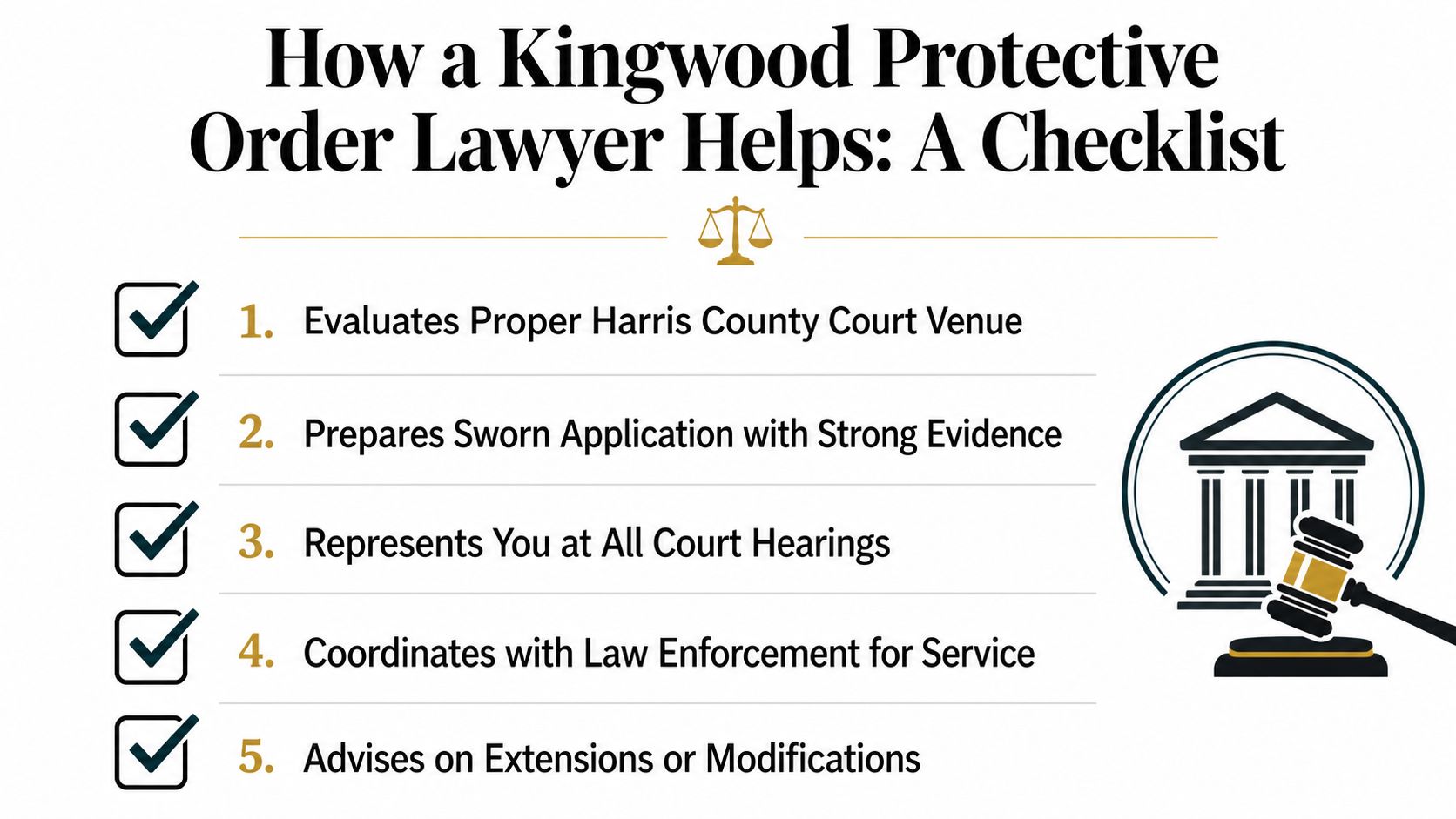
A local lawyer should begin with venue, not paperwork. The first review should identify where the conduct occurred, where each party lives, whether a divorce or custody case is pending, whether a 2025 eligibility expansion may apply, and whether emergency ex parte relief is justified. That analysis prevents a Kingwood client from spending valuable time in the wrong court.
The work behind a stronger filing
Counsel can help preserve phone records, request body-camera footage, seek surveillance-video preservation, organize medical and police records, and prepare witnesses for direct examination and cross-examination. A lawyer can also coordinate the protective-order strategy with a related criminal case, divorce, SAPCR, or enforcement proceeding. Those matters can affect one another even when they use different court procedures.
For clients defending against an application, the approach is different. The lawyer should first explain every restriction and insist on complete compliance. The defense may challenge jurisdiction, contest the qualifying relationship, present complete communications, identify inconsistencies, and negotiate narrowly written provisions for necessary child-related or work-related contact when appropriate.
Bring these materials to a consultation:
- Court documents: Existing divorce, custody, criminal, or protective-order filings.
- Evidence: Police reports, photographs, medical records, texts, emails, voicemails, and videos.
- Witness information: Names, contact details, and a short description of what each person personally observed.
- Timeline: Dates, locations, reports made, service details, and upcoming hearing dates.
A law practice may also use administrative support to organize intake and records. For background on that operational role, see virtual assistants for family law. Ask the attorney about flat-fee pricing, hourly billing, and whether limited-scope representation is appropriate for a particular task. Call before serving the respondent, before the hearing, and immediately after any alleged violation. For a related issue involving enforcement of family-court orders, review the restraining order lawyer resource for Kingwood.
If you're in Kingwood, Humble, Porter, or Northeast Houston, Law Office of Bryan Fagan – Kingwood TX Lawyers can review the relationship, evidence, venue, and any connected family or criminal case during a free consultation. Visit Law Office of Bryan Fagan – Kingwood TX Lawyers to schedule a consultation and bring your protective-order papers, incident records, and hearing information so the team can help you identify the next legal step.