You leave a consultation in Kingwood with one question still nagging at you: if the problem existed before the wedding, should you seek an annulment instead of a divorce? Perhaps you've learned that your spouse concealed a prior marriage, or you're questioning whether either of you could legally consent at the ceremony. The answer depends on how the marriage began, not how quickly it broke down.
Texas treats annulment and divorce as different legal remedies, not interchangeable ways to end a relationship. Before choosing, screen four facts: Was there a defect when you married? Does that defect match a Texas statutory ground? What happened after you discovered it? When would you file, and could death affect the case? Getting the choice wrong can cost time and money, so Kingwood, Humble, Porter, and Northeast Houston residents should identify the specific facts before filing.
| Question | Annulment | Divorce |
|---|---|---|
| What does the case challenge? | Whether a legal defect existed when the marriage began | How to end a legally valid marriage |
| What must you show? | A qualifying formation defect and compliance with applicable statutory conditions | A statutory basis for dissolution |
| What happens to the marriage's legal status? | The court may treat a voidable marriage as invalid from inception | The court ends the marriage prospectively |
| Is the ordinary divorce waiting period required? | The 60-day divorce waiting period doesn't apply, though the case can still take time | A court generally must wait 60 days after filing, subject to an exception |
If you're also dealing with grief, uncertainty, or the emotional weight of ending a relationship, therapy for moving forward after divorce may offer support alongside legal advice. Emotional support can help you make decisions more steadily, but it doesn't determine which legal remedy Texas allows.
Why This Question Matters for Kingwood Families Right Now
A spouse in Humble discovers that a partner hid a serious fact before the wedding. A couple in Kingwood separates soon after marrying and wonders whether a short marriage can be undone. These situations may feel alike, but the legal question is different: did something make the marriage invalid when it began, or did a valid marriage later become unsustainable?
That distinction matters because Texas doesn't let a couple choose annulment just because it seems more fitting, less complicated, or less painful than divorce. An annulment asks a court to examine the marriage's formation. Divorce asks the court to end a valid marriage and address the practical issues that follow. The facts that matter most are often dates, communications, what each spouse knew, and what they did after discovering a problem.
For a Kingwood or Northeast Houston resident, start with four screening fields:
- Defect at formation: What specific condition existed when you married?
- Statutory ground: Does Texas law recognize that condition as a basis for annulment?
- Post-discovery conduct: Did you voluntarily continue living together after learning about the alleged defect or after duress ended?
- Filing and death timing: Is there a reason to act promptly, including a spouse's serious illness or an estate issue?
Practical rule: A painful marriage isn't automatically an invalid marriage. Focus first on what was true at the ceremony, then on what happened afterward.
A rushed filing can send you down the wrong path. If the marriage was legally valid and later failed, divorce is generally the route to consider. If a qualifying defect affected the marriage from the start, ask an attorney to assess annulment eligibility before you file.
How Texas Law Defines Annulment and Divorce
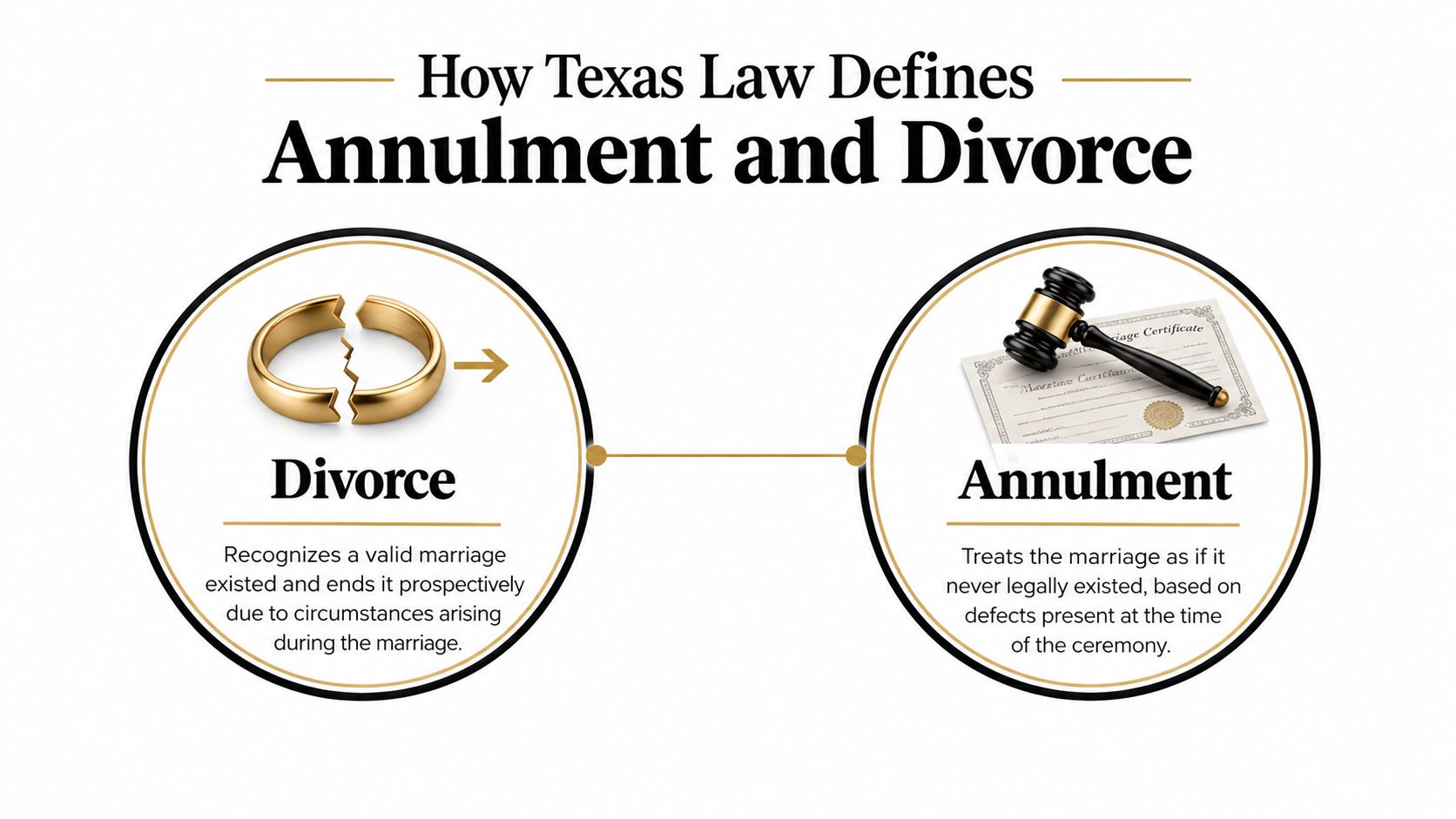
Texas law treats annulment as a status-validity remedy, not another form of ordinary marital dissolution. A divorce ends a legally valid marriage going forward. An annulment generally asks the court to treat a voidable marriage as invalid from its beginning because a legally significant defect existed when the parties married. Texas Family Code Chapter 6 provides the statutory framework.
The difference becomes clearer in three steps:
- Ask what the court is being asked to decide. In a divorce, the spouses accept that a valid marriage existed and ask the court to end it. In an annulment, the petitioner challenges the marriage's legal validity based on a defect at formation.
- Identify whether the marriage is void or voidable. A voidable marriage may be treated as valid unless and until a court grants the required annulment. A void marriage is legally invalid under the applicable law. These terms have distinct legal effects, so don't assume that alleging a problem alone changes your marital status.
- Separate the legal label from the practical outcome. A court order matters. You can't treat a marriage as annulled merely because you believe it should never have happened.
Texas presumes a marriage valid unless the law expressly makes it void or voidable and the required legal proceeding is completed. That presumption means a Kingwood resident needs more than regret, a brief relationship, or a spouse's later misconduct to establish that the marriage was invalid from the beginning.
In practical terms, divorce changes the parties' status prospectively: the marriage ends through a court judgment. Annulment addresses whether the marriage should be recognized as valid at all. That retroactive character can raise separate questions about rights previously obtained on the basis of the marriage, so don't assume an annulment leaves every other legal matter untouched.
Eligibility and Grounds Under Texas Family Law
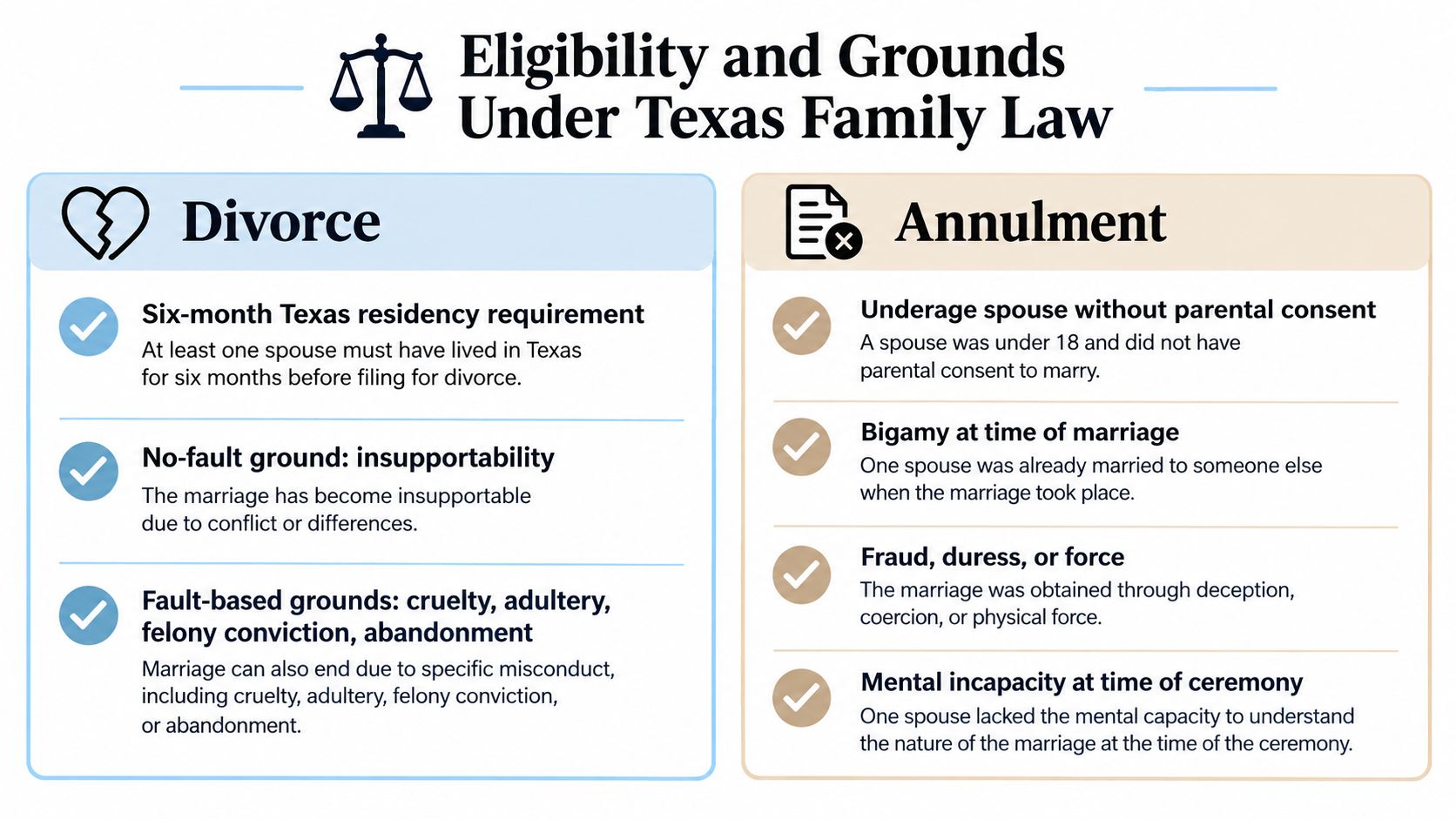
The two paths demand different proof. A person seeking divorce must meet Texas's residency rules and establish a statutory basis for ending the marriage. A person seeking annulment must tie the claim to a legally recognized defect at formation and satisfy the conditions that apply to that particular ground.
Divorce relies on a basis for ending a valid marriage
Texas divorce cases generally require that a spouse meet the state's residency requirements, including the six-month Texas residency requirement. A spouse may seek a no-fault divorce based on insupportability, meaning the marriage can't continue because of discord or conflict that destroys the legitimate ends of the relationship. Texas also recognizes fault-based grounds, including cruelty, adultery, abandonment, conviction of a felony, confinement in a mental hospital, and living apart. Confirm how a particular ground applies to your circumstances before relying on it.
For Kingwood and Harris County residents considering divorce, the Divorce Lawyer in Kingwood, TX page describes divorce representation for clients in Kingwood and Harris County.
Annulment focuses on a defect at the ceremony
Texas Law Help lists potential annulment circumstances that include fraud, duress or force, lack of mental capacity, permanent impotence, intoxication or drug impairment at the ceremony, concealment of a recent divorce, and marriage within 72 hours after the license was issued. The Texas Law Help guide to annulment or void marriage explains these possible grounds.
Ordinary marital problems don't become annulment grounds just because they're serious. Later infidelity, financial stress, and incompatibility may support a divorce strategy, but they don't by themselves show that a legal defect existed when the couple married.
There's also a post-discovery condition to examine. For certain claims involving fraud, duress, or force, Texas law requires that the petitioner did not voluntarily cohabit with the other spouse after learning of the fraud or after being released from the duress or force. That's why a timeline can matter as much as the original allegation.
You can watch this overview as another way to organize the basic questions before speaking with counsel:
The practical proof threshold is straightforward: divorce requires a statutory basis to dissolve a valid marriage; annulment requires a qualifying formation defect and compliance with the conditions tied to that ground. Write down the marriage date, discovery date, relevant communications, and living arrangements afterward before discussing your options with an attorney.
Legal Consequences for Property, Children, and Support
An annulment doesn't mean the court ignores everything the couple built or every responsibility they have. Texas public legal guidance warns that property and children may still be materially affected, even when an annulment judgment characterizes the marriage as never legally existing. Texas public legal guidance on annulment.pdf) also explains that a marriage subject to annulment generally can't be challenged in a proceeding filed after either party's death, subject to an Estates Code exception.
| Dimension | Annulment | Divorce |
|---|---|---|
| Property | The court may still need to address property consequences; don't assume a clean slate | The court addresses property division as part of ending a valid marriage |
| Children | Custody and support questions can still arise | The court addresses parenting and support as part of the divorce |
| Spousal support | The outcome requires case-specific legal analysis | The court may consider support under the applicable Texas rules |
| Immigration and benefits | Retroactive treatment may affect rights based on the belief that a valid marriage existed | The divorce ends the marriage prospectively, which may still affect rights and benefits |
An annulment is an in-rem proceeding, meaning it concerns marital status. Texas permits jurisdiction when the marriage occurred in Texas or either party is domiciled there. But a status judgment doesn't answer every question about children, money, or third-party rights. Immigration status, benefits, and inheritance interests obtained on the premise of a valid marriage deserve separate review before you assume the consequences.
Divorce uses a more familiar framework. Texas courts address property division, apply the child's best-interest standard to custody decisions, and determine child support under the applicable rules. Annulment doesn't erase a child's needs or automatically resolve who will care for the child and how support will work.
Kingwood families concerned about assets can review the firm's information on property division in a Kingwood divorce. For the emotional side of a separation, DeTalks' divorce recovery guide offers a separate resource for thinking about coping and next steps.
Don't choose a remedy based on its label. Evaluate the status issue, property, parenting, support, and potential effects on benefits or inheritance as separate questions.
Procedural Steps, Timelines, and Costs in Texas
A divorce and an annulment can both require court filings, notice to the other party, evidence, and a final order. The timelines differ, but the legal label alone doesn't tell you how quickly a case will finish.
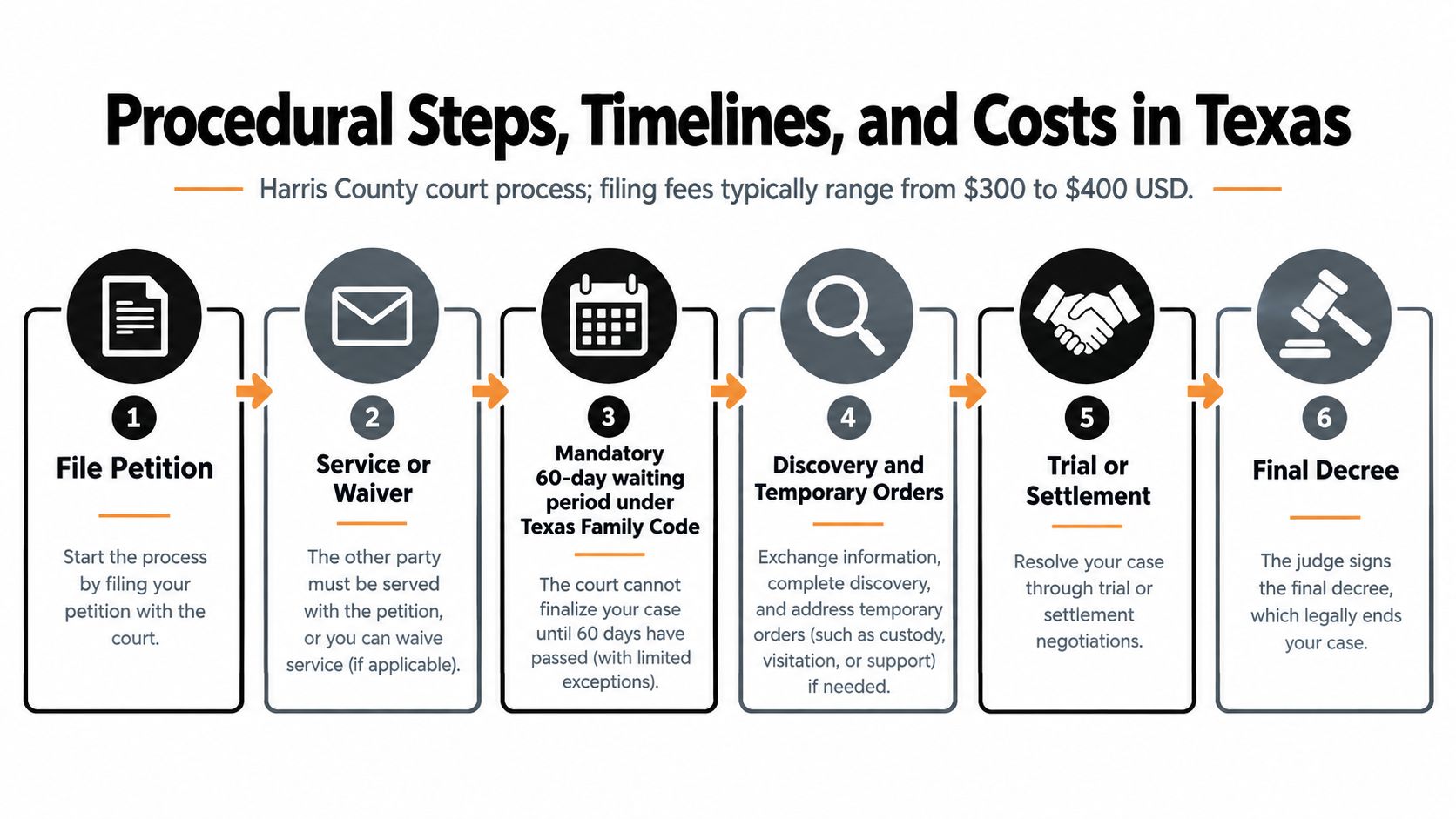
A divorce moves through filing, resolution, and decree
A typical divorce starts with a petition. The other spouse must receive service, or the parties may use a legally valid waiver where appropriate. Under Texas Family Code section 6.802, a court generally can't grant a divorce before the 60th day after filing; an exception may apply if the court finds that family violence occurred during the marriage. Texas Family Code section 6.802 states that the waiting period is calculated from filing, not from separation.
While the case proceeds, the spouses may exchange information through discovery, ask for temporary orders, negotiate, or attend mediation. If they don't resolve the disputed issues, the court may decide them at a final hearing. A guide to how long a divorce takes can help Kingwood residents understand why case-specific facts and court scheduling affect timing.
An annulment requires evidence about marital status
An annulment is an in-rem status action. Texas jurisdiction may be available when the marriage occurred in Texas or either spouse is domiciled here. The petitioner needs to identify the claimed formation defect, gather evidence, and show that the statutory conditions for that ground are met.
The 60-day divorce waiting period doesn't apply before a court grants an annulment or declares a marriage void. That doesn't guarantee a quick order. Disputed facts, service, hearings, and court availability can all extend the process.
Both routes can involve court filing fees and attorney fees. A contested annulment can require substantial work to prove the defect and address what happened afterward, and it can cost more than a straightforward divorce. A Kingwood client should not assume annulment is a faster or cheaper divorce.
Common Misconceptions Worth Correcting
Annulment isn't a shortcut for an unhappy marriage. It's a narrow legal remedy aimed at a defect affecting the marriage's formation. If the marriage began legally and later deteriorated, divorce is generally the path to investigate.
Historical evidence illustrates that narrow role. A study of Alameda County Superior Court records found that 6,408 spouses petitioned for divorce between 1890 and 1910, while 93 sought annulment, approximately 1.45% as many annulment petitions as divorce petitions. The historical court-record summary shows how uncommon annulment petitions were in that setting. Those figures aren't a measure of modern Texas cases, but they reinforce that annulment serves a more limited function than divorce.
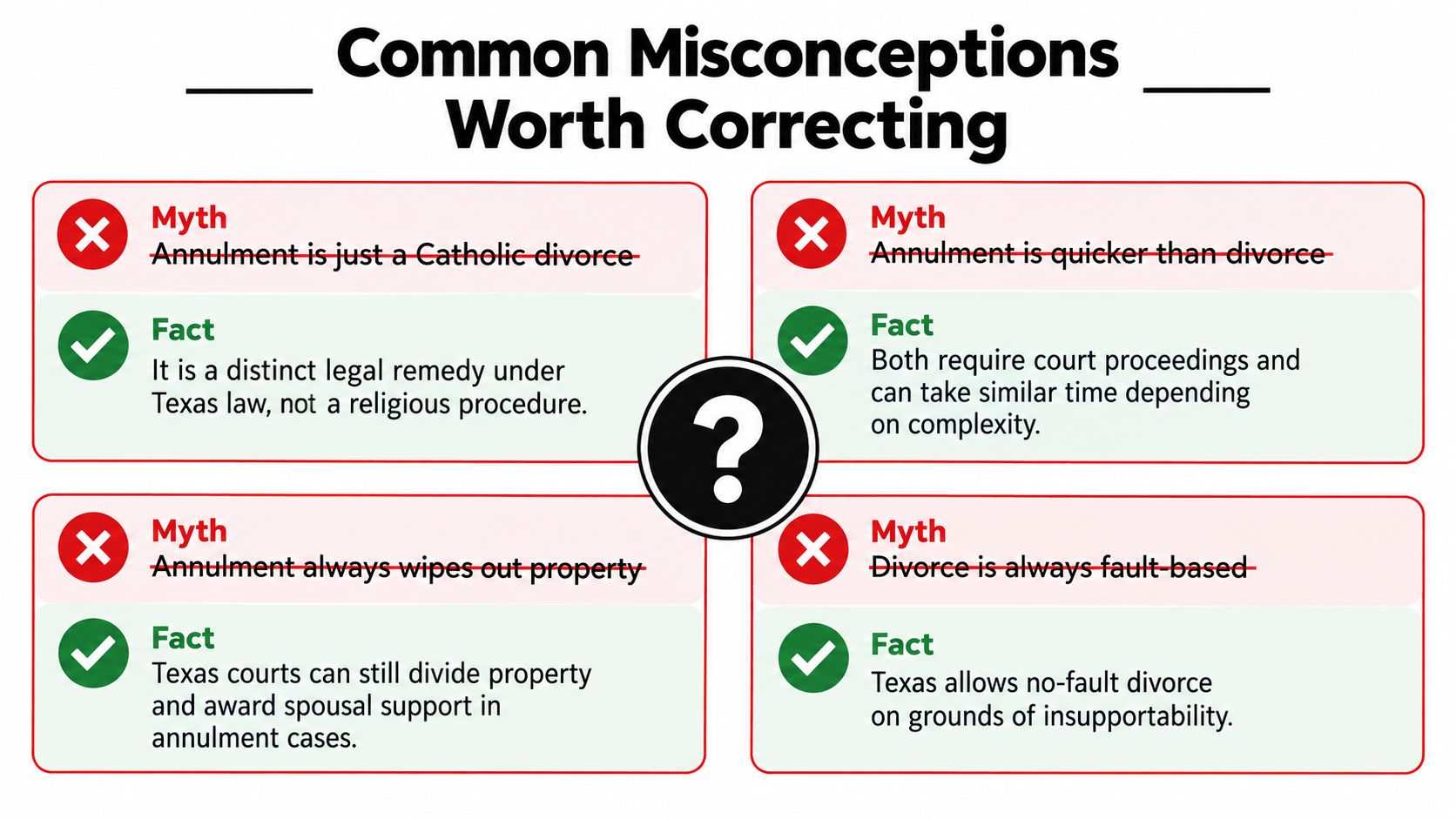
Here are the assumptions I'd challenge in a Kingwood consultation:
- Myth: “Annulment is just a religious divorce.” A religious annulment and a civil annulment are not the same thing. Texas civil law determines marital status in court.
- Myth: “Annulment is automatically faster.” The divorce waiting period doesn't apply to annulment, but contested evidence, service, hearings, and scheduling can still take time.
- Myth: “Annulment wipes out property and support.” Texas guidance cautions that property and children may still be affected. You need separate advice about financial and parenting consequences.
- Myth: “Any unhappy marriage qualifies.” Incompatibility, financial conflict, and later infidelity don't by themselves establish a defect at formation.
International comparisons can confuse the issue because legal systems don't all classify nullity, void marriages, religious annulments, and administrative or notarial dissolutions the same way. A procedure used elsewhere doesn't establish eligibility in Texas.
For a Porter, Humble, or Kingwood resident, the useful question isn't “Which option is easier?” It's “Do the facts about how this marriage began support an annulment under Texas law?”
How to Choose the Right Path and When to Call a Kingwood Attorney
Use the four screening fields to organize your facts before you make a filing decision:
- Defect at formation: Identify what was allegedly wrong when the marriage took place.
- Statutory ground: Match that fact to a ground Texas law recognizes.
- Post-discovery conduct: Record whether you continued living together after learning about the issue or after duress ended.
- Filing and death timing: Note any urgency involving a spouse's health or an emerging estate matter.
If your concern involves fraud, force, intoxication at the ceremony, or a concealed prior marriage, ask for an annulment-focused review. If the marriage began validly and later broke down, divorce is likely the more appropriate route. If you can't tell which description fits, get legal advice before filing. Texas permits an annulment action when the marriage occurred in Texas or either spouse is domiciled there.
Keep your notes organized and preserve relevant messages or records. If you need to prepare documents for review, a tool for editing and signing legal PDFs can help with document handling, but it can't replace legal advice about which remedy applies. If you're unsure whether you need counsel, the firm's guide to whether you need a divorce lawyer in Kingwood may help you consider your next step.
The Law Office of Bryan Fagan – Kingwood TX Lawyers handles divorce matters, including contested divorce, for people in Kingwood and nearby communities. Kingwood, Humble, Porter, and Northeast Houston residents can discuss the facts in a free consultation at the Kingwood office and get practical, client-focused guidance on which path fits their situation.
If you're weighing annulment against divorce, bring your timeline, messages, and questions to a free consultation with the Law Office of Bryan Fagan – Kingwood TX Lawyers. The Kingwood team can help assess whether the facts support an annulment or whether divorce is the more reliable route, then explain the family-law issues that may follow.