You've filed. The clerk stamped the petition, you paid the fee, and then you went home to the same kitchen, the same mortgage, and the same uncertainty about who picks up the kids Friday. That gap is where Kingwood families get hurt. Filing starts the case. It doesn't settle your schedule, protect a bank account, or order anyone to pay a bill.
My advice is blunt. Treat the weeks after filing as the start of your divorce, not a waiting room. What happens after you file for divorce depends on what you actively request, document, and negotiate right away, whether you live in Kingwood, Humble, Porter, or elsewhere in Northeast Houston.
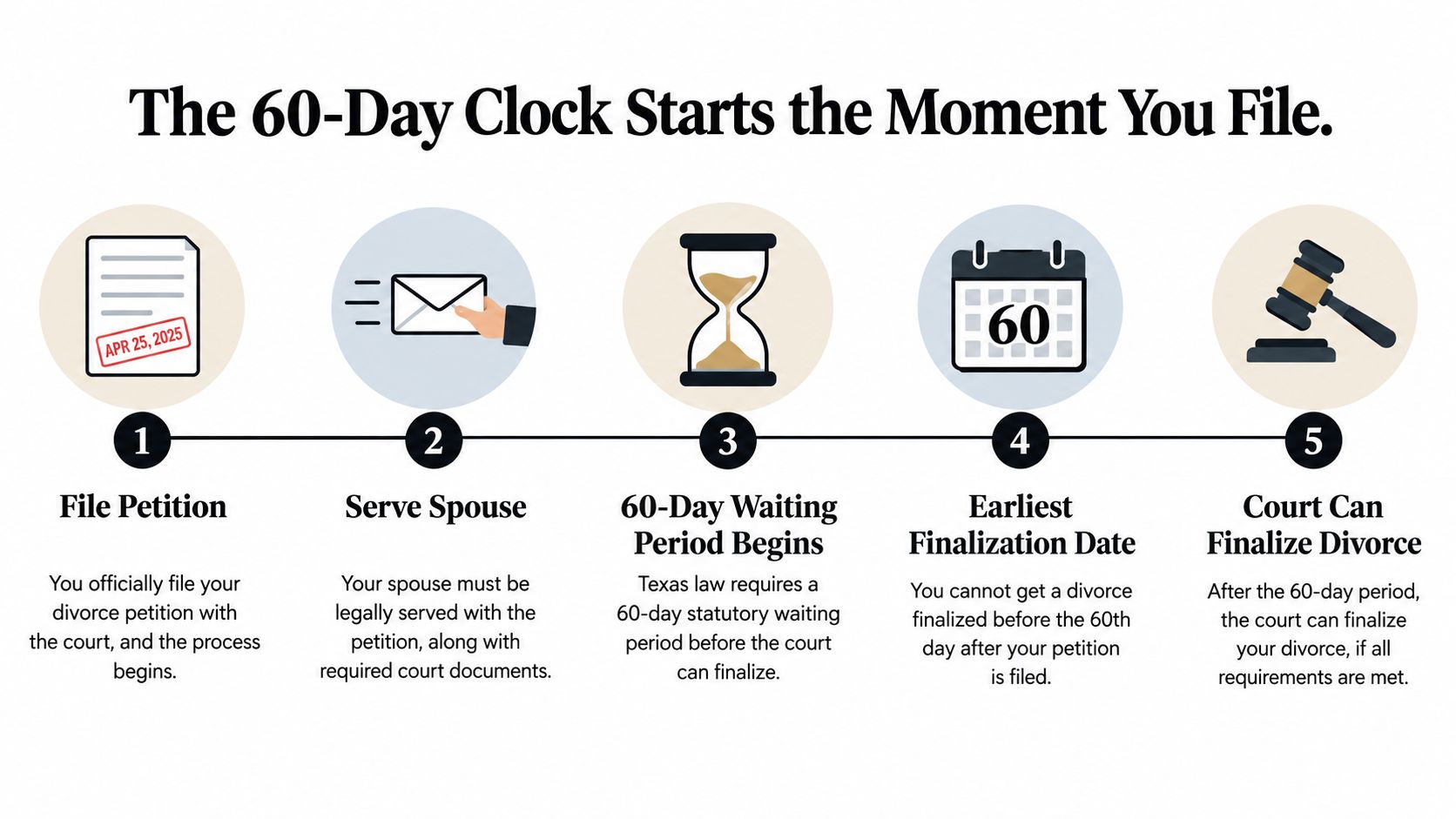
The 60-Day Clock Starts the Moment You File
You filed the Original Petition for Divorce, and now you're counting days. Do it correctly. In Texas, a court generally can't finalize a divorce until at least 60 days have passed after filing, and that waiting period is a minimum, not a promised finish date, under Texas Family Code section 6.702 on the divorce waiting period.
Counting begins the day after filing and includes weekends and holidays, and if the 60th day falls on a weekend or holiday, the case generally proceeds on the next business day, according to TexasLawHelp guidance on filing a divorce with children. Put the filing date and day 60 on your calendar today. Ask your lawyer to confirm both dates in writing.
What the 60 Days Do Not Do
Your marriage stays legally intact until a judge signs the Final Decree of Divorce. Filing alone doesn't divide property, set child support, or let you remarry. If you and your spouse can't resolve property, debts, conservatorship, possession, or support, a judge must decide those issues, and that work routinely pushes a case well past day 60.
Don't sit on those 60 days. Use them to gather records, request temporary orders if you need them, and decide whether you're negotiating or preparing for a hearing. In my experience, the spouse who treats this period as dead time starts behind.
The Two Family Violence Exceptions
The wait can be waived in narrow family violence situations. One exception involves a spouse who has been convicted of or received deferred adjudication for family violence against the filing spouse or a household member. The other involves an active protective order or a magistrate's emergency protection order because of family violence during the marriage.
Calendar rule: Day 60 is the earliest ordinary door, not the day the judge must sign anything.
If you think an exception might apply in your Kingwood or Humble case, raise it immediately, not at the final hearing. You still need a signed decree, and there's a separate waiting rule before remarriage that catches people off guard later. Get the dates right now, and you'll avoid a preventable reset.
Service of Process and the Other Spouse's First Moves
Filing puts papers in the courthouse. Service of process puts them in your spouse's hands, and until that happens, your case can't move forward in any meaningful way. You can't serve your own spouse. A process server, constable, or other authorized person delivers the citation and petition, then files proof with the court.
In an amicable Kingwood case, your spouse may sign a waiver of service. That's faster and less confrontational, but don't pressure anyone to sign one and don't sign one yourself without reading it. A waiver changes how notice works. Get advice before you use it to save a week and create a bigger problem.
The Answer and What Comes With It
After service, the respondent has a deadline to file an Answer, and missing it has consequences. An answer tells the court your spouse is participating. Your spouse may also file a counter petition asking for different relief on custody, property, or support.
- If you're the petitioner: Confirm service happened and ask when the answer is due.
- If you're the respondent: File an answer even if you think you agree on everything.
- If service is being avoided: Tell your lawyer promptly so you can discuss lawful alternative service options.
Don't ignore papers because you're hoping the case will go away. It won't. It will proceed without your input.
When Your Spouse Does Nothing
That's the default track, and it has its own timeline on top of the 60 day wait. A filed Return of Service must generally remain on file for at least 10 days before a default divorce can be completed, separate from the 60 day waiting period, with the day of filing and the court date not counted, as described in the TexasLawHelp default divorce process.
A sloppy or missing Return of Service stalls finalization in Harris County and Montgomery County cases alike. Confirm the service record with the district clerk early. For Porter and Northeast Houston clients, that one phone call often explains why a supposedly simple case isn't moving.
Filing Does Not Freeze Anything, Temporary Orders Do
This is the misconception I correct most often. Filing doesn't freeze joint accounts, guarantee support, stop a spouse from changing the children's routine, or decide who stays in the house. Texas doesn't recognize a separate legal separation status, so you need court orders to create enforceable rules while the case is pending, a point explained in the State Law Library guide to filing for divorce in Texas.
Temporary orders are that operating framework. A Texas court can issue temporary orders covering conservatorship, possession, child support, spousal support, exclusive use of the residence, bill payment, attorney's fees, and property preservation, as reflected in the Tarrant County temporary orders packet for divorce. They're not automatic. You have to ask, set a hearing, and bring evidence.
What Temporary Orders Can Address in a Texas Divorce
| Issue Addressed | What a Court Can Order | When It Matters Most |
|---|---|---|
| Children | Temporary conservatorship and a possession schedule | When parents can't agree on pickups, school nights, or holidays |
| Support | Temporary child support or spousal support | When one spouse controls most income |
| Housing and bills | Exclusive use of the residence and payment of household obligations | When both spouses claim the home or bills go unpaid |
| Property | Restrictions to preserve accounts and other marital property | When you fear sales, transfers, or drained accounts |
| Fees | Temporary attorney's fees | When one spouse can't afford counsel to participate fairly |
Picture a Kingwood spouse who controls the checking account, cancels a card, and announces the kids will now stay elsewhere during the school week. Without temporary orders, you're arguing by text message. With them, you have enforceable terms. Families working through those parenting terms sometimes consult a Child Custody Lawyer in Kingwood, TX for custody and conservatorship representation for Kingwood families.
A temporary restraining order is different. It's short term emergency relief to protect a person or preserve property, and it requires prompt follow up and a hearing. Read the distinction in our Kingwood guide to temporary restraining orders in Texas family law cases before you assume regular temporary orders move fast enough.
If there's immediate danger or threatened dissipation of assets, don't wait for a routine hearing date. Say so on the first call.
Gather pay records, account statements, messages about threats or schedule changes, and a list of monthly bills. That evidence is how a judge decides. Ask early, because informal arrangements are hard to enforce and delay usually favors the spouse who already controls the money or the house.
Discovery, Inventory, and the Financial Paper Trail
After temporary stability, the case turns to proof. Discovery is the formal exchange of information, and in a contested Texas divorce it's where settlements are built or blown up. You can't divide what you can't identify, value, or prove.
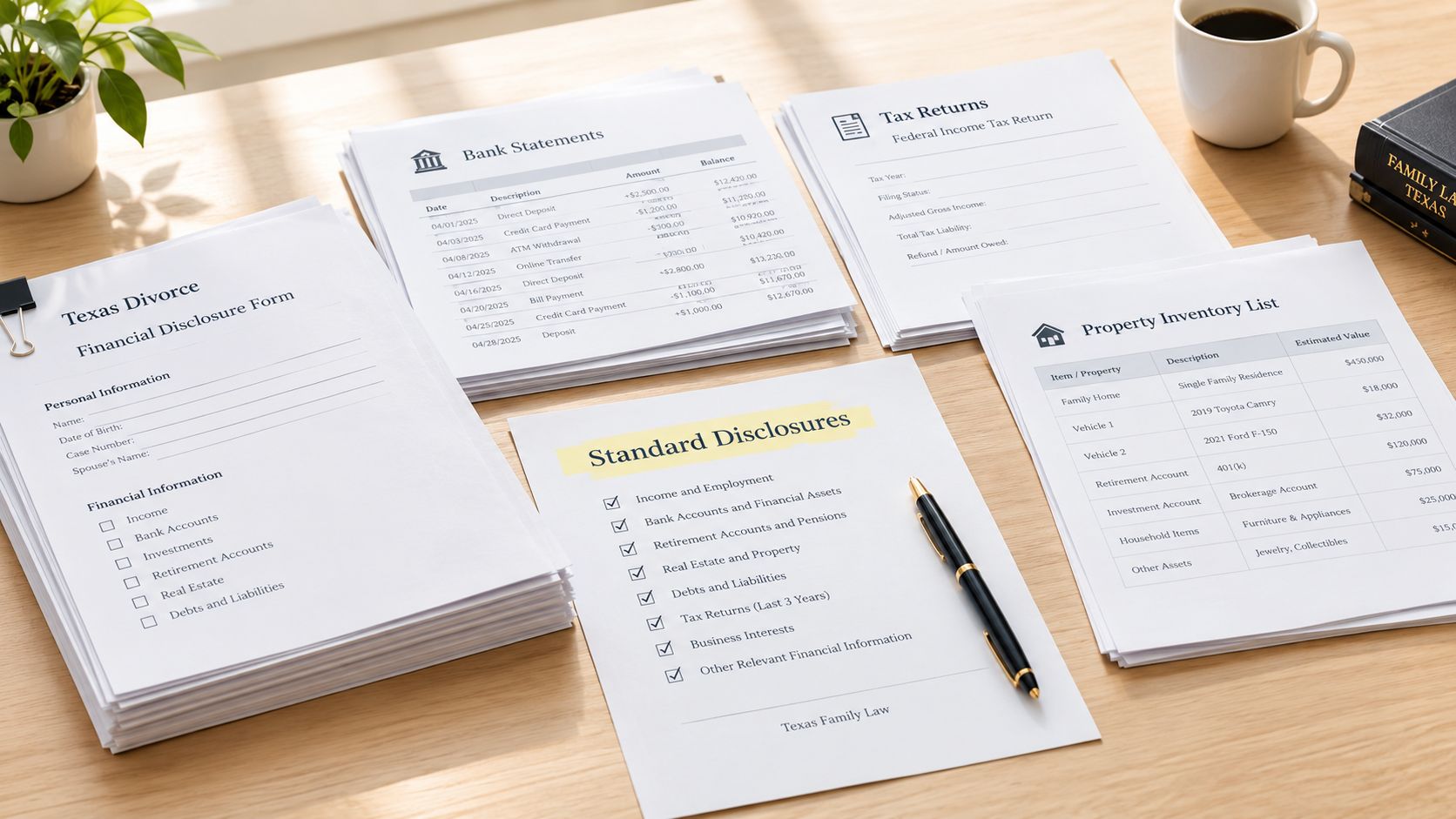
Each side may have to exchange a sworn inventory and appraisement listing separate and community property and debts, along with recent tax returns and bank records. Treat that inventory seriously. You sign it under oath, and gaps or low valuations will get challenged.
The image below shows the kind of financial file you should start building now, not the night before a deadline.
What the Records Actually Reveal
Bank and brokerage statements show transfers, cash withdrawals, and debt run up before filing. Tax returns expose income that doesn't match a pay stub, side business revenue, or rental property in Humble or Porter that never made it into conversation. Credit card records can show dissipation, meaning community funds spent for a non marital purpose while the marriage was breaking down.
Start with a simple folder system.
- Income: Pay stubs, bonuses, business records, and benefit statements.
- Accounts: Bank, brokerage, and retirement statements for every account you know about.
- Debts: Mortgages, auto loans, credit cards, and personal loans.
- Property: Deeds, titles, appraisals, and insurance policies.
Our plain language overview of discovery in a Texas divorce explains the tools lawyers use, from document requests to depositions.
If Your Spouse Stonewalls
Don't retaliate by withholding your own records. Document the requests, meet your deadlines, and let your lawyer seek a court order compelling production. Judges can impose consequences for discovery abuse, and a clean record on your side makes that argument stronger.
For Northeast Houston clients, my recommendation is simple. Over disclose to your own lawyer, organize early, and never guess at values you can document. Courtroom arguments rarely fix a weak paper trail.
Choosing the Path to a Final Decree
You have four realistic paths, and picking one is a strategy decision, not a personality test. Judge each option by cost, time, privacy, and control, and by whether your spouse can negotiate openly and safely.
The comparison below lays out those four paths side by side.
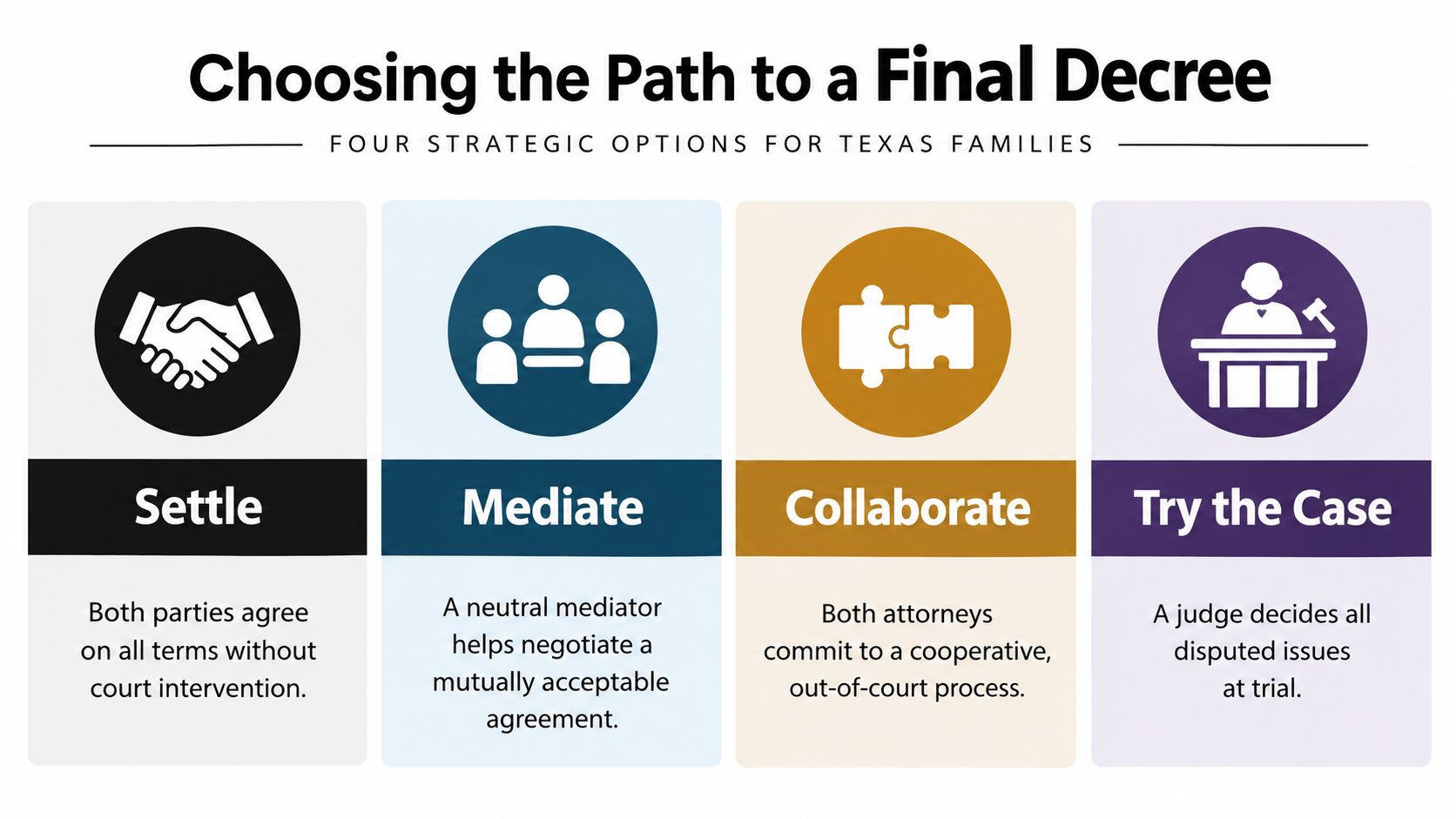
Negotiated settlement works when both spouses disclose finances and can compromise with counsel guiding the terms. It's usually the fastest and most private route, and you control the outcome instead of handing it to a judge who met your family that morning. For most Kingwood families, that's the best first goal.
Mediation adds a neutral mediator who helps you reach agreement but doesn't decide your case. It's often where stubborn custody or property issues finally move. Review how mediation for divorce works in Texas before you dismiss it as just another meeting. A mediated agreement you helped write usually holds up better in daily co parenting than an order imposed after trial.
Collaborative divorce is a structured out of court process where both sides and their lawyers commit to resolving the case without litigation, sometimes with neutral specialists. It suits spouses who want privacy and problem solving but need more support than mediation alone. It doesn't suit a case with hidden assets or coercion, because the process depends on voluntary transparency.
The short video below walks through how these resolution choices play out in practice.
Trial is the right tool when there's family violence, asset concealment, or a spouse who won't move on a child's safety. It's also the most expensive and public path. Recent reporting citing Martindale Nolo research places average United States divorce costs at about $11,300, with a median of $7,000, contested matters that settled averaging about $10,600, and cases reaching trial averaging $20,379 or more, according to a state by state report on the hidden cost of divorce.
Don't choose trial to punish your spouse. Choose it when the facts require a judge. Ask your lawyer directly which path fits your evidence, your budget, and your kids, and revisit that answer after discovery, because new records can change the strategy for Humble and Northeast Houston families too.
The Final Decree and the 30-Day Remarriage Rule
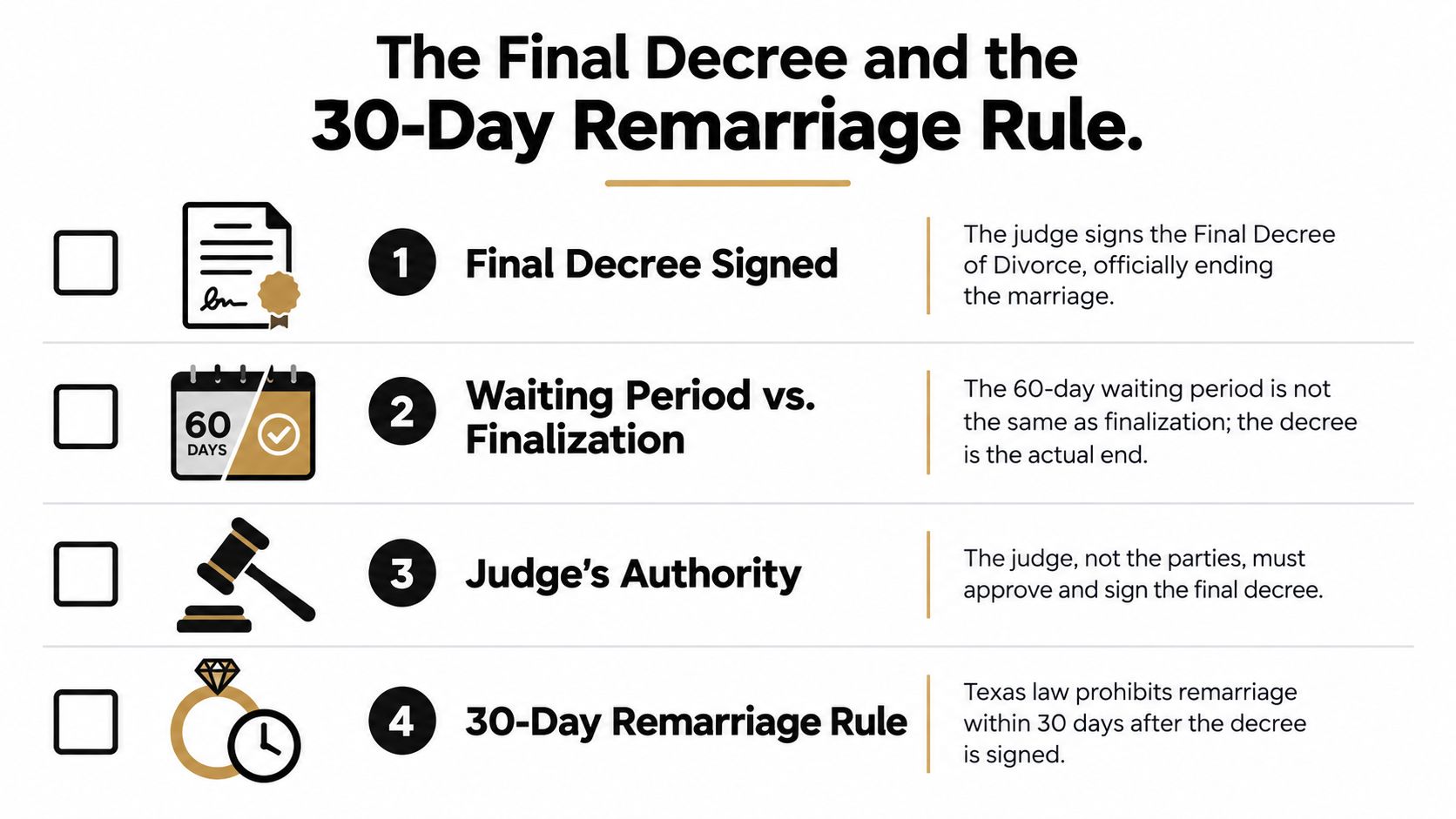
The Final Decree of Divorce is the document that ends your marriage. The waiting period expiring doesn't do it, handshake agreements don't do it, and temporary orders don't do it. The judge signs the decree, the signed decree gets filed with the clerk, and only then are you divorced.
Except in cases involving family violence, a court generally can't finalize the divorce until at least 60 days have passed after the petition is filed, and a person generally must wait 30 days after the judge signs the decree before marrying someone else, as explained in the State Law Library guide to finalizing a Texas divorce. Build that remarriage wait into any wedding plans. I've seen couples book venues before anyone checked the decree date.
The checklist below separates signing the decree from everything that must happen after it.
What Must Be in the Decree
A Texas decree should address division of community property and debt, conservatorship and possession of children, child support, and spousal maintenance when it applies. Texas courts provide Supreme Court approved forms, but the right forms and procedure differ depending on whether you have children, agree on all issues, or need a contested hearing, which is why the Texas Judicial Branch forms page organizes them by case type. Forms are a starting point, not legal advice for a Kingwood home, retirement accounts, and a parenting plan.
Read the proposed decree line by line before the hearing. Check names, property descriptions, account identifiers your lawyer advises including, deadlines, and who pays which debt. Errors are far harder and more expensive to fix after signing.
The Paperwork After the Judge Signs
Signing starts the clean up work. Retirement divisions may require a Qualified Domestic Relations Order, often called a QDRO, prepared and submitted to the plan administrator. Real estate may need deeds signed and recorded, vehicles need title transfers, and a spouse keeping the home may need to refinance if the decree requires it.
Notify insurers, employers, and lenders as the decree directs, and keep proof of every transfer. Clients finalizing cases with a Divorce Lawyer in Kingwood, TX receive divorce representation for clients in Kingwood and Harris County, but you still need to do your part on follow through. A clean decree only works if you execute it.
The Quiet Aftermath, Money, Kids, and the Decade Ahead
The financial hit doesn't wait for the decree. It starts when one household becomes two, with two rents or mortgages, duplicate utilities, and childcare that still has to be paid while the case is pending. That's why temporary orders and an honest budget in the first weeks matter more than optimistic talk about starting over.
The long term data are sobering. A United States Census Bureau working paper found mothers' average household income fell from roughly $90,000 to $100,000 before divorce to about $42,000 at divorce, recovered to approximately $60,000 after 10 years, and remained about 30% below the pre divorce average a decade later, in the Census Bureau working paper on divorce and household income. Those are averages, not a prediction for your Kingwood family, but they show why housing, insurance, taxes, retirement, and support decisions deserve real analysis.
Moves to Make During the Case
Decide, through agreement or temporary orders, who pays the mortgage, insurance, childcare, and minimum debt payments each month. Don't drain retirement accounts, close joint credit, change beneficiaries, or move money without legal advice, because a court may view those moves as dissipation or a violation of temporary restrictions. Document every payment you make for the children and the household.
Children feel the split in practical ways, from a move across Northeast Houston to less parental time during a workweek. Keep exchanges predictable, keep adult conflict away from them, and don't use support or possession as a bargaining chip. Those choices affect both your credibility in court and your child's stability at home.
Grief is part of this transition even when divorce is the right decision. If you're struggling to process the loss while managing the legal steps, this divorce grief counseling guide from Katy Teen & Family Counseling walks through common stages families experience after divorce. Legal planning and emotional support aren't competing priorities. For Humble and Porter parents, tending to both during the case usually leads to better decisions at mediation and fewer regrets after the decree.
Enforcement, Modification, and When to Call a Kingwood Attorney
A decree is enforceable, but it isn't self executing when someone decides to ignore it. If your ex spouse stops paying child support, refuses to return the children on time, or won't sign a deed the decree requires, don't improvise your own remedy. Withholding possession because support is late usually creates a second violation instead of fixing the first.
Keep a dated record of missed payments, late exchanges, and refused transfers. Save messages and receipts. Your lawyer can then evaluate enforcement tools, which may include income withholding, license related consequences for support arrears, or a motion asking the court to compel compliance and, in serious cases, hold a person in contempt. Bring the decree and your records to that conversation, because enforcement turns on clear language and clear proof.
When the Decree No Longer Fits
Child related orders can be modified when circumstances materially and substantially change, but the original decree controls until a court changes it. Job loss, a significant income shift, relocation, remarriage, or a child's changing medical or educational needs may justify asking for a change to conservatorship, possession, or support. A verbal agreement to do something different is risky, even when both parents mean well, because the signed order is what a court can enforce.
- Act promptly: Support changes generally don't rewrite the past, so delay can leave you owing under an outdated order.
- Don't move first and explain later: Relocation and school changes can trigger urgent court fights.
- Put agreements through the court: Get a signed modified order for Kingwood, Humble, or Porter families.
Call a Kingwood family law attorney when you're unsure whether you need temporary orders, when discovery reveals accounts you didn't know existed, when mediation stalls, or when compliance breaks down after the decree. Earlier advice is usually cheaper and gives you more options than a call after an account is emptied or a hearing is next week. Our Kingwood office offers a free consultation, and we'll give you a direct assessment of where your case stands and what to request next.
If you've filed in Kingwood, Humble, Porter, or Northeast Houston and you're unsure what to request during the waiting period, we can review your filing date, service status, temporary orders needs, and financial documents with you. Schedule a free consultation at our Kingwood office through Law Office of Bryan Fagan – Kingwood TX Lawyers and leave with a clear next step for your case.