You see a child-support deduction on your paycheck and wonder whether payroll got the amount right. Or you're the parent waiting for support that hasn't arrived, and you want to know how to collect it. For Kingwood, Humble, Porter, and Northeast Houston families, the next step isn't guesswork: compare the paperwork with the order, identify what kind of withholding is involved, and act promptly if something doesn't match.
What Child Support Garnishment Means for Kingwood Parents
Child support garnishment is the common name for taking support directly from a parent's income. In Texas, that usually means income withholding built into a child-support order, not a separate lawsuit to garnish wages. The court or the Texas Office of the Attorney General (OAG) can direct an employer to deduct support and send it through the payment system.

For a parent paying support, a deduction appearing unexpectedly can feel alarming. For a parent owed support, the same process can be a relief after payments have gone quiet. Texas generally treats withholding as the default collection method under Texas Family Code Chapters 154 and 158, so in many cases the payroll deduction follows from the support order itself.
A separate writ of garnishment is a different court process. It may be used as an additional collection tool, but it isn't the same thing as an income-withholding order sent to an employer. Knowing which document you're dealing with matters because the right response, deadlines, and parties involved may differ.
Start with the paperwork
Before challenging a deduction or asking for enforcement, find the support order and the Income Withholding for Support notice. Then compare the ordered amounts with the pay stub and payment history. The practical questions are straightforward: How was the deduction calculated? What notice should you receive? When can an employer stop withholding? Which income is protected?
The Law Office of Bryan Fagan represents both parents who owe support and parents seeking to collect it in Kingwood, Humble, and Northeast Houston. The focus should be the issue in front of you: whether the amount is correct, the order needs updating, or support needs to be enforced.
The Legal Basis for Wage Withholding in Texas
Your employer did not decide to dock your paycheck, and in most Texas cases the other parent did not have to file anything new to make it happen. Wage withholding is the default collection method built into the support order itself, so your first move after a deduction appears is to verify the amount against that order, not to assume someone started a fresh case against you.
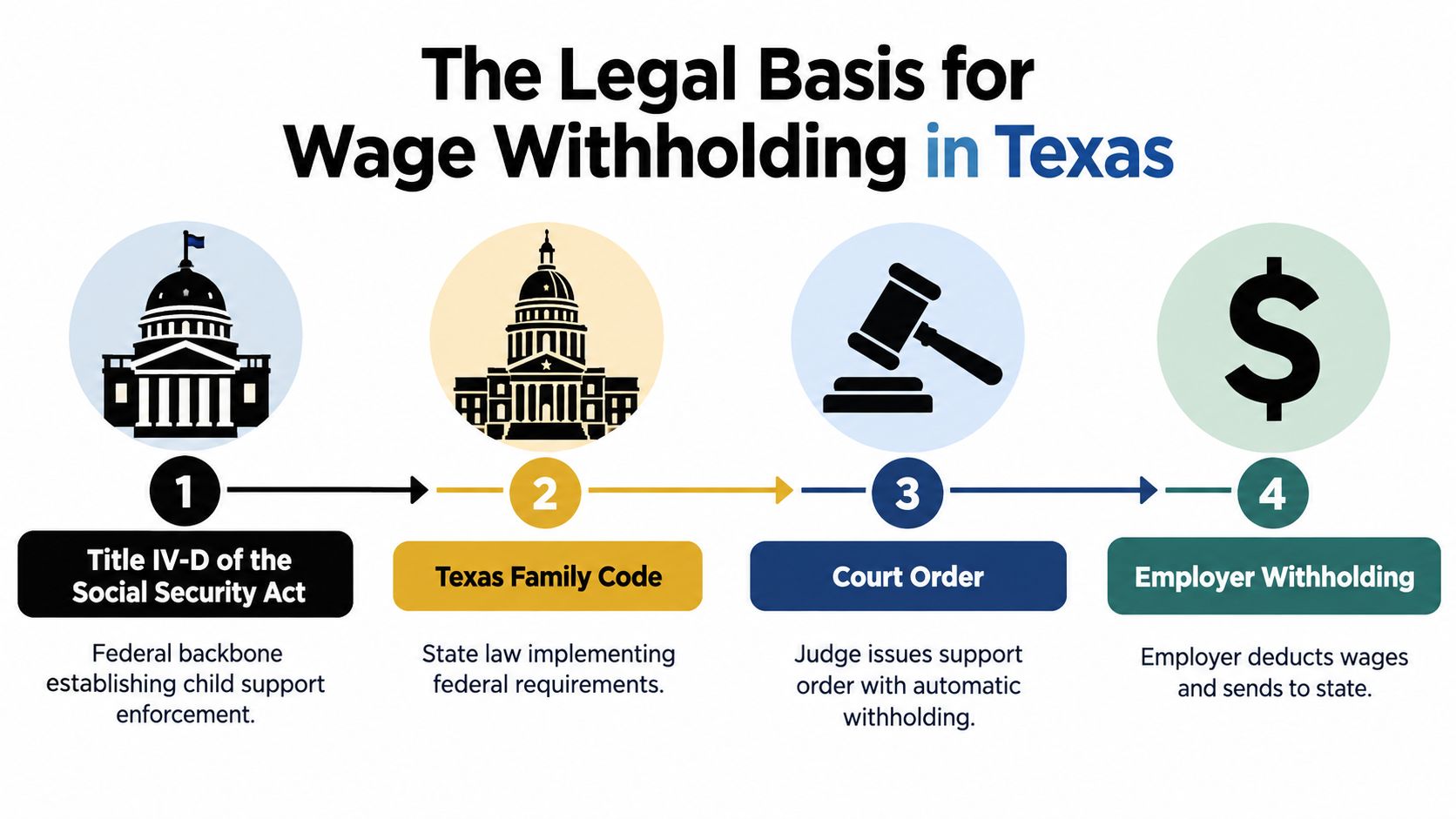
The federal side of this system was built in stages: the Social Services Amendments of 1974 created the Title IV-D child support enforcement program, the Child Support Enforcement Amendments of 1984 required states to set up income-withholding procedures, and later federal law made immediate withholding standard for new and modified orders. That history matters for exactly one reason. It explains why the deduction is automatic rather than something a parent has to request each time a payment is missed.
How federal rules connect to Texas orders
Federal law sets the framework. Texas fills in the working details through Family Code Chapters 154 and 158, which is where the document your employer follows comes from. The court or the Title IV-D agency orders withholding from the obligor's disposable earnings, the notice tells the employer how much to take and where to send it, and payroll handles the rest subject to applicable limits.
That split between federal and state authority is your first real decision point. If the deduction looks wrong, figure out which document controls it: the Texas support order, an income withholding notice, or paperwork from another state. Each has a different correction process, and arguing against the wrong one burns time you do not have. Whether the right fix is a modified order, an exemption claim, or a challenge to the withholding itself depends on getting that answer first.
Interstate cases add a layer. The controlling order may have been issued in another state, or your employer may receive withholding paperwork that crosses state lines. A Kingwood child-support attorney can identify which order controls before you file anything.
How a Writ of Garnishment Moves Through Texas Courts
A writ is a court-issued process, not just another name for the routine paycheck deduction in a support order. It may enter the picture when a parent seeks to reach funds held by a bank or use an additional court collection remedy after support is owed. The exact procedure depends on the facts and the type of asset involved, so don't assume a wage-withholding notice and a writ have identical requirements.
A typical sequence looks like this:
- An order and unpaid balance exist. The parent seeking collection or the OAG gathers the support order and payment information.
- An application is filed. The applicant asks the court for the appropriate writ or enforcement relief.
- The court process moves forward. If the request is granted, the writ is issued and served on the relevant third party, such as a bank or employer.
- The third party responds. The bank or employer follows the legal instructions, subject to applicable limits and procedures.
- A dispute may require court attention. If the obligor contests the action, the court may set a hearing to consider the issue.
For many Kingwood families, the more familiar route is an Income Withholding for Support order sent to the employer by the court or OAG. Private support orders can also include income-withholding language. That route is generally different from filing a separate writ application.
What each parent should watch
Consider a Porter parent who has missed payments and then learns that the employer received withholding paperwork. The parent who owes support should check the notice against the order and pay stub, then respond quickly if an amount or identity is wrong. The parent owed support should check the payment record and ask whether the funds are being sent to the correct account.
A writ doesn't erase the limits on what can be taken. If you've received a writ or want to enforce an order, get legal advice before a deadline passes. The firm's child-support enforcement information for Harris County outlines enforcement issues local parents may need to address. Families dealing with a separate CPS investigation can review CPS Defense Attorney in Kingwood, a resource describing defense against CPS investigations for Kingwood families.
Notice Requirements and Limits on What Can Be Withheld
A Kingwood parent opens a pay stub and sees a new child support deduction. Do not guess whether it is right. Ask payroll for the Income Withholding for Support order or notice, then compare three items line by line: the order amount, the employer's calculation, and the pay stub deduction. If the name, case number, amount, or start date looks wrong, put the objection in writing quickly.
Texas limits combined withholding for child support and certain other family-support obligations to 50% of disposable earnings under the cited rules. When multiple orders apply, the employer combines them but must follow the statutory maximum and priority rules. Current child support takes priority when the combined orders exceed the applicable ceiling; unpaid balances do not disappear just because withholding is capped. See the Texas Family Code provisions on withholding allocation.
Treat Texas and federal rules as separate checklists. An employer may cite a federal garnishment concept while applying the wrong Texas priority, or rely on take-home pay instead of disposable earnings. That is where mistakes start.
Disposable earnings are not the amount left after every deduction an employee chooses. Texas materials account for legally required deductions and qualifying nondiscretionary retirement contributions, along with employee medical, hospitalization, and disability insurance coverage for the employee and children. If the calculation looks off, audit the inputs, not the net pay.
Texas child support withholding limits at a glance
| Situation | Withholding Limit | Priority Rule | Verification Source |
|---|---|---|---|
| Child support and certain other family-support orders | Combined withholding is capped at 50% of disposable earnings; an employer that receives two orders must still stop at the ceiling and pay current support first | Current support receives priority when the combined amounts exceed the ceiling | Texas Family Code allocation rules |
| Multiple orders affecting the same employee | The employer combines the amounts, subject to the statutory maximum | The employer allocates payments under the statute | The withholding orders and Texas statutory rules |
| SSI income | SSI is exempt from child-support withholding | Do not treat SSI as wages available for garnishment | Federal review of SSI and child-support enforcement |
My recommendation is simple: keep the notice, order, and every pay stub in one folder. If the deduction is wrong, ask payroll to identify the calculation in writing and get legal advice before the next paycheck locks in the error. For wage-garnishment issues beyond child support, Lein Law Offices garnishment help offers a separate overview. For establishing, modifying, or enforcing support in Harris County, review the firm's Child Support Attorney in Kingwood page.
Exemptions, Income Sources, and How to Contest the Amount
Not every payment is protected just because it isn't a regular paycheck. Texas administrative guidance defines earnings broadly, including wages, commissions, bonuses, severance, independent-contractor compensation, pensions, annuities, workers' compensation, disability or retirement-program payments, and unemployment benefits. SSI is different: it's exempt from child-support withholding.
That distinction is important if you've changed jobs, received a bonus, or started receiving benefits. An employer may need updated paperwork after a job change, and interstate cases can involve different procedures. Don't assume another state's withholding cap applies just because your order was issued there. Ask a lawyer to identify the controlling order and applicable rules before you rely on a percentage or exemption.
Choose the right path
| Problem | Practical response |
|---|---|
| The deduction doesn't match the order | Compare the order, notice, and pay stub. Ask payroll or the issuing agency to identify the calculation. |
| Your income has changed | Request a support review or modification. Withholding itself doesn't automatically change the amount in the order. |
| The money is SSI | Document the income source and raise the exemption with the agency or court handling enforcement. |
| You've been served with a writ | Read the papers carefully, calendar deadlines, and get advice about how to contest the action. |
| You're owed support | Ask the OAG or your lawyer about enforcement options, which can include tax-refund interception, license-related remedies, contempt proceedings, and court-authorized collection against bank funds. |
To contest a deduction, gather the support order, withholding notice, recent pay records, and any payment history. Then contact the OAG in a IV-D case or the court handling the order and ask what written filing or hearing request is required. A parent owed support should also verify the balance and ask which enforcement tool fits the case rather than assuming wage withholding is the only option.
The Texas child-support calculation resource can help you understand the amount underlying an order. For questions about whether support can reach an account held by a business, Morgan & Morgan's discussion of LLC accounts and child support offers a related perspective. A Kingwood parent dealing with enforcement of divorce-decree or custody terms can also review Enforcement of Court Orders in Kingwood.
Stopping or Correcting a Garnishment in Kingwood
A garnishment can follow the paperwork and still leave a family in a difficult spot. Suppose a noncustodial parent loses a job in Porter, takes a lower-paying warehouse job in Northeast Houston, and finds that the original support amount now leaves too little for basic expenses. The wrong move is to ignore the deduction and hope the arrears sort themselves out. The right move is to check the numbers and promptly seek a review of the order.
Begin with an audit:
- Compare documents. Match the withholding notice against the order and each pay stub.
- Check the payment trail. Compare deductions with remittance confirmations and request an updated balance from the OAG or the private attorney handling the case.
- Update employment details. Report the job change quickly so the employer and issuing agency have accurate information.
- Request updated paperwork. A new employer needs the proper withholding notice. Don't rely on an informal conversation to change what payroll is required to do.
- Ask for a modification if the order no longer fits. A deduction doesn't itself revise the court-ordered support amount.
Errors have different fixes. Payroll can correct a calculation or data-entry issue when it has valid instructions. The OAG may be able to address certain administrative record problems. If the ordered amount itself needs to change, a court modification may be necessary. Keep copies of what you send and note who received it.
A federal oversight review found that in 8 of 49 reviewed withholding cases, or 16%, the amount entered for withholding differed from the court-ordered amount; recipient-address discrepancies appeared in 12% of cases (HHS Office of Inspector General review). That's why an order should never be treated as proof that every payroll deduction is accurate.
If a dispute involves enforcing or correcting an order, Badesha Law's court-order enforcement overview offers a related discussion of enforcement issues. For Texas parents, guidance on changing child support without going to court can help frame the question, but don't assume an informal agreement changes a court order. Get advice on the steps your case requires.
How a Kingwood Family Law Attorney Supports You
A child-support withholding problem calls for a practical review, not guesswork. An attorney can compare the order with payroll records, check how arrears are being allocated, identify whether an income exemption applies, and help request a modification when a parent's circumstances have changed. If a writ or contempt matter is pending, counsel can help you understand the filing requirements and prepare a response.
For a parent owed support, legal help can clarify the payment history and available enforcement options when payments stop. A parent paying support may need to determine whether payroll made an error, whether the OAG's balance is accurate, or whether the support order should be reviewed. In either situation, bring the actual documents. The order and pay stubs are more useful than a rough estimate of what happened.
The Law Office of Bryan Fagan serves Kingwood and nearby communities, including Humble, Porter, and Northeast Houston. Local knowledge matters when a case involves Harris County procedures, OAG records, job changes, commuting, and a household budget already under pressure. The firm handles family law and also provides estate planning, criminal defense, and civil legal services.
You don't have to figure out Texas withholding alone. Before you call, gather your support order, recent pay stubs, withholding notices, and any payment history or correspondence from the OAG. That gives the attorney a concrete starting point to review what's happening and explain your options.
The Law Office of Bryan Fagan – Kingwood TX Lawyers helps Kingwood-area parents review child-support withholding, pursue enforcement, and seek changes when an order no longer reflects their circumstances. Schedule a free consultation at the Kingwood office and bring your support order, pay stubs, and withholding notices for review. Visit Law Office of Bryan Fagan – Kingwood TX Lawyers to get started.