You're driving home to Kingwood after a night in Houston when flashing lights appear behind you. Maybe the stop began on Northpark Drive, or perhaps you were headed through Humble or Porter after work. If a prior DWI conviction already appears in your Harris County record, the new arrest can affect your freedom, license, finances, employment, and family responsibilities all at once. An arrest is still only an allegation, but you should treat the situation as urgent.
A DWI second offense in Kingwood, TX involves two separate legal tracks, the criminal prosecution and the Texas Department of Public Safety license process. The practical questions are immediate: What happens at the Harris County Jail, how quickly must you request an ALR hearing, when could an ignition interlock become part of your driving plan, and how can you protect your ability to work? This guide explains those issues in plain English for Kingwood, Humble, Porter, and Northeast Houston drivers.
Why a Second DWI in Kingwood Feels Different
The driver may have left a Houston Rockets game the night before and believed enough time had passed to drive safely the next morning. On Northpark Drive, an officer sees the vehicle cross a lane line and notices the odor of beer during the stop. The driver already has a Class B misdemeanor DWI conviction filed in Harris County. What may have felt like another traffic stop is now being reviewed as a repeat DWI case.
Texas generally treats a second DWI offense as a Class A misdemeanor, not a Class B misdemeanor. Under Texas Department of Transportation guidance, the charge can carry a fine of up to $4,000, a jail range of 30 days to 1 year, and driver's license consequences that can extend to 2 years. These penalties make a second case materially more serious than a first-time DWI. Texas Department of Transportation explains impaired-driving penalties.
The practical difference starts before trial
A Class A misdemeanor affects the bond conversation, the conditions imposed after release, and the strategy for preserving lawful driving. A judge or court may address ignition interlock installation, alcohol monitoring, treatment, reporting, and restrictions on travel or driving. An occupational license may become necessary for a person who needs to reach a job site in Humble, take children to school in Kingwood, or travel to a medical appointment in Northeast Houston.
The financial consequences also extend beyond the courthouse. Texas guidance states that a second-offense DWI can trigger an annual surcharge of up to $2,000 for 3 years to keep a license. Texas impaired-driving guidance discusses the Driver Responsibility surcharge. That obligation is separate from the court fine, attorney fees, interlock expenses, insurance costs, and other case-related charges.
A repeat arrest can also signal a need for support
A second arrest doesn't automatically prove alcohol dependence, and every case deserves an individualized legal review. Still, if drinking has become difficult to control, families may want to find structured alcohol addiction care through an appropriate treatment resource. Voluntary support can help address safety and health concerns, while legal counsel handles the criminal and license proceedings.
Practical rule: Don't wait for the first court date to understand the license deadline, bond conditions, and evidence issues.
The rest of this guide addresses the legal definition, penalties, ALR timeline, interlock logistics, Harris County procedure, and the steps a Kingwood driver should take immediately.
What Texas Law Says About a DWI Second Offense
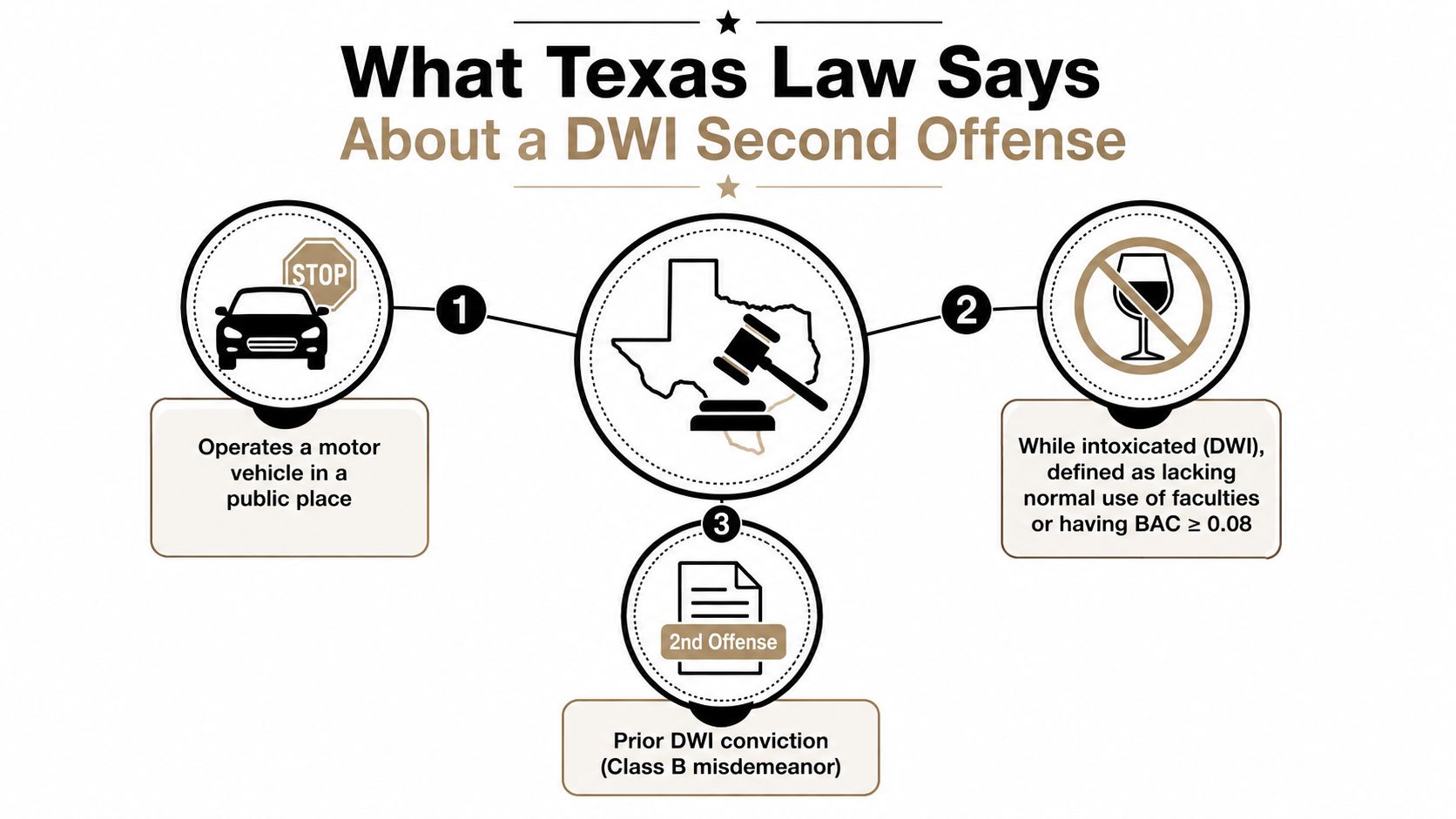
Texas prosecutors must prove the basic DWI elements before they can rely on a prior conviction to pursue a second-offense charge. In plain language, the state generally builds its case around three questions:
- Did the person operate a motor vehicle?
- Did that operation occur in a public place while the person was intoxicated?
- Can the state prove a qualifying prior DWI conviction?
Texas defines intoxication as not having the normal use of mental or physical faculties because of alcohol, drugs, or another substance, or having a blood or breath alcohol concentration of 0.08 or higher. The prosecution may use driving behavior, an officer's observations, field sobriety testing, breath evidence, blood evidence, and statements to support its theory.
How a Harris County case file develops
Consider a Porter or Humble driver leaving a refinery shift and traveling on Will Clayton Parkway. A Harris County prosecutor may review the reason for the stop, dashcam and body-camera footage, field sobriety instructions, the officer's observations, breath or blood results, and the paperwork proving the earlier DWI conviction. Each piece matters because the state must connect the evidence to the legal elements.
The prior conviction requires careful attention. The timing of the earlier case can affect how prosecutors classify the new charge, and Texas sources describe a 36-month period that can increase license consequences when the earlier conviction falls within that period. A Texas DWI defense resource discusses timing and second-offense license consequences. Out-of-state DWI convictions may also require review because the precise language, disposition, and legal equivalence matter.
Criminal prosecution and ALR are separate
The criminal case asks whether the person committed DWI and whether the prior conviction supports the enhanced charge. The DPS Administrative License Revocation process is a separate civil matter involving driving privileges. A driver can face both tracks at the same time, and a result in one proceeding doesn't automatically resolve the other.
An experienced Kingwood DWI lawyer examines the stop, arrest, testing, records, and prior-conviction proof separately. A mistake in the paperwork or an inaccurate description of the earlier disposition may affect the enhancement, even though it won't automatically erase the new arrest.
Criminal Penalties Compared to a First Offense
A first DWI and a second DWI don't carry the same classification or exposure. Texas guidance describes a standard second offense as a Class A misdemeanor, with up to $4,000 in fines, 30 days to 1 year in jail, and license consequences that may extend to 2 years. Review the firm's Texas DWI penalties overview for related information about how DWI consequences can affect a Texas driver.
| Penalty | First Offense | Second Offense |
|---|---|---|
| Classification | Generally Class B misdemeanor | Generally Class A misdemeanor |
| Maximum fine | Information varies by the specific statutory circumstances | Up to $4,000 |
| Jail exposure | Lower than a second offense | 30 days to 1 year |
| License consequence | Less severe than a repeat offense | Can extend up to 2 years |
| Ignition interlock | May be ordered in some circumstances | Often central to bond, license, or probation planning |
The important comparison isn't just the maximum numbers. A second case can change daily routines through interlock requirements, stricter community supervision, alcohol testing, treatment evaluations, and monitoring. A driver who commutes from Kingwood to Houston may need a carefully documented plan for work, school, childcare, and essential travel.
What a negotiated resolution may address
A defense lawyer may work to reduce jail exposure, challenge the enhancement, seek an occupational license, and negotiate conditions that the client can realistically follow. A court may also consider monitoring or treatment conditions, but the exact terms depend on the facts, the court, and the outcome. A second DWI conviction generally creates a more demanding supervision environment than a first case.
Harris County courts serving Kingwood, Humble, and Porter treat repeat allegations seriously. That doesn't mean the result is predetermined. Early review can reveal weaknesses in the stop, testing, identification of the driver, or prior-conviction paperwork before a client makes an irreversible decision.
The practical takeaway is simple. A second conviction can reshape work, transportation, finances, and family life for years, so legal strategy should begin before the evidence becomes harder to obtain.
What to Do Right After a Second DWI Arrest in Kingwood
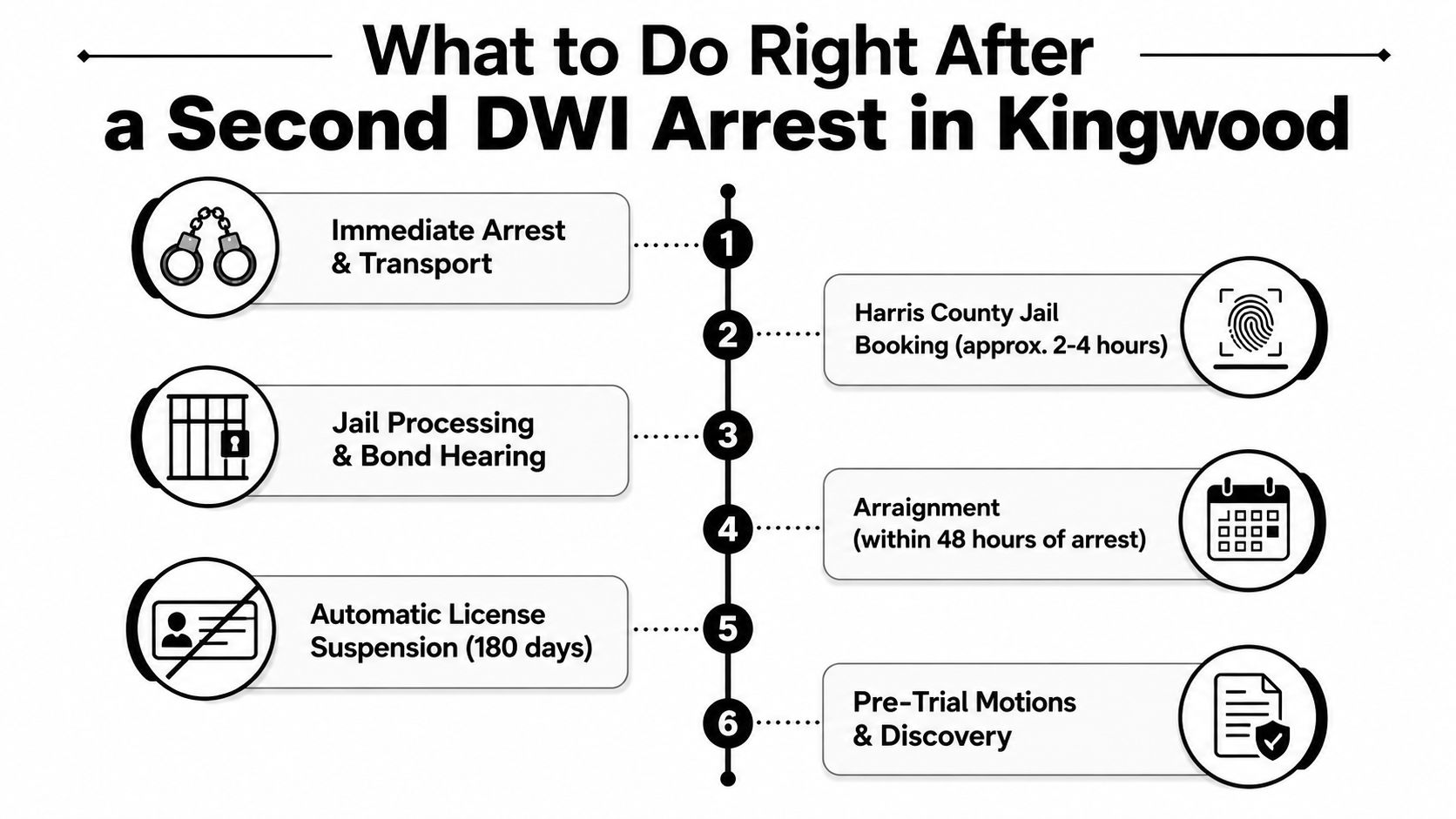
The first hours can feel disorganized. You may be transported for booking, processed through a Harris County facility, given bond paperwork, and told to appear in court without understanding which deadline matters most. The immediate goal is to preserve your rights and create a reliable record of what happened.
The first day
During booking and release, provide required identification information, but don't explain the facts of the stop to officers, friends who may repeat the conversation, or anyone posting online. Don't argue with jail staff, delete messages, or discuss the case on social media. Save every document, including the notice connected to your license, bond paperwork, court date, property receipts, and release conditions.
A Kingwood bondsman may help arrange release on a Class A misdemeanor bond. Before a family member posts property or signs an obligation, the family should understand the bond conditions, interlock requirements, travel limits, and next court date. Calling a lawyer before making that decision can prevent avoidable confusion.
Preserve details while they're fresh
Write down where you were, what you ate or drank, when you left, which roads you used, weather and road conditions, what the officer said, and how each field sobriety test occurred. If you can safely do so, photograph the location and surface conditions where testing happened. Keep receipts, phone-location records, passenger information, and vehicle-repair records that may help establish context.
The ALR deadline is urgent. Texas DWI materials state that the driver generally has 15 days from arrest to request an ALR hearing. This Texas DWI resource explains the ALR hearing deadline. Set phone reminders for that deadline and the arraignment date, then send the paperwork to counsel.
If driving privileges are at risk, review the requirements for an occupational driver's license after a DWI in Kingwood. Don't drive if your license has been suspended or your release terms prohibit driving.
Watch this general video only as background information, not as a substitute for advice about your arrest.
Today, physically gather your papers, write your timeline, preserve electronic evidence, and contact a Kingwood DWI lawyer before the first bond review or court appearance.
Common Defenses a Kingwood DWI Lawyer May Raise
A defense begins with the facts, not with a promise of dismissal. A driver stopped on Loop 494 may have a different issue from someone stopped on Northpark Drive after a medical episode or a confusing lane shift. The lawyer's job is to test each part of the state's proof.
| Defense Strategy | Prosecutor's Typical Counter |
|---|---|
| Challenge the traffic stop | The officer may point to a lane violation, speeding, equipment issue, or other observed basis |
| Question field sobriety testing | The state may rely on the officer's observations and video rather than the test alone |
| Examine breath-testing records | The prosecutor may argue the device and operator followed required procedures |
| Raise rising alcohol concentration | The state may argue driving behavior and other evidence show intoxication while driving |
| Contest the prior conviction | The state may produce certified records and argue the earlier case qualifies |
Stop and field sobriety testing
Suppose an officer follows a Kingwood driver through a poorly marked area near Loop 494 and initiates a stop after a brief lane movement. Counsel may examine whether the officer observed a traffic violation and whether road construction, lighting, or another vehicle explains the movement.
Field sobriety evidence also requires context. A person with a knee injury, balance disorder, eye condition, fatigue, or anxiety may not perform reliably on roadside exercises. The lawyer can compare the report with body-camera footage, instructions, surface conditions, footwear, weather, and the officer's scoring.
Chemical testing and timing
For a breath test, counsel may request maintenance, certification, calibration, and procedural records, including the relevant 30-day calibration log described in the defense strategy. A gap doesn't automatically invalidate a result, but it can create a question that requires technical review. Blood evidence raises different issues, including collection, labeling, storage, chain of custody, and laboratory procedures.
A Porter resident arrested after a late dinner may also have a rising-alcohol issue. If alcohol was consumed shortly before driving, the concentration at the time of driving may differ from the concentration later measured. That defense depends on the timeline, consumption evidence, testing interval, and qualified analysis.
Finally, the earlier case deserves its own review. Was it a juvenile adjudication, an out-of-state disposition, or a case resolved through a procedure that may not qualify as a prior conviction for enhancement? The answer depends on the records and governing law. For general information about possible DWI defense approaches, see how to get a DUI dismissed.
The Hidden Costs Beyond the Courtroom
A second DWI can affect a Kingwood household long after the court setting ends. A driver may be planning around the criminal case while also handling DPS requirements, insurance, vehicle technology, work interruptions, and treatment or supervision costs. Separating those obligations makes the household budget easier to understand.
The DPS surcharge and license planning
Texas guidance states that a second-offense DWI can lead to an annual surcharge of up to $2,000 for 3 years to keep a license, as noted in the Texas impaired-driving task force's explanation of DWI consequences. This charge is separate from the court fine. Ask counsel how it fits with a suspension, reinstatement requirements, and any occupational-license plan.
SR-22 insurance can add another layer. It gives proof of financial responsibility through an insurer, while a driver with multiple DWI convictions may face higher premiums or fewer coverage choices. The actual cost and filing period depend on the insurer and driving record, so request written quotes instead of relying on a general estimate.
Ignition interlock is a daily responsibility
An ignition interlock requires a breath sample before a vehicle starts. Depending on the court order or license arrangement, the driver may also have service, calibration, reporting, and compliance duties. A Kingwood driver commuting through Humble or Porter should identify an authorized vendor, confirm installation and monthly service charges, and arrange transportation if the vehicle is unavailable.
A failed sample, missed appointment, or irregular reading can raise questions with the court, probation officer, or DPS. Save the device report and contact counsel promptly. A single alert needs context, not a casual explanation.
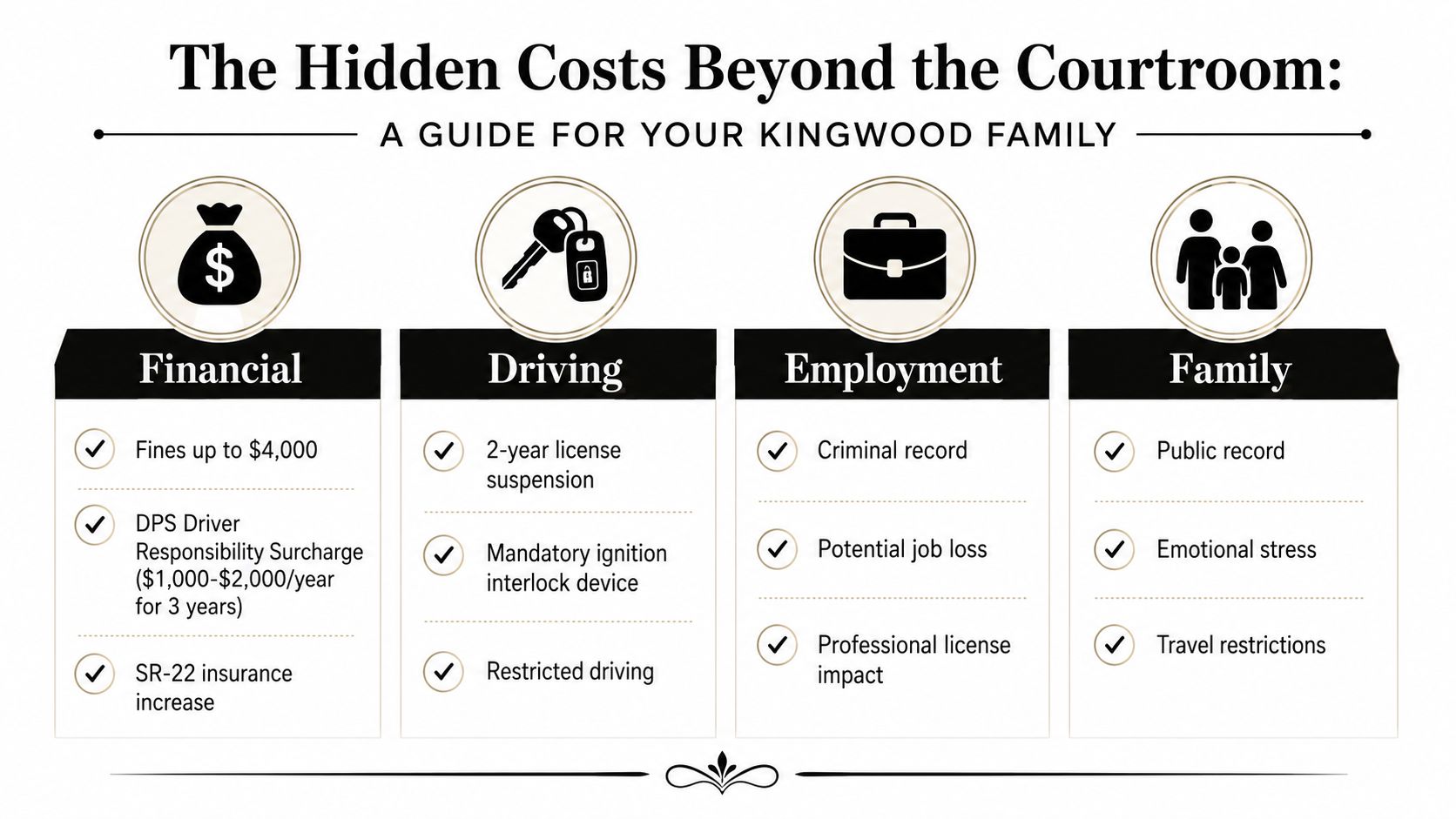
Family effects may include missed work, school transportation problems, limited vehicle access, background-check concerns, and difficult conversations with a spouse. A second DWI can strain a marriage; if that happens, the Kingwood divorce team can coordinate with the DWI defense so deadlines and court orders in one case do not undermine the other. Tell both lawyers about overlapping obligations.
Next, list every payment, driving restriction, appointment, and work conflict. Bring that list to counsel, along with any interlock or DPS notice, so the defense plan reflects daily life rather than only the courtroom charge.
How Harris County Courts Handle Second Offenses
A Kingwood DWI case may move through the Harris County criminal court system rather than a courtroom in Kingwood itself. The physical experience can involve downtown Houston facilities, prosecutors assigned to misdemeanor matters, repeated settings, and waiting for the court to call the case.
The early appearances
Magistration and bond usually occur shortly after arrest. The judge addresses release, bond conditions, and immediate restrictions. At the first formal court setting, the charge is identified and the case begins moving through the court's docket. A client may not need to speak at length, but attendance, appropriate conduct, and compliance with every order matter.
Dress conservatively. Arrive early, silence your phone, and expect that a setting may take longer than the actual conversation with the judge. The defense lawyer handles routine communication, explains whether the client must appear, and asks for bond modifications when a condition is unclear or unworkable.
Discovery and motions shape the case
Counsel should seek the evidence needed to evaluate the stop and arrest, including body-camera video, dashcam footage, 911 audio, field notes, breath records, blood records, and prior-conviction documents. Where applicable, the review may include Intoxilyzer 9000 records and related maintenance or calibration material.
Pretrial motions can challenge the traffic stop, field sobriety evidence, statements, or chemical testing. The lawyer may file a motion to suppress when the facts support it, then use the court's ruling to guide negotiations with the District Attorney's Office.
A dedicated DWI court program and a conventional misdemeanor docket aren't identical. A treatment-based program may require strict reporting, testing, classes, and compliance, while the standard track focuses on litigation, negotiation, or trial preparation. Eligibility and terms must be confirmed with the assigned court.
The timing of a plea or trial depends on discovery, motions, court availability, witnesses, and negotiations. A local Kingwood lawyer can reduce unnecessary travel by clarifying appearances and preparing the client for each setting.
Your Next Three Steps and How a Kingwood Lawyer Helps
A second DWI case isn't one problem. It contains the criminal charge, the DPS administrative license process, potential ignition interlock obligations, the $2,000 annual surcharge, and SR-22 insurance planning. Treating those tracks separately helps prevent one missed deadline from creating a new problem.
Preserve the evidence
Within the first 48 hours, ask counsel to preserve and request body-camera video, dashcam footage, 911 audio, breath or blood records, field notes, booking materials, and prior DWI documents. Write your own timeline before memories blur, but don't post it online or send detailed explanations to prosecutors.
Protect the license process
Request the ALR hearing in writing through the Texas Office of Administrative Hearings within 15 days of arrest. Keep proof that the request was submitted, and don't drive if your license is suspended or your release conditions prohibit driving.
Get advice before making admissions
Speak with a Kingwood DWI lawyer before discussing the case with prosecutors, a probation department, or treatment providers in a pre-plea setting. Treatment can be valuable, but the timing and wording of statements may affect the criminal case, bond, or supervision strategy.
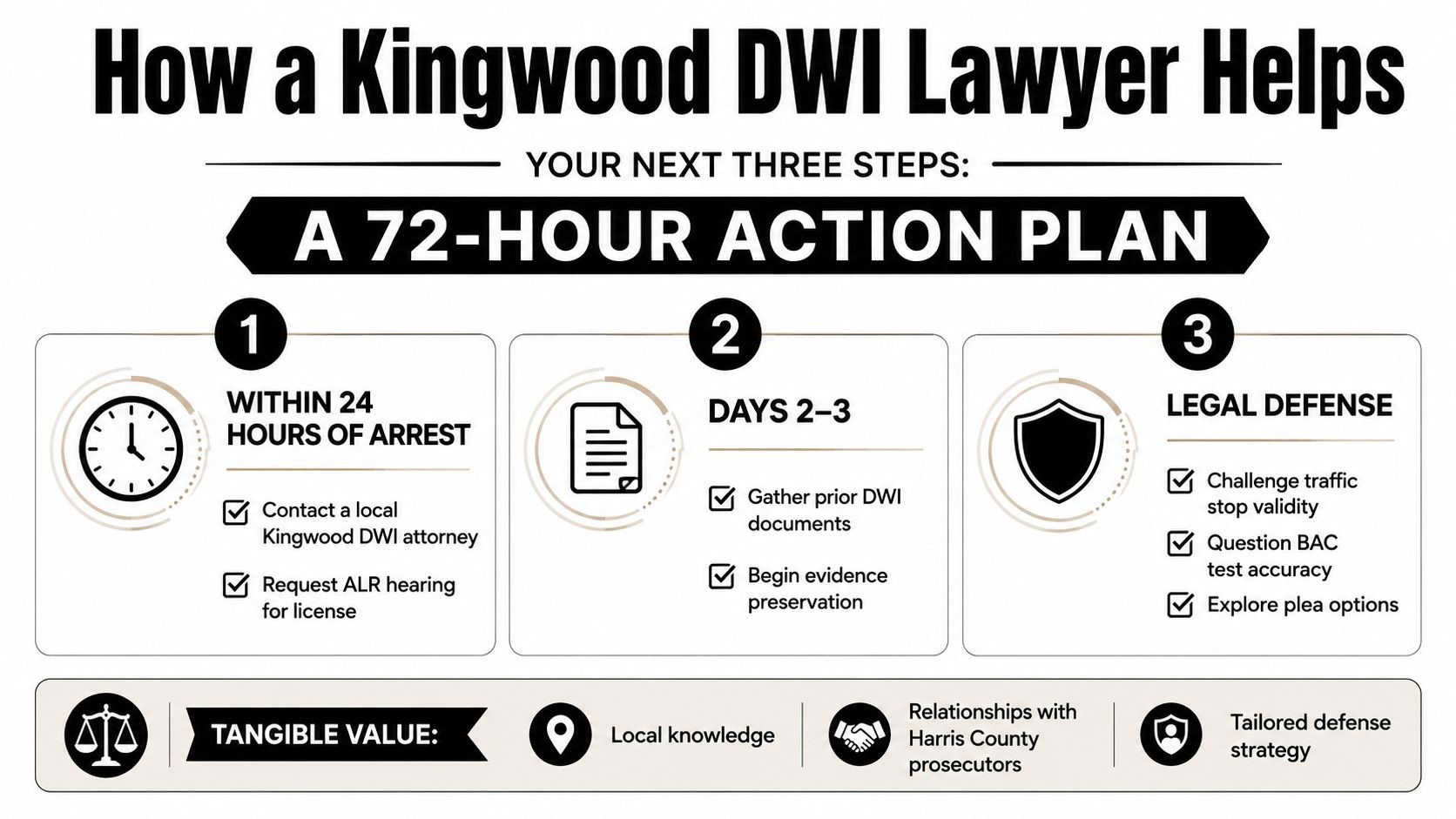
A local lawyer can review the file, identify suppression issues, communicate with the Harris County prosecutor, coordinate interlock logistics, and help plan license reinstatement and surcharge compliance. The Law Office of Bryan Fagan, PLLC, serves Kingwood and Northeast Houston clients with criminal-defense guidance alongside its family, estate, and civil-law services.
The Law Office of Bryan Fagan – Kingwood TX Lawyers offers local, client-focused representation for Kingwood, Humble, Porter, and Northeast Houston residents facing a second DWI and related license issues. Schedule a free, confidential consultation at the Kingwood office so an attorney can review your deadlines, evidence, bond conditions, and practical path forward with plain-English, no-judgment guidance.