A DWI can turn a normal Kingwood morning into a scramble. You may be staring at a suspended license notice and wondering how you're supposed to get to work in Humble, take your kids across Northeast Houston, or keep up with court dates without making things worse.
In Texas, an occupational driver license, often called an essential need license, can help in that situation. It's a restricted license for limited driving after a suspension, and Texas DPS says it is meant for essential needs like work-related travel. If you're trying to understand whether an occupational drivers license after DWI Kingwood TX is possible in your case, the safest way to think about it is simple. First, check eligibility. Then gather the right papers. Then file in the correct court and follow the order exactly once it's granted.
A clear starting point on legal intoxication limits can also help put the whole DWI process in context, and the legal alcohol limit overview from Tru Dallas Detox on legal limits is a useful plain-language resource for that background.
Your Guide to Staying on the Road After a DWI in Kingwood
If you're in Kingwood and your license is on hold, the pressure usually hits fast. Morning school drop-off still has to happen. Work still expects you on time. The bills don't pause just because the State has paused your driving privilege.
That's why people start looking for a legal path that keeps life moving without creating a new charge. A Texas ODL can be that path, but only if the court process is handled carefully and the order is specific to your situation. The license is limited, and it's not automatic.
What an ODL really does
A Texas occupational license is not a return to normal driving. It gives you a way to drive for essential needs, usually under strict conditions set by the court. For a Kingwood resident, that often means trying to preserve the ability to commute to Humble, reach school or court-required appointments, and keep household responsibilities on track.
The first question is never, “Can I drive today?” It's, “Am I eligible to ask for this relief under Texas law?” That distinction matters because the court and DPS treat the process as a legal remedy, not a convenience.
If you want more context on how a DWI penalty can affect the broader case, the internal guide on DWI penalties in Texas is a helpful companion.
Why local residents need a step-by-step plan
Kingwood, Porter, Humble, and Northeast Houston drivers often face the same practical problem, no car means no commute. Texas law does offer a path forward, but the order has to fit your driving reality. If your job starts early, your route needs to be spelled out. If you drive children to school or care for a household member, that needs to be explained clearly too.
The strongest ODL applications are not broad. They're specific, narrow, and easy for a judge to understand.
That's the mindset that keeps the process manageable. You don't need to guess. You need a plan, the right paperwork, and a court order that matches your real life.
Understanding Your Eligibility for an ODL in Texas
Before anything gets filed, you need to know whether Texas law gives you a path to apply. An occupational driver license, sometimes called an essential need license, is tied to your recent alcohol-related history and the type of suspension you're facing. It isn't a general hardship license for everyone, and it isn't left to local preference.

For DWI-related cases, Texas DPS says a 90-day wait can apply after a prior alcohol-related contact within 5 years, a 180-day wait can apply after a prior DWI conviction within 5 years, and a person with two or more DWI convictions in the preceding 5 years may have to wait one year after suspension before applying. Those time periods are grounded in state law treatment of repeat alcohol-related driving offenses, not in local discretion. You can read the state's explanation on the Texas DPS occupational driver license page.
How repeat history changes the timeline
Many individuals find this aspect confusing. They assume every DWI suspension follows the same schedule, but this is not the case. Texas considers the recent alcohol-related history leading to the suspension, and this history can establish a waiting period before you can seek relief.
If this is your first serious alcohol-related driving issue, your path may be very different from someone with prior convictions. That's why the details in your record matter so much. The court is looking at the exact legal posture of your suspension, not just the inconvenience it creates.
Why the third DWI changes everything
Texas crime records materials also show that the State tracks arrests, convictions, prior DWI history, and recidivism as part of a measurable statewide problem, not just a local one. In those materials, Texas law distinguishes misdemeanor and felony DWI for occupational-license purposes, and a third DWI is classified as a third-degree felony. That felony threshold can sharply limit or end occupational-license relief.
That's a major turning point for a Kingwood driver. A first or second DWI case may still leave room to seek an occupational license after the required wait and proper filing. A third case moves into a different legal category, so the analysis changes fast.
If you're trying to gauge where your case stands, the most practical next step is to compare your charge history with the waiting period rules before you spend time and money on paperwork. A Kingwood DWI lawyer can review that history and tell you whether you're looking at an immediate filing, a delayed filing, or no ODL path at all.
Gathering the Necessary Documents for Your ODL Petition
Once eligibility is on the table, the next challenge is paperwork. People often expect the hard part to be court, but the document set is where many applications fall apart. Texas law requires a verified petition, a proposed order, proof of financial responsibility through an SR-22 certificate, and a certified copy of the court order before DPS will issue the license.
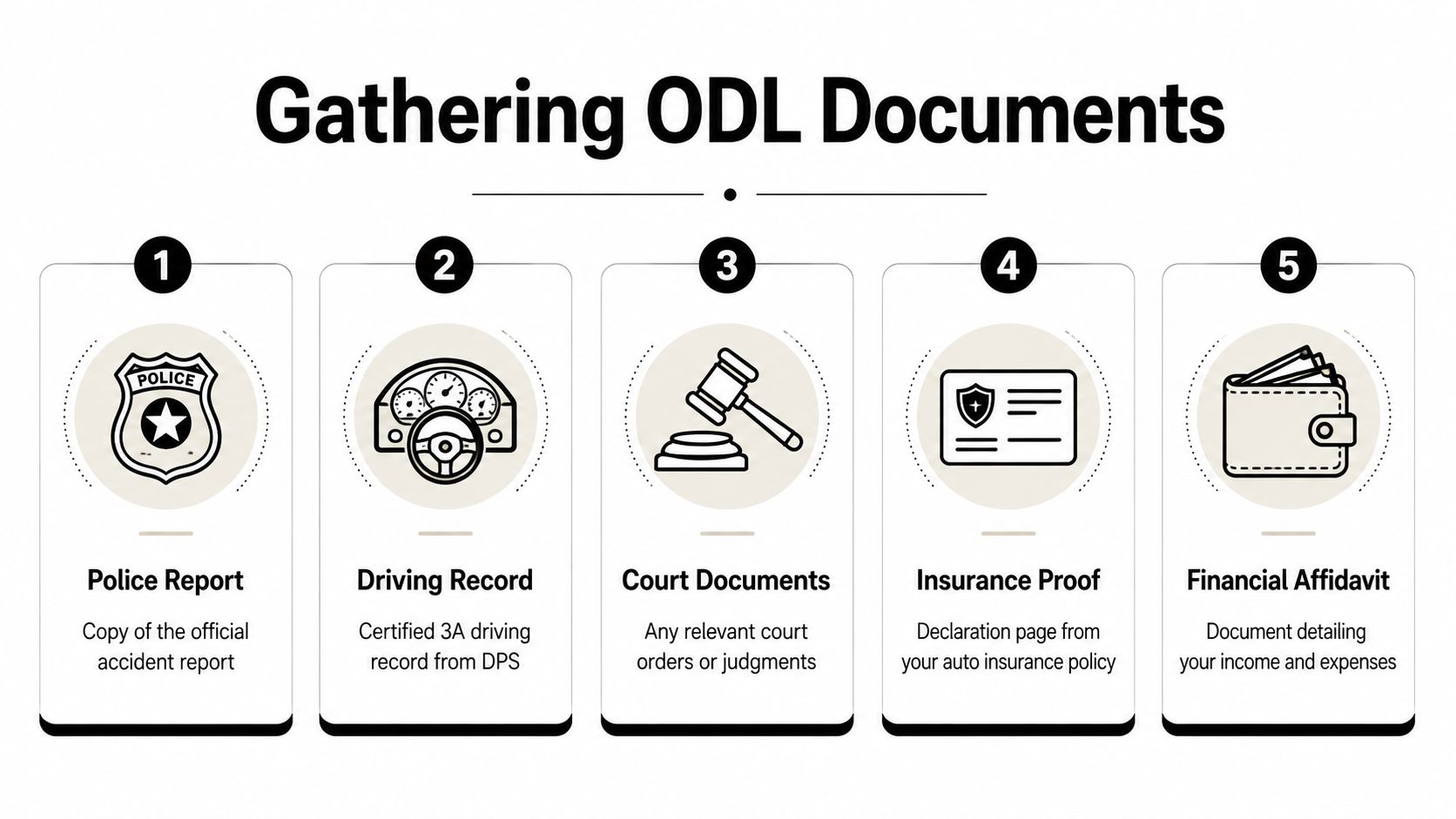
Texas legal guidance also notes that the DPS submission includes a $10 fee for the license, which means the process has two parts, court approval first, DPS processing second. The filing details are set out in the Texas DWI occupational license guide at Texas DUI Law Firm's explanation of the Texas process.
The documents that do the heavy lifting
A verified petition is the document where you explain why you need to drive and what limits you're asking the court to approve. A proposed order is the draft you give the judge, so the court can sign a version that spells out your permitted driving terms. The SR-22 is your proof of financial responsibility, and without it, the process stalls.
The certified copy of the court order matters because DPS won't issue the occupational license without the actual signed order in the required form. That part surprises people who assume a judge's oral approval is enough. It isn't.
Here's a practical way to organize the file:
- Verified petition: Your sworn request to the court, with the exact driving need stated clearly.
- Proposed order: The judge's draft order, ready for signature if the court approves.
- SR-22 certificate: Proof that your insurance meets Texas financial responsibility rules.
- Certified court order copy: The signed order DPS needs before it will process the license.
- Supporting records: Whatever your case needs to show your driving schedule, destinations, or household needs.
For local preparation help, the firm's page on what to bring to a consultation with a family lawyer in Texas is useful because the same discipline applies here, bring the key records, don't leave the court guessing.
If your case overlaps with family obligations, the existence of Enforcement of Court Orders in Kingwood can matter too, since Harris County courts often deal with exact compliance issues in divorce decree and custody order provisions. The same habit of precision helps in an ODL file.
Practical rule: If a document helps explain why you need to drive, include it early and label it clearly. Confusion creates delay.
Filing Your Petition and Preparing for the Hearing
The first filing rule is simple. For alcohol-related suspensions, Texas DPS says you must first contact your resident county court or justice of the peace court to begin the process, and DPS only issues the license after the court grants an order. So the court petition comes first, then DPS.
That order matters in Kingwood cases because the wrong filing path can stall you at the start. Harris County procedure can be unforgiving when a petition lands in the wrong court or leaves out a required attachment. A strong filing should state the exact counties, work or school destinations, household destinations, and driving hours, because that specificity helps the judge tailor a usable order.

What usually slows a case down
The common mistakes are predictable. Missing the SR-22. Filing in the wrong court. Forgetting a certified copy of the court order. Failing to account for an ignition interlock requirement in an alcohol-related suspension. Those errors are avoidable, and they're the kind of thing that can send a Kingwood resident back to square one.
The petition itself should also be narrow. A route plan that says “I need to drive anywhere I want” won't help. A route plan that identifies the job site in Humble, the household stop in Northeast Houston, and the exact driving hours gives the judge something concrete to sign.
What a hearing feels like
Some unopposed occupational-license requests are granted without a hearing if the petition is complete and local jurisdictional rules are satisfied. When a hearing is needed, it's usually direct and practical. The judge wants to know why you need to drive, where you're going, and whether your request is consistent with the suspension and any alcohol-related restrictions.
A court hearing doesn't have to feel dramatic. It should feel organized. If you've filed in the correct court, supported the petition with the right documents, and kept your requested driving terms tight, you've already done most of the work.
What to remember before filing
- File in the right court: The resident county court or justice of the peace court is where alcohol-related ODL requests begin.
- Use exact driving details: Counties, destinations, and hours should be specific.
- Expect court first, DPS second: The license doesn't start with DPS paperwork alone.
- Check interlock issues early: Alcohol-related suspensions often need that addressed in the order.
Navigating Life with Your New Occupational License
Getting the order signed is a relief, but it's not the end of the rules. An occupational license is for non-commercial driving only, and the court can specify exact driving times, places, and daily duration. Texas legal help materials also note that courts may limit driving to no more than 12 hours per day. That means a Kingwood resident commuting to Humble or Northeast Houston still has to stay inside the written limits of the order.

The safest habit is to treat the order like a map, not a suggestion. If your order says work in one county, school in another, and home in a specific area, stay there. If your hours are limited, plan around them before you start the car.
What the court can restrict
A judge can narrow the license by time of day, by destination, and by the amount of driving you're allowed to do each day. That gives you just enough room to function while the suspension is in place, but not enough freedom to treat it like an ordinary license. The restrictions are there to show the court that your driving is controlled and necessary.
For example, if your commute runs from Kingwood to a job in Northeast Houston, the route and hours need to match the order. If you decide to make extra stops that aren't covered, or drive outside the permitted window, you may put the license at risk.
Why compliance matters every single day
Violating an occupational order can lead to bigger problems than losing the privilege. It can create a new criminal issue and make it harder to regain full driving rights later. That's why the safest plan is to keep a copy of the order in the car, check the hours before each trip, and stay within the written limits.
Your occupational license protects only the driving the court approved. It doesn't protect extra stops, longer trips, or commercial driving.
That point matters for people in Kingwood, Humble, and Northeast Houston who rely on a predictable commute. Once the order is in place, the discipline is in following it exactly.
How a Kingwood DWI Attorney Can Streamline the Process
An occupational license case looks simple until you start filling out the forms. Then the details stack up fast, and every detail matters. Expert guidance emphasizes that successful petitions name the exact counties, work or school destinations, household destinations, and driving hours. It also warns about common mistakes like filing in the wrong court, omitting a certified court order, missing the SR-22, or failing to address interlock requirements.
That's where local representation helps. A Kingwood lawyer who works on DWI matters can match the petition to the suspension, prepare the proposed order, and keep the filing tied to the court that has authority over the case. In a process like this, clarity is practical, not cosmetic.
The Law Office of Bryan Fagan – Kingwood TX Lawyers handles criminal defense matters, including DWI, for local clients who need a measured, organized approach. If your case involves a suspended license after a DWI, that kind of local guidance can reduce the chance of a filing error or a missed requirement. You can read more on the firm's DWI lawyer in Kingwood, TX page if you want to understand how that support fits into a criminal case strategy.
What a lawyer can help organize
A careful attorney can line up the court packet, check that the driving limits are narrow enough to be approved, and make sure the paperwork reflects the actual travel needs of a Kingwood resident. That matters because judges respond better to petitions that are specific and complete. It also matters because DPS won't issue the license until the court order and supporting materials are correct.
The process can also touch family life in indirect ways. If you're already juggling custody exchanges, school runs, or court-ordered obligations in Harris County, a restricted driving order has to fit around those responsibilities without creating new violations.
For many people, a significant value of local counsel is peace of mind. You're not trying to guess which court to use or whether the order language is tight enough. You're getting help from someone who knows the process and can keep the case moving.
Schedule a free consultation at the Kingwood office if you need help with an occupational license after a DWI. A local attorney can review your suspension, explain whether you qualify, and walk you through the court filing so you can make the next decision with confidence.
If you're dealing with an occupational drivers license after DWI Kingwood TX, the Law Office of Bryan Fagan – Kingwood TX Lawyers can help you sort out eligibility, filing, and court order requirements in plain language. Visit Law Office of Bryan Fagan – Kingwood TX Lawyers to schedule a free consultation at the Kingwood office and get guidance that fits your case and your commute.