You're home in Kingwood, your phone is filling with missed calls, and you're trying to understand how a traffic stop on Northpark Drive turned into a felony DWI arrest. The immediate questions are practical and frightening. Will you lose your license? Can you keep your job? Will your family see you go to prison?
A felony DWI is not a misdemeanor DWI with a harsher label. The charge moves into a different court process, brings greater exposure to incarceration and fines, and can affect your driving privileges, employment, professional licensing, immigration status, and family relationships. If you're facing felony DWI in Kingwood, Humble, Porter, or Northeast Houston, you need a defense plan built around the actual evidence and the prior convictions the State is relying on.
When a DWI Stop in Kingwood Becomes Something Much Bigger
Consider a realistic Saturday night. A Kingwood resident is driving along Northpark Drive when a deputy stops the vehicle after observing a lane violation. The driver completes field sobriety tests, provides a breath sample, and is taken into custody. At the station, the person learns prosecutors are relying on an older DWI conviction from 2013 and another from 2018, including a probation-related record.
The handcuffs change the situation immediately. A stop that might have been handled as a misdemeanor now carries felony exposure because the State alleges qualifying prior DWI convictions. Under Texas Penal Code §49.09(b), a third or subsequent DWI is generally a third-degree felony, punishable by 2 to 10 years in the Texas Department of Criminal Justice and a fine of up to $10,000. The statute focuses on qualifying prior convictions, not merely the breath-test result. Texas transportation guidance on impaired-driving law explains the third-offense felony threshold and the punishment range.
Practical rule: Never assume an old DWI counts just because a prosecutor says it does. The State still has to prove that each prior conviction qualifies and can be used legally.
A felony arrest also changes where the case goes. Harris County sheriffs may transport the accused to the main jail for booking and processing rather than sending the matter through Kingwood Municipal Court. The case then proceeds through the Harris County felony system, where the District Attorney's Office reviews the evidence and the prior-history allegations.
Texas felony DWI law also covers crashes involving serious bodily injury and death. Statewide data helps explain why prosecutors treat those cases aggressively. In 2022, Texas recorded 24,589 alcohol-impaired driving crashes, 1,163 fatalities, and 2,513 suspected serious injuries, according to TxDOT's statewide crash comparison report.
The defense must therefore address more than intoxication. It may involve the legality of the stop, the reliability of testing, the chain of custody, the validity of prior convictions, bond conditions, and the separate license process.
The Three Ways Texas Turns a DWI Into a Felony
Texas typically reaches felony DWI territory through three distinct legal pathways. Identifying the pathway matters because each one requires the State to prove different facts.
Repeat DWI convictions
The repeat-offense route applies when prosecutors allege two qualifying prior intoxication-related convictions. A new DWI can then be charged as a third-degree felony under Penal Code §49.09(b), with 2 to 10 years of imprisonment and a fine of up to $10,000. Texas DWI law guidance identifies prior convictions as the trigger, rather than a BAC threshold alone.
The State must prove more than the existence of names and dates. Defense counsel should examine whether the earlier cases were convictions for qualifying offenses, whether the records identify the correct person, whether the prior court had jurisdiction, and whether the paperwork establishes the required connection. Out-of-state convictions and related intoxication offenses may require careful legal analysis. An old conviction doesn't automatically disappear from enhancement analysis, as illustrated by Texas appellate case law on prior DWI use.
Intoxication assault
Intoxication assault applies when intoxication causes serious bodily injury to another person. A fender-bender on Woodland Hills Drive might begin as a property-damage investigation, but the charge can become far more serious if a passenger suffers an injury that meets the statutory definition of serious bodily injury.
Texas treats intoxication assault as a third-degree felony, generally carrying 2 to 10 years in prison and a fine of up to $10,000. The charge can be increased further when the injured person is a qualifying on-duty firefighter, EMS worker, peace officer, or judge. Texas felony DWI defense information describes this offense and its aggravating circumstances.
Intoxication manslaughter
Intoxication manslaughter is the most severe of these three pathways. It arises when an intoxicated driver causes another person's death. A fatal collision on Kingwood Drive can therefore lead to a felony prosecution focused not only on intoxication, but also on operation, causation, and the circumstances surrounding the death.
The punishment classification and enhancements must be reviewed from the charging instrument and applicable statute. The possible consequences can exceed the standard third-degree felony range, especially when prosecutors allege prior felony convictions. A careful lawyer should never estimate exposure from the arrest label alone.
The distinction between criminal and family proceedings also matters when a child, custody arrangement, or support obligation is involved. For background on how family law cases proceed in the Harris County courts serving Kingwood, see Harris County Family Courts: A Kingwood Resident's Guide.
| Pathway | Statute | Felony Degree | Typical Trigger |
|---|---|---|---|
| Repeat-offense DWI | Penal Code §49.09(b) | Third-degree felony | Two qualifying prior DWI convictions |
| Intoxication assault | Penal Code §49.07 | Third-degree felony | Intoxication causes serious bodily injury |
| Intoxication manslaughter | Penal Code §49.08 | Felony prosecution | Intoxicated operation causes a death |
Felony DWI Penalties and Hidden Consequences in Texas
The punishment range is only the starting point. A felony DWI can continue affecting your life after court supervision or incarceration ends.
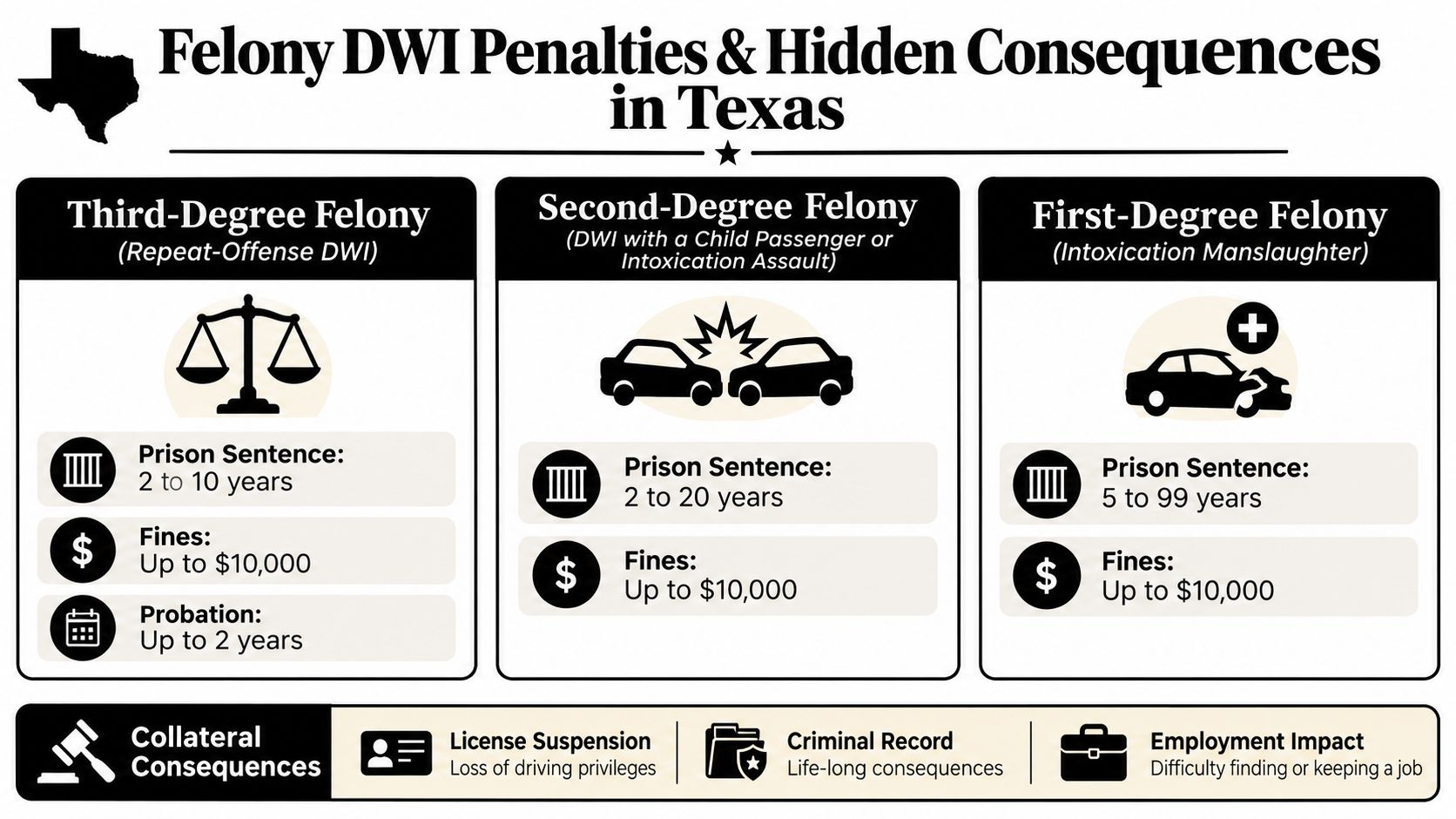
For a third-degree felony based on repeat DWI convictions, Texas law provides 2 to 10 years in prison and a fine of up to $10,000. Texas guidance on the third DWI confirms that this is the core punishment range. The sentence can become more severe when habitual-offender allegations apply. One prior felony may raise the punishment into a second-degree-felony range, while two sequential prior felonies can increase exposure to 25 years to life, according to Texas DWI enhancement guidance.
Intoxication assault carries the same 2-to-10-year range and up to a $10,000 fine, while its practical consequences may include an ignition interlock, license complications, treatment requirements, and restrictions on daily transportation. Intoxication manslaughter can bring a substantially longer prison range and may involve restitution issues connected to the victim's family. The exact classification and punishment allegations must be confirmed from the charging documents.
Consequences that don't appear in the headline
A felony conviction can affect voting eligibility and firearm rights under Texas criminal procedure rules. Employers may question the conviction, licensing agencies may review it, and noncitizens can face immigration consequences. Insurance costs can also rise after a DWI-related driving record problem.
License suspension is handled through a separate administrative process. That means a person can face license consequences even while the criminal case remains unresolved. The defense plan must protect both tracks, not just the felony docket.
For a detailed explanation of Texas DWI punishment issues, review the firm's resource on DWI penalties in Texas. The right outcome may be dismissal, reduction, probation, or a negotiated sentence, but none of those possibilities should be assumed before the evidence and prior convictions are examined.
How the Kingwood and Harris County Court Process Actually Works
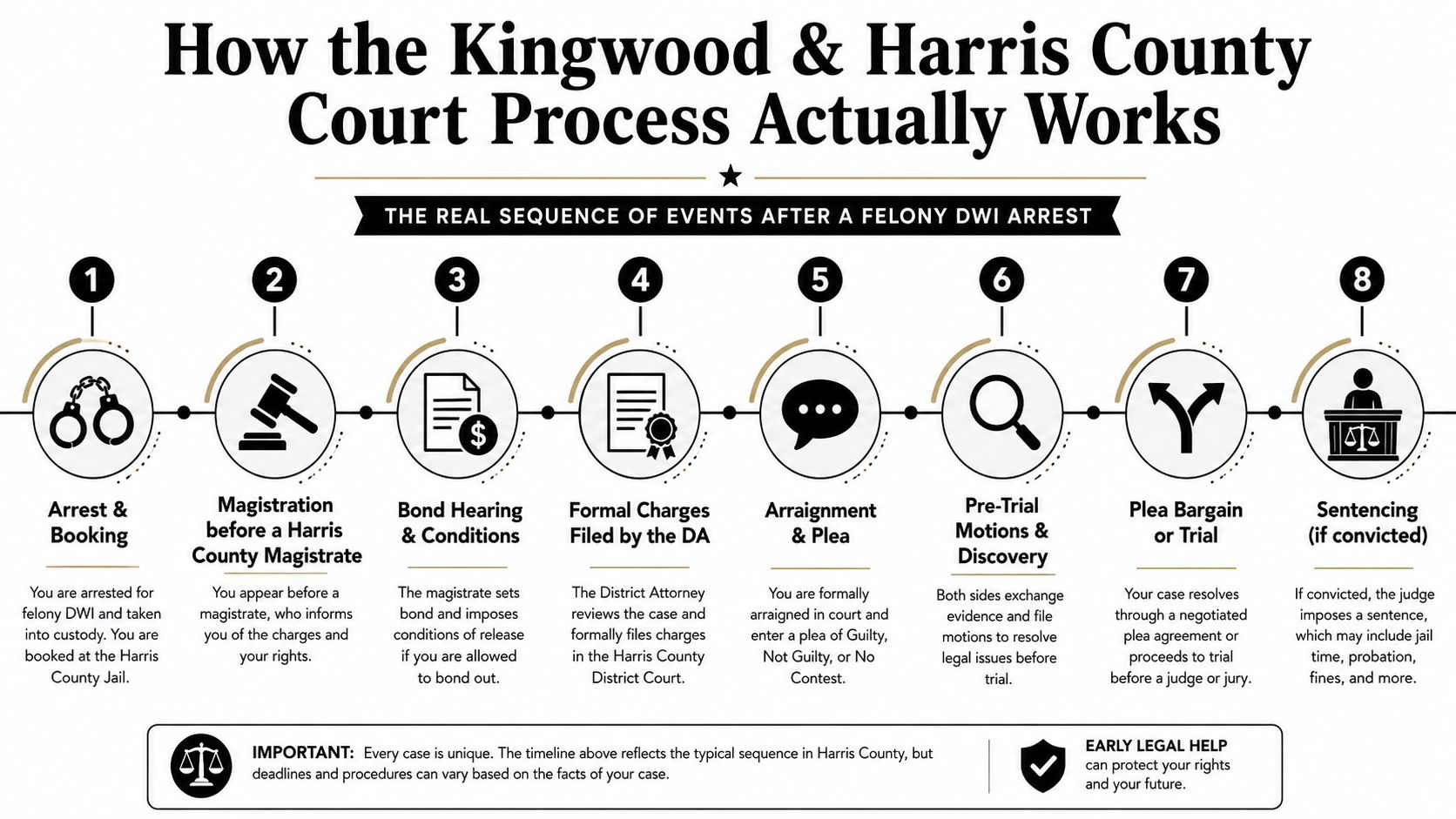
A felony DWI arrest in Kingwood doesn't stay in a local traffic courtroom. The process usually begins with arrest, transport, booking, and magistration before a Harris County magistrate. The magistrate addresses bond and release conditions, while the District Attorney's Office evaluates how to file and pursue the felony case.
Kingwood Municipal Court handles Class C misdemeanors and traffic matters. It isn't the court that handles a felony DWI prosecution. A felony case proceeds through the Harris County criminal court system, with the specific courthouse and courtroom depending on the filing and assignment.
What happens after release
After bond, the case moves through formal charging, arraignment, discovery, motions, negotiations, and potentially trial. The State may present the case for grand jury review before an indictment. Defense counsel should request and analyze reports, recordings, test records, witness information, and documentation supporting every prior conviction.
Common bond conditions can include an ignition interlock, alcohol monitoring, travel restrictions, reporting requirements, and no-contact terms in injury cases. Violating a condition can create a new problem and damage negotiations, so follow every condition exactly.
Pretrial motions may challenge the traffic stop, arrest, statements, blood draw, breath testing, or other evidence. The defense may also contest whether the State can prove the prior convictions that increase the charge. Plea discussions can happen while motions are pending, but a lawyer should understand the evidence before recommending any resolution.
The sequence differs from other Harris County matters. For example, Child Support Attorney in Kingwood addresses establishing, modifying, and enforcing child support in Harris County, while a felony DWI follows the criminal docket and its own procedural rules.
For broader background on courtroom stages, see the firm's guide to the steps in the criminal trial process.
Felony DWI Defense Strategies That Hold Up in Court
A strong defense starts by matching the legal challenge to the weak point in the State's proof. A person with a repeat-offense charge needs a different first move from someone accused of causing serious injury or death.
Stop and arrest challenges
The officer must have a lawful basis for the traffic stop. A lane violation may be disputed through dash-camera footage, roadway conditions, witness accounts, or the officer's written observations. If the stop lacked reasonable suspicion, a lawyer may seek suppression of evidence gathered afterward.
The arrest also requires legal justification. Statements made during custody, a blood draw, and test results may raise constitutional or procedural questions. The defense should examine whether officers obtained required warnings, warrants, consent, and documentation.
Scientific evidence review
Field sobriety tests can be affected by instructions, lighting, footwear, balance, medical conditions, fatigue, and stress. Breath evidence requires review of the device, administration, maintenance, operator training, and surrounding circumstances. Blood evidence requires attention to collection, storage, transfer, laboratory procedures, and chain of custody.
Prior convictions deserve their own investigation. The State must connect the records to the accused and establish that they qualify under Texas law. A defective judgment, missing sentence information, jurisdiction problem, or identity mismatch can affect the felony enhancement.
| Defense Strategy | What It Attacks | Typical Outcome |
|---|---|---|
| Traffic-stop challenge | Reasonable suspicion and officer observations | Suppression hearing, reduction, or dismissal if critical evidence is excluded |
| Arrest and statement challenge | Probable cause, custody, and warnings | Exclusion of statements or related evidence |
| Breath or blood review | Testing reliability and chain of custody | Weakened intoxication proof or stronger negotiation position |
| Prior-conviction challenge | Identity, jurisdiction, and qualifying-offense records | Possible reduction from felony exposure |
| Injury or causation challenge | Serious bodily injury or causal connection | Charge reduction or contested trial issue |
Necessity, medical necessity, and rising-BAC defenses can fit narrow fact patterns, but they aren't interchangeable defenses. Counsel should test whether the evidence supports one before presenting it to a Harris County prosecutor or jury.
People comparing diversion concepts in other jurisdictions may also find DUI diversion Orange County help useful for general background, but a Kingwood case must be evaluated under Texas law and Harris County procedure. The firm's discussion of how to get a DUI dismissed offers additional context on evidence-based dismissal strategies.
What to Do Right Now After a Felony DWI Arrest
The first hours matter. Don't try to solve the case by explaining everything to investigators or posting your version online.
In the first hours
Invoke your right to remain silent. Give identifying information when required, then state that you want a lawyer. Don't volunteer explanations, apologies, guesses, or statements about how much you drank.
Contact a Kingwood felony DWI lawyer. Ask counsel to review the arrest, bond paperwork, charging allegations, prior convictions, and license situation before you sign waivers or make strategic decisions.
Preserve the timeline. Write down where the stop occurred, what the officer said, which tests were requested, what you said, who witnessed the events, and when the arrest and testing occurred. Don't alter or embellish the account.
Save evidence. Identify witnesses, preserve photographs, retain medical records, and tell your lawyer about nearby businesses or vehicles that may have recorded the stop or collision.
In the next days
- Follow bond conditions exactly. Ignition-interlock rules, testing, reporting, and travel restrictions can affect continued release.
- Protect the license case. Ask counsel about the Administrative License Revocation process and the deadline for requesting a hearing. The criminal case and ALR case are separate.
- Avoid social media. Don't discuss the arrest, alcohol use, injuries, police conduct, or possible defenses in posts or messages.
- Protect work and licensing. If driving, a professional license, immigration status, or security clearance matters to your income, tell your lawyer immediately.
A confidential legal review should happen before the first major court decision. Early action gives counsel a chance to preserve video, request discovery, challenge testing, and address the prior-conviction allegations before the case becomes harder to defend.
Why Local Representation Matters for Felony DWI Charges
A Kingwood felony DWI case is handled under Texas law, but the practical experience occurs in Harris County courtrooms. Judges, prosecutors, defense lawyers, clerks, and court staff work within local procedures and expectations. A lawyer who regularly handles felony matters in the area can identify the assigned court, understand filing practices, monitor bond conditions, and respond when a hearing or motion is set.
Local access also helps the client. Kingwood and Humble residents can meet with counsel close to home, provide records quickly, and discuss employment or family concerns without treating the case as a distant file. That matters when the defense requires repeated review of video, lab records, prior judgments, and bond paperwork.
The Law Office of Bryan Fagan – Kingwood TX Lawyers handles criminal defense along with family law, estate planning, probate, and civil litigation. For a felony DWI client, the relevant issue is direct criminal-defense representation, clear communication, and a plan addressing both the charge and the consequences outside the courtroom.
A local lawyer can't promise a particular result. A local lawyer can make sure the case receives attention from someone who understands where it is filed and what must happen next.
Your lawyer should also know the practical details surrounding stops on routes such as U.S. 59 and Loop 494, while still testing the actual evidence rather than relying on assumptions. The goal is focused preparation, not a generic defense package.
Your Next Step With the Law Office of Bryan Fagan
The smartest move after a felony DWI accusation in Kingwood is to obtain a confidential case review before evidence disappears and deadlines pass. A lawyer should examine the charging instrument, offense report, testing records, bond conditions, and every prior conviction the State claims supports felony treatment.
The Kingwood office serves residents of Kingwood, Humble, Porter, and Northeast Houston. During a free consultation, ask which felony pathway prosecutors are using, whether the prior convictions qualify, what license deadlines apply, and which defense issues should be investigated first.
Don't wait for an indictment or a court date to begin. Early preparation preserves the opportunity to challenge the stop, question the testing, contest prior records, and negotiate from a position informed by the evidence.
The Law Office of Bryan Fagan – Kingwood TX Lawyers offers local felony DWI defense focused on protecting your liberty, license, record, and family stability. Schedule a free consultation by visiting Law Office of Bryan Fagan – Kingwood TX Lawyers and bring your arrest paperwork, bond conditions, and prior DWI information for review.