You're at the kitchen table in Kingwood, trying to answer a question that sounds simple: how do we make this adoption official? Maybe a foster placement call brought a child into your home. Maybe you're a Humble stepparent who has raised a child for years and wants to know when filing makes sense. Maybe a relative in Porter is caring for a child after a CPS case.
The difficult part usually isn't signing an adoption petition. It's choosing the correct Texas adoption path and putting termination, consent, the home study, filing, and finalization in the right order. Texas adoption law has developed through major changes, from the state's first adoption statute in 1850 to court approval in 1931, amended birth certificates in 1935, sealed original birth certificates in 1957, and limited adult adoptee access to original birth certificates beginning in 2005. Those changes help explain why adoption can involve records, names, sealed files, and post-adoption documents as well as a final decree. Texas adoption history and records law
For families in Kingwood, Atascocita, Humble, Porter, and Northeast Houston, the right legal sequence depends on the child's situation. This guide focuses on the local decision points that can determine whether a case moves smoothly or stalls in a Harris County courtroom.
Starting Your Lake Houston Adoption
A Kingwood couple may receive a foster-placement call and assume the adoption begins with filing paperwork. A Humble stepparent may sign a consent form and expect the case to be finished. Those assumptions can delay the case because Texas doesn't use one uniform adoption process.
The correct order depends on the situation. A relative may be caring for a child after a CPS matter. A newborn may be placed privately at a Houston-area hospital. A family may be responding to an international referral, or a stepparent may be seeking adoption after a divorce. Each path handles parental rights, notices, records, evaluations, and post-placement requirements differently.
Start by identifying the legal sequence before preparing the petition. In many cases, termination, consent, the home study, filing, and finalization must be addressed in a particular order. Filing before the required termination or consent work is complete can leave the judge unable to finalize the adoption. An incomplete birth-father search, outdated home study, or unresolved jurisdiction issue can also lead to a continuance, even when the adults agree.
Practical rule: Treat the adoption as a sequence of legal decisions, not as one filing event.
The order controls the outcome
A Lake Houston family should answer these questions first:
- What is the child's placement? Identify whether DFPS, an agency, a relative, a stepparent, or a private arrangement placed the child.
- Which parents have legal rights? Determine who may consent, whose rights may require termination, and whether notice or a parent search is necessary.
- What is the home study status? Confirm whether the study is complete, who conducted it, whether it applies to the proposed placement, and whether it remains current.
- Which court has authority? Review any earlier termination case, the child's circumstances, and Harris County filing requirements before submitting documents.
- What must be ready for finalization? Ask about updated reports, required consents, post-placement information, and the documents the judge will review before signing the final order.
Texas adoption figures include foster-care, private domestic, and intercountry matters, showing why families can encounter very different procedures. The statewide totals reported for recent years also demonstrate that adoption is not one single case type. Texas adoption volume and categories
Those figures do not predict what will happen in an individual Kingwood, Atascocita, Humble, Porter, or Northeast Houston case. They do reinforce the practical questions that should guide the first attorney meeting: whose consent matters, whether termination comes first, when the home study should occur, which records must be filed, how long each stage may take, and which costs may be avoided or reimbursed.
Choosing the Right Texas Adoption Path
The adoption path determines what must happen first in a Lake Houston case. A stepparent adoption may begin with consent or termination of the other parent's rights. An agency or private placement may require coordinated birth-parent paperwork and hospital planning. A relative or kinship case may depend on CPS records, placement history, and an earlier court order.
| Adoption Type | Who Files | Home Study | Termination or Consent |
|---|---|---|---|
| Stepparent | Stepparent, often with the biological parent | A study is generally required, with procedures that may depend on the case | The other parent's rights must be addressed through consent or termination |
| Agency | Agency placement with adoptive parents filing the petition | Agency or authorized study process | Agency and birth-parent consents or terminations must be valid |
| Private domestic | Prospective adoptive parents, often after a private placement | Licensed or authorized study generally required | Relinquishment, consent, or termination must address each required parent |
| Relative or kinship | Relative or caregiver files, sometimes after DFPS involvement | Study requirements still apply, with case-specific procedures | Existing parents' rights must be addressed, often alongside a CPS case |
Stepparent adoption
A stepparent in Humble, Kingwood, or another Lake Houston community may already be raising the child. That relationship does not remove the need to resolve the other parent's legal rights. The case may proceed by consent, or it may require a contested termination proceeding before the adoption petition can reach finalization. Review the Texas stepparent adoption questions and consent rules before assuming the process will be routine.
Texas law gives older children a direct role in certain cases. In a stepparent adoption, a child 12 or older generally must provide written or in-court consent. If the adoption changes the child's name, a child 10 or older must also consent to that name change in writing.
Agency and private adoption
Agency adoptions involve an organization that may arrange the placement, coordinate consents, maintain records, and provide post-placement services. The adoptive parents still file the petition, but the agency's work affects which documents and approvals must be ready.
Private domestic adoption, sometimes called independent adoption, involves a direct placement arrangement. Plan early for the Texas Family Code requirements, birth-parent rights, hospital procedures, and the birth father's legal status. The order matters. Consent and release arrangements should be addressed before filing, while the home study and supporting records must be ready for the court's review.
Do not treat an uninvolved birth father as irrelevant. His identity, notice, consent, or possible termination must be evaluated. A Houston-area delivery also requires coordination among the hospital, agency, attorneys, and prospective parents so release planning does not become an emergency.
Relative, kinship, and foster-to-adopt cases
A relative caring for a child after DFPS involvement may need CPS records, placement documentation, and information from an earlier termination proceeding. Foster-to-adopt cases run through DFPS, not through a private attorney. Public-system adoptions represent a distinct category of Texas cases, with procedures that differ from private placements.
Interstate and military circumstances add another layer. A placement involving a child or parent outside Texas may require ICPC clearance before the child crosses state lines. A military parent stationed away from the area, including a deployment connected to Fort Cavazos, may require careful service and scheduling arrangements.
The filing sequence should be confirmed before anyone signs or submits documents. Depending on the case, the practical order may involve termination, consent, the home study, filing, and finalization. For a broader explanation of the rights-ending stage, review termination of parental rights in Texas. The adoption petition cannot replace a valid resolution of parental rights.
Building the Adoption Case
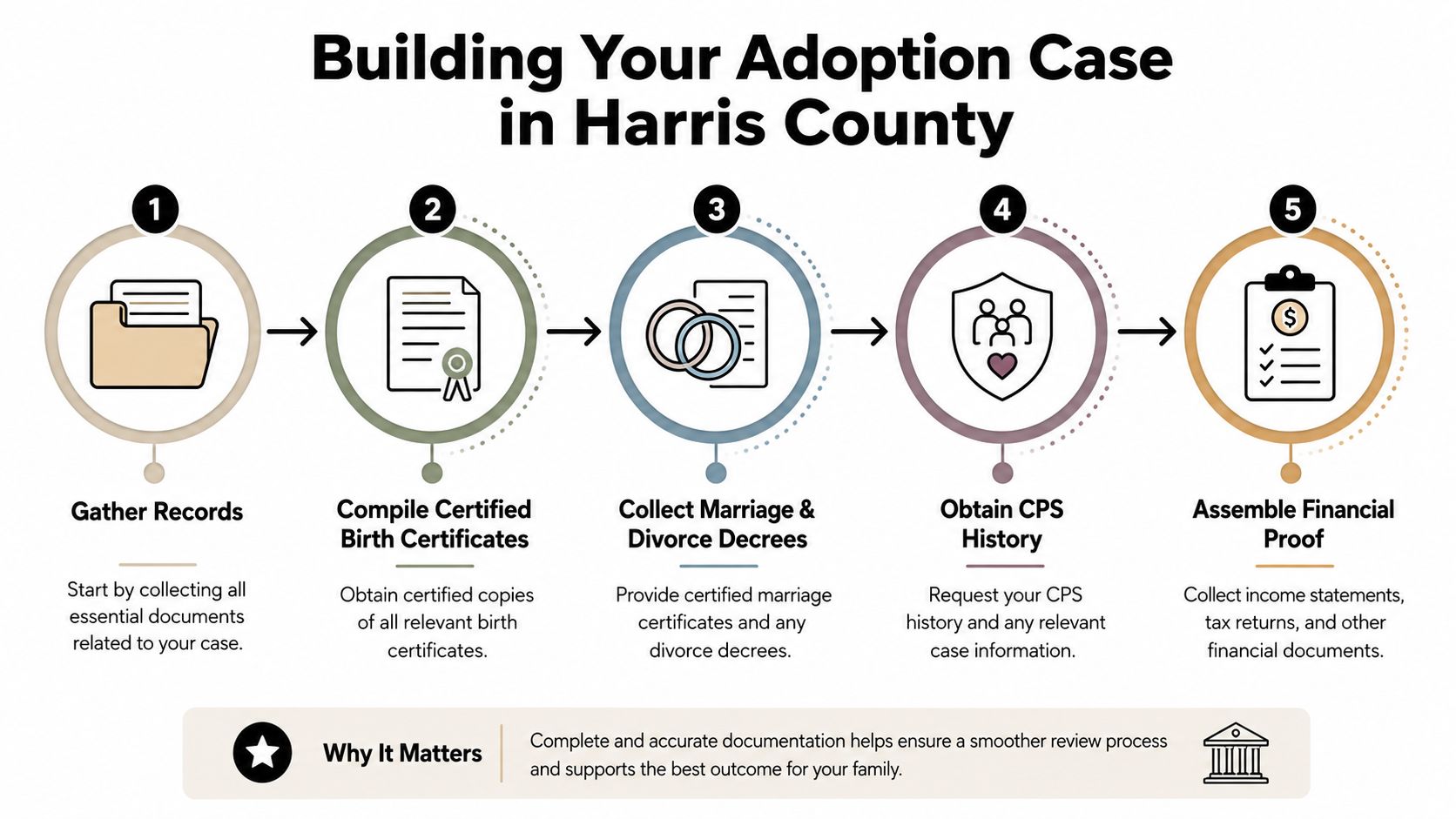
A well-prepared Harris County adoption file answers the judge's questions before the final hearing. Start with records, not assumptions. Gather certified birth certificates, marriage and divorce decrees, CPS history, prior termination orders, placement documents, and identification records for everyone whose legal status affects the case.
Assemble the documents first
Create a shared folder, paper file, or secure electronic checklist. Include:
- Certified birth certificates: Obtain the child's certificate and the relevant parent records required for the petition.
- Marriage and divorce records: Collect documents that establish the stepparent relationship or explain a prior family-law order.
- CPS and placement history: Request records connected to a DFPS or CPS case and identify missing reports early.
- Termination orders: Locate every prior order involving the child's parent-child relationships.
- Household information: Prepare employment, residence, medical, financial, and family-history information for the home study.
- Birth-father information: Record known names, addresses, possible relatives, and any facts relevant to the registry or service process.
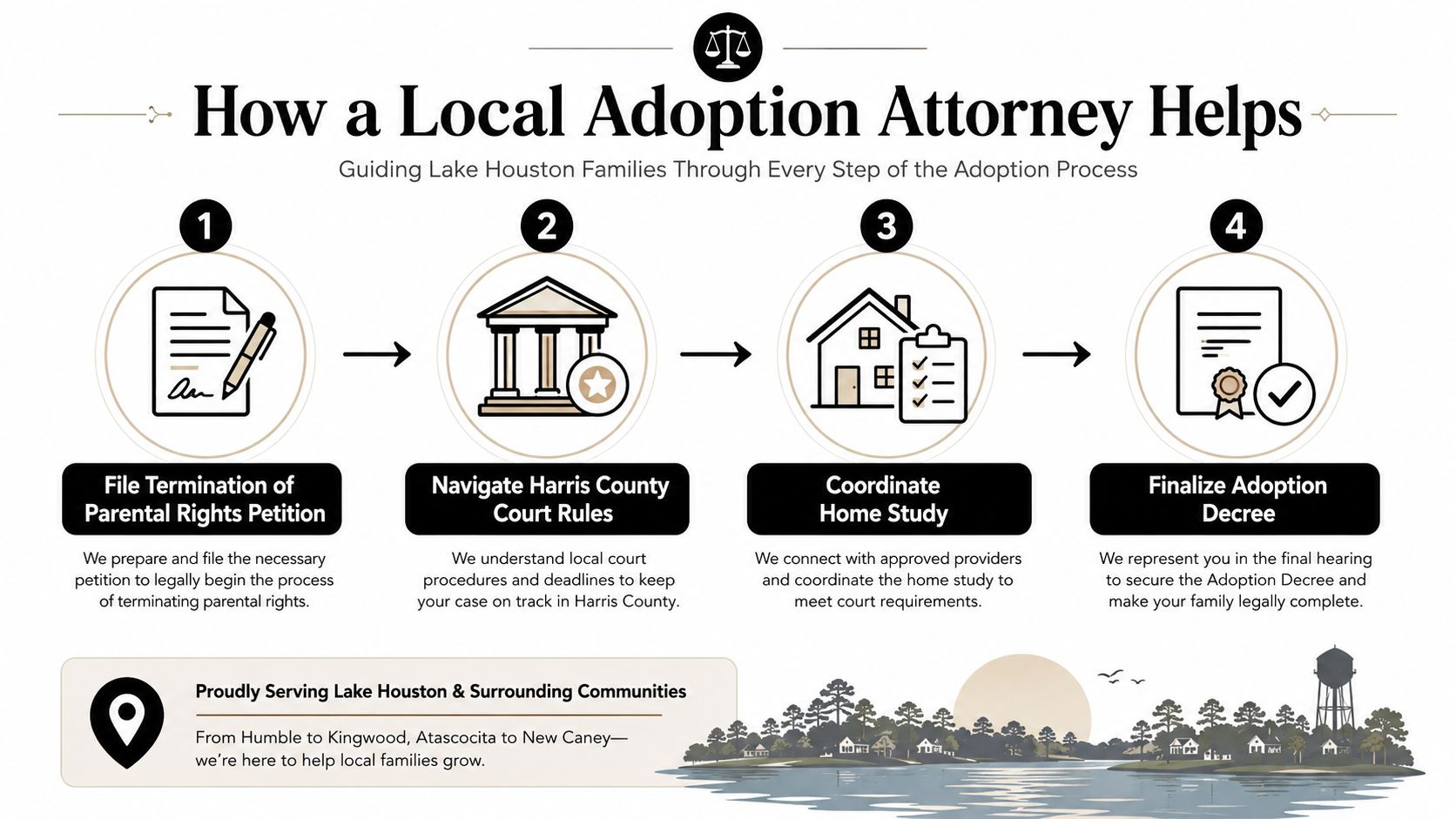
The Harris County petition is filed through the Family Intake Division of the Harris County Clerk's Office. Local adoption materials explain that the filing must include the cause number and court of continuing jurisdiction from the earlier termination case when one exists. Harris County adoption filing procedure
Complete the home study honestly
Texas guidance requires a licensed or authorized evaluator to assess safety, household space, interviews, background history, and at least one in-home visit. The evaluator reviews criminal, abuse and neglect, medical, financial, and family-history issues, and household members generally participate in the process. Texas DFPS home study guidance
For a Kingwood or Atascocita household, expect a social worker to visit the home, interview household members, check references, review background information, and prepare a written report for the court. Fingerprinting and background checks are routine parts of the review. An incomplete disclosure can cause more difficulty than the underlying issue, so discuss concerns with counsel before the evaluator finds them independently.
Texas law also requires the study to include applicants and other people living in the home. Federal guidance says the evaluator must visit the home at least once and interview household members. Texas home study statute
Resolve consent and termination
A voluntary relinquishment uses an affidavit of voluntary relinquishment and must satisfy Texas legal requirements. An involuntary termination requires evidence and a court order. These are different proceedings with different risks, and the court must address the legal rights of each living parent who remains involved.
The birth-father registry can also matter when paternity is uncertain or the father hasn't participated. Counsel should identify the applicable registry and notice steps instead of treating silence as consent.
After the rights issues are resolved, the attorney prepares the IFA, or petition for adoption, pays the Harris County Clerk filing fee, serves required parties, and addresses any court-ordered guardian ad litem or amicus attorney. Before finalization, the court may review an updated social study, post-placement information, consents, records, and the proposed final order. The judge's concern is the child's legal and practical stability, not merely whether the adults agree.
Planning Time and Adoption Costs
Families searching for an adoption lawyer in Lake Houston often ask for one total price and one completion date. That's the wrong starting point. Adoption type, parental-rights disputes, home-study timing, document availability, and court scheduling determine both the budget and the calendar.
Texas benchmarks commonly place private domestic infant adoptions at 12 to 24 months, foster-care adoptions at 12 to 18 months, stepparent and kinship adoptions at 3 to 6 months, and relative or kinship matters more broadly at 6 to 12 months. These are general estimates, not promises for a specific Harris County case. Texas adoption timeline benchmarks
| Adoption Type | Typical Duration | Key Cost Categories | Variables That Extend Timeline or Cost |
|---|---|---|---|
| Private domestic infant | 12 to 24 months | Attorney fees, agency or placement expenses, home study, service, filing, and records | Contested consent, revocation issues, hospital coordination, and missing records |
| Foster-care | 12 to 18 months | Legal work, filing and service costs, study-related expenses, and possible reimbursable costs | DFPS documentation, termination proceedings, placement requirements, and court scheduling |
| Stepparent or kinship | 3 to 6 months | Filing, service, home study, attorney fees, and amended records | Disagreement from the other parent, service problems, and child-consent requirements |
| Relative or kinship | 6 to 12 months | Filing, service, study, records, and legal representation | CPS history, unresolved parental rights, residency, and updated reports |
Private domestic adoption commonly ranges from about $20,000 to $50,000, with legal fees representing only part of the total. Foster-care adoption may involve little or no agency fee and may include reimbursement for some legal expenses through Texas adoption assistance. Texas adoption cost categories and assistance
Build a cash-flow plan
Ask for separate estimates for filing fees, service of process, the home study, post-placement reports, amended birth certificates, final-hearing court costs, and attorney fees. The timing matters because families may pay different expenses at different stages rather than one amount at the beginning.
A useful consultation should identify which costs are fixed, which depend on third parties, and which may be reimbursable. Review adoption costs in Texas before meeting with counsel, then request a case-specific written outline. Don't rely on a broad online range when a contested parent, interstate issue, or CPS file could change the budget substantially.
How a Local Adoption Lawyer Helps
A local adoption attorney's value appears in the handoffs between people and deadlines. Consider a representative Kingwood relative adoption after a CPS case. The lawyer first reviews the placement paperwork and prior orders, identifies whether parental rights have already been terminated, and requests certified records that the family may not know how to obtain.
If termination remains unresolved, counsel sequences that proceeding before relying on the adoption petition. If a parent is willing to consent, the attorney checks whether the consent documents meet Texas requirements and whether additional notice or registry steps remain.
Prevent avoidable continuances
A lawyer can coordinate the home study with the agency or social worker, track missing background documents, communicate with CASA or DFPS when appropriate, and prepare the petition for the correct Harris County court. The attorney also manages service, publication when required, and responses to court notices.
In a Humble stepparent case, the practical work may focus on locating the other parent, proving service, addressing a disputed consent, and preparing the child and stepparent for questions at the final hearing. In a private Houston placement, the attorney may coordinate with the hospital and agency so release documents, birth-parent paperwork, and placement records don't arrive out of sequence.
A judge can continue an otherwise supported adoption when a required record, consent, notice, or updated report is missing.
The attorney also reviews the proposed final decree, confirms the requested name change, checks the child's identifying information, and prepares the family for the hearing. Local knowledge doesn't guarantee a result, but familiarity with Harris County filing procedures helps counsel identify practical problems before the hearing date.
This firm's role can include family-law representation as well as broader Kingwood legal services. The Law Office of Bryan Fagan – Kingwood TX Lawyers serves local clients in family law, criminal defense, estate planning, probate, and civil matters, which can be useful when an adoption intersects with custody, guardianship, or estate planning concerns.
Questions to Ask Before Hiring
Your first consultation should produce a plan, not just reassurance. Ask questions that reveal whether the attorney understands your exact adoption path and the local process affecting Kingwood, Humble, Porter, and Northeast Houston families.
- Experience with your adoption type: Ask how the lawyer handles stepparent, private, agency, foster-to-adopt, and relative matters, and whether the case involves a CPS file or disputed parental rights.
- Harris County court familiarity: Ask where the petition will be filed, whether an earlier termination case controls jurisdiction, and how the attorney tracks clerk and court requirements.
- Consent and termination strategy: Ask which parent's rights must be addressed, how the birth-father registry and service issues will be handled, and what happens if a parent refuses to consent.
- Home study coordination: Ask who communicates with the evaluator, what documents the household must prepare, and how the attorney responds to an unfavorable or incomplete report.
- Communication and fees: Request a written explanation of billing triggers, filing expenses, service costs, home-study charges, and who will provide routine updates.
- Final hearing preparation: Ask how the family will prepare, which documents the judge may review, and who will correct errors in the proposed final order.
- Conflicts and privacy: Confirm how the firm handles sensitive medical, financial, CPS, and family-history information, especially when multiple relatives or agencies are involved.
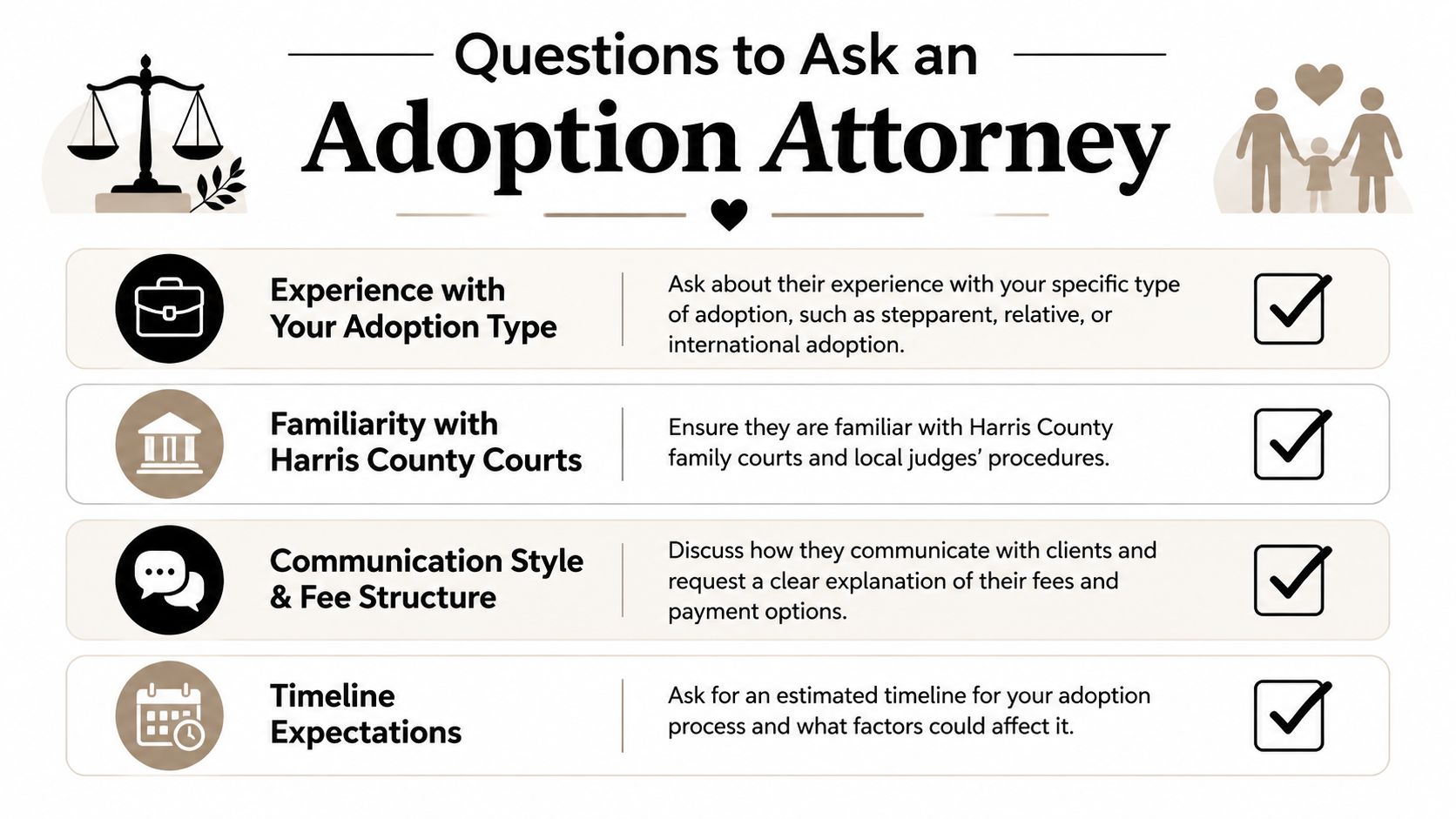
Ask for a written milestone outline. It should identify who manages day-to-day updates, who communicates with the social worker or agency, who appears in court, and what facts could change the expected timeline. Transparent communication won't remove every delay, but it gives your family a realistic way to respond when a record, consent, or court date changes.
Your Next Steps Toward Adoption
Lake Houston families often reach the first consultation with an incomplete file and several competing deadlines. Gather the child's available records, medical and personal background, marriage or divorce documents, CPS paperwork, prior court orders, and known information about each parent. Bring what you have. Mark missing items instead of waiting for a perfect packet.
Request a consultation and bring three direct questions: Which Texas adoption path fits these facts? Which court has jurisdiction? What must happen first, termination or consent, the home study, or filing? The answer depends on the adoption type and the facts of your case.
Prepare for the local process
Ask counsel to explain:
- Harris County filing logistics: Confirm Family Intake Division requirements and whether an earlier termination case controls the adoption file.
- Background review: Ask how criminal or CPS history, medical information, finances, and household members may affect the home study.
- Consent and notice: Identify every parent or interested party whose consent, service, or termination must be addressed.
- Post-placement work: Confirm whether updated social-study information or post-placement reporting is required before finalization.
- Names and records: If the adoption changes the child's name, ask how the final order and amended birth certificate will be handled. Families needing separate assistance can review name change services for a minor in Kingwood.
Before the meeting, write down the placement date, child's age, each parent's location, prior court cases, home-study status, and any objection to the adoption. These facts help counsel determine whether the case can proceed by consent or requires termination work, additional service, or DFPS coordination.
Ask for a written milestone outline. It should identify who provides updates, who communicates with the social worker or agency, who appears in court, and which missing record, consent, or court date could change the schedule. Confirm how filing expenses, service costs, home-study charges, and other case costs are handled.
The Law Office of Bryan Fagan – Kingwood TX Lawyers helps families in Kingwood, Humble, Porter, and Northeast Houston organize adoption issues and prepare for Harris County filing and finalization. Schedule a consultation through the firm's Kingwood adoption service page to discuss the next legal step.