In Texas, having 2 ounces or less of marijuana is a Class B misdemeanor punishable by up to 180 days in jail and a $2,000 fine. The stakes are real even for a first arrest, especially when a stop near Kingwood turns into a Harris County criminal case.
Maybe a deputy stopped you on Northpark Drive, or your teenager was questioned after leaving a smoke shop near Kingwood Drive. Perhaps the substance was a vape cartridge, gummy, or hemp-labeled product, and nobody can tell you whether Texas treats it like marijuana. You need a clear answer, not judgment.
Texas possession law depends on what the product is, how much the State says you possessed, whether it was usable, and whether prosecutors can prove you knew about and controlled it. A marijuana possession lawyer in Kingwood, TX should investigate those points immediately. This guide explains the major charge levels, the difference between flower and concentrates, what happens after arrest, and how a local defense lawyer can challenge the State's case for residents of Kingwood, Humble, Porter, and Northeast Houston.
Why Marijuana Possession Charges in Kingwood Deserve Serious Attention
A traffic stop on Northpark Drive can move quickly. An officer may say the vehicle smells like marijuana, ask who owns a backpack, and search before you understand what's happening. By the time you reach a Harris County booking facility, a small amount of plant material may have become a formal criminal accusation.
Texas hasn't decriminalized personal marijuana possession. Under Texas Health and Safety Code § 481.121, possession of a usable quantity remains criminal, and the offense level rises with the alleged weight. That means “it was only a little” isn't a defense by itself. It may affect the charge, but it doesn't erase the need to examine the stop, search, testing, and proof of possession.
The local court path matters
A Kingwood arrest typically enters the Harris County criminal system. Depending on the charge and location, the case may involve a Harris County precinct court, a justice of the peace process, or a district court such as the 484th or 485th District Court when felony-level allegations are filed. The exact route depends on the charging decision and court assignment.
A misdemeanor can still affect employment and housing background checks. A conviction may also create problems with financial aid, professional licensing, travel, and future applications. Those consequences can last beyond the date you finish any sentence.
Practical rule: Treat the first court notice as urgent. Don't assume a low-level marijuana case will disappear because it involves a first arrest.
A first-time Kingwood defendant should take three immediate steps:
- Stop explaining: Give identifying information when required, then use your right to remain silent.
- Preserve facts: Write down the location, timeline, names of witnesses, and what officers said while your memory is fresh.
- Get local advice: Speak with counsel before discussing the facts with police, prosecutors, friends, or anyone posting about the case online.
The goal isn't to panic. It's to prevent a manageable case from becoming harder through an unnecessary statement, missed setting, or lost evidence.
How Texas Law Classifies Marijuana Possession
Texas uses a weight-based structure for ordinary marijuana possession. The State generally must prove that you knowingly possessed a usable quantity. Possession can mean actual control, such as marijuana found on your person, or constructive possession, such as marijuana located in a shared vehicle or home where prosecutors claim you knew about it and exercised control.
The charge levels are explained in Texas marijuana possession penalties under Section 481.121. The important point is that the amount alleged by the State can change the entire case posture.
The penalty ladder
| Quantity | Charge Class | Jail or Prison Range | Maximum Fine |
|---|---|---|---|
| 2 ounces or less | Class B misdemeanor | Up to 180 days in jail | Up to $2,000 |
| More than 2 ounces, up to 4 ounces | Class A misdemeanor | Up to 1 year in jail | Up to $4,000 |
| More than 4 ounces, up to 5 pounds | State jail felony | 180 days to 2 years in a state jail facility | Up to $10,000 |
| More than 5 pounds, up to 50 pounds | Felony | Up to 2 to 10 years | Texas law provides felony punishment that increases with the charged range |
| More than 50 pounds | Felony | Higher felony exposure as the alleged quantity increases | Higher felony exposure as the alleged quantity increases |
| More than 2,000 pounds | Felony | Up to 5 to 99 years | Texas law provides felony punishment that increases with the charged range |
The penalty descriptions and weight ranges are summarized in the Texas possession-of-controlled-substance defense information for Kingwood. For the lower misdemeanor tiers, the numbers are concrete: 2 ounces or less can mean a Class B misdemeanor, up to 180 days in jail, and a fine of up to $2,000. Above 2 ounces and up to 4 ounces, the case becomes a Class A misdemeanor with up to 1 year in jail and a $4,000 fine.
Why the scale affects defense strategy
Weight isn't always as simple as a bag placed on a scale. A lawyer should examine whether the State weighed usable marijuana or included packaging, debris, moisture, or unrelated material. The defense should also ask whether the lab confirmed that the substance was marijuana and whether the State can connect you to it.
A surcharge or driver's license consequence may also affect a defendant, depending on the case and applicable orders. Those issues should be reviewed rather than assumed. The same applies to collateral consequences involving work, school, housing, and licensing.
If marijuana was found in a Kingwood apartment with roommates, the State may rely on constructive possession. Mere presence in a room or vehicle doesn't automatically prove knowledge and control. The prosecution still has to connect the evidence to you.
Marijuana Flower vs THC Concentrates and Hemp Products
A marijuana flower case and a THC-product case shouldn't be treated as identical. Texas enforcement has shifted, and delta-8, THCA, and other hemp-derived intoxicants can create criminal exposure when they exceed the legal THC limit, according to 2026 Texas reporting on THC and cannabis enforcement.
The product's form matters. A vape cartridge, edible, wax, shatter, or other concentrate may raise questions that don't appear in a traditional flower case. Investigators may focus on packaging, labeling, total product weight, laboratory testing, and the concentration of THC.
Concentrates can create felony exposure quickly
Texas legal summaries describe a much harsher framework for concentrated THC. Under the cited framework, less than 1 gram of THC can be a state jail felony, 1 to 4 grams can be a third-degree felony, 4 to 400 grams can be a second-degree felony, and more than 400 grams can be a first-degree felony. Those classifications are summarized in Texas drug-law information concerning concentrated THC.
That distinction changes the defense conversation. A small-looking cartridge may not be evaluated the same way as loose flower. Counsel should determine what the State claims the substance was, what weight it used, and whether the laboratory measured the relevant material correctly.
Hemp labeling isn't the end of the analysis
A receipt from a Kingwood smoke shop, a product label, or a delivery record may help, but none automatically decides the case. The State may argue that the product exceeded the lawful THC threshold or belonged to a controlled category. The defense should obtain the testing records and compare them with the label, package contents, and applicable law.
The reverse is also true. A product sold as marijuana may not be properly classified after testing. A hemp-derived product, vape, or edible can raise a reclassification defense when laboratory results, labeling, or product composition do not support the charge filed.
For residents of Kingwood, Humble, and Northeast Houston, the practical lesson is simple: preserve the packaging, purchase records, text messages, and delivery information. Don't throw the product away, alter it, or post photographs online. Those materials may become important evidence.
What to Do After a Marijuana Arrest in Kingwood
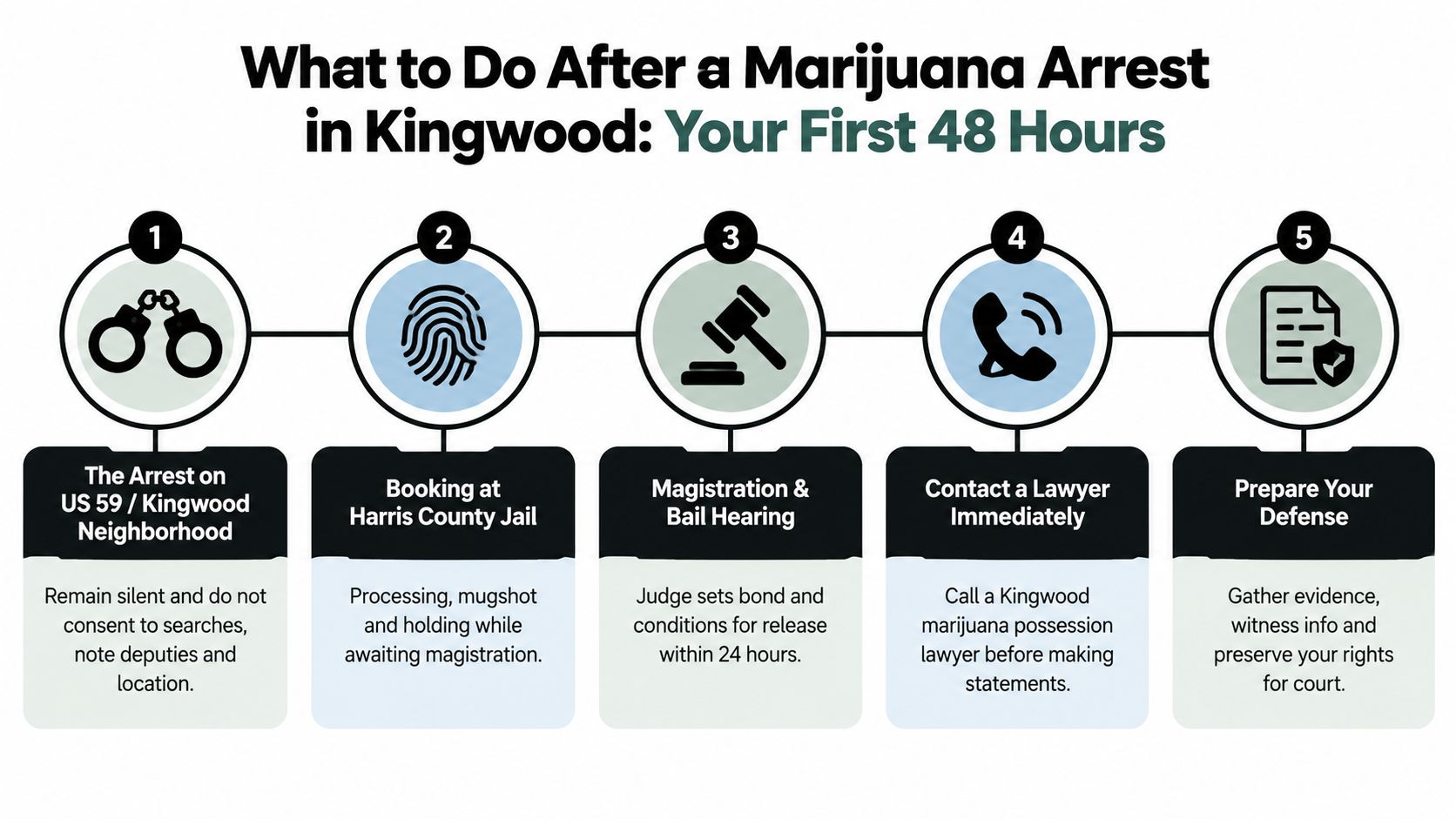
The first hours after an arrest often feel disorganized. Deputies may arrest someone in a Kingwood neighborhood or along US 59, transport that person for booking, and leave the family trying to understand what happens next. The safest approach is disciplined and quiet.
From handcuffs to the first setting
After booking at the Harris County Joint Processing Center, the accused person waits for magistration before a local judge. The judge addresses release and bond conditions. A Class B misdemeanor case may still require careful attention to the release terms and the first court setting.
Do these things:
- Identify yourself, then stop answering offense questions. Say that you want a lawyer.
- Don't consent to a search. You can be respectful while clearly declining consent to search a vehicle, bedroom, phone, or bag.
- Document the encounter. Write down the stop location, timing, statements, witnesses, and any search details.
- Preserve lawful-purchase evidence. Keep texts, receipts, labels, and delivery records connected to hemp products.
- Don't miss court. Read every notice and speak with counsel about the first appearance and later settings.
Read what happens at an arraignment hearing so you understand why the first setting matters. Don't post about the arrest on social media, argue with officers online, or ask friends to contact witnesses without legal guidance.
Your safest sentence after arrest is: “I want to remain silent, and I want to speak with a lawyer.”
If a family's concerns also involve a child-welfare investigation, a CPS Defense Attorney in Kingwood handles defense against CPS investigations for Kingwood families. That is a separate legal matter, but the marijuana accusation may affect how the family should communicate with investigators.
Early attorney involvement gives counsel time to preserve body-camera footage, examine the probable-cause information, investigate the product, and address potential diversion or reduction before positions harden.
Common Defenses a Kingwood Marijuana Lawyer Can Raise
“Only a little” doesn't mean the State automatically wins. It means the defense should focus on the specific proof required for the charge.
Constructive possession isn't automatic
Suppose officers find marijuana in a shared Kingwood apartment, a borrowed vehicle, or a room used by several people. Prosecutors may claim you had care, custody, control, or knowledge. A defense lawyer can challenge that theory by identifying other people with equal access, showing the item wasn't in your exclusive space, and examining whether officers found statements, fingerprints, messages, or other evidence connecting you to it.
The question isn't merely whether marijuana was nearby. The question is whether the State can prove your knowing control beyond a reasonable doubt.
Search and seizure issues can change the case
A lawyer should reconstruct the traffic stop minute by minute. That includes the original reason for the stop, the timing of questions, the moment officers requested consent, and whether a search or K-9 investigation extended the detention. The Supreme Court's rule in Rodriguez v. United States limits prolonging a traffic stop for a dog sniff when the unrelated investigation adds time without adequate legal justification.
Bedroom searches require the same scrutiny. Counsel should ask whether someone with authority gave valid consent, whether officers had a warrant, and whether an exception to the warrant requirement applies.
Testing and weight deserve independent review
The Harris County Institute of Forensic Sciences records can reveal chain-of-custody gaps, testing limitations, or a mismatch between the substance tested and the item seized. A lawyer should compare the laboratory paperwork with photographs, packaging, property records, and the officer's report.
The defense may also challenge whether packaging or paraphernalia inflated the alleged weight. In a hemp-product case, testing may determine whether the substance falls within the lawful threshold or supports the State's classification. A product label isn't conclusive, but neither is an officer's assumption based on appearance.
How a Criminal Defense Lawyer Builds Your Case
A defense lawyer's work begins before the first meaningful negotiation. The lawyer reviews the arrest information, identifies evidence that may disappear, and makes sure you understand what each court setting can accomplish.
At the bond hearing, counsel may argue for reasonable conditions and, when appropriate, a personal recognizance bond rather than a cash surrender. During pretrial preparation, the lawyer requests the State's evidence, seeks body-worn camera footage from Kingwood-area stops, examines lab records, and files motions to suppress an unlawful search or exclude unreliable testing.
A client can help by preparing a factual timeline. If you need a practical format for organizing dates, witnesses, and documents, this resource on how to structure a case summary can help you assemble information for your attorney. Keep the summary factual, don't speculate, and don't send sensitive details to anyone other than your lawyer.
The work behind each court stage
| Case Stage | Lawyer's Action | Client Benefit |
|---|---|---|
| Bond hearing | Requests manageable conditions and evaluates release options | A clearer path through the first days after arrest |
| Evidence review | Examines reports, video, lab records, and property documentation | A defense based on the actual evidence |
| Pretrial litigation | Challenges unlawful stops, searches, detention, weight, or testing | Potential exclusion of evidence or a stronger negotiating position |
| Plea discussions | Addresses dismissal, diversion, or reduction where legally available | A chance to avoid or limit conviction consequences |
| Trial preparation | Prepares cross-examination and presents lawful defenses | A prepared response when negotiation isn't enough |
Article 45 may be relevant in some pretrial discussions, and prosecutors may consider dismissal, diversion, or reduction depending on the charge, evidence, record, and local practice. No lawyer should promise a particular result. The right question is whether counsel has a defensible reason for pursuing each option.
If trial is warranted, preparation should include cross-examination of the arresting officer and forensic analyst. The lawyer should test every link in the State's chain, from the initial stop to the final laboratory conclusion.
Choosing the Right Marijuana Possession Lawyer in Kingwood
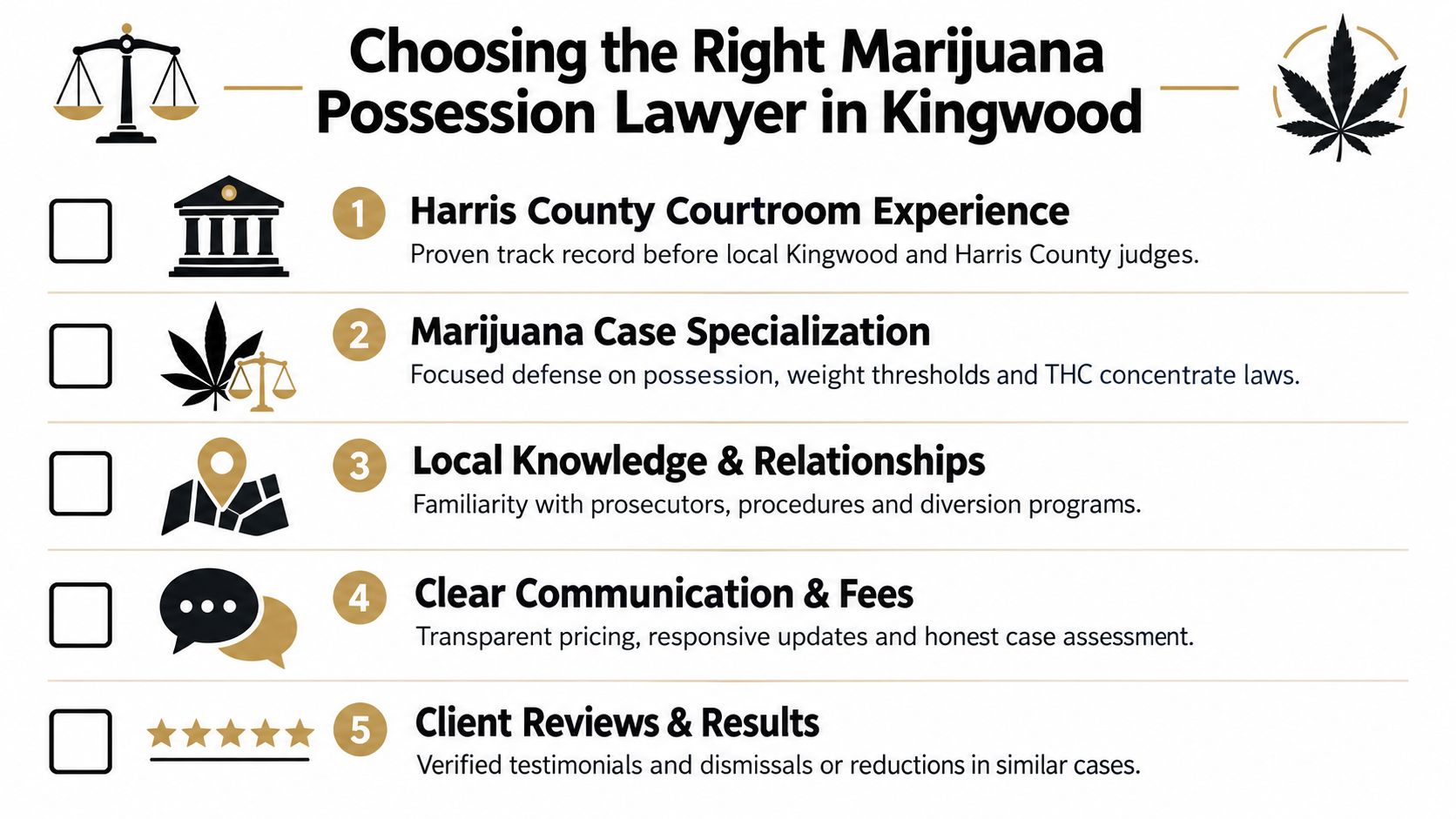
Use this checklist before hiring anyone:
- Harris County experience: Ask whether the lawyer regularly handles local misdemeanor and felony cases.
- Marijuana defense knowledge: Ask about weight, constructive possession, searches, and THC-product testing.
- Personal attention: Find out who will handle your file and appear at early settings.
- Written fees: Request a clear agreement describing what the fee covers.
- Straight answers: Reject guarantees of dismissal or certainty before counsel reviews the evidence.
A Kingwood lawyer should understand how a case moves through Harris County courts, including local procedures, prosecutors, and felony-level assignments. Familiarity with the area doesn't guarantee an outcome, but it helps counsel anticipate practical deadlines and courtroom requirements for clients from Kingwood, Humble, Porter, and Northeast Houston.
Ask direct questions during the consultation. Will the attorney review the offense report before discussing strategy? Has the lawyer challenged a search, questioned laboratory testing, or litigated constructive possession? Who will attend the first appearance? How will the lawyer communicate updates?
Red flags and green flags
A lawyer who quotes a firm price without reviewing the offense report may be guessing about the work required. Be cautious if the practice outsources first appearances, promises a dismissal, avoids trial questions, or communicates poorly.
Look for a lawyer who explains uncertainty without frightening you, provides a written fee agreement, describes the next legal step, and gives realistic expectations. The guide to choosing a criminal defense lawyer offers a useful starting point for comparing counsel.
The Law Office of Bryan Fagan, Kingwood TX Lawyers serves Kingwood and surrounding communities in criminal defense and other legal matters. The firm also handles family law, estate planning, probate, and civil litigation, so clients can address separate legal concerns through a local practice when those issues arise.
Key Takeaways and Next Steps for Kingwood Residents
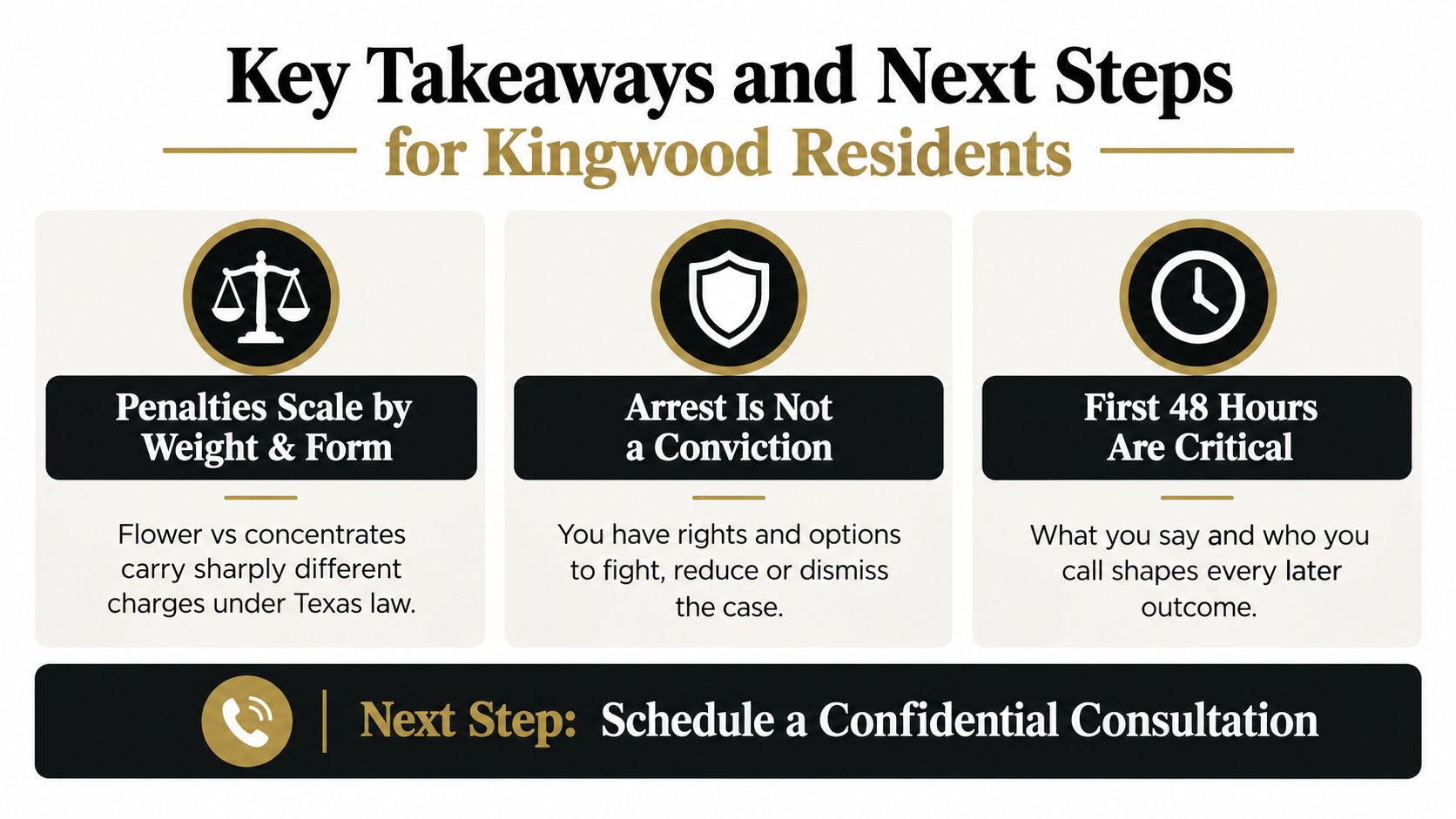
Texas marijuana cases turn on decisions, not assumptions. The key questions are the product's form, the alleged weight, the laboratory evidence, the legality of the stop and search, and whether prosecutors can prove that you knowingly possessed the substance.
A Class B case is still serious because 2 ounces or less can carry up to 180 days in jail and a fine of up to $2,000, as described in the Texas marijuana penalty framework. Concentrates and certain THC products can create different and more severe exposure, so a vape, gummy, or hemp-labeled product requires its own analysis.
Keep the practical priorities in order:
- Stay silent: Don't try to explain the substance or persuade officers at the roadside.
- Document everything: Record the stop, search, arrest, witnesses, and timeline.
- Preserve evidence: Keep messages, receipts, packaging, and product information.
- Act before court: Contact counsel before the first appearance at a Harris County Criminal Justice Center or a Kingwood-area justice court.
- Avoid guarantees: An arrest isn't a conviction, but a defense needs evidence and timely action.
The first forty-eight hours can affect later motions, negotiations, and diversion discussions. A confidential consultation helps you understand which facts matter before you make a statement or miss a court requirement.
The Law Office of Bryan Fagan – Kingwood TX Lawyers provides local criminal defense guidance for marijuana possession arrests involving flower, concentrates, vapes, edibles, and hemp-derived products. Schedule a free consultation at the Kingwood office so an attorney can review your arrest details, explain your options, and help protect your next court date.