You get a text from your former spouse on a Thursday evening: they've moved to Porter, started a job farther west, or taken your child across state lines. The next exchange never happens. Your calls go unanswered, and you're left wondering whether to contact police, file something in Harris County, or wait for the other parent to return.
For Kingwood, Humble, Porter, and Northeast Houston parents, enforcing a Kingwood custody order when a parent moves starts with identifying exactly what changed. A parent's personal move, an unauthorized change to the child's residence, a missed visit caused by distance, and a relocation that requires a new order are different legal problems. Ask the court for the wrong remedy, and you can lose time, credibility, and an opportunity to protect your relationship with your child.
What Kind of Move Are You Actually Dealing With
A Humble parent might move to a nearby community but continue following the possession schedule. A Porter parent might move personally while the child remains in the court-ordered geographic area. Another parent might enroll the child in a new school outside the restriction without agreement or court approval. The facts may look similar from the outside, but Harris County courts analyze them differently.
Start with this four-part classification.
A personal move by a parent
A custody order generally governs the child's residence, possession, access, exchanges, notice, and transportation. It doesn't automatically prohibit a parent from changing their own residence. But the moving parent may still need to provide updated residence, mailing, telephone, and employment information, and the move can make the existing exchange schedule harder to follow.
If the noncustodial parent moves away, that doesn't automatically erase their possession rights or their responsibility to exercise them. Save travel receipts, exchange messages, and missed-visit records. The issue may be compliance with transportation and notice terms, not an unlawful relocation of the child.
An unauthorized change to the child's residence
If the child is taken outside a geographic restriction without the required agreement, notice, or court approval, treat that as an enforcement issue. The exact wording of the order controls. A parent's stated intention to move isn't enough by itself, and a parent can't rewrite a custody order by relocating.
Read Texas guidance on relocating outside a Humble ISD geographic restriction alongside the actual order. Don't rely on memory or a prior informal arrangement.
Missed possession caused by distance
Distance can explain a missed exchange, but it does not automatically excuse one. Determine whether the other parent refused possession, failed to appear, failed to provide transportation, or could no longer meet a schedule that was designed for local travel.
A move that requires modification
If the order no longer works because of a genuine change in circumstances, modification may be appropriate. That's different from proving that the other parent violated a clear existing term.
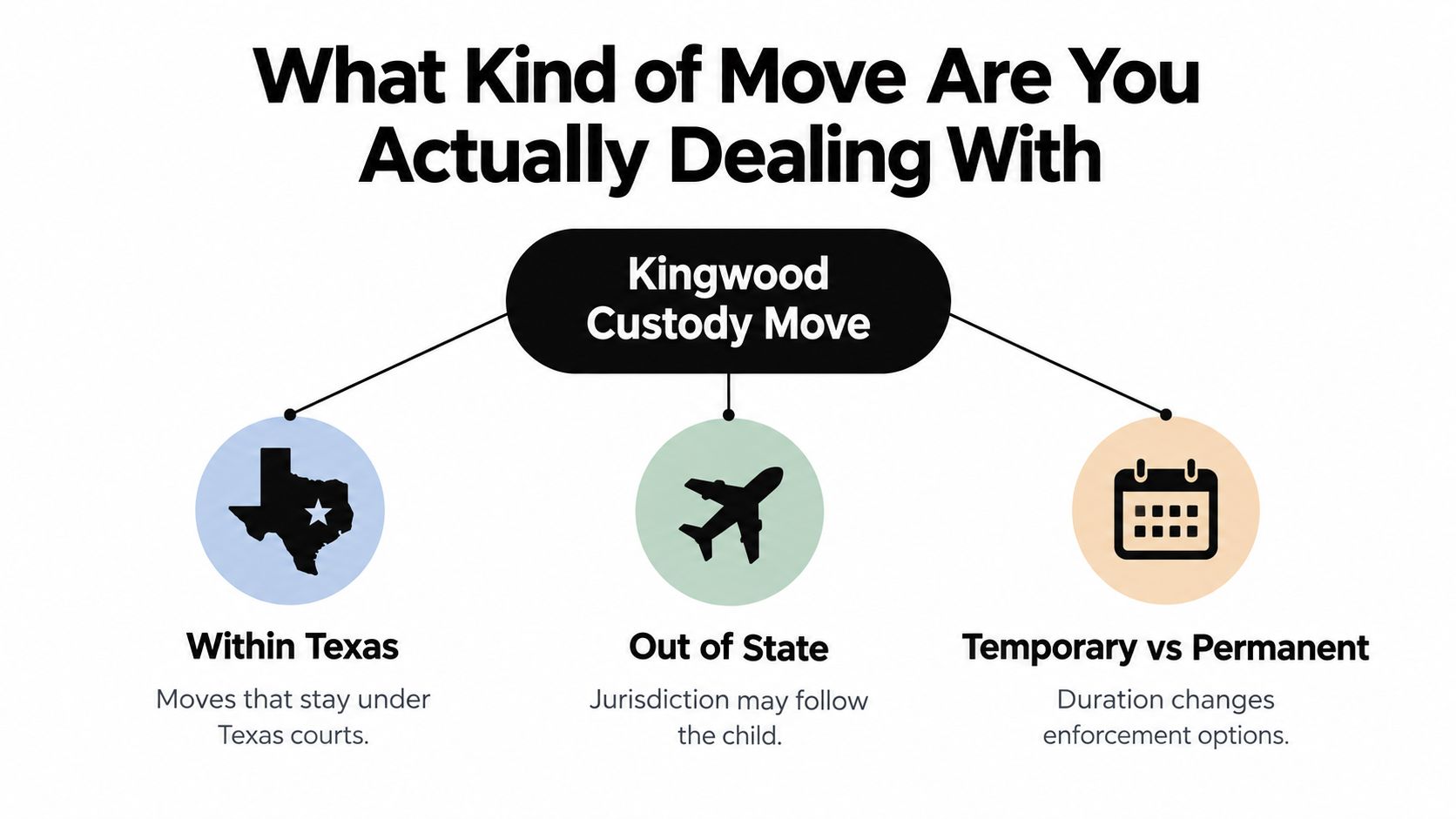
Practical rule: First identify whether the child moved, the parent moved, or the schedule became unworkable. That answer usually points toward enforcement, modification, or both.
Why Texas and Not the New State Usually Stays in Control
Texas relocation disputes are usually governed by the Uniform Child Custody Jurisdiction and Enforcement Act, known as the UCCJEA, which Texas codified in Family Code Chapter 152. The law separates four functions: initial custody jurisdiction, exclusive continuing jurisdiction, jurisdiction to modify an existing determination, and temporary emergency jurisdiction. Texas Children's Commission benchbook materials explain the framework used by Texas courts.
For an initial case, Texas generally qualifies as the child's home state when the child lived in Texas with a parent for at least six consecutive months immediately before the proceeding began. If the child is absent, Texas may still qualify when the child lived here during the previous six months and a parent remains in Texas. A parent's move doesn't automatically transfer authority to the new state.

What continuing jurisdiction means locally
The Texas court ordinarily keeps exclusive continuing jurisdiction until it finds that neither the child nor the child and a parent has a significant connection with Texas and that substantial evidence about the child is no longer available here. Jurisdiction can also change when the child, parents, and every person acting as a parent no longer reside in Texas.
For a Kingwood family, “significant connection” can involve continuing relationships, school history, medical information, parenting records, and the child's ongoing ties to Harris County. “Substantial evidence” means the court can still access meaningful information about the child's care and circumstances in Texas. Those facts matter more than the fact that one parent now has a different address.
Texas also ordinarily recognizes and enforces a qualifying custody order from another state when the issuing state exercised jurisdiction consistently with the UCCJEA and the order hasn't been lawfully modified. Texas can enforce an order without automatically gaining authority to modify it.
A move can create two separate questions: Which court enforces the existing order, and which court can change it? Don't assume the state where the child is temporarily located answers both.
If another state's custody proceeding is already pending, tell your attorney immediately. The UCCJEA discourages competing litigation, and a Texas court may stay, enjoin, or condition a later proceeding to prevent conflicting orders. Filing first isn't a substitute for filing in the court with proper authority.
Building the Evidence Before You File Anything
Don't begin with an angry timeline. Begin with the order.
Request a certified, complete copy from the issuing court. Include every page and later modification, not just the page showing the possession schedule. Mark the geographic restriction, exchange provisions, notice requirements, address-exchange language, and any transportation terms.
Then create a violation chart. Each entry should match one event to one precise order provision.
| Date and event | Exact order term | Available proof | Relief connected to the event |
|---|---|---|---|
| Missed exchange | Possession and access language | Messages, calendar, witness | Make-up possession |
| Child moved outside area | Geographic restriction | School or address records | Compliance or return relief |
| No address update | Notice provision | Returned mail, preserved notices | Enforcement of notice duties |
Texas model orders commonly require written updates to residence, mailing address, employment, and contact information. Preserve notices, returned mail, emails, and messages showing when you requested current information. If the parent moved and you can't locate them, document address, employment, and service attempts rather than treating an unanswered message as proof of every allegation.
Preserve digital records correctly
Keep original messages on the device where possible. Export complete conversations, preserve the dates and sender information, and save emails with their headers when available. Screenshots can help, but screenshots without authentication may be challenged.
School enrollment records, daycare records, medical records, travel receipts, exchange confirmations, and location information can help establish where the child has been and what the moving parent did. Don't alter images, crop out context, or combine separate conversations into one exhibit.
A vague statement such as “the other parent interfered” is weak. Write what happened, when it happened, where the exchange was supposed to occur, what the other parent said or did, and which term was violated. Documenting custody violations in Texas can help you organize the facts before asking a court to act.

Evidence standard: A judge can enforce a clear obligation. Your job is to show the exact obligation, the specific violation, and reliable proof of both.
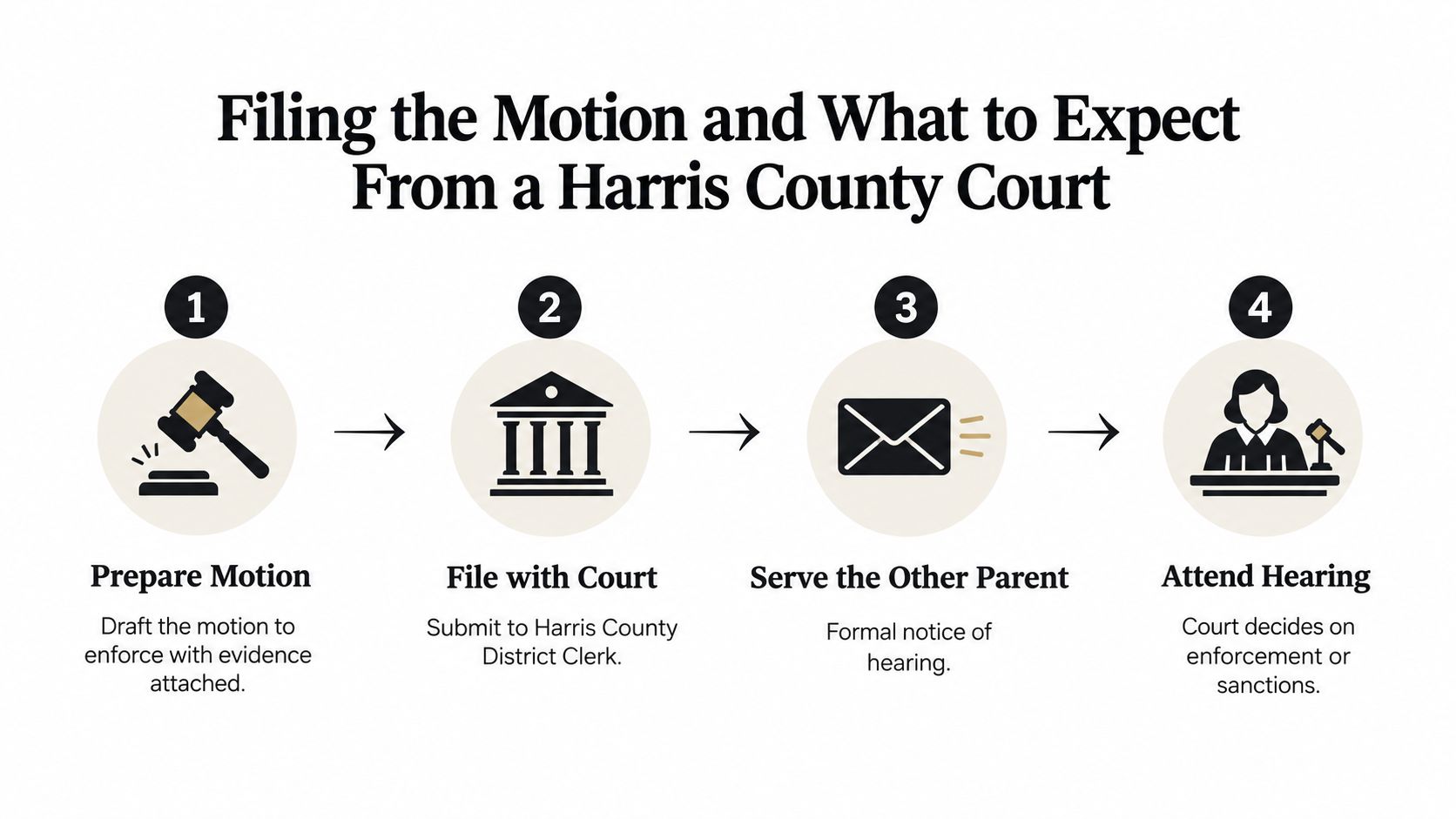
Filing the Motion and What to Expect From a Harris County Court
Once the evidence is organized, confirm the original court, cause number, and current order. Texas generally keeps enforcement and modification filings under the prior proceeding's docket number, and the original court ordinarily retains continuing jurisdiction unless the case is transferred.
Suppose a Kingwood parent misses a scheduled exchange after the other parent moves. The first filing should identify the order, list each missed event, attach supporting evidence, and request relief tied to those violations. Depending on the facts, requested relief can include make-up possession, attorney's fees, costs, contempt, an order requiring compliance, or an order requiring the child's return. A warrant-related remedy may be available in an appropriate case, but it requires careful legal analysis.
Service controls the hearing
For a final order involving possession or access, the respondent generally must be personally served at least 10 days before the hearing. That requirement comes from Texas procedure and matters especially when the relocating parent lives outside the area.
If the parent can't be found, record diligent attempts. Check known addresses and employment information, preserve returned mail, and give the process server useful facts. A court may grant default relief when a properly served respondent doesn't appear, but contempt still requires legally sufficient proof. A missed appearance doesn't automatically prove intentional violation.
The court may focus on whether the order's language is specific enough to enforce. “Don't interfere” is less useful than a clearly defined exchange time, location, transportation duty, or geographic boundary.
What the timeline can look like
The sequence is usually straightforward, but the calendar depends on service, court availability, the parent's location, and whether the other side contests the allegations.
- Prepare the motion. Identify each violation and attach organized exhibits.
- File in the existing case. Use the correct court and docket information.
- Serve the other parent. Personal service and hearing notice must comply with the applicable rules.
- Attend the hearing. The judge evaluates proof and decides whether to order compliance, make-up time, costs, contempt, or other authorized relief.
For a local reference focused on enforcing divorce decree and custody order provisions in Harris County, see Enforcement of Court Orders in Kingwood. Don't promise yourself a quick result. A well-supported filing can still take time when service fails or the other parent raises jurisdictional issues.
When You Actually Need a Modification Instead
Enforcement asks the court to make the other parent follow the existing order. Modification asks the court to change the order. Those are not interchangeable requests.
If the order clearly requires an exchange in Kingwood and the other parent refuses to appear, enforcement is the direct remedy. Ask for proof-based relief tied to the missed exchange. Don't use a contempt motion to obtain a brand-new transportation schedule that the current order never required.
A modification case addresses a material and substantial change in circumstances and whether new terms serve the child's best interest. Relocation, a new work schedule, changed school needs, or long-distance travel may support a request to revise geographic, possession, transportation, or communication terms. The move itself doesn't rewrite the existing order while the case is pending.
Use the right question
Ask yourself: Can the judge enforce the words already written, or do I need different words?
| Situation | Better legal focus |
|---|---|
| The child was taken outside a clear restriction | Enforcement |
| A parent skipped possession required by the order | Enforcement |
| Distance makes transportation terms impractical | Modification, possibly alongside enforcement |
| Parents informally changed exchanges | Preserve the agreement, but don't assume it permanently amended the order |
| A new schedule is needed after relocation | Modification |
Informal accommodations can create confusion. If you allowed a different exchange location for several months, the other parent may argue that the parties accepted a new practice. That doesn't necessarily amend the signed order, but it can complicate the factual record.
A Kingwood parent should avoid asking for contempt where compliance was impossible because the order lacked operational detail. If the schedule doesn't explain who transports the child or where the exchange occurs after a long-distance move, seek a workable modification rather than overstating the violation.
Out-of-State Moves, Registration, and Working With Local Resources
An interstate move adds a registration step when the existing custody order came from another state. Texas generally must recognize and enforce that order if the issuing court exercised jurisdiction in substantial conformity with the UCCJEA, or if the underlying facts satisfy the Act's standards, and the order hasn't been properly modified. Texas Family Code Section 152.303 addresses Texas recognition and enforcement principles.
Registration typically requires a request for registration, two copies of the custody determination, including one certified copy, a sworn statement under penalty of perjury that the order hasn't been modified to the filer's knowledge, and party-identification information unless confidentiality protections apply. Texas Family Code Section 152.305 describes these filing requirements.
Texas guidance identifies the district court in the county where the child lived during the prior six months as the ordinary registration location. For a Kingwood or Northeast Houston family, gather school, daycare, medical, and residence records before choosing the filing location. An emergency, a competing case, or a different residence history can change the strategy.
Registration creates a local enforcement path
Registration makes the order enforceable in Texas from the registration date. The opposing parent receives notice and has 20 days to request a hearing to contest registration. If they don't timely request that hearing, the registration procedure generally prevents them from contesting the custody determination through that process.
Registration isn't the only possible route to enforcement in every situation, but it can convert a difficult multistate dispute into a Texas proceeding. A Kingwood attorney can coordinate registration, service, enforcement, and any needed modification without encouraging competing litigation in two states.
If the child may be concealed or possession may be lost immediately, ask about expedited enforcement. Texas recognizes an expedited procedure similar to habeas corpus. Preserve the child's known location, school information, medical records, travel itinerary, and communications.
The Office of the Attorney General may have a role in certain support or address matters, but it doesn't replace a private custody enforcement strategy. Local law enforcement may need a specific court order and clear facts before taking action. Don't assume an officer can resolve a civil possession dispute at the curb. Get legal advice promptly, especially if the child's location is uncertain.
Your Next Step From Kingwood and the Help We Can Provide
Your child misses an exchange after the other parent moves from Kingwood. Before filing, identify what happened: a personal move by the parent, an unauthorized change to the child's residence, or a missed exchange made harder by distance. That distinction determines whether you should seek enforcement, modification, registration, or expedited relief.
This week, take these steps:
- Preserve every communication. Save messages, emails, call logs, exchange confirmations, and notices about the move.
- Obtain the complete certified order. Do not rely on a partial copy or online summary.
- Document the child's residence. Gather school, daycare, medical, travel, and address records.
- Stop relying on informal changes. Communicate in writing, follow the current order, and do not treat temporary flexibility as a permanent amendment.
A clear violation supports an enforcement discussion. A schedule that no longer works because of distance may require modification. An order from another state raises registration and jurisdiction issues before you file in Harris County or elsewhere.
The Law Office of Bryan Fagan, Kingwood TX Lawyers serves Kingwood, Humble, Porter, and Northeast Houston in custody, support, enforcement, and modification matters. The firm also handles estate planning, probate, criminal defense, and civil litigation.
The firm's enforcement lawyer in Kingwood, TX page provides a starting point. Bring your order, violation chart, communications, and relocation evidence to a consultation. Do not wait for another missed exchange to create a larger service or jurisdiction problem.
The firm can help assess enforcement, modification, registration, or expedited relief. Visit Law Office of Bryan Fagan – Kingwood TX Lawyers to schedule a free consultation at the Kingwood office.