Your mother in Kingwood calls because your father fell, and the hospital wants answers. Who can access his bank account? Who can speak with doctors? Can the family afford a nursing facility without putting your mother's home and monthly income at risk? If the only document you can find is an old will, you may not have the authority you need today.
That's why families searching for an elder law attorney in Lake Houston often need more than ordinary will preparation. Elder law brings together incapacity planning, long-term care financing, Medicaid eligibility, guardianship, powers of attorney, probate, and the protection of a vulnerable adult's dignity. The right plan gives families in Kingwood, Humble, Porter, and Northeast Houston a practical path through decisions that can otherwise become rushed, expensive, and divisive.
When Your Family Needs an Elder Law Attorney
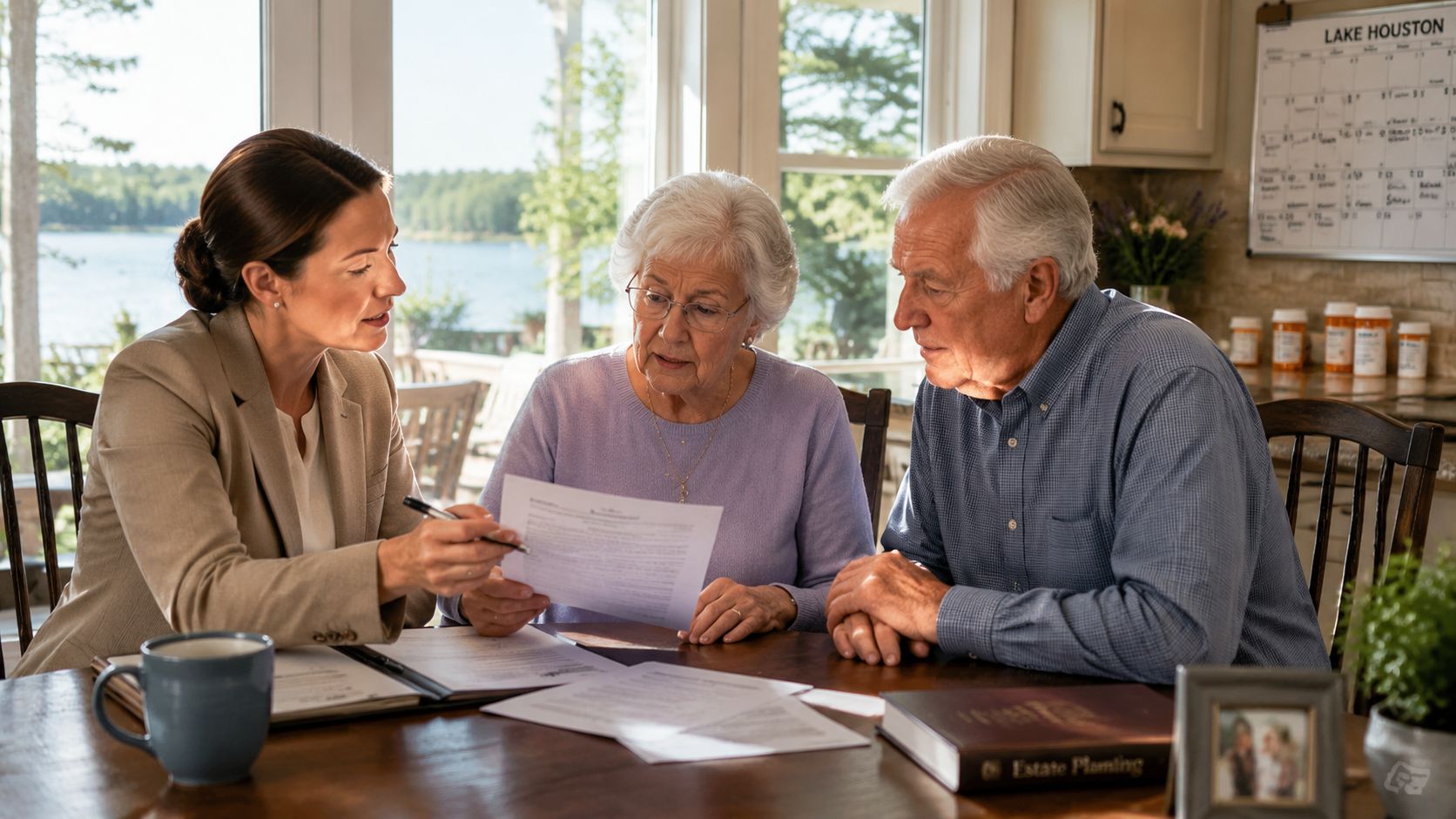
A Kingwood family may spend years helping an aging parent with transportation, prescriptions, and household tasks without realizing that informal help doesn't create legal authority. Then a stroke, dementia diagnosis, or fall changes everything. The adult children may discover that they can't access financial accounts, sign important documents, or make certain decisions because their parent never completed the right planning documents while still competent.
Another Lake Houston family may have a different problem. A parent is entering a nursing facility, and the family assumes the only question is whether Medicaid will pay. In reality, eligibility can depend on the applicant's age, residency, income, resources, medical situation, and the structure of the household's finances. Waiting until admission can limit the choices available to the family.
The problems elder law solves
Elder law isn't just estate planning for older clients. It addresses the legal consequences of aging and incapacity while the person is alive, including:
- Long-term care planning: Families need to understand how care may be paid for and how financial decisions can affect eligibility.
- Decision-making authority: A durable power of attorney and medical planning documents can help a trusted person act when the principal can't manage matters independently.
- Guardianship: When voluntary planning documents are missing or inadequate, a court-supervised guardianship may become necessary.
- Estate administration: After death, an attorney can help the personal representative identify assets, resolve debts, and distribute property under Texas law.
- Family coordination: Clear legal roles can reduce conflict among siblings who disagree about care, money, or living arrangements.
Practical rule: Don't wait for a hospital admission to ask whether your family has legal authority. Review the plan while your parent can still explain and approve it.
Families also need care information that recognizes the older adult as a person, not just a collection of legal and medical problems. These dignity-focused home care insights can help relatives think about support at home while they address the legal side.
If your parent is showing memory changes, facing a major diagnosis, or preparing for long-term care, an elder law consultation can identify the immediate risks and the documents or applications that deserve attention first. You don't need to wait until the family agrees on every detail.
What Elder Law Actually Covers in Texas
Texas elder law grew into a distinct specialty because older adults face overlapping legal problems that don't fit neatly into one practice area. Its roots reach back to the Older Americans Act of 1965, which President Lyndon B. Johnson signed on July 14, 1965, creating a federal framework for services, advocacy, and legal support for older adults. Elder law emerged as a distinct U.S. specialty in the late 1970s and early 1980s, and by the mid-1990s the American Bar Association recognized it as one of only 18 board-certified specialties. This legal history helps explain why the field covers planning, benefits, guardianship, long-term care, and capacity rather than only wills.
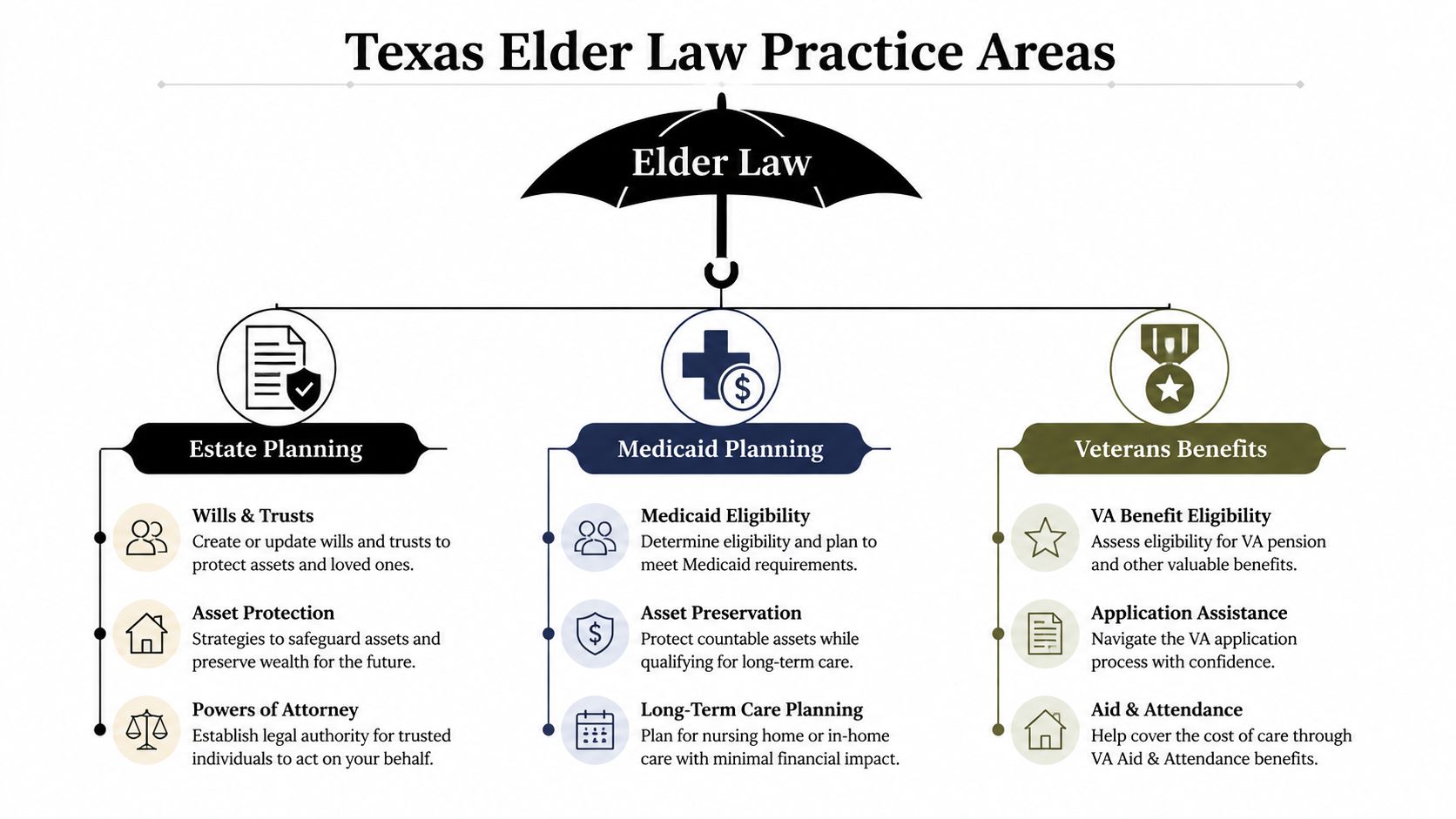
The main planning areas
Medicaid and long-term care planning focus on how an older adult may qualify for nursing facility or community-based services while handling income and countable resources lawfully. The attorney reviews ownership, account designations, property, marital finances, and the timing of decisions. Families shouldn't transfer assets casually or rely on a generic online checklist because a poorly timed transaction can create new problems.
Guardianship is a court process for an adult who can't make or communicate responsible decisions about personal welfare, property, or both. The court may appoint a guardian of the person, a guardian of the estate, or both. Guardianship can protect someone who is vulnerable, but it also creates continuing duties and court oversight.
Powers of attorney let a competent person choose an agent to help manage property and financial matters. Health care directives and related medical documents address a different category of decisions. The documents should match the person's wishes and be executed before capacity has substantially declined.
Estate planning may include a will, trust, beneficiary designations, incapacity documents, and a plan for the home and other assets. A Kingwood family looking for Estate Planning Attorney in Kingwood will find services described as wills, trusts, and estate plans for Kingwood families.
Probate and estate administration begin after death. Texas law provides different administration paths, and a properly prepared will may authorize independent administration. That process can reduce repeated court supervision while the personal representative gathers assets, addresses debts, and distributes the estate.
The best approach starts with the family's actual problem. A general estate plan may be appropriate for a healthy retiree with straightforward assets. An elder law attorney becomes especially important when incapacity, Medicaid, guardianship, a dependent spouse, or a complicated family structure enters the picture.
Texas Medicaid Rules That Affect Lake Houston Families
Long-term care financing is the issue many local families underestimate. A will controls what happens after death, but it doesn't answer how a spouse will pay for care while both spouses are alive. Texas Medicaid planning requires attention to the applicant's age, Texas residency, financial eligibility, and medical eligibility under the applicable Medicaid for the Elderly and People with Disabilities program. Texas Health and Human Services guidance explains the program framework that makes income and resource screening central to the application.
For 2026, Texas lists a nursing-facility income cap of $2,982 per month for an individual, a community-spouse allowance of up to $4,066.50, and an exempt-resource range from $32,532 to $162,660, with the homestead and certain personal property excluded under the applicable rules. The Texas Medicaid handbook provides these figures and the related program information. These limits aren't a do-it-yourself formula because the outcome depends on the household's complete financial and medical circumstances.
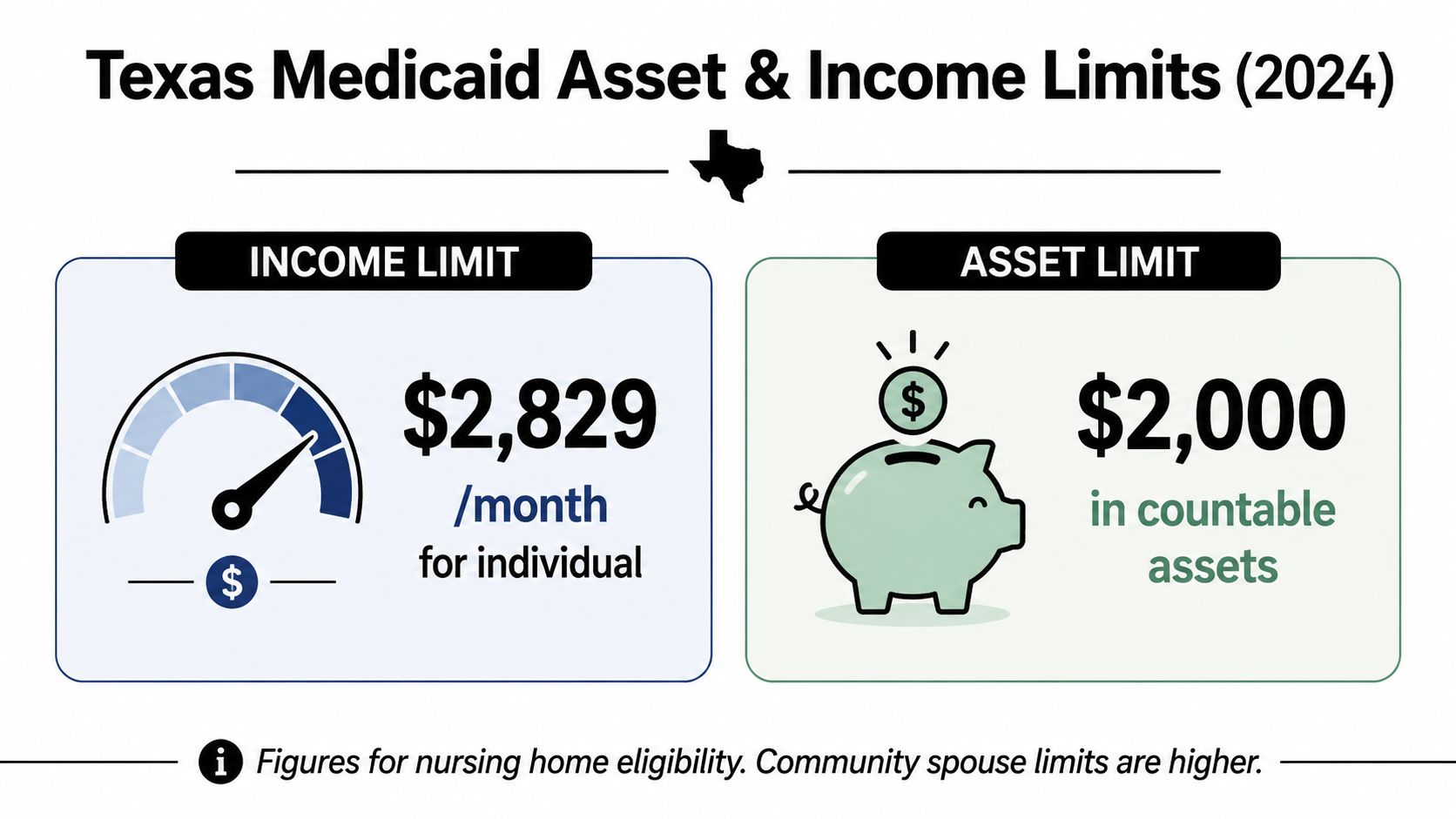
How the rules affect a married couple
Consider a married couple in Kingwood where one spouse needs nursing-facility care and the other remains at home. The nursing-facility spouse is the Medicaid applicant. The spouse living in the community may qualify for protections involving income and resources, but the family must document ownership, balances, regular expenses, and the home's status accurately.
Countable resources can include financial assets that Medicaid considers available to the applicant. Exempt resources may receive different treatment, and the homestead is a major reason families shouldn't assume they must sell their home immediately. The legal question isn't, “How much money does the couple have?” It's, “Which assets count, who owns them, how are they titled, and what rules apply to this application?”
What I tell Lake Houston families: Never give away a home, add a child to an account, or move money because someone promised it will create Medicaid eligibility. Get the full plan reviewed first.
Advance planning gives a family time to organize records, understand spousal protections, and evaluate lawful options. Crisis planning may still help, but it begins with fewer choices and more pressure. A special needs trust may also be relevant when a disabled beneficiary's eligibility requires careful asset management. Review the legal considerations at this Texas special needs trust resource before assuming a standard inheritance will work.
For Lake Houston residents, the practical recommendation is simple. Start before the parent enters a facility, bring complete financial information to counsel, and treat Medicaid planning as part of the overall elder law plan rather than as an application form completed at the end.
Guardianship and Powers of Attorney in Texas
Guardianship and powers of attorney solve different problems. A power of attorney is voluntarily granted by a person who has capacity. Guardianship is created through a court process when the person can no longer make or communicate responsible decisions and no less restrictive alternative adequately protects them.
Texas uses a statutory durable power of attorney form in Estates Code Section 752.051. The Texas Estates Code includes an official form that can be used statewide to name an agent and grant authority over property matters. For a competent Kingwood parent, signing an appropriate durable power of attorney may prevent children from needing to seek a guardianship to manage bills or financial accounts.
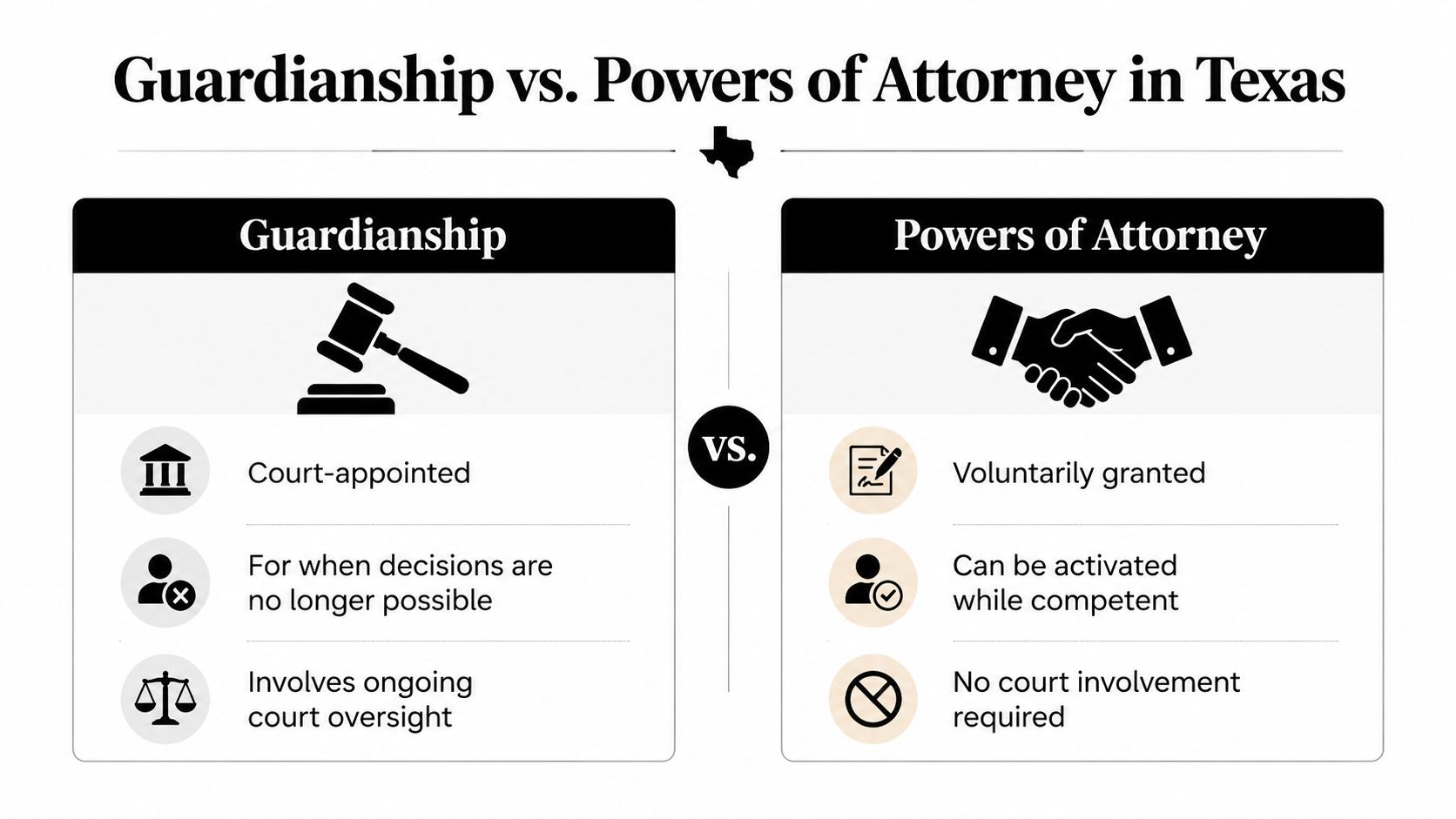
Choosing between the two
Use this decision framework:
- If the person is competent and willing: Discuss a durable financial power of attorney, medical decision-making documents, and clear instructions while the person can participate.
- If the person's capacity is uncertain: Arrange a focused legal review before asking for signatures. Capacity and undue influence concerns can affect whether documents are valid.
- If the person can't make decisions and no usable authority exists: Ask an elder law attorney whether guardianship, emergency relief, or another legal alternative is appropriate.
- If family members disagree: Don't let conflict substitute for a legal plan. The attorney can identify who has authority and what court process may be required.
Guardianship brings continuing responsibilities. Texas distinguishes between the guardian of the person and the guardian of the estate. The guardian of the person must file a sworn annual report, generally measured from the date the guardian qualified to serve, and the report is due no later than the 60th day after the reporting period ends. Texas Estates Code Section 1163.102 sets out that reporting requirement.
The guardian of the estate has separate duties, including an inventory and annual account. One appointment can therefore create more than one filing obligation. Families in Kingwood should maintain a calendar, preserve receipts and account records, and ask counsel before making significant financial decisions.
For a plain-language overview of medical authority, families can review how a health care POA works before meeting with counsel. A separate review of durable versus medical powers of attorney can help clarify that financial authority and health care authority aren't interchangeable.
The firm's Enforcement of Court Orders in Kingwood service concerns enforcing divorce decree and custody order provisions in Harris County, which is a different issue from elder guardianship. That distinction matters when a family is trying to identify the right legal practice area.
How to Choose the Right Elder Law Attorney
Start with the problem, not the title on the website. An attorney may offer wills and probate but have limited experience with Medicaid eligibility, guardianship reporting, or long-term care planning. A family in Porter or Humble should ask direct questions before hiring anyone.
Questions that reveal useful experience
Ask whether the attorney regularly handles Texas Medicaid planning and applications, how the office reviews a married couple's finances, and whether the attorney helps with urgent admissions as well as advance planning. Ask how the firm approaches powers of attorney when a parent's capacity is changing, and how it manages guardianship reporting after appointment.
Local familiarity also matters. Ask whether the attorney works with Harris County probate and guardianship matters, how the office communicates with siblings or other decision-makers, and who will attend meetings and answer follow-up questions. You're not looking for a sales pitch. You're testing whether the lawyer can explain the legal issue in language your family understands.
A useful test: After the consultation, you should know the next decision, the documents needed to make it, and the risk of waiting.
Bring the facts that allow the attorney to give useful guidance:
- Health information: Diagnoses, care needs, recent hospital events, and current living arrangements.
- Financial records: Bank and investment statements, income sources, property information, insurance, and major recurring expenses.
- Existing documents: Wills, trusts, powers of attorney, directives, deeds, beneficiary forms, and prior court papers.
- Family context: Marital status, children, blended-family concerns, disagreements, and the people already helping with care.
Ask how the attorney charges for the work and what the initial consultation includes. Legal fees vary by matter, so you should receive a clear explanation of whether the representation involves document preparation, Medicaid planning, an application, probate, guardianship, or continuing administration. Don't accept a vague promise that one package solves every aging-related problem.
Families can also review this guide to choosing an estate planning attorney as they compare counsel. The right attorney should be candid about what can be handled now, what requires additional information, and what cannot be guaranteed.
Your Next Steps with the Law Office of Bryan Fagan
Begin by writing down the immediate concern in one sentence. “My mother may need nursing-facility care,” “My father can't manage his bills,” or “My parents have no plan if one becomes incapacitated” gives the attorney a clear starting point. You don't need to diagnose the legal problem before scheduling a consultation.
For a Kingwood or Lake Houston family, the first meeting should focus on priorities, authority, care, and protection. Bring the documents you have, even if they're incomplete or outdated. If you can't gather everything, bring what's available and explain what's missing.
What to prepare
A practical folder should include:
- Current wills, trusts, powers of attorney, and medical directives.
- Recent account statements and information about income.
- Deeds, mortgage information, insurance policies, and vehicle records.
- Nursing-facility or home-care information, if care has already begun.
- Names and contact information for close family members involved in decisions.
- Any notices from Medicaid, a court, a facility, or another government agency.
The Law Office of Bryan Fagan, Kingwood TX Lawyers, serves Kingwood and surrounding Northeast Houston communities with family law, criminal defense, estate planning, wills, trusts, probate, and civil litigation services. For an elder law matter, the legal team can help a family identify whether the urgent issue is incapacity planning, Medicaid eligibility, guardianship, probate, or a related estate planning concern.
The office's local presence matters when relatives are coordinating from different parts of Houston. Clear communication helps the family understand who has authority, which documents matter, and what should happen next. It also keeps the conversation grounded in the older adult's wishes, safety, finances, and dignity.
Don't wait until every sibling agrees or every statement is organized. A free consultation at the Kingwood office is the right place to sort the facts, identify the risks, and decide whether legal action is needed now or planning can proceed in stages.
The Law Office of Bryan Fagan, Kingwood TX Lawyers, helps Lake Houston families address Medicaid planning, powers of attorney, guardianship, wills, trusts, and probate under Texas law. Schedule a free consultation by visiting Law Office of Bryan Fagan – Kingwood TX Lawyers and take the first practical step toward protecting your loved one and your family's future.