A Friday night argument in a Kingwood subdivision can turn into a criminal case before anyone has time to cool down. A damaged mailbox, a scratched vehicle, or a broken porch light may look like a private dispute, but a call to a Harris County constable can put the incident into the criminal-justice system immediately.
For residents searching for criminal mischief Kingwood TX, the central issue is usually the same: what happened, who caused it, and how much damage can the State prove? Texas uses the claimed value of the property damage to determine whether the charge is a fine-only misdemeanor, a more serious misdemeanor, or a felony. That classification affects bond, court assignment, negotiation, restitution, and the possibility of clearing the record later.
The discussion below focuses on Kingwood, Humble, Porter, and Northeast Houston residents who need practical guidance after an arrest, citation, or police investigation. The exact facts matter, so treat this as a roadmap, not a substitute for confidential legal advice.
When a Kingwood Night Takes a Wrong Turn
The argument starts outside a Kingwood home on a Friday evening. Voices rise between neighbors, someone steps into the street, and a resident kicks a mailbox post hard enough to break it. The other homeowner calls for help. Harris County Precinct 4 constables arrive, separate the parties, and ask questions on the front lawn in a calm but formal way.
The accused may still believe this is only a neighborhood disagreement. That changes when an officer places one party under arrest. The drive down Northpark Drive toward the Harris County Jail is quiet, but the consequences feel immediate. The person in custody starts thinking about work, children, a spouse, immigration concerns, professional licensing, and what a criminal record could mean.
The first phone call from the booking area often brings more questions than answers. What happens next? How quickly can the person get out? Does the homeowner's promise not to cooperate end the case? Who decides whether the damage is worth a few hundred dollars or several thousand?
Practical rule: Don't explain the incident in detail to police, the property owner, or anyone posting about it online before speaking with a defense lawyer.
A mailbox dispute can become a criminal mischief allegation because Texas law treats intentional or knowing property damage as a criminal offense. The same basic event can remain a low-level misdemeanor or become a felony when the State claims a higher repair value. The legal definitions come first, and the dollar classification follows.
What Texas Law Actually Calls Criminal Mischief
Texas Penal Code § 28.03 generally addresses criminal mischief when a person intentionally or knowingly damages or destroys tangible property belonging to another person, or tampers with property and causes impairment or loss. The statute also recognizes reckless conduct in certain formulations. Intent remains the central issue in most Kingwood cases, because prosecutors must connect the accused person's mental state to the alleged damage. The governing language appears in Texas Penal Code § 28.03.
The elements prosecutors must prove
A Harris County prosecutor usually needs to establish several points:
- Mental state: The person acted intentionally, knowingly, or in a situation where the statute recognizes recklessness.
- Property damage: The conduct damaged, destroyed, or impaired tangible property.
- Ownership: The property belonged to someone else, or the State can prove the required property interest.
- Causation: The accused person's conduct caused the loss being claimed.
“Tangible property” means physical property that can be touched. A vehicle door, fence, mailbox, window, sign, phone, or building fixture can fit that description. Keying a car door is a straightforward example. Cutting a fence may qualify as tampering if the conduct affects the fence's function.
“Belonging to another” doesn't always mean the victim owns every part of the property outright. A landlord, tenant, roommate, business, school, utility provider, or public entity may have a legally relevant interest. Ownership and consent can become important when family members or roommates share access to the same home, vehicle, or belongings.
Charging documents may allege that a defendant “intentionally and knowingly damaged or destroyed tangible property” or “tampered with tangible property and caused pecuniary loss.” The wording matters because the State must prove the charged theory, not merely show that an argument occurred.
For a general comparison of how vandalism allegations are handled in another jurisdiction, readers may find this vandalism bail guide for Ventura useful background, although California law doesn't control a Kingwood case. Family-law disputes can also overlap with criminal allegations, while the Harris County Family Courts: A Kingwood Resident's Guide describes how family law cases proceed in the Harris County courts serving Kingwood.
Penalty Levels and What They Mean in Harris County
A damage estimate can decide whether a Kingwood arrest remains a fine-only misdemeanor or becomes a felony case. Texas uses specific dollar thresholds, and Harris County prosecutors generally build the charge around the property loss they believe they can prove.
| Damage Value | Charge Class | Maximum Punishment |
|---|---|---|
| Less than $100 | Class C misdemeanor | Fine up to $500 |
| $100 to less than $750 | Class B misdemeanor | Up to 180 days in jail and a $2,000 fine |
| $750 to less than $2,500 | Class A misdemeanor | Up to one year in jail and a $4,000 fine |
| $2,500 to less than $30,000 | State jail felony | 180 days to two years in a state jail facility and a $10,000 fine |
| $30,000 to less than $150,000 | Third-degree felony | Two to ten years in prison and a $10,000 fine |
| $150,000 or more | Second-degree felony | Two to twenty years in prison and a $10,000 fine |
Why the estimate can change the case
The first repair estimate is only a starting point. Defense counsel should check whether it includes reasonable repair costs, replacement, labor, materials, unrelated prior damage, or upgrades. A revised valuation can move the allegation into a lower classification and improve plea or dismissal options.
The alleged property type also matters. Texas may impose enhanced treatment for damage involving certain places of worship, burial sites, public monuments, and community centers serving medical, social, or educational purposes. Interference with a public water supply is addressed separately. Damage involving utility equipment or community infrastructure deserves immediate legal attention because prosecutors may treat it more seriously than a private dispute.
The defense should address valuation before agreeing to restitution. A plea or sentence may require payment to the owner, and the amount can remain disputed even after the criminal charge is reduced. Do not make payment offers or detailed statements about the incident before counsel reviews the evidence and the proposed resolution.
Bond conditions require the same care. A misdemeanor allegation can become a felony when the claimed loss crosses a threshold or an enhancement applies. A general explanation of immigration bail bond costs may clarify why felony classification creates added concerns, but it cannot determine what will happen in Harris County.
Classification also shapes the record-clearing plan. A lower-level case may support dismissal, deferred disposition, or later expunction depending on the result and the defendant's history. Felony allegations demand early attention because the charge, plea, and final disposition can limit those options. Get the valuation, enhancement allegations, bond terms, and eventual record outcome reviewed together.
Common Situations That Lead to Criminal Mischief Charges in Kingwood
Kingwood cases often begin with ordinary property disputes. A business reports graffiti near FM 1960. A homeowner finds a keyed vehicle in Kingwood Greens or Royal Brook. A neighbor claims someone damaged a mailbox or porch after an argument. A dispute involving Town Center Park equipment or a utility-related structure may draw more serious attention because communal property and public infrastructure carry broader safety implications.
The likely charge depends on facts that aren't always obvious at the scene. Police may record the owner's first repair estimate, while the prosecutor later obtains a contractor statement, photographs, surveillance footage, or an agency valuation. The initial classification can change as that evidence develops.
| Scenario | Typical Damage Range | Likely Charge | Degree |
|---|---|---|---|
| Minor mailbox, light, or fixture damage | Less than $100 | Class C misdemeanor | Misdemeanor |
| Car keying or porch damage with a higher repair claim | $100 to less than $750 | Class B misdemeanor | Misdemeanor |
| Graffiti, broken windows, or multiple damaged fixtures | $750 to less than $2,500 | Class A misdemeanor | Misdemeanor |
| Significant vehicle, business, or structural damage | $2,500 to less than $30,000 | State jail felony | Felony |
| Major commercial, utility, or infrastructure loss | $30,000 or more | Higher felony classification | Felony |
This table is only a starting point. A small increase in documented damage can move a case into a different class, but the State still must prove who caused the damage and what loss the conduct caused.
Fireworks, BB guns, or other conduct that creates a risk to people may lead investigators to consider separate allegations such as reckless conduct or deadly conduct. Those accusations aren't automatically established by a criminal mischief complaint. They require their own factual and legal analysis.
Parents should act quickly when a juvenile is involved. Young adults in the transition from school, work, or family supervision can also face lasting consequences from a property allegation. Don't let a child or young adult give a detailed statement because the incident seems minor.
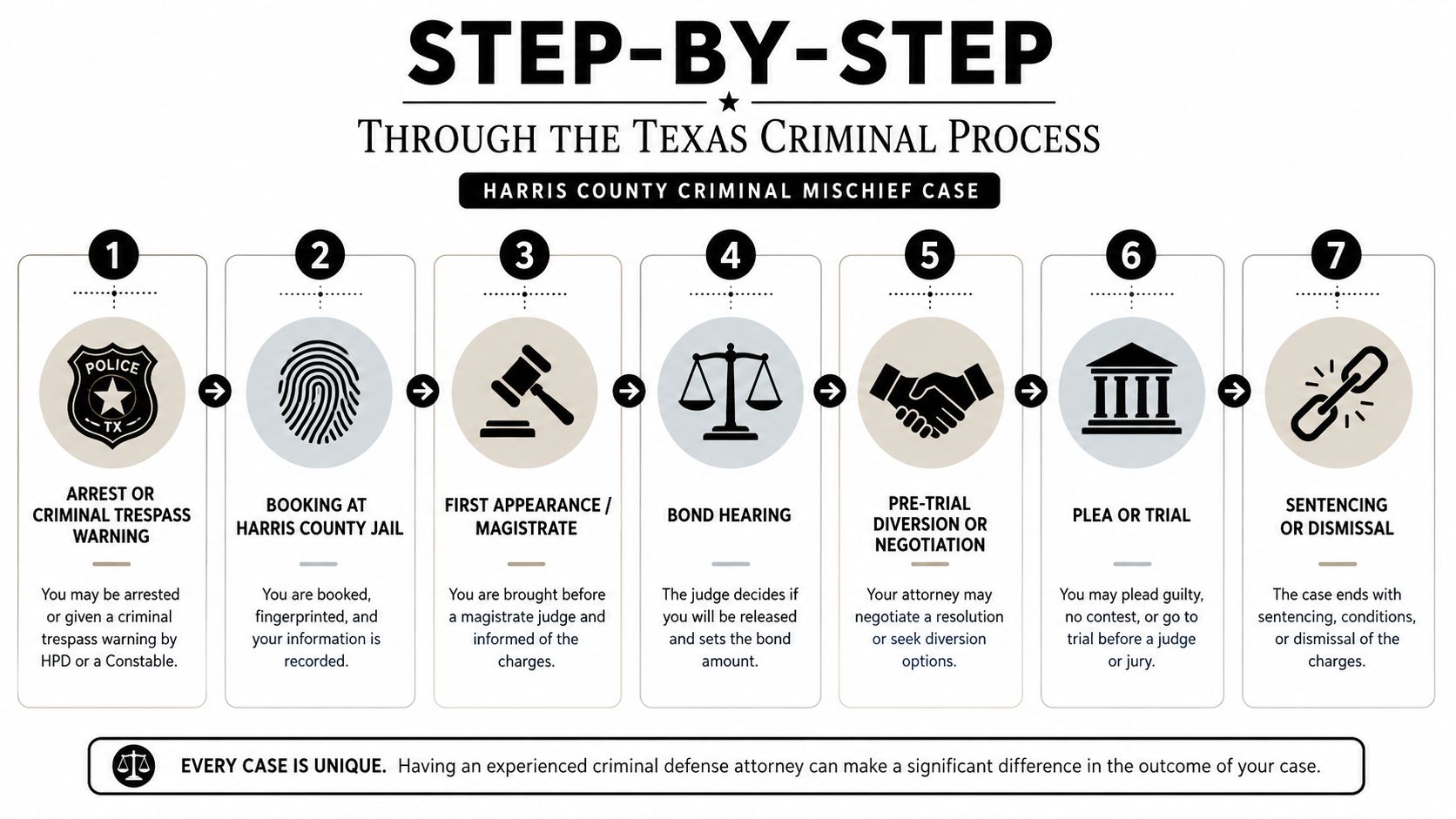
Step-by-Step Through the Texas Criminal Process
A Kingwood criminal mischief case usually follows a recognizable path, although timing varies by charge, evidence, court, and custody status. Cases connected to the Atascocita and Humble sub-station areas may begin moving quickly after arrest, so waiting for paperwork to “sort itself out” is a poor strategy.
The first days
Arrest or warning: HPD or a constable may arrest the accused, issue a criminal trespass warning, or refer the matter for further investigation. A warning doesn't resolve a pending criminal investigation.
Booking: The accused is processed at the Harris County Jail. Personal property is collected, identifying information is recorded, and the person waits for magistration.
Magistration: A Harris County magistrate reviews the accusation and sets bond conditions. The accused may post a cash or surety bond, subject to the court's requirements.
First appearance: After release, the defendant receives information about the court and upcoming settings. The charge may proceed in a County Court at Law or, for a felony, one of the Harris County District Courts, including the 180th, 183rd, 208th, 228th, or 263rd District Courts.
The court process and defense decisions are explained in more detail in the steps in the criminal trial process.
Discovery and resolution
Arraignment and discovery: The defense reviews the charging instrument, body-camera footage, witness accounts, photographs, messages, dispatch records, and damage estimates. The lawyer should test both identification and valuation.
Pretrial options: Depending on eligibility, the prosecutor may consider pretrial intervention, deferred prosecution, restitution, counseling, or community service. These options aren't guaranteed, and the defendant should understand whether completion leads to dismissal or another result.
Plea or trial: A case may resolve through a negotiated plea, dismissal, diversion, probation, or trial. A bench probation outcome and a jury trial involve different risks, and the right choice depends on the evidence and the client's priorities.
The court may not provide constant status updates. Counsel should monitor settings, obtain discovery, and explain what each offer means before the defendant accepts it.
Defenses and Ways to Reduce the Consequences
The strongest defense often starts with the damage number. A property owner's estimate may include full replacement when a repair would restore the property, or it may include damage unrelated to the incident. Counsel should compare photographs, invoices, contractor statements, repair records, and the condition of the property before and after the event.
A valuation dispute can have major consequences near a statutory boundary. The defense should ask who prepared the estimate, when it was prepared, whether the person inspected the property, and whether the amount reflects real loss. Photograph metadata and original files may help establish when images were taken and what they show.
Evidence that can change the accusation
- Causation: The State must connect the charged conduct to the claimed damage. Preexisting cracks, earlier vandalism, weather, or another person's actions can weaken that connection.
- Identification: Weak surveillance, no fingerprints, inconsistent witness accounts, and a credible alibi can create reasonable doubt.
- Intent: An accident, mistake, lawful activity, or misunderstanding may undermine the required mental state.
- Ownership and consent: Family members, roommates, tenants, and co-owners may disagree about who had authority over the property or whether permission existed.
- Enhancement proof: If the State relies on a habitation or special-property enhancement, the prosecution must prove the facts required by the statute, not merely use a label.
Mitigation matters even when the defense doesn't produce a complete dismissal. Voluntary restitution, a mental-health or substance-use evaluation, community service, counseling, employment records, and good-faith character evidence can support a better resolution. Payment should be coordinated with counsel so it doesn't become an unintended admission.
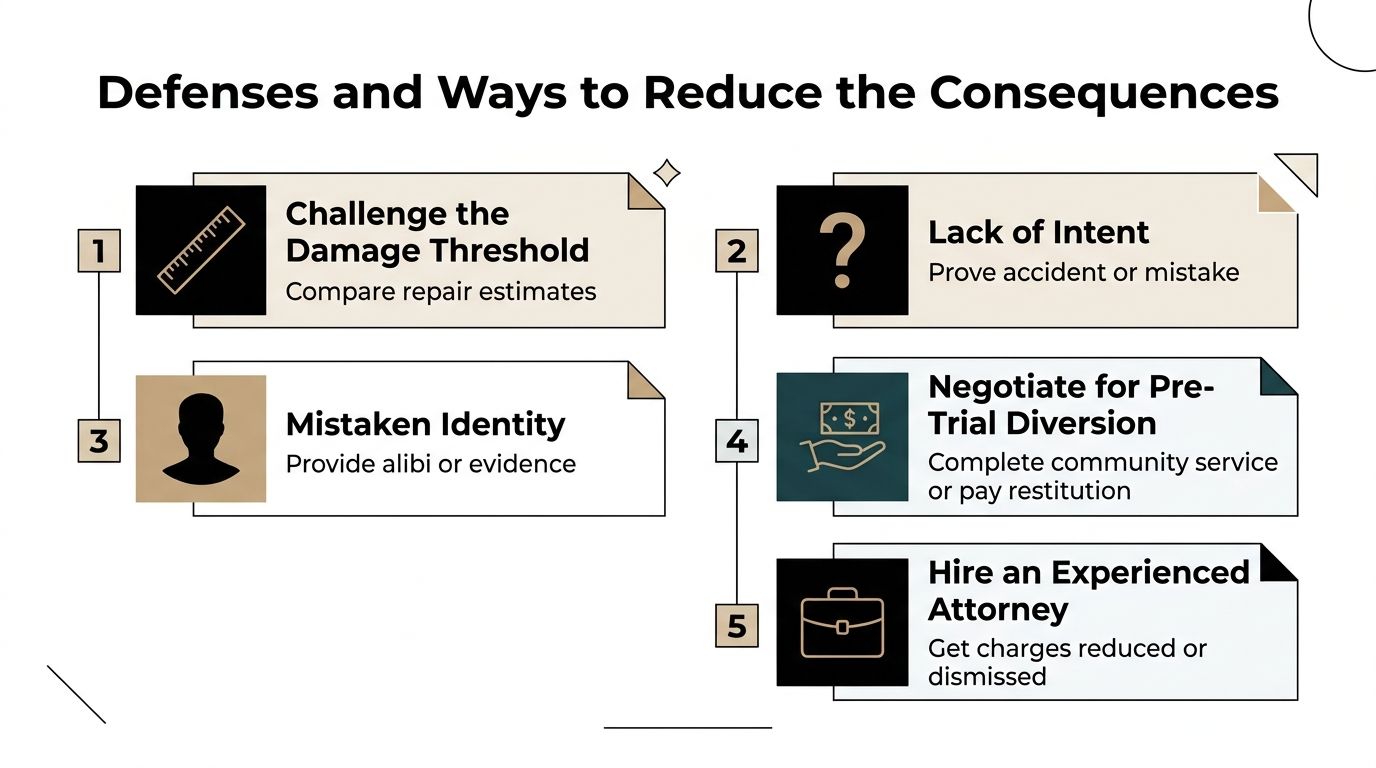
A completed diversion or deferred-adjudication arrangement may provide a path toward a more favorable outcome, but the terms and later record consequences must be reviewed before signing. The deferred adjudication resource for Texas cases explains the basic concept.
The goal is specific, not abstract. Depending on the facts, the defense may seek dismissal, pretrial diversion, reduction to a lower misdemeanor, or a resolution that limits future record consequences.
Clearing Your Record After a Kingwood Case Ends
A case ending favorably doesn't always mean the record disappears automatically. Expunction generally seeks destruction of qualifying records, while non-disclosure seals qualifying information from public view without treating it as a complete destruction. Eligibility depends on the way the case ended, the charge, prior history, waiting periods, and other statutory requirements.
A dismissal, acquittal, successful pretrial diversion, or completed deferred adjudication can create different possibilities. Texas expunction rules are addressed through Article 55 of the Code of Criminal Procedure, while non-disclosure rules appear in Government Code Chapter 411. The result depends on the specific disposition, not the fact that the defendant avoided jail.
Harris County filing steps
A typical record-relief process may require:
- Court selection: File the petition in the court that handled the criminal case.
- Certified records: Obtain certified copies of the disposition and related case documents.
- Service: Provide notice to the District Attorney's Office and affected agencies.
- Agency processing: Allow the agencies time to update their records. The statutory process can involve a 180-day state-agency update window, as addressed in the applicable Texas procedures.
The defense should also review records maintained by local police agencies and the Texas Department of Public Safety. A sealing request may need to address municipal records, booking information, and reporting systems separately.
Before applying for a job, license, apartment, or professional credential, ask whether an expunction or non-disclosure petition should be filed first. A prior conviction changes the analysis, and an earlier application can create practical complications. Use this guide to expunging a criminal record as a starting point, then obtain a case-specific review.
Why a Local Kingwood Attorney Makes a Real Difference
Local knowledge affects practical decisions. A lawyer familiar with Harris County prosecution practices can evaluate how a criminal mischief allegation may be handled in the 183rd and 339th District Courts, how Kingwood Police Department and Harris County Sheriff's Office reports commonly present property disputes, and how misdemeanor judges at the Justice of the Peace Courts approach bond and compliance issues.
The courthouse and jail process also matters. Defense counsel should understand bond procedures connected to the Harristrop 1200 Baker facility, know when discovery is likely to arrive, and recognize the negotiation windows that may exist before a case becomes harder to resolve. Those details don't replace legal analysis, but they can prevent avoidable delays.
A local attorney can also negotiate directly with a property owner about restitution without allowing the dispute to control the entire criminal case. The right approach may involve obtaining a better repair valuation, documenting payment, preserving defenses, or refusing an unfair demand.
The Law Office of Bryan Fagan – Kingwood TX Lawyers handles criminal defense along with family law, estate planning, probate, and civil litigation for Kingwood and Northeast Houston residents. The practice offers free consultations, weekend availability, and direct attorney communication, which can help a defendant understand the immediate decisions after an arrest.
If you're facing a criminal mischief allegation in Kingwood, Humble, Porter, or Northeast Houston, gather your arrest paperwork, bond documents, photographs, messages, and repair information before your consultation. Visit Law Office of Bryan Fagan – Kingwood TX Lawyers to schedule a confidential review and discuss a practical defense strategy with a local attorney.