Collaborative divorce in Kingwood is a written, statutorily structured process in which both spouses and their lawyers commit in advance to settle without going to court. Texas formalized the process in 2011, and a participation agreement is what gives that commitment its legal structure.
You may be sitting at your kitchen table in Kingwood, trying to decide whether your marriage can end without turning every conversation into a courtroom fight. Perhaps you and your spouse still communicate about the children, but you disagree about the house, retirement accounts, support, or what a workable parenting schedule should look like. You want privacy and control, yet you also need legal advice that protects your future.
That's where the collaborative divorce process in Kingwood, TX can make sense. It isn't a friendly settlement discussion. Both spouses hire their own lawyers, sign an agreement to resolve the case without tribunal intervention, and work through financial and parenting issues in a structured team process.
The important question isn't whether collaborative divorce sounds peaceful. The question is whether the structure fits your relationship, finances, safety concerns, and priorities. A routine case may be better suited to mediation. A high-conflict or urgent case may require litigation. This guide explains how Texas law works, what the process looks like in Kingwood and nearby Humble, Porter, and Northeast Houston, what drives cost and timing, and how to choose the right path.
What Collaborative Divorce Really Means for Kingwood Couples
You and your spouse may still coordinate school pickups and discuss the children, yet disagree about the house, retirement accounts, support, or parenting schedule. You want privacy and control without turning every disagreement into a public court fight. In that situation, collaborative divorce may fit, but only if both of you can participate respectfully.
The collaborative divorce process in Kingwood, TX begins with separate legal representation. Each spouse hires a lawyer who gives individual legal advice. The lawyers commit to resolving the case through settlement rather than preparing it for trial, and everyone signs a written participation agreement. Under Texas law, that agreement commits the parties to resolve the matter without tribunal intervention, as described in this Texas collaborative divorce overview.
The commitment changes the negotiation
A conventional divorce lawyer may negotiate while also building a case for court. Collaborative lawyers work under a different commitment. The spouses agree to exchange information, identify their priorities, and address property, support, and parenting issues as one settlement.
The process is private and structured, not casual. Your lawyer still protects your legal interests, explains the consequences of proposals, and challenges terms that do not serve you. The team's purpose is to solve the family's practical problems without turning every issue into a separate contest.
Practical rule: Collaborative divorce works only when both spouses want a settlement process. It is the wrong tool when one spouse wants a quieter way to pressure the other.
For families in Kingwood, Humble, Porter, and Northeast Houston, the team approach can help preserve a workable co-parenting relationship. It may also suit a case involving complicated finances, a business or retirement interests, or property that requires careful review before division. A durable parenting plan often depends on detailed discussion rather than quick concessions.
Mediation may be the smarter choice when the issues are limited and both spouses can make decisions with help from their individual attorneys. Collaboration adds a team structure, so it should earn its additional time and expense through real complexity or a need for joint problem-solving.
Choose another process if domestic violence, intimidation, hidden property, or refusal to disclose information is present. Voluntary cooperation cannot protect you from those risks. Start with a candid consultation and assess the facts before promising to collaborate.
How Texas Law Defines the Collaborative Process
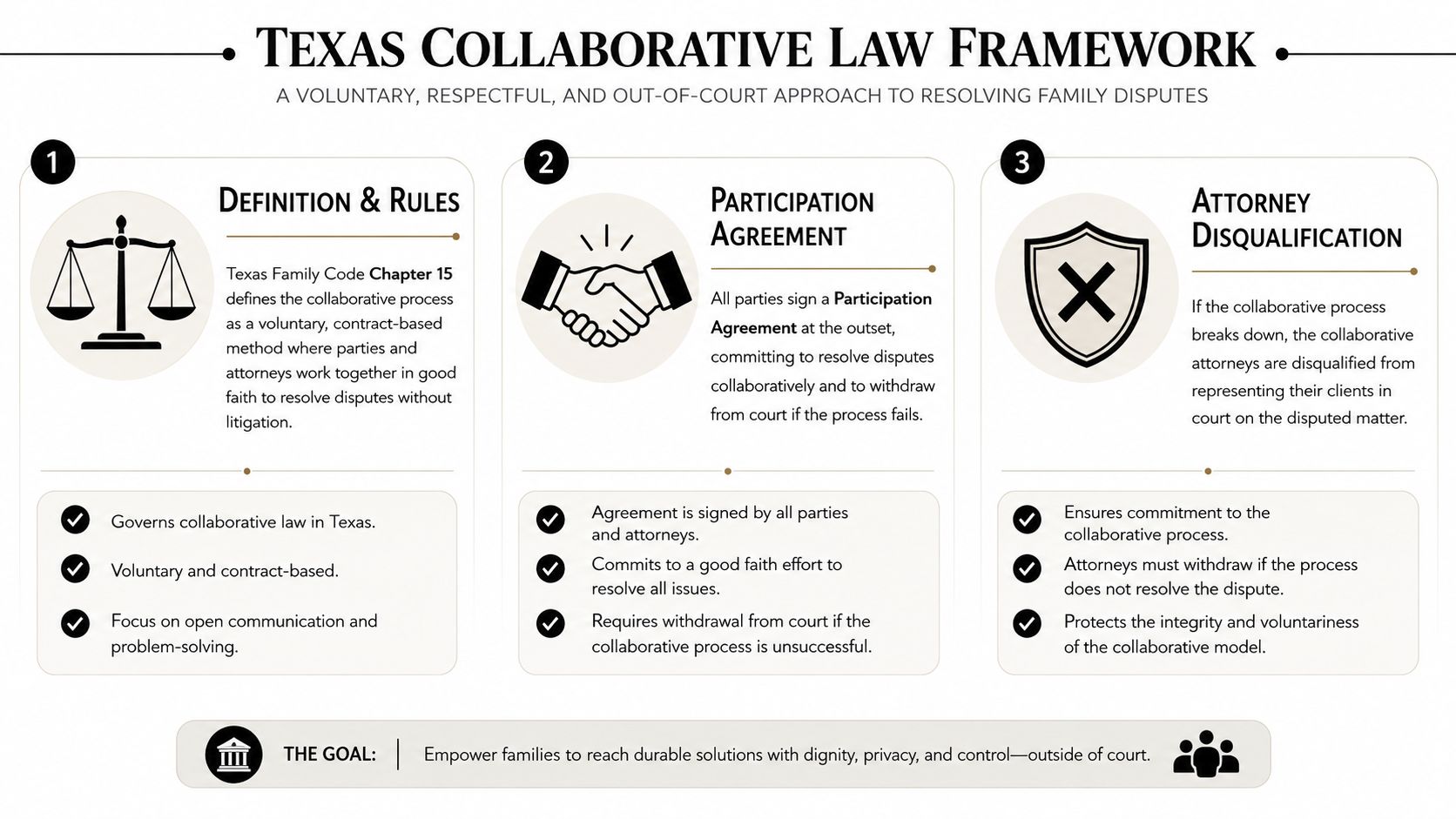
Texas collaborative divorce operates under Chapter 15 of the Texas Family Code. The law defines the process through a written participation agreement, not through informal discussions between spouses or lawyers. Texas codified collaborative divorce through House Bill 3833 in 2011, creating the statutory framework that applies to Kingwood cases. You can review the statute in the Texas Family Code collaborative law provisions.
The participation agreement comes first
Both spouses must sign the agreement, and it must be in a record. It identifies each collaborative lawyer, describes the scope of the matter, and includes a provision suspending tribunal intervention while the process is pending. In plain English, the spouses and lawyers agree to work outside ordinary court intervention while they attempt settlement. The statutory requirements are summarized in Texas Family Code Section 15.101.
The agreement also supports the process's central safeguard. If collaboration fails, the lawyers generally can't switch roles and represent their clients in contested court proceedings. The parties may need new litigation counsel. That possibility encourages everyone to take the process seriously, share information, and avoid tactical threats.
Retained experts are typically expected to serve in a neutral capacity unless the parties agree otherwise in writing. A financial professional may help evaluate assets, debts, cash flow, or valuation questions. A child specialist or other neutral professional may help the parents address the children's needs without turning each parenting disagreement into an accusation.
That team structure distinguishes collaborative divorce from mediation. A mediator facilitates negotiations but doesn't represent either spouse. Collaborative lawyers remain involved as each spouse's legal adviser, while neutral professionals address technical or family-centered questions.
Texas requires informed consent
Before signing, a prospective collaborative lawyer must explain the material benefits and risks of collaborative law compared with litigation, mediation, arbitration, or expert evaluation. The lawyer must also explain that participation is voluntary and may be ended unilaterally, with or without cause. Those requirements appear in Texas Family Code Section 15.111.
For a Kingwood parent, the practical lesson is simple. Don't sign because your spouse, a friend, or a website says collaboration is always better. Sign only after your own attorney has explained what happens if negotiations fail, what information you need to provide, and whether your case requires the support of a Child Custody Lawyer in Kingwood, TX.
Step by Step Through a Kingwood Collaborative Case
A Kingwood couple may agree on the goal of a respectful divorce, yet still face disputes over a home, parenting time, debt, or business income. The collaborative process gives those disputes a planned setting for resolution. It should begin with a candid fit assessment, not a promise that teamwork will solve every case.
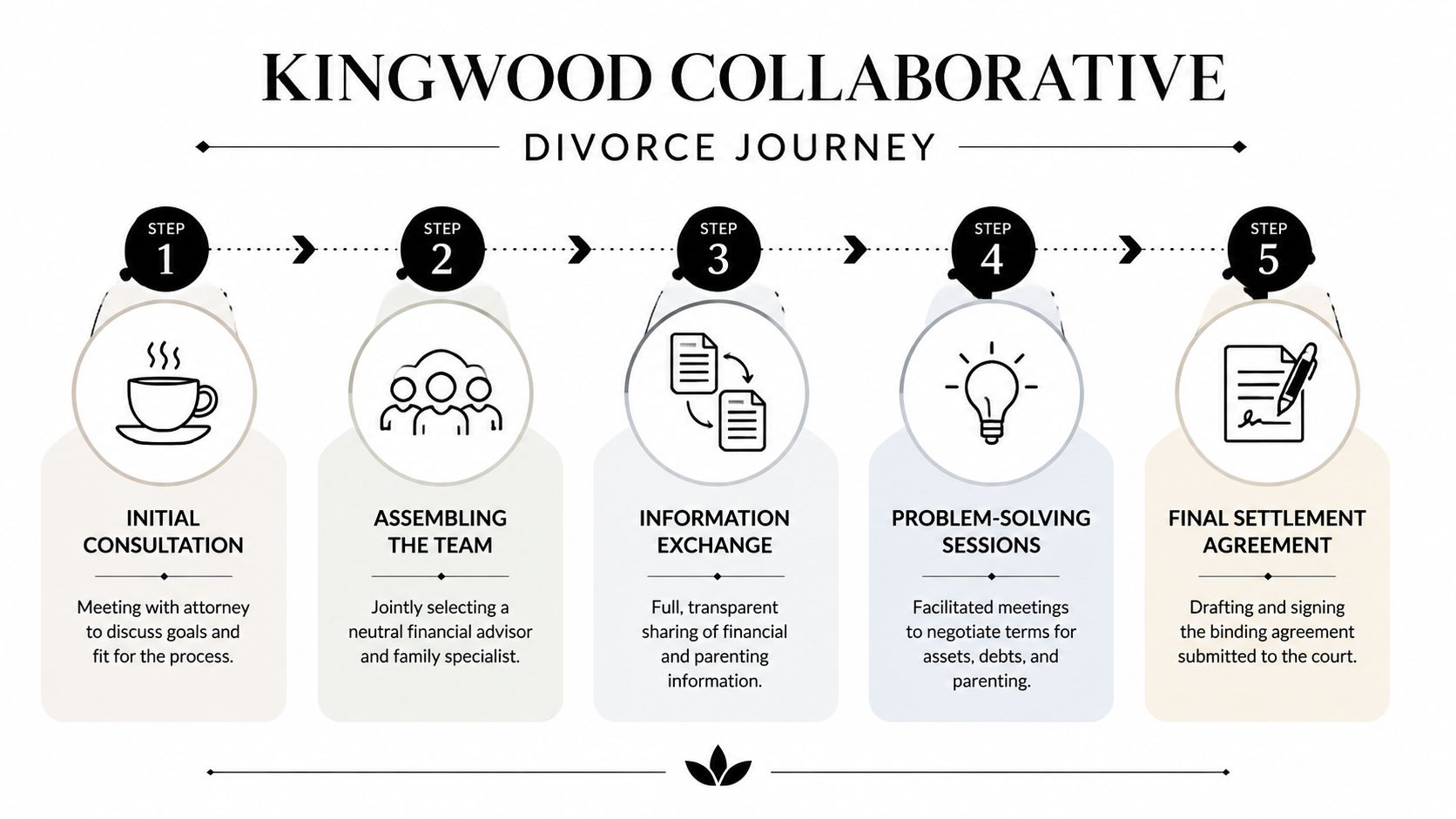
1. Start with separate consultations
Each spouse needs independent legal advice. Your first meeting should cover safety, children, property, debts, income, taxes, business interests, and the result you want the final settlement to achieve. Your attorney should also identify urgent issues, explain the relevant Texas law, and help you compare collaboration with mediation, direct negotiation, or litigation.
Bring records that show the family's financial and parenting situation. You do not need a perfect file before the consultation, but missing information should be identified early.
2. Sign the participation agreement
If both spouses and their attorneys agree that collaboration fits, they sign a written participation agreement. The agreement identifies the lawyers, defines the matter, and establishes the process while collaborative work continues.
The case then centers on settlement meetings instead of contested motions. Disagreement does not disappear. The agreement gives the spouses and professionals a defined way to address it, exchange information, and test possible solutions.
3. Build the right professional team
The spouses and lawyers may jointly engage neutral professionals. A financial specialist can organize records and examine property, debt, income, and future cash-flow needs. A child specialist or divorce coach can address parenting concerns and communication patterns.
Choose professionals for a specific problem, not for appearances. A complex estate may justify a financial neutral. A parenting-heavy dispute may benefit from a child-focused professional. A straightforward case may work better with a smaller team. If the issues are narrow and the financial picture is already clear, mediation may be more practical.
4. Exchange information and negotiate
The spouses share relevant financial and parenting information, then attend structured meetings. Each lawyer advises that lawyer's client, while the neutral professionals help clarify interests and develop workable options. One spouse may need housing stability while the other needs liquidity. A negotiated property division can address both needs more effectively than insisting on an equal division of individual assets.
Parenting discussions should address routines, school needs, transportation, communication, holidays, and future changes. A schedule that appears balanced may fail for a family living between Kingwood, Humble, and Northeast Houston if it ignores work hours, school locations, or transportation demands.
5. Draft and finalize the agreement
After the spouses resolve the issues, the lawyers prepare the settlement agreement and related court documents. Texas law requires the agreement to state prominently that it is not subject to revocation, using boldfaced type, capital letters, or underlining. If that requirement is satisfied, a party is entitled to judgment on the collaborative settlement agreement despite Rule 11 or another conflicting rule, as provided in Texas Family Code Section 15.105.
The final court appearance generally presents the completed uncontested resolution. The judge is not being asked to decide every issue that the spouses already settled.
Texas also sets reporting milestones. If the spouses have not settled within 180 days after signing the participation agreement, a status report is required. If the process continues, another report is due at one year. If the case remains unresolved within two years of filing, the court may set it for trial or dismiss it without prejudice under the Texas framework. These deadlines make early case planning important.
You can also watch this overview of the process:
Collaborative Divorce Versus Mediation and Litigation
No divorce method wins in every Kingwood case. Collaborative divorce is strongest when both spouses can exchange information and negotiate with professional support. Mediation may be more efficient when the issues are limited and both parties already understand the basic financial and parenting picture. Litigation is necessary when a spouse won't cooperate, immediate court protection is needed, or the parties can't negotiate safely.
| Criteria | Collaborative Divorce | Mediation | Traditional Litigation |
|---|---|---|---|
| Privacy | Settlement-focused and generally private, subject to required court filings | Private negotiation, followed by court documents if settlement is reached | Court pleadings and hearings create a more public process |
| Control | Spouses create the outcome with advice from their own lawyers and neutral professionals | Spouses negotiate with a mediator's assistance | A judge decides disputed issues under Texas law |
| Lawyer involvement | Each spouse's lawyer participates throughout the process | Lawyers may attend, advise, or prepare clients depending on the arrangement | Lawyers prepare and present the case in court |
| Complexity | Team-based structure can address interconnected finances and parenting concerns | Often efficient for narrower disputes | Formal discovery and motion practice may be needed |
| If it fails | The collaborative lawyers may be disqualified from continuing in contested litigation | Parties can generally continue with their lawyers, subject to the engagement terms | The case proceeds through the court process |
| Best fit | Cooperative spouses who value privacy, structure, and comprehensive problem-solving | Parties who can negotiate with limited professional coordination | High conflict, urgent, coercive, or information-resistant disputes |
Why mediation may be the smarter choice
Mediation is often the practical answer for an uncontested or moderately disputed divorce. If the home, debts, income, and parenting schedule are clear, adding a full collaborative team may create more coordination than the case needs. Before mediation, review these essential steps before divorce mediation, including gathering records and identifying the decisions that must be made.
Kingwood couples who already communicate well may prefer a mediator's focused assistance and separate legal review. You can also explore divorce mediation in Kingwood when the dispute needs help but not a multidisciplinary process.
Why litigation still has a place
Litigation is not a moral failure. It's the right tool when a spouse hides assets, refuses disclosure, uses intimidation, or creates an urgent need for court orders. A judge can impose enforceable orders involving property, support, possession, or parenting when voluntary cooperation breaks down.
My recommendation is direct. Choose collaboration for structured cooperation, mediation for a simpler negotiated case, and litigation when protection, compelled information, or judicial authority matters more than privacy and flexibility.
Who Collaborative Divorce Fits and When It Falls Short
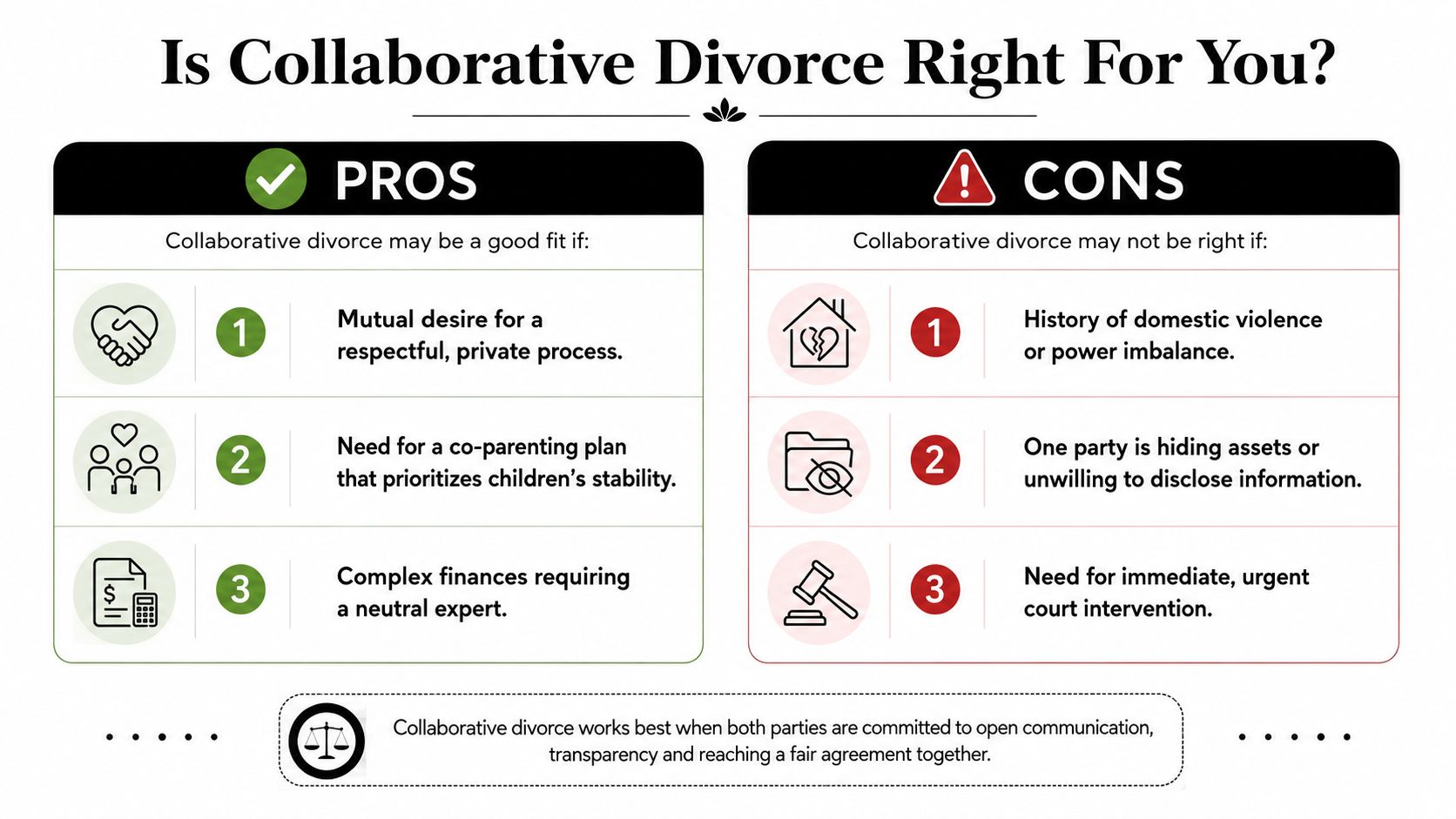
Collaborative divorce tends to fit couples who can disagree without threatening one another. A parent in Kingwood may want a parenting plan that reflects school routines, activities, transportation, and the children's relationship with both parents. A team can help the parents discuss those details directly instead of asking a judge to impose a schedule based on limited courtroom evidence.
The process also has value in complicated financial cases. A family business, multiple properties, retirement assets, or uncertain cash flow can create questions that require more than a quick exchange of account statements. A neutral financial professional may organize the information and help both spouses understand the consequences of different settlement options.
Signs the process may fit
- Cooperative communication: You and your spouse can attend meetings, listen, and respond without turning every issue into a personal attack.
- A privacy priority: You prefer private settlement discussions and want to limit public court conflict.
- Interdependent decisions: Property, support, taxes, and parenting choices affect one another, so a coordinated team would help.
- A continuing family relationship: You'll need to co-parent after the divorce and want to preserve a functional communication channel.
Warning signs to take seriously
Domestic violence, coercive control, a serious power imbalance, hidden assets, or a spouse who refuses to provide records can make collaboration unsafe or ineffective. Immediate threats involving children, property, or personal safety may require court intervention rather than a deliberate settlement process.
You also don't need to choose collaboration merely because you want a respectful divorce. Emotional support can help, but counseling isn't a substitute for legal advice. A practical resource such as this therapy for divorce guide may help you think through the emotional side while your attorney addresses rights and legal options.
If your spouse won't negotiate in good faith, don't let the word “collaborative” pressure you into surrendering necessary protections.
Cost and Timeline Expectations in Kingwood
Collaborative divorce doesn't have a universal price. The total cost depends on attorney involvement, the number of meetings, document complexity, neutral professional fees, valuation questions, parenting needs, and whether the spouses make steady progress.
The team-based structure can cost more than a very simple mediated settlement because the parties may jointly engage a financial specialist, child specialist, or divorce coach. That additional work may be economically rational when it prevents repeated disputes, clarifies complicated assets, or produces a parenting plan the family can follow. It may be unnecessary when the parties have few assets, no significant parenting disagreement, and already understand the issues.
Budget by the work your case needs
Ask your Kingwood attorney to separate the expected categories:
- Attorney work: Individual advice, preparation, meetings, drafting, document review, and settlement implementation.
- Neutral professionals: Financial analysis, valuation assistance, parenting support, or communication coaching when appropriate.
- Case expenses: Record collection, appraisals, document preparation, and court-related filing or presentation requirements.
A responsible lawyer shouldn't promise that collaboration will automatically be cheaper. The process can reduce procedural conflict, but it still requires preparation and professional time. Ask what is included, what triggers additional work, and how the team will avoid duplicating tasks.
Timing follows cooperation and complexity
Texas law creates a structured pace. A status report is required if the case hasn't settled within 180 days, and another report is due at one year if the process continues. If the case remains unresolved within two years of filing, the court may set it for trial or dismiss it without prejudice, as explained in the Kingwood divorce timeline resource.
Those milestones don't promise a result by a particular date. They prevent the process from becoming endless. If your main goal is the fastest possible uncontested resolution and the issues are simple, mediation or an uncontested divorce may be more efficient than assembling a larger team.
Choosing the Right Collaborative Attorney in Kingwood
Your attorney should do more than describe collaboration as peaceful. The lawyer should test whether the process fits your facts and explain what you'll risk if it fails.
Start with training and experience. Ask whether the attorney has collaborative-law training through recognized professional organizations such as Collaborative Divorce Texas, the International Academy of Collaborative Professionals, or another established collaborative-law group. Then ask how often the lawyer works with financial neutrals, child specialists, and divorce coaches in Kingwood, Humble, and Northeast Houston matters.
Questions to take into the consultation
- What makes my case suitable or unsuitable? You want a case-specific answer, not a general sales pitch.
- How do you handle disclosure? Ask how the team identifies missing records and addresses disagreements about valuation.
- What happens if negotiations fail? The lawyer should explain the disqualification structure and the practical need for new litigation counsel.
- Who may join the team? Ask when a neutral financial or parenting professional adds value and when that expense may be unnecessary.
- How are fees handled? Request a clear explanation of attorney billing, neutral fees, meeting preparation, drafting, and additional work.
- How will you communicate? Agree on realistic communication methods and response expectations before signing.
You can also use this guide to choosing a divorce lawyer in Kingwood, Texas to structure your questions.
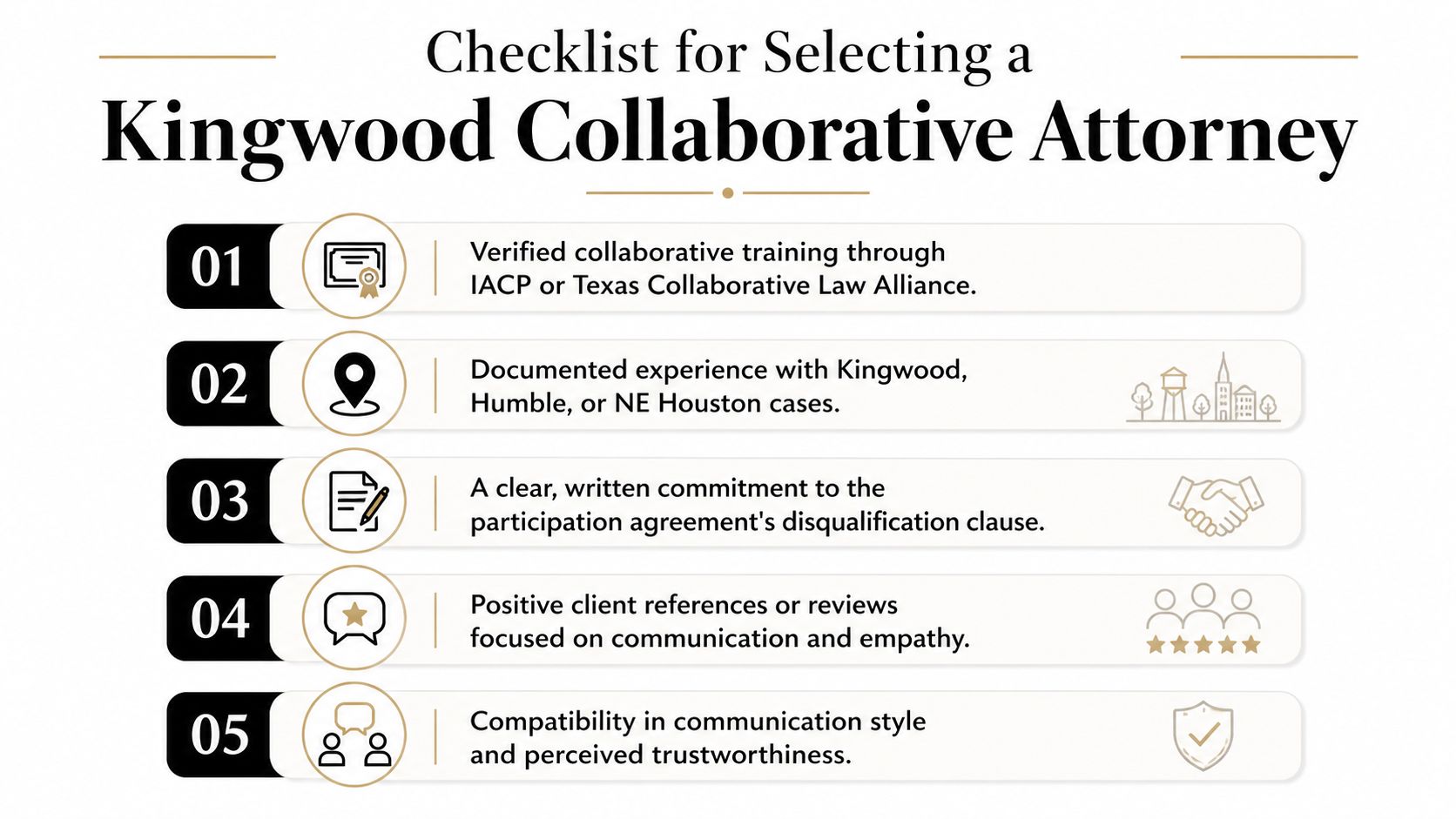
The right fit includes communication style. You'll discuss private finances, parenting fears, and long-term consequences with this person. Choose a lawyer who gives you direct answers, listens carefully, and is willing to say when mediation or litigation would serve you better.
Next Steps and Local Kingwood Resources
Use a simple decision test. If you and your spouse can exchange information, negotiate safely, and need a coordinated solution, ask about collaborative divorce. If the issues are limited and cooperation already exists, ask whether mediation or an uncontested divorce would be more efficient. If there's intimidation, concealment, or an urgent need for court authority, discuss litigation promptly.
For your consultation, bring income records, property and debt information, recent account statements, insurance details, children's school and activity schedules, and a list of the issues you and your spouse can't resolve. Don't delay because your records aren't perfect. A lawyer can help identify what's missing.
The Law Office of Bryan Fagan serves families in Kingwood, Humble, Porter, and throughout Northeast Houston. A free consultation gives you a low-pressure opportunity to discuss the collaborative divorce process in Kingwood, TX and compare it with mediation or litigation based on your actual circumstances.
The Law Office of Bryan Fagan – Kingwood TX Lawyers can help you evaluate collaborative divorce, mediation, uncontested divorce, and courtroom representation under Texas law. Schedule a free consultation at the Kingwood office, bring your questions and available records, and get a practical recommendation for protecting your family, finances, and future.