You may have a will from your first marriage, a retirement account with an old beneficiary form, and a home you bought with your new spouse in Kingwood, Humble, or Porter. On paper, you've planned ahead. In practice, those documents may point in different directions.
That gap creates the central problem in blended family estate planning. A will can say one thing while a retirement account, life insurance policy, joint title, or trust says another. Texas property rules, prior divorce orders, minor children, stepchildren, and a surviving spouse's need for housing can make a seemingly simple plan difficult to administer.
The answer usually isn't another document sitting in a drawer. It's a coordinated plan that connects your family goals, property titles, beneficiary forms, trusts, wills, and family-law orders.
Why Blended Families in Kingwood Need a Different Estate Plan
Consider a familiar Kingwood situation. A widow has two minor children from her first marriage. She later marries again, and she and her new spouse purchase a home in Humble. The new spouse loves the children and helps raise them, but the spouse also has children from a prior relationship. Both adults assume the other understands what should happen if one of them dies.
That assumption can leave everyone exposed. If the widow dies without an effective plan, Texas intestacy rules may not distribute property in the way she expected. A standard will may provide for her new spouse but fail to preserve assets for her children. If the surviving spouse later changes a beneficiary designation or leaves the home to different heirs, the first spouse's children may receive little or nothing.
Blended families have become a meaningful part of family life in Texas and across the country. In Canada, blended families represented 9.0% of couple families with children under 24 in 1995 and 12.4% in 2016, according to the Statistics Canada data discussed in the McGill Law Journal article. In the United States, Transamerica reports that 11.7 million children live in blended families, and that half of households formed by remarriage after divorce have co-resident biological children under 18, as described in its estate-planning guide for blended families.
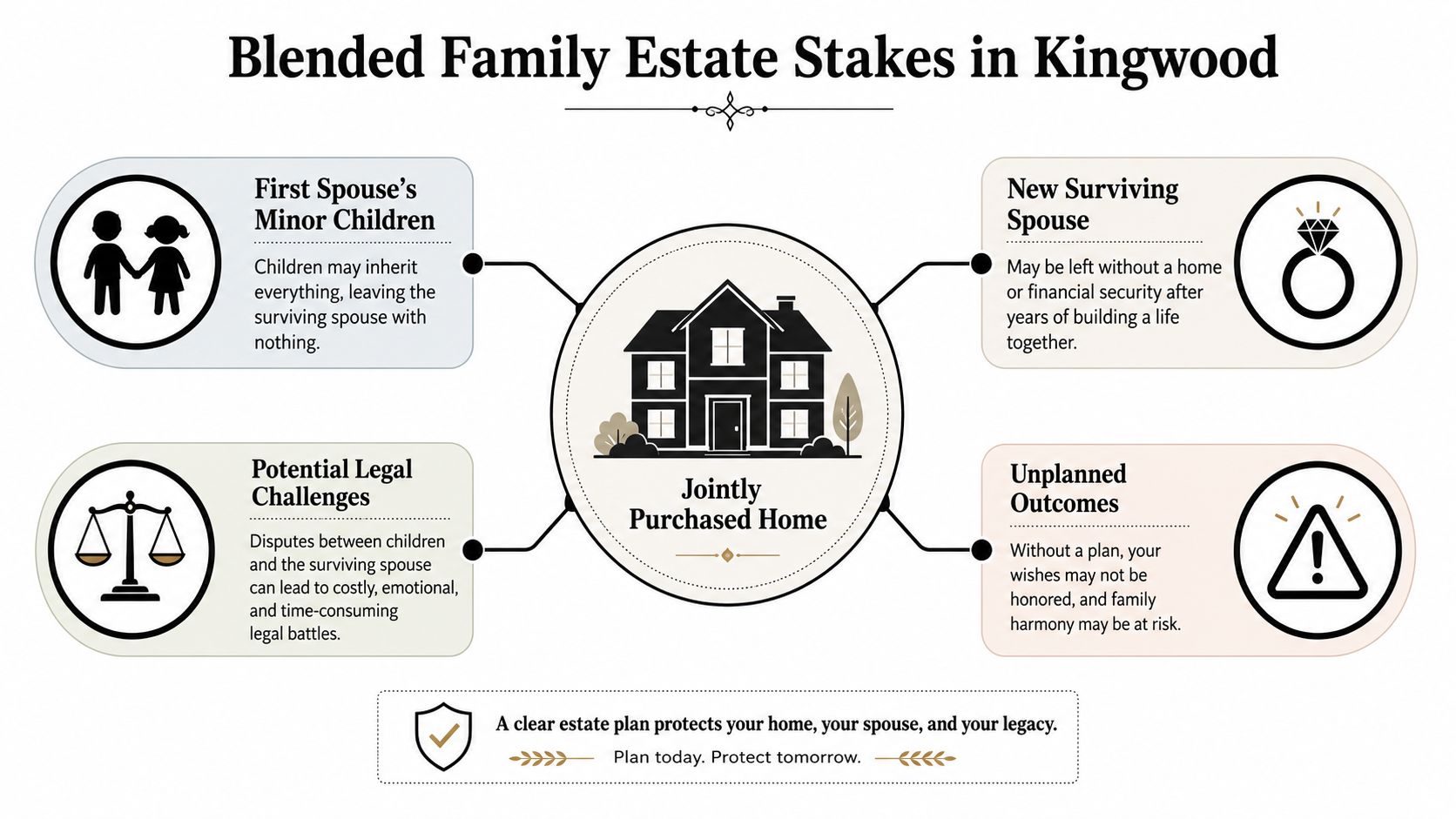
Three pressure points deserve attention
The surviving spouse needs stability. A surviving spouse may need to remain in the family home, use income from investments, and pay ordinary living expenses. A plan that sends property immediately to children may create a housing crisis or force a sale.
Children from prior relationships need protection. A parent may want a spouse supported during life while still ensuring that property eventually reaches the parent's own children. A simple outright gift to the surviving spouse can give that spouse complete control, including the ability to change the eventual recipients.
Stepchildren need deliberate treatment. Under a will, trust, or beneficiary form, stepchildren shouldn't be assumed to inherit just because they're loved and included in daily family life. If you want a stepchild to receive property, name that child clearly and use the right transfer method.
Probate disputes in Harris County can become especially difficult when family members disagree about title, beneficiary forms, capacity, or the meaning of an old will. For a plain-language overview of the issues families should consider, review this blended family will guidance, then treat it as a starting point rather than a substitute for Texas-specific advice.
Mapping Your Goals and Inventorying What You Own
Before anyone drafts a will or trust, write down what you want the plan to accomplish. Asset selection should follow family goals, not the other way around. A Kingwood couple with a home in Porter, retirement accounts, and children from earlier marriages may need a different structure for each category of property.
Start with four questions:
- Who must receive support? List your spouse, biological children, adopted children, stepchildren, and anyone else who depends on you.
- Who should ultimately inherit specific property? Identify whether certain assets should remain with your children, pass to your spouse, or be divided among both family branches.
- What should happen to the home? Decide whether the surviving spouse may live there for life, sell it and move, refinance it, or use proceeds to purchase another residence.
- Who should not receive property? If someone should be excluded, make that decision deliberately and discuss how the documents will express it.
Then prepare a one-page inventory. Include the property's location, approximate ownership, debt, current beneficiary, and the person or trust you believe should receive it.
Build the inventory by asset type
- Real property: List the Kingwood residence, any Humble or Porter property, vacation property, and the deed names. A deed can control ownership independently of a will.
- Retirement accounts: Record every 401(k), IRA, pension, and similar account, along with the current primary and contingent beneficiaries.
- Insurance and investment accounts: Include life insurance, brokerage accounts, annuities, and accounts with transfer-on-death or payable-on-death designations.
- Business interests: Note ownership percentages, operating agreements, buy-sell terms, and who can control the business after death.
- Personal property: Identify jewelry, firearms, collectibles, vehicles, heirlooms, and items with emotional value. A written list can prevent disputes, but it must match the governing documents where necessary.
The key audit question is simple: Does this asset pass through the will or trust, or does it pass directly to a named person? Retirement accounts, life insurance, and many financial accounts transfer through beneficiary instructions. Jointly titled property may pass by survivorship. That means a signed will alone may not reach the asset.
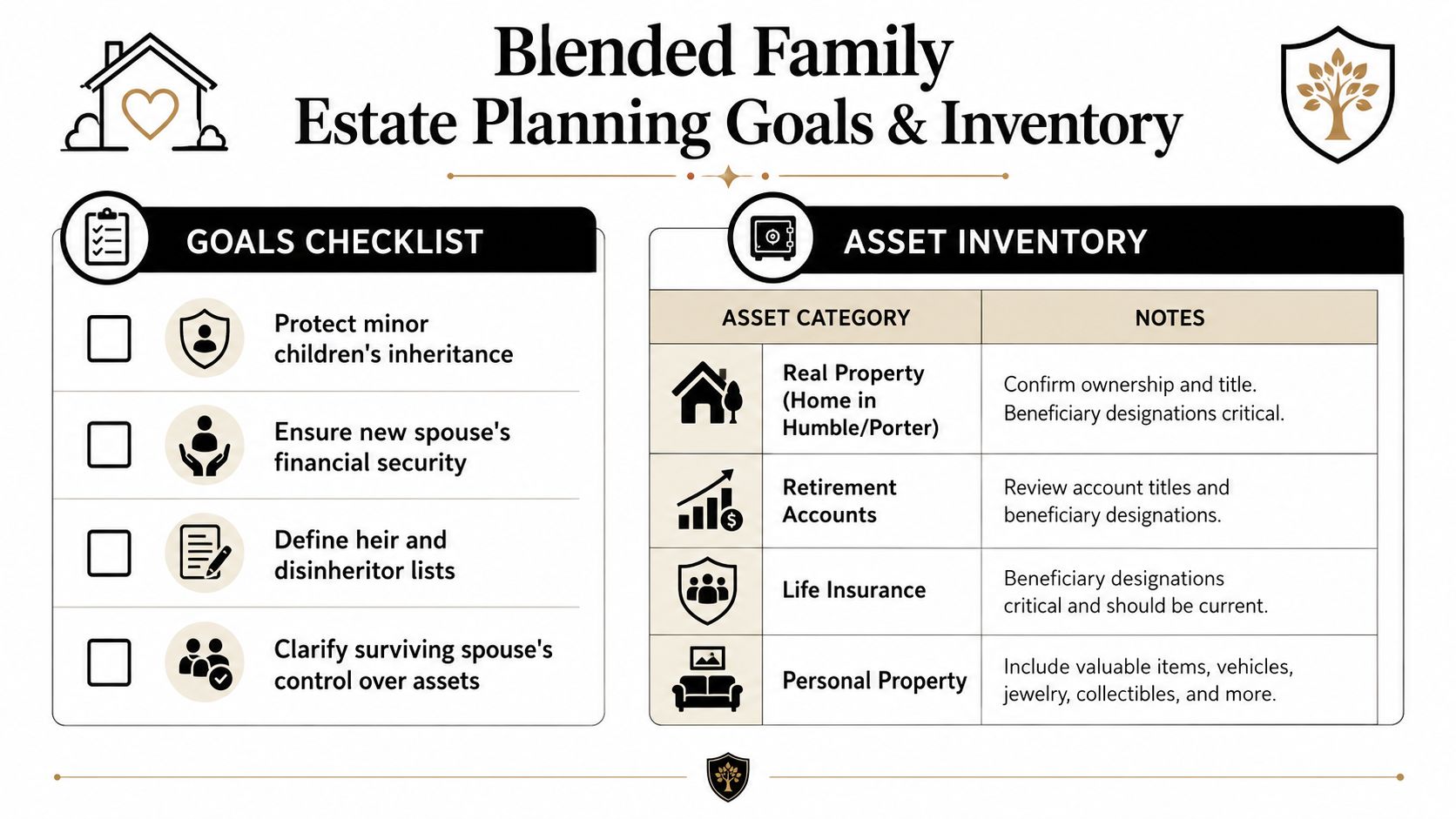
Bring the snapshot to a Kingwood estate planning meeting. If the household also faces family-safety concerns, Protective Orders in Kingwood address protective orders in domestic violence and family safety matters. That issue belongs in the broader family-law conversation, even though it isn't an estate document.
Choosing Between Wills, Revocable Trusts, and QTIP Structures
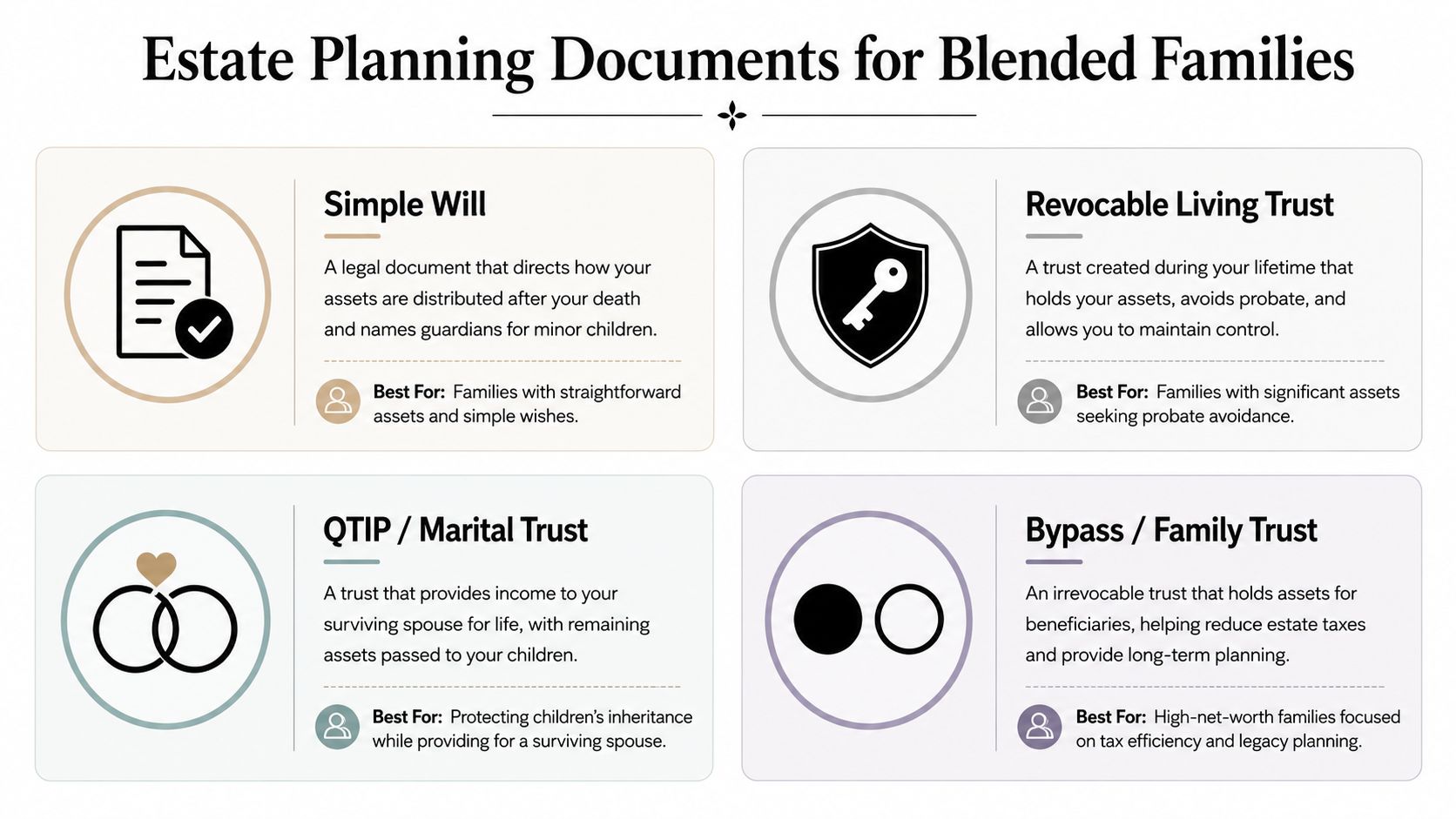
Each planning tool solves a different problem. The mistake is treating a will, trust, and beneficiary form as interchangeable.
A simple will
A will names beneficiaries, appoints an executor, and can nominate guardians for minor children. It's essential for many Texas families, but it generally operates through probate. It also doesn't control assets that pass by beneficiary designation, survivorship title, or another transfer mechanism.
For a first marriage with shared children and straightforward property, a will may be an appropriate foundation. In a blended family, it often needs additional structure because the surviving spouse and children from prior relationships may have competing interests.
A revocable living trust
A revocable living trust can hold property during your lifetime and provide instructions after death. It may help manage assets if you become incapacitated and may keep trust-owned property out of probate. But signing the trust isn't the same as transferring assets into it. The home, accounts, and other property must be titled or designated in a way that gives the trust authority over them.
You can review the practical role of this structure through the firm's information on revocable living trust benefits. A trust is only as effective as its funding and its coordination with beneficiary forms.
A QTIP or marital trust
A QTIP-style marital trust can provide the surviving spouse with income and, when the trust permits it, access to principal for defined needs. The remaining property can then pass to the first spouse's children after the surviving spouse dies. This addresses the common Kingwood concern that a spouse should be able to stay in the home without gaining unlimited power to redirect the inheritance.
A trust can authorize the spouse to occupy the residence, pay expenses from trust assets, or sell the property and reinvest proceeds under stated rules. The drafting details matter because overly rigid terms can make ordinary life difficult, while overly broad discretion can defeat the children's protection.
A bypass or family trust
A bypass or family trust is often paired with a marital trust. It separates the surviving spouse's permitted benefit from the ultimate ownership of the property. The blended-family trust guidance describes bypass and QTIP trusts as a combined strategy, while Schwab also explains the use of a bypass or family trust with a marital trust to protect children from a prior relationship.
| Structure | Main purpose | Common Texas blended-family use |
|---|---|---|
| Will | Names beneficiaries and fiduciaries | Guardianship nominations and property requiring probate |
| Revocable trust | Holds and manages property | Coordinated management and probate avoidance for funded assets |
| QTIP or marital trust | Supports the surviving spouse | Housing and income while preserving a later inheritance |
| Bypass or family trust | Protects the first spouse's intended beneficiaries | Separating spouse's benefit from children's ultimate ownership |
A Kingwood Estate Planning Attorney in Kingwood works with wills, trusts, and estate plans for Kingwood families. The right document stack depends on ownership, family relationships, support needs, and how much control the surviving spouse should have.
This video provides additional general context about estate planning for blended families:
Aligning Beneficiary Designations and Account Titles
The most carefully drafted trust can fail if the assets never reach it. Beneficiary forms and ownership records operate as a separate layer of the plan, and that layer deserves its own audit.
Start by requesting current records for every retirement account, life insurance policy, brokerage account, and bank account with a payable-on-death or transfer-on-death designation. Confirm the primary beneficiary, contingent beneficiary, percentage allocation, and whether the form names an individual or a trust.
Use a written audit
Create a table with five columns:
- Account or property
- Current owner
- Primary beneficiary
- Contingent beneficiary
- Intended result under the estate plan
Compare the last column with the signed will or trust. If the trust should receive an account, ask whether the designation names the trust correctly. If children should receive shares, check whether they're identified individually or through a carefully drafted class description.
A former spouse still listed on an old 401(k) is a classic Texas remarriage problem. An updated will doesn't automatically rewrite that account form. Federal law and plan rules can affect retirement-account beneficiary rights, and the plan administrator's records must be reviewed rather than assumed.
Check titles, not just forms
Review deeds for the Kingwood home, vehicles, brokerage registrations, and business interests. Ask whether property is held individually, jointly, with survivorship rights, or in a trust. Community property and survivorship arrangements can change where property goes after death, so the deed and account agreement deserve the same attention as the will.
Funding a revocable trust means changing ownership or beneficiary instructions where appropriate. Keeping a signed trust document in a safe does not place the home or investment account under its terms.
For a plain-language explanation of the issue, see what a beneficiary designation is. Families also sometimes need a Child Custody Lawyer in Kingwood, TX for custody and conservatorship representation for Kingwood families. That family-law work may affect the people you name as guardians or fiduciaries, but it doesn't replace the beneficiary audit.
Texas Community Property Rules and the Risks of Remarriage
Texas generally distinguishes separate property from community property. Property owned before marriage, along with certain gifts and inheritances, may remain separate property. Property acquired during marriage may be community property, depending on the asset, records, agreements, and applicable legal rules.
A second marriage can make that distinction harder to apply. Suppose one spouse brings a paid-off Kingwood home into the marriage. The new spouse later contributes to mortgage payments, repairs, taxes, or major improvements. Those contributions may raise questions about reimbursement, ownership interests, characterization, and the surviving spouse's rights. Family assumptions should not decide those issues.
Keep separate property on a separate track
A premarital agreement can define property rights before marriage. A partition or exchange agreement may address property during marriage. Draft and execute these agreements carefully, then review them with the will, trust, deeds, and account forms so the documents do not work against one another.
A practical plan might identify a premarital business or inherited account as property intended for the first spouse's children, while separately providing the new spouse with housing, income, or other support. The trust can carry out that arrangement and reduce the chance that the surviving spouse and children must negotiate after death.
Mortgage contributions need particular attention. Paying household expenses does not resolve every ownership question, and a surviving spouse may have rights affecting the home even when one spouse originally owned it. Keep records of payments, improvements, and agreements. Counsel can then analyze those facts under Texas law.
Analyze spousal rights before relying on a waiver
Clients sometimes ask whether a Texas surviving spouse can make a “courtesy election” that overrides the plan. The answer depends on how spousal rights, homestead protections, community-property entitlements, and contractual agreements apply together. A trust may state your wishes, but it cannot override Texas homestead protections, community-property entitlements, or a surviving spouse's statutory right to a family allowance.
The plan should be coordinated before remarriage or as soon as possible afterward. Review the property agreement, retitle assets where appropriate, and fund the trust. Confirm that the surviving spouse receives meaningful support without receiving unrestricted control over assets reserved for the children. The will alone cannot accomplish that result if beneficiary designations, ownership records, or trust funding point elsewhere.
Coordinating Estate Planning With Family Law in Harris County
Estate planning and family law should be reviewed together when divorce, custody, support, or guardianship is part of the family's history. A divorce decree may address property and beneficiary rights, but it doesn't guarantee that every old account form has been updated or that the new estate plan reflects the final court orders.
Begin with the family-law file. Gather the divorce decree, property division orders, child-support orders, custody and conservatorship orders, adoption records, and any agreement affecting inheritance or life insurance. Your estate planning attorney needs to know what obligations already exist before drafting new instructions.
Protect children without contradicting court orders
A will can nominate a guardian for a minor child, but a nomination isn't the same as an automatic custody transfer. If a parent dies, the court considers the child's legal circumstances and applicable orders. The surviving legal parent may have rights that affect who will care for the child.
Child support also belongs in the planning discussion. A parent may need life insurance or trust provisions that help fund ongoing support, but those provisions must fit the existing order and the child's actual needs. Naming a trustee who can manage money for a child may be more practical than giving a minor direct control over property.
Beneficiary forms deserve review after divorce, remarriage, or a major custody change. An old designation can conflict with the property division terms or the parent's current wishes. A coordinated meeting can identify the conflict before a death creates a contested administration.
For local information about court resources and family-law proceedings, visit Harris County family court information for Kingwood residents. The same local legal team may handle family-law concerns, estate documents, probate, and related civil matters, but each issue still requires its own careful analysis.
Family Conversations and a Kingwood Review Timeline
A good plan needs family communication as well as legal documents. Adult children and stepchildren don't need every private financial detail, but they should understand who will serve as trustee, where important records are kept, and how the plan handles the home.
Use simple language: “We want you to know how the house and accounts will be managed if one of us dies.” Then explain the principle, not every dollar or asset. A neutral trustee can reduce pressure on the surviving spouse and children, while a family member with strong loyalties may intensify conflict.
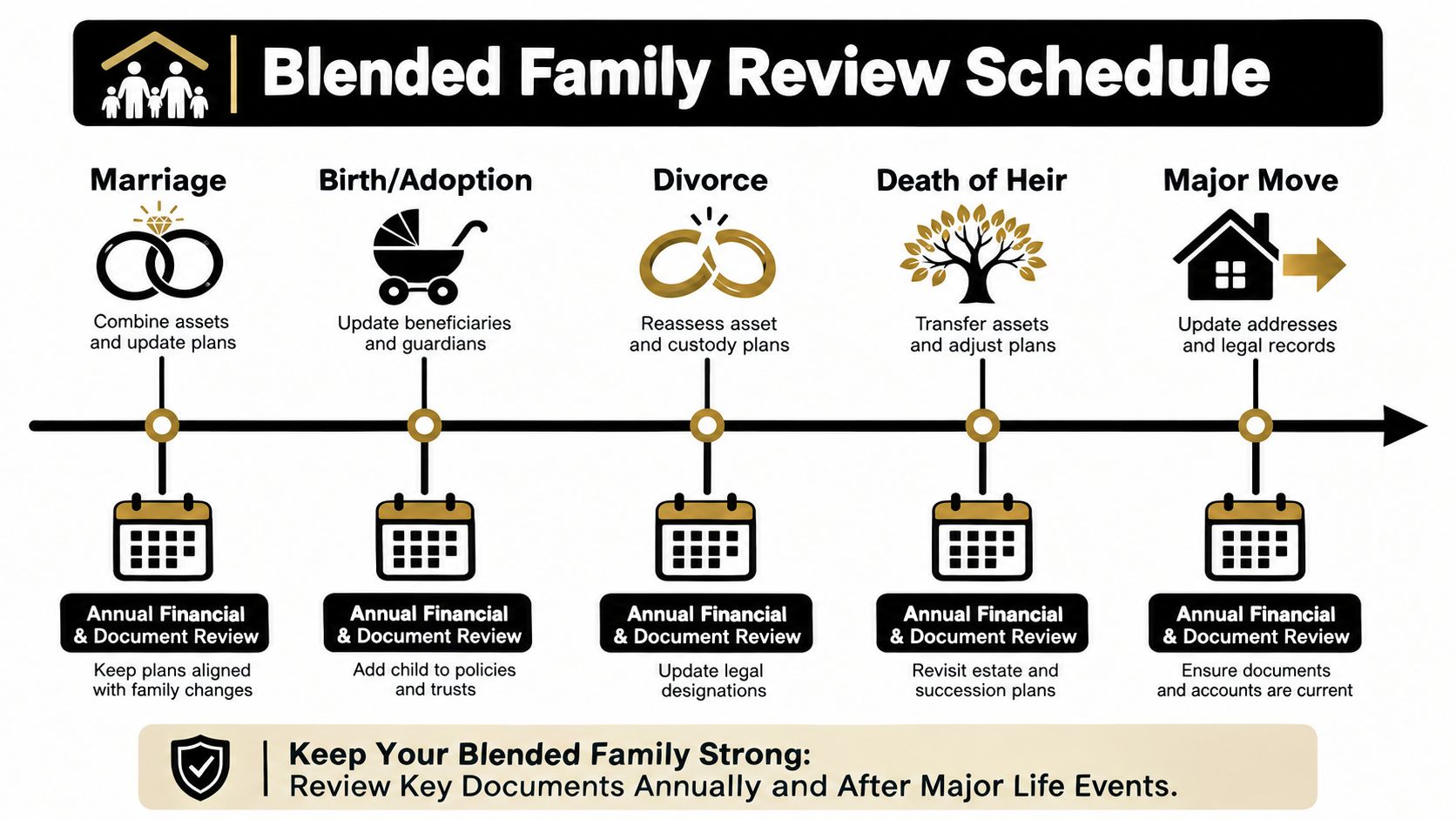
Review the plan after marriage, birth or adoption, divorce, death of an heir, a major move, or a significant change in assets. An annual review should confirm titles, beneficiary forms, trustee information, guardianship choices, and contact details.
Kingwood, Humble, Porter, and Northeast Houston families can schedule a free consultation with the Law Office of Bryan Fagan to compare their family-law orders, property titles, beneficiary designations, wills, and trusts. The goal is a plan that reflects the family you have today, not the family you had before remarriage or divorce.
The Law Office of Bryan Fagan – Kingwood TX Lawyers helps local families coordinate wills, trusts, probate, beneficiary designations, and related family-law concerns. Schedule a free consultation at the Kingwood office to review your blended family plan and identify the documents, titles, and account forms that need attention.