Skip to content
A Kingwood couple may spend years building a social life around a country club, only to discover during divorce that the membership can't be divided in half. One spouse may want to keep playing with the children and friends they share. The other may reasonably expect credit for the membership's economic value, especially if marital funds paid the initiation costs and dues.
Kingwood country club membership division in a divorce requires two separate questions. First, what interest does the membership represent under Texas community-property law? Second, what will the club permit under its bylaws and membership policies? A divorce decree can address the marital value, but the club's written rules may determine who can use the membership after the divorce.
When a Country Club Membership Becomes Part of Your Divorce
A country club membership isn't just a dues receipt. Depending on the membership documents, it may include use rights, an equity interest, a refund or redemption right, or a contractual privilege that can't be transferred. Some memberships may also matter because of access to club facilities, priority within the club's membership system, and the practical value the family attaches to belonging there.
Texas courts have recognized that a membership's value depends on evidence, not on what the couple paid. In a Texas divorce involving a Raveneaux Country Club membership, an appellate court upheld treatment of the membership as having zero value when the evidence showed it couldn't be sold or transferred. The wife argued that it should be valued at $8,500, based on the membership cost and dues paid by the husband's employer, but the court upheld the trial court's decision under the circumstances. (Texas appellate opinion involving the Raveneaux membership)
Practical rule: The amount originally paid is evidence, but it isn't automatically the membership's divorce value.
The four questions that shape the case
A Kingwood or Humble client should begin with these questions:
- When was the membership acquired? A membership obtained during the marriage may be community property, while a membership acquired before marriage may require separate-property analysis.
- Where did the money come from? Initiation payments, transfer fees, and dues may have been paid from marital income, separate funds, or a mixture.
- What does the membership document provide? The certificate, bylaws, and current club policies may reveal whether the interest is transferable, refundable, or personal to one member.
- What will the club allow after divorce? The club may not accept a decree that attempts to create two memberships from one.
That last question causes much of the confusion. A membership can be a marital asset for property-division purposes while remaining a single club account that only one former spouse may use. Resolving the issue early can prevent the couple from spending time and money arguing for a result the club won't implement.
Community Property Versus Separate Property in Texas
A Kingwood couple may agree that one spouse should keep the country club membership, while the club recognizes only one account under its bylaws. Divorce law answers a separate question: whether the membership interest, or its financial value, belongs in the marital estate.
Texas law begins with a straightforward framework. Community property generally includes property acquired during the marriage with community funds. Separate property generally includes property owned before marriage or received individually as a gift or inheritance. Community property is divided in the divorce, while separate property remains outside the marital estate. The Texas State Law Library's explanation of property division in divorce describes this framework.
Apply those rules to a Kingwood Country Club membership. If the couple joined during the marriage and paid the initiation cost from marital income, the membership or its economic value will commonly be treated as community property. That classification does not require the club to issue two memberships. Instead, the marital estate may need to account for the benefit or value connected to the single account the club permits.
What can change the initial classification
Texas generally presumes that property possessed during or after the marriage is community property unless a spouse proves otherwise. Records can change that result:
- Premarital purchase records: A membership agreement and financial records may support a claim that one spouse acquired the interest before marriage.
- Gift or inheritance records: A spouse may argue that separate funds paid the initiation cost if the money can be traced from the gift or inheritance into the membership. See our guide to separate property tracing in a Kingwood divorce for how that documentation works.
- A marital agreement: A valid prenuptial or postnuptial agreement may address how particular property interests are characterized or divided. Prenuptial & Postnuptial Agreements in Kingwood involves drafting and reviewing marital property agreements for Kingwood clients.
The purchase date, source of the initiation funds, and payment history for dues may matter more than the membership certificate. The certificate may identify the member, but it does not necessarily show who supplied the money or which rights the membership carries.
Why separation does not end the inquiry
The date spouses began living separately is not automatically a cutoff for every community-property question. Income, payments, reimbursements, and membership changes may continue afterward and affect the accounting. Keep statements and records for the entire relevant period instead of assuming the financial picture ended when one spouse left the Kingwood home.
How a Kingwood Country Club Membership Is Actually Valued
Valuation begins by identifying what the family owns. An equity membership may include a measurable financial interest, such as a right connected to resale, redemption, or a club buyback. A non-equity membership may provide use rights without ownership value. If the membership can't be transferred or redeemed, its practical value may be limited even when the couple paid substantial initiation costs.
The club's membership office is often the best starting point. Before a lawyer or financial professional assigns a number, the parties should request the current transfer rules, redemption terms, dues obligations, assessment information, and any records of permitted transfers. A Texas family-law discussion of country club memberships identifies comparable transfers, buyback or redemption pricing, replacement cost, and net liquidation value as relevant valuation benchmarks. (Country club membership valuation discussion)
Four benchmarks that may matter
Comparable transfers can show what members have paid when the club permits transfers. Those comparisons must involve the same club or a comparable interest, not a different club with a different membership structure.
A buyback or redemption price may provide a more concrete figure if the club itself has a written program. The value may be reduced by applicable charges or conditions.
Replacement cost asks what it would cost to obtain a similar club membership or comparable access. This can be useful when no resale market exists, but it may describe the cost of a substitute rather than the value of the existing membership.
Net liquidation value considers what would remain after permitted transfer expenses, commissions, or other deductions. If the club forbids a sale, the liquidation analysis may support a very low value or no transferable value.
| Valuation Benchmark | What It Measures | When It Applies | Practical Caveat |
|---|---|---|---|
| Comparable transfers | Actual permitted transactions | When the club allows comparable transfers | A different membership category may not be a fair comparison |
| Buyback or redemption price | What the club may pay or return | When written club terms provide a buyback or redemption | Conditions and deductions can affect the result |
| Replacement cost | Cost of obtaining similar access | When no reliable resale market exists | Replacement cost isn't automatically resale value |
| Net liquidation value | Amount remaining after permitted costs | When resignation or liquidation is available | A transfer ban can eliminate a liquidation market |
The goal isn't to force an attractive number into the settlement. It's to identify the value that the membership can realistically produce. A property division resource for Kingwood divorces can help clients organize the broader marital estate so the membership is evaluated alongside the home, retirement accounts, investments, and other assets.
Why Club Bylaws Often Control the Outcome
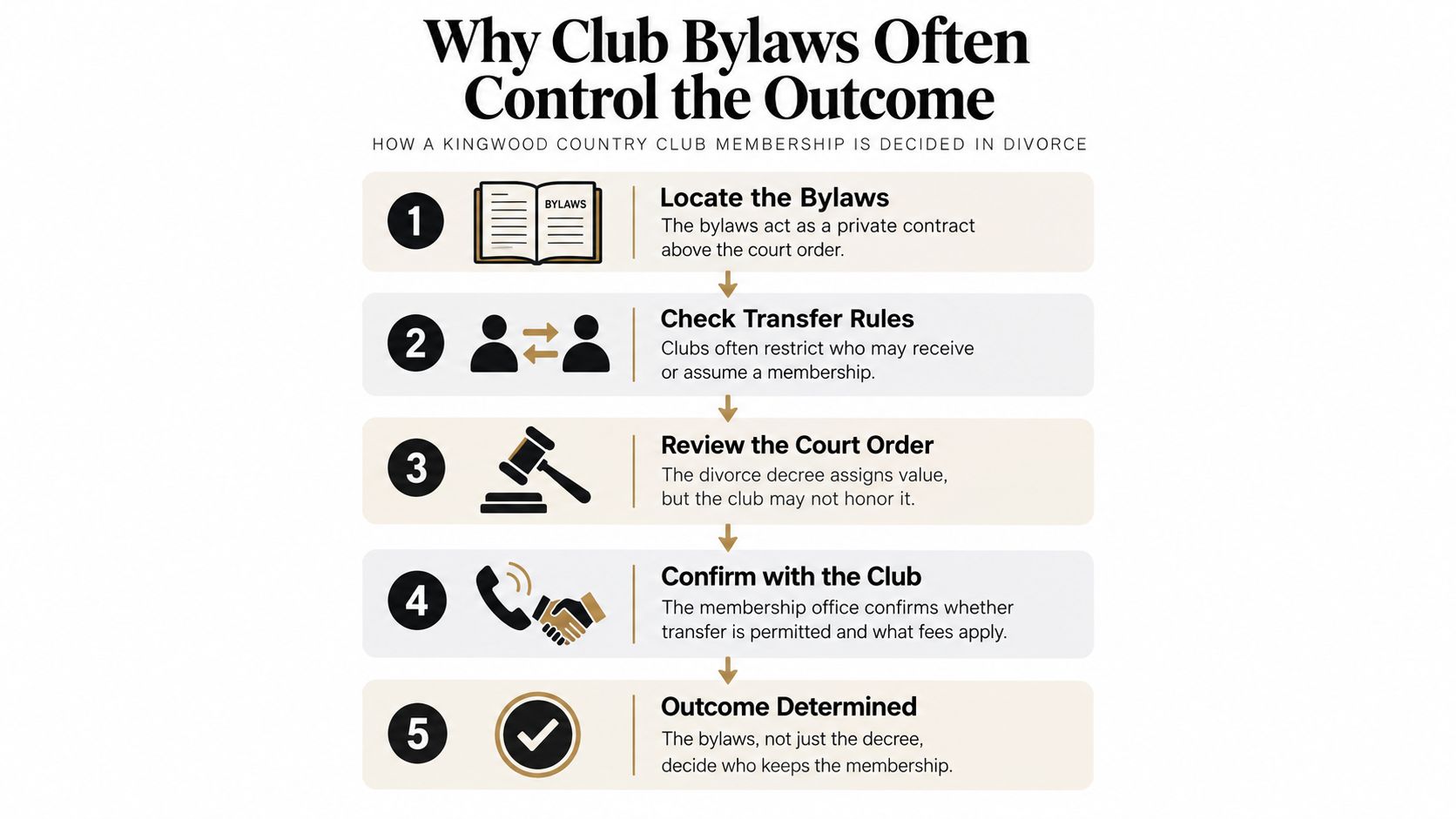
A divorce court divides marital property, but a private club controls its membership system through its governing documents. That distinction matters. The court may award the membership to one spouse, yet the club may still require notice, approval, resignation, reapplication, or compliance with its own transfer process before recognizing the result.
One country club's bylaws state that a membership “shall not be partitioned or divided” by a divorce decree and that one spouse loses membership privileges when the divorce becomes final. The same bylaws allow the divorced spouse to apply separately and pay the initiation fee for the new category sought, along with applicable dues. (Country club bylaws addressing divorce and membership rights)
Three restrictions to look for
Transfer clauses may prohibit assignment to a former spouse or another person without club approval. A court can decide which spouse receives the marital interest, but it may not be able to compel the club to accept a person who doesn't satisfy the club's rules.
Reapplication rules may treat divorce as a new membership event. The nonmember spouse might have to submit an application, meet the club's requirements, pay a new initiation fee, and accept the membership category the club offers.
Notice requirements may require the member to tell the club about the divorce by a specified process. Ignoring notice obligations can create uncertainty about dues, assessments, privileges, and the effective date of a change.
A Texas club bylaw illustrates another common structure. It provides that a membership can't be partitioned into two memberships, and the decree may award exclusive use to either spouse. If the decree doesn't do so, the membership remains with the originally elected member. (Texas club bylaw on exclusive membership use after divorce)
The practical lesson for a Kingwood divorce is simple: read the bylaws before negotiating the property settlement. A judge may divide the economic value on paper, while the club determines who can use the facilities on Saturday.
Settlement Options Buyout Offset and Co Ownership
Most couples have three practical paths. The right choice depends on the membership's actual value, the club's rules, each spouse's liquidity, and whether continued contact would create more conflict than convenience.
Buyout
A buyout allows one spouse to keep the membership and compensate the other for the agreed value. Payment may come from available cash, another investment, or an agreed payment structure. The spouse keeping the membership generally assumes future dues and other obligations, but the decree and settlement agreement should say exactly when that responsibility begins.
A buyout is clean when the membership has a supportable value and one spouse has the resources to pay. It becomes difficult when the membership has no established resale market, when the club must approve a transfer, or when the proposed owner can't satisfy the club's requirements.
Offset
An offset awards the membership to one spouse while giving the other spouse additional value from another part of the community estate. The offset might involve home equity, retirement assets, or another property interest. This approach avoids forcing a sale of a membership that can't be sold.
The parties must compare assets carefully. A retirement account, home interest, and club privilege don't necessarily have the same liquidity, tax treatment, or future risk. A settlement can look equal on paper and still feel unfair if one spouse receives an asset that can't be accessed easily while the other receives readily available funds.
Co-ownership or shared use
Shared use is possible only if the club's rules permit it. One Texas club policy provides that only one spouse may retain the membership after divorce, with the decision made by agreement or judicial determination. Until that decision, the former spouses may remain jointly and severally liable for dues, fees, and other charges. (Texas club rules addressing post-divorce membership and liability)
| Option | How It Works | Best For |
|---|---|---|
| Buyout | One spouse keeps the membership and pays agreed value to the other | Couples with a supportable value and available liquidity |
| Offset | One spouse keeps the membership and receives less of another community asset | Couples who want to avoid a cash payment or sale |
| Shared use | Both former spouses use the membership if club rules allow it | Former spouses who can cooperate and obtain club approval |
A Divorce Lawyer in Kingwood, TX provides divorce representation for clients in Kingwood and Harris County. Regardless of counsel chosen, the agreement should address dues, assessments, club communications, transfer paperwork, indemnity, and what happens if the club rejects a proposed arrangement.
Negotiation Strategies That Work for Kingwood Clients
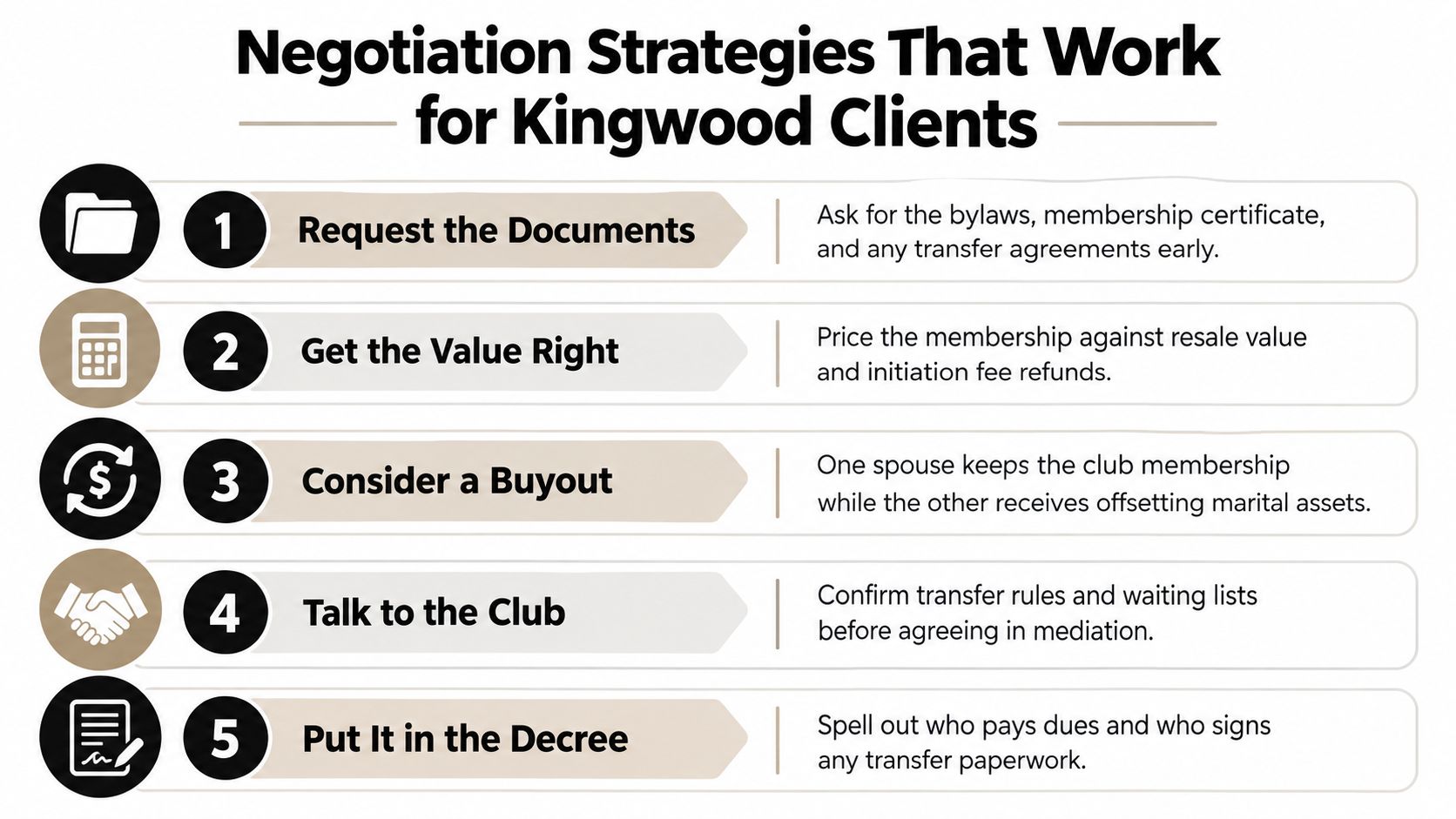
Start with documents, not assumptions. Ask the club for the current bylaws, membership certificate, transfer policy, reapplication materials, and written information about resignation or redemption. A club's informal statement may help, but the written rules should guide the settlement language.
Build a usable valuation file
Collect initiation-fee receipts, dues statements, capital-assessment records, and communications from the membership office. Bank and brokerage statements can help establish whether the initiation payment came from community funds or a traceable separate-property source. Keep the records dated and organized so the discussion doesn't depend on memory.
A negotiation position becomes stronger when it recognizes liquidity. If the membership can't be sold, demanding a cash payment based only on the original initiation cost may not persuade the other spouse. An offset against home equity or another community asset may offer a more workable solution, particularly when neither spouse wants to risk a club rejection or a forced resignation.
Put the assumptions in writing
A settlement should identify the membership category, the spouse who will seek or retain membership, and the steps required for club approval. It should also address what happens if the membership committee denies an application or refuses a transfer. Without that language, the parties may finish the divorce with a property award that can't be implemented.
A temporary shared-use period may help both spouses transition, but it should have clear dates, scheduling rules, and payment responsibilities. Don't assume that a temporary agreement binds the club. Confirm the arrangement with the membership office before relying on it.
Negotiation focus: Treat the membership as one part of the entire balance sheet. A workable offset may resolve the dispute more effectively than an argument over an uncertain resale figure.
The same approach helps clients in Humble, Porter, and Northeast Houston who have other complex assets. The membership should be negotiated alongside real estate, retirement accounts, business interests, and debt, not treated as an isolated symbol of the marriage.
Questions to Ask a Kingwood Divorce Attorney and Next Steps
Bring focused questions to the first meeting. A useful consultation should help you understand both the Texas property analysis and the club's operational rules.
Questions about ownership and value
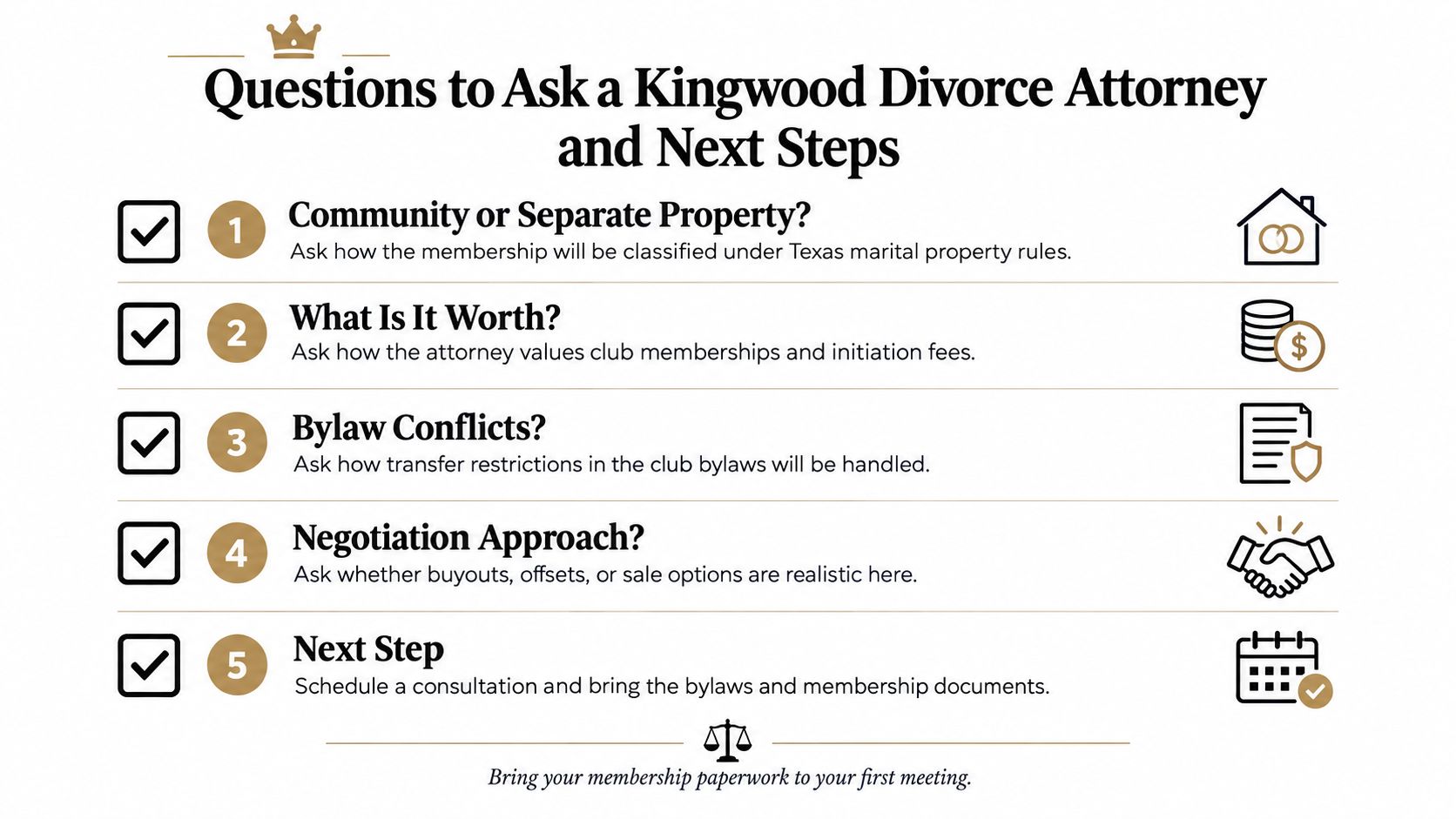
Ask whether the membership is likely to be community property, separate property, or partly both. Explain when it was acquired, identify who paid the initiation cost, and bring records showing how dues and assessments were paid.
Ask whether the membership is equity or non-equity, whether it can be transferred, and whether the club offers a buyback or redemption process. You should also ask which valuation method fits the available evidence, such as comparable transfers, a club redemption figure, replacement cost, or net liquidation value.
Questions about the bylaws and settlement
Ask which provisions address divorce, notice, reapplication, exclusive use, dues, assessments, and liability. Then ask whether the proposed divorce decree can be implemented by the club or whether the settlement needs a buyout, offset, resignation, or separate application.
Discuss realistic outcomes:
- Buyout: Can one spouse pay an agreed value without creating another financial problem?
- Offset: Could home equity, retirement funds, or another asset balance the membership interest?
- Shared use: Does the club allow it, and can both spouses follow detailed rules after divorce?
- Fallback plan: What happens if the club denies a transfer or refuses the proposed membership arrangement?
Gather the membership certificate, bylaws, transfer and reapplication policies, initiation-fee receipts, dues statements, assessment notices, and relevant bank records. Also tell counsel about any marital agreement, gift, inheritance, or premarital ownership claim.
Texas has timing rules that can affect fraud allegations and other divorce issues, so don't wait to ask about deadlines. A Kingwood family law attorney can review the documents, explain the available paths, and help you decide whether negotiation, mediation, or litigation is appropriate.
The Law Office of Bryan Fagan – Kingwood TX Lawyers can review your membership documents, address Texas property division, and negotiate a buyout or offset that fits the rest of your marital estate. Schedule a free, confidential consultation by visiting Law Office of Bryan Fagan – Kingwood TX Lawyers, serving Kingwood, Humble, and Northeast Houston in family, estate, criminal, and civil legal matters.