Skip to content
Harris County's historical record includes 12,635 eminent-domain acquisitions and 2,259 completed buyouts, but the immediate legal answer for a divorcing Kingwood homeowner is that a flood-control buyout can turn the marital home into cash proceeds that must be addressed in the divorce. Timing, title, and the wording of the Final Decree of Divorce determine who can act and how the money is divided.
A Kingwood spouse may be trying to negotiate custody, arrange separate living expenses, and protect a child's routine when a Harris County Flood Control District notice arrives. The notice may offer to acquire the family home, or it may signal that the County is moving toward an eminent-domain case. Either way, signing documents or accepting payment without coordinating the transaction with the divorce can create a property dispute that lasts well beyond closing.
This issue is different from an ordinary home sale. The home may no longer be worth treating as a house in the divorce once the buyout process is underway. The parties need to identify whether the asset is still land and improvements, a pending claim, or money ready to be distributed. Residents of Humble, Porter, and Northeast Houston face the same concern when a flood-control acquisition overlaps with a pending or recently completed divorce.
When a Flood Buyout Meets a Pending Divorce in Kingwood
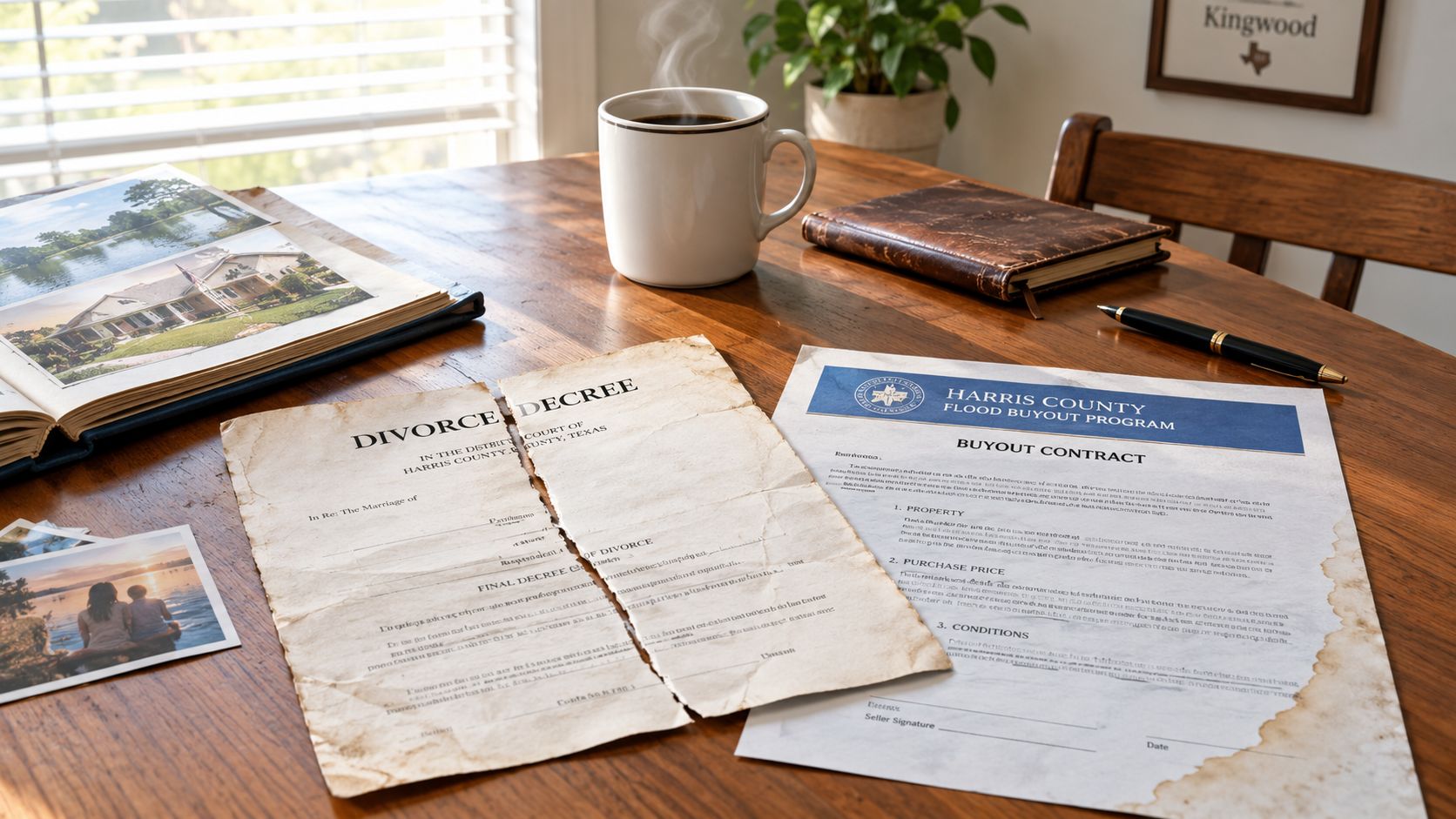
A Kingwood homeowner receives a Harris County flood-control notice while a divorce is pending. Both spouses remain on the deed, one spouse lives in the house, and the other spouse has moved to Humble. The proposed acquisition may look like a practical way to leave a flood-prone property, but the notice immediately raises harder questions. Who may negotiate with the County? Does both spouses' consent matter? Can one spouse sign the closing papers? Is the payment community property, separate property, or a disputed marital asset?
Those questions shouldn't wait until the closing appointment. A divorce filing doesn't automatically give one spouse authority to sell or release the other spouse's interest in community real estate. Temporary orders, a mediated settlement agreement, a partition agreement, or a later Final Decree of Divorce may change what each person can do, but the exact language matters.
The immediate risk
The practical mistake is treating the buyout as “my house” or “my money” before the marital-property analysis is complete. A home acquired during marriage is generally presumed to be community property unless a spouse proves a separate-property claim. The parties may still disagree about reimbursement, debt payments, improvements, or the value of a separate contribution.
Practical rule: Don't sign a buyout agreement, counteroffer, deed, or closing instruction until the divorce pleadings and property records have been reviewed together.
Harris County residents can learn more about the related property-division concerns in this discussion of flood-damaged home division in a Texas divorce. The important point is that a pending buyout creates a moving asset. The value and form of the property may change while spouses are still negotiating their divorce.
Why waiting creates leverage problems
If one spouse controls the communications with the County, that spouse may receive the offer, negotiate valuation, or learn about title problems before the other spouse does. That imbalance can make settlement more difficult, particularly in a contested divorce. It can also leave the parties arguing about whether the money was received before or after the marriage legally ended.
For a Northeast Houston family, the safest approach is to notify divorce counsel promptly, preserve every County communication, and ask for temporary orders or settlement language that addresses the property. The sooner the legal and buyout timelines are aligned, the less likely a closing delay or post-divorce accounting dispute becomes.
Understanding the Legal Nature of Harris County Buyouts
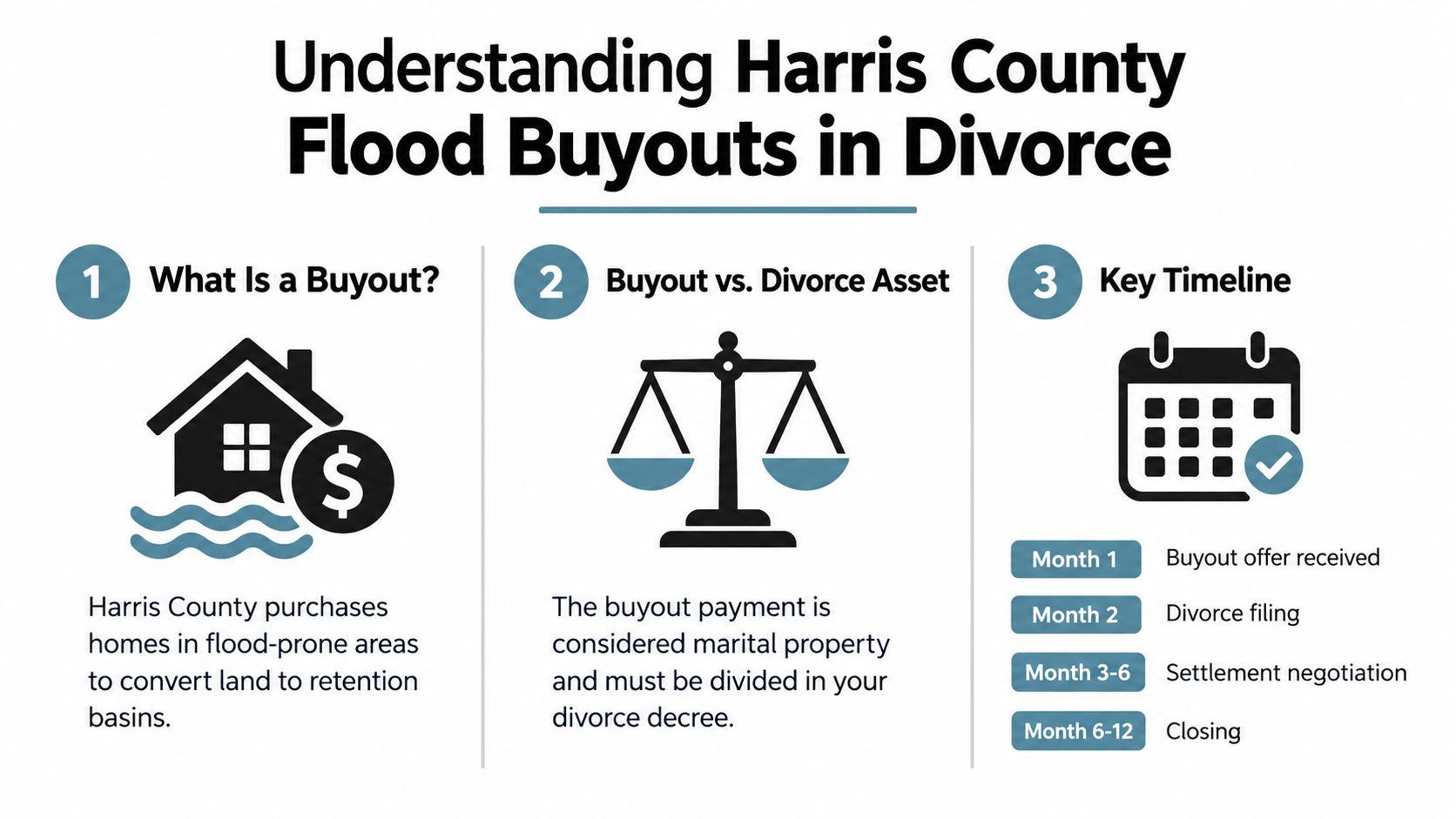
A Harris County flood-control buyout is a mitigation acquisition, not just a disaster-recovery payment. The Flood Control District describes acquisitions aimed at homes in areas several feet deep in the floodplain where channel improvements or detention basins aren't cost-effective. After acquisition, the structure is removed, utilities are capped, the land is leveled, and FEMA grant conditions restrict future private development. The Harris County Flood Control District home buyout materials explain why the transaction permanently changes the property's future use.
That distinction matters in a divorce because the asset changes form. Before closing, the spouses may own a homestead with a mortgage, taxes, insurance, maintenance costs, and occupancy issues. After closing, they may be dealing with net cash proceeds, liens, relocation expenses, and a parcel that cannot return to ordinary private development. A decree that divides only “the house” may not adequately address what happens when the County acquires it.
Voluntary acquisition versus eminent domain
A voluntary buyout depends on an agreement between the owner and the public entity. The parties still need to resolve title, authority, valuation, and closing terms, but the owner generally has a negotiated transaction rather than a condemnation judgment. That doesn't mean one spouse can accept the offer for both spouses without addressing ownership and the divorce court's orders.
Eminent domain follows a different path. Harris County states that it performs a title search and works through title issues, and County materials indicate that an owner who disagrees with an offer may face eminent-domain litigation. In that setting, the dispute may involve the County's authority to acquire the property and the amount of compensation, while the divorcing spouses still have an independent dispute over how the compensation should be allocated.
The two proceedings can overlap without resolving each other. A condemnation case may establish compensation, but it doesn't automatically decide how divorcing spouses divide the marital estate. Likewise, a divorce decree may allocate the economic benefit between spouses without eliminating every title or possession issue the County must clear before closing.
The title search is a practical checkpoint
A title search can reveal both spouses, prior deeds, liens, probate interests, or divorce documents that affect the transaction. If the decree contains a restriction on sale, assigns the property to one spouse, or requires cooperation, the County and the spouses need clear instructions about who signs and when.
The same discipline applies to other family-law financial issues. For example, a Child Support Attorney in Kingwood addresses establishing, modifying, and enforcing child support in Harris County. That issue is separate from buyout proceeds, but both require accurate orders and careful attention to the family's actual financial circumstances.
How Texas Law Classifies Buyout Proceeds in Divorce
Texas courts divide the marital estate in a manner that is just and right, not necessarily in an exact equal split. Texas Law Help explains that a Final Decree of Divorce identifies community assets and debts, states what each spouse keeps, and may require a property sale with instructions for distributing the proceeds. The Texas divorce decree guidance also describes the decree as the order that ends the marriage and addresses the marital estate.
For a Kingwood family, classify the buyout proceeds through a deliberate sequence.
Identify the property's character. Determine when the home was acquired, how title was taken, and whether either spouse claims separate-property ownership or reimbursement. A home purchased during the marriage is commonly treated as community property unless the separate-property claim is proved.
Identify the transaction stage. A signed offer isn't the same as a completed closing. The property may still be subject to a mortgage, tax obligation, insurance expense, title issue, or disagreement over the County's valuation. The decree should reflect whether the parties are dividing real estate, a contract right, or cash proceeds.
Identify the deductions. The parties should specify whether mortgage payoff, delinquent taxes, valid liens, title-clearing expenses, and agreed transaction costs come out before the division. “Split the money” leaves too many questions unanswered.
Choose the distribution method. One spouse might receive the net buyout funds while the other receives an offsetting retirement account or other asset. Alternatively, the decree might direct a percentage or specific allocation after defined deductions.
Why the final decree matters
The signing of the Final Decree of Divorce is the key legal milestone. Negotiations, informal promises, and trial findings don't provide the same practical certainty as enforceable decree language. A Texas Supreme Court source describes a divorce decree as a final judgment, and Texas procedure may still address community property omitted from the original judgment. That possibility is not a substitute for careful drafting.
A decree that says one spouse receives “the residence” can become ambiguous if the residence has already been acquired and demolished. A decree that awards “all proceeds” without defining the account, deductions, and cooperation duties can create a later enforcement dispute. The more precisely the document identifies the buyout, the less room remains for either spouse to reinterpret the bargain.
For a detailed treatment of this issue, see the guidance on FEMA flood buyout proceeds in a Texas divorce. The legal objective isn't to force an equal split in every case. It is to give the court or the spouses enough information to divide the estate in a way that is supported, enforceable, and genuinely just and right.
Two Approaches to Handling Buyouts in Your Decree
A pending buyout usually calls for a choice between fixing the property's value now and treating the acquisition as a future liquidation. Neither method works in every case. The right choice depends on the County's offer, the parties' agreement, the property's debt, the likelihood of closing, and whether the divorce is contested.
| Approach | Best For | Key Requirement |
|---|---|---|
| Assign a fixed value now | An uncontested case where the spouses agree on present value and one spouse will receive the property interest | A reliable appraisal and an offset that accounts for debt and other marital assets |
| Defer division until closing | A pending, disputed, or uncertain acquisition where the final payment and deductions aren't known | Detailed contingent language covering authority, expenses, proceeds, and cooperation |
Assigning a fixed value
The first approach treats the home as an asset with a current market value. An appraisal can support that value, while the decree assigns the property to one spouse and gives the other spouse an offset or other marital asset. This can make the divorce easier to finalize when both spouses agree that the appraisal fairly reflects the property.
The weakness is that a conventional appraisal may not capture the practical effect of a pending public acquisition. A buyout offer, condemnation risk, use restriction, mortgage balance, or required relocation can change the economic reality. If the County later pays a different amount, the spouse who received the property may gain or lose relative to the spouse who received the offset.
This method works best when the parties understand the risk and deliberately accept it. The decree should still address responsibility for taxes, insurance, maintenance, and any later cooperation needed for the County transaction.
Deferring division until closing
The second approach treats the buyout as a contingent liquidation event. The decree can direct the parties to cooperate with the County, identify who may communicate and sign, require preservation of documents, and establish how net proceeds will be calculated after agreed deductions. This approach tracks the actual money rather than relying on a value that may become obsolete before closing.
The trade-off is administrative work. The spouses may remain connected through a property transaction after the divorce, and the decree must be specific enough to prevent new disagreements. It should identify the account or payment recipient, deadlines for distributing proceeds, required accounting, and the consequences if a spouse refuses to sign a necessary document.
A deferred-proceeds clause can be safer, but only if it answers the questions that caused the parties to defer division in the first place.
In a contested Kingwood divorce, flexibility often matters more than a quick estimate. In an uncontested divorce, a fixed value may be efficient if the parties have full information and knowingly agree to the risk. A family-law attorney should compare both approaches against the actual County paperwork, not a generic form.
Steps to Protect Your Interests Before Signing
The documents in your hands should tell the same story as the proposed decree. If the County treats the transaction as an acquisition, the divorce paperwork must explain what happens to title, debt, closing authority, and net proceeds. Begin by creating a single file for the buyout and divorce rather than sending isolated documents to different people.

Build the transaction record
Collect the County offer, appraisal materials, eligibility communications, title correspondence, maps, proposed closing documents, and every written counteroffer. Add the deed, mortgage statements, tax records, insurance information, repair records, and any earlier agreement between the spouses. Missing one communication can make it harder to determine whether the parties are discussing an active offer, an older voluntary program, or an eminent-domain process.
Then obtain current payoff information. A mortgage payoff isn't the same as the balance shown on a monthly statement, and tax obligations can change before closing. The decree should say which verified expenses are deducted, who pays carrying costs before closing, and how the parties receive an accounting.
Match temporary orders to the property
If the case isn't final, ask whether temporary orders need to address occupancy, insurance, maintenance, taxes, and communications with the County. A spouse who remains in the home may have day-to-day responsibilities, but the order should avoid creating confusion about who controls a major transaction. If both spouses must sign, the order can establish a process for timely cooperation without deciding the final economic division prematurely.
Review whether either spouse is making a separate-property or reimbursement claim. The separate-property tracing guidance for Kingwood divorces may be relevant when one spouse asserts that part of the home's value came from premarital funds, an inheritance, or another separate source. The claim still needs supporting records and should be addressed expressly in the proposed division.
Before signing, compare the decree to the transaction stage. A closed buyout calls for the actual closing statement and fixed net proceeds. A pending acquisition needs contingent provisions that remain workable if the offer changes, closing is delayed, or the County requires additional title documents.
A short video can help families understand why flood-control acquisitions and divorce planning must be coordinated, but it doesn't replace document review:
Finally, confirm the program's current status before relying on an old application or offer. Harris County materials state that the voluntary buyout program has ended and is no longer accepting applicants, while the Flood Control District continues to describe home buyouts as a flood-damage reduction tool and provides a hotline for eligibility and process questions. A Kingwood decree should distinguish a completed transaction, an older pending transaction, and a future possibility that isn't currently available.
Why Local Legal Guidance Is Essential for Complex Cases
A form divorce assumes that the property can be identified, valued, transferred, or sold in a straightforward way. A flood-control acquisition rarely fits that assumption. The home may be under a County offer, subject to a title search, occupied under temporary orders, encumbered by debt, or moving toward eminent-domain litigation while the spouses are still arguing about property division.
Local guidance matters because the lawyer must coordinate several legal questions at once. Family law determines how the marital estate is divided. Real-estate and title issues affect who must sign and what the County can accept. Eminent-domain procedure may affect valuation and the timing of compensation. Civil-law experience can become relevant when the parties dispute contracts, liens, or obligations connected to the transaction.
What careful representation looks like
A useful consultation should produce more than a general explanation of community property. Counsel should be able to:
- Read the decree language: Identify whether the proposed order addresses the property, the payment, the debts, and post-closing cooperation.
- Map the timeline: Compare the divorce filing, temporary orders, County communications, offer acceptance, title review, and anticipated closing.
- Test the valuation: Determine whether a fixed appraisal makes sense or whether the proceeds should remain contingent.
- Protect the accounting: Define deductions and require records so neither spouse has to rely on an informal calculation.
- Prepare for disagreement: Establish what happens if one spouse refuses to sign, challenges the offer, or claims a separate interest.
A do-it-yourself document may reduce immediate expense, but it cannot interview the County, analyze a title problem, or adapt its language to a changing acquisition. It also may divide a house that no longer exists as a privately usable asset. That is a serious drafting problem, not a minor technicality.
The Law Office of Bryan Fagan's Kingwood practice serves local clients in family matters and also handles estate planning, probate, criminal defense, and civil disputes. Those areas are distinct, but the same client-focused principle applies: explain the legal position clearly, identify the practical risk, and give the client a plan that fits the records and the family's circumstances.
Schedule Your Free Consultation with Kingwood Attorneys
If you're in Kingwood, Humble, Porter, or Northeast Houston and a Harris County flood-control buyout overlaps with your divorce, gather your papers before making a decision. Bring the County notice, offer or condemnation documents, deed, mortgage information, tax records, temporary orders, settlement papers, and any proposed Final Decree of Divorce. A lawyer can then determine whether the home should be valued now, whether the proceeds should be divided after closing, and what authority each spouse has during the transaction.
The first appointment should answer practical questions. Is the buyout voluntary or connected to eminent domain? Has the County completed its title search? Is the property still an asset, or has it become a right to receive money? Which expenses should reduce the proceeds, and what language will prevent one spouse from controlling the transaction without accountability?
Kingwood families shouldn't have to choose between responding to a flood-control deadline and protecting their divorce rights. A clear order can address cooperation, signatory authority, taxes, insurance, maintenance, debt payoff, closing expenses, and the final distribution. It can also preserve a separate-property claim when the evidence supports one, rather than leaving the issue to an informal promise.
Schedule a free consultation at the Kingwood office to discuss your specific circumstances. The Law Office of Bryan Fagan provides local, client-focused guidance for family transitions and property disputes, with practical attention to the documents that control your financial future.
The Law Office of Bryan Fagan – Kingwood TX Lawyers can review your flood-control buyout documents, divorce orders, title records, and proposed property division so the home and its proceeds are addressed consistently. Visit Law Office of Bryan Fagan – Kingwood TX Lawyers to schedule a free consultation and discuss your next step with a local Kingwood legal team.