A Forest Cove couple can spend months dealing with water damage, contractor invoices, insurance correspondence, and temporary living arrangements. Then one spouse files for divorce, and the damaged home becomes the largest asset on the marital inventory. The mortgage balance may be easy to find, but the home's actual divisible value is not.
That problem is especially serious in Kingwood, Humble, and Northeast Houston, where flood exposure, elevation, repairs, insurance history, and buyer confidence can differ from one street to the next. A Forest Cove property shouldn't be assigned a neighborhood-wide value or a single automated estimate and treated as settled fact. The property's own condition and history control.
Texas divorce law requires more than a quick calculation of equity. Community property is divided in a manner that is “just and right,” and debt matters along with ownership. A careful valuation can affect whether one spouse keeps the home, whether the other receives a buyout, and whether the proposed division reflects the marital estate accurately.
When a Flood-Damaged Forest Cove Home Meets Divorce
A couple on Woodbridge, Shadow Lake, or North Woodland Hills may still be living with visible water lines, unfinished drywall, and rooms that don't feel like home. The FEMA trailer is gone, but the repair invoices keep arriving. An insurance claim may remain open while the divorce petition turns every financial decision into a potential dispute.
That household is dealing with three pressures at once. The spouses must preserve the property, document the loss, and determine what the home is worth for division. A spouse who wants to keep the house may point to the pre-flood appraisal. The spouse who wants a cash settlement may focus on remaining repairs, buyer hesitation, flood disclosure, and the possibility that the property will be harder to finance or sell.
Forest Cove has a wide value spread because homes and parcels vary substantially in size, updates, lot position, and flood exposure. One 2026 Forest Cove listing roundup described prices from about the $200,000s to more than $1 million, while a 2020 automated valuation example for 920 Forest Cove Dr. estimated the home at $483,900, with a model range of roughly $416,000 to $535,000. Those figures come from the Forest Cove Kingwood housing overview, and they illustrate why a neighborhood label can't replace a property-specific valuation.
Practical rule: The buyout number should come from the home's condition, flood history, repair status, and market evidence, not from a Zestimate-style number selected because it favors one spouse.
Hurricane Harvey in 2017 also shaped buyer perceptions in Kingwood because some streets flooded while nearby higher-ground streets did not. The Forest Cove townhome area suffered especially severe consequences, with floodwaters destroying the former complex. That history makes disclosure, elevation, remediation, and marketability central issues in a divorce.
A Forest Cove valuation deserves the same care as any other major marital asset. For local guidance about dividing a flood-damaged property, review the Lake Houston flood-damaged home division resource. The records you preserve and the appraisal method you choose will shape settlement negotiations long before a judge sees the case.
Documenting the Damage Before You Talk to Anyone Else
Don't begin with an argument about what the house is worth. Begin with a record that another person can understand without relying on either spouse's memory.
Start with a clean evidence file
During the first recovery period after floodwaters recede, use this order:
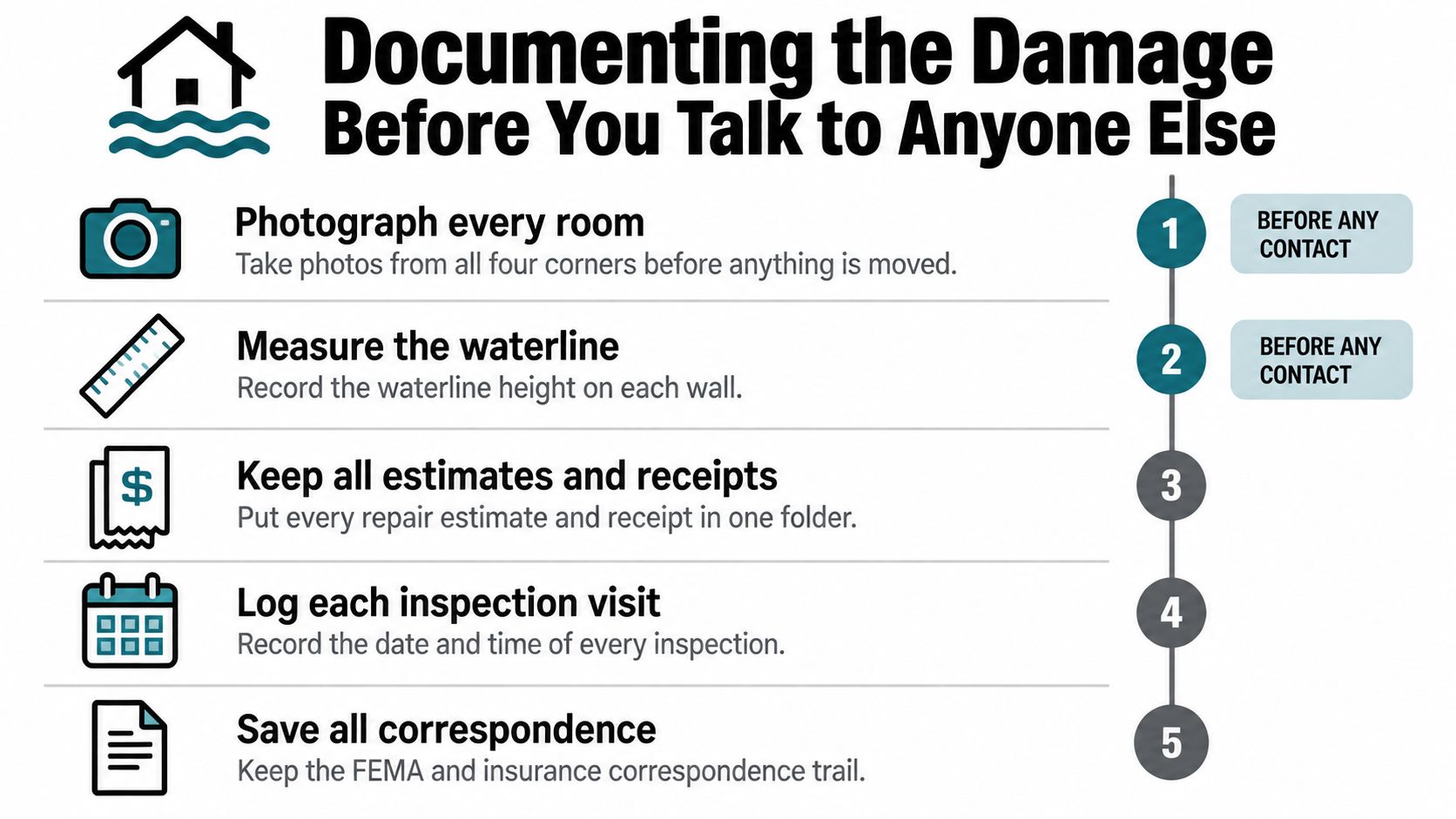
Photograph every room. Take pictures from standing height and from each corner before materials are moved. Capture baseboards, drywall cuts, the HVAC platform, subfloor removal, cabinets, insulation, appliances, and visible waterlines. Keep timestamps enabled and preserve the original files.
Record the waterline and elevation information. Save the FEMA flood elevation certificate, any City of Houston Elevation Certificate, and every NFIP letter or flood-related notice. If a document doesn't exist, write down that it was requested and keep the request.
Separate estimates from paid invoices. Create different folders for mitigation, demolition, drying, engineering, materials, and rebuilding. A contractor bid isn't the same as a paid invoice, and neither proves that the work was necessary or completed.
Preserve the insurance trail. Save the declarations page, adjuster reports, photographs submitted to the carrier, correspondence, denial letters, partial denial letters, supplemental requests, checks, and releases.
Ask the mortgage holder for a written accounting. Request information about escrow, insurance payments, disbursements, and any flood insurance refund. Don't rely on a phone conversation that can't later be verified.
Why the file matters
Texas Family Code doesn't require a particular flood-documentation packet. In practice, though, a Harris County judge, mediator, appraiser, or opposing lawyer will want to know what happened, when it happened, what was repaired, and who paid. Missing records create room for disagreement over whether work was completed, whether an invoice was reasonable, and whether insurance already covered the expense.
Keep the evidence in a shared, orderly format when safe to do so. Don't delete photographs, move money, discard damaged materials, or authorize major repairs just to improve the appearance of the home before the valuation process is understood. If children or extended family are involved, separate property records from other family-law issues. For example, Grandparents' Rights in Kingwood addresses custody and visitation rights for grandparents in Harris County, which is distinct from the property valuation question.
How a Forest Cove Home Is Actually Valued in a Divorce
A divorce valuation should answer one question clearly: what is this specific property worth for the purpose being decided? Insurance value, replacement cost, tax value, and fair market value aren't interchangeable.
The three approaches
The sales comparison approach examines comparable sales, listings, and contract information. It can be persuasive when the appraiser finds similar Forest Cove properties with similar flood exposure, repairs, elevation, lot characteristics, and buyer appeal. Broadly selecting homes from a different part of Kingwood can distort the result.
The cost approach separates land from the structure and considers what it would cost to replace or repair the building, subject to depreciation and market realities. For flood-damaged property, that approach can be cross-checked against elevation information, documented repairs, and the building's actual vulnerability. The Congressional Budget Office's flood-risk methodology explains the importance of separating structure value from land value and applying expected flood damage to the structure component rather than automatically reducing the entire property by the same amount.
The income approach is more relevant when the property produces rental income or has a meaningful business use. It may have limited weight for an owner-occupied marital residence, but it shouldn't be ignored if one spouse claims that rental potential or lost rental use changes the property's value.
| Valuation Approach | What It Measures | Strength in Forest Cove | Weakness in Forest Cove |
|---|---|---|---|
| Sales comparison | Prices for genuinely comparable properties | Reflects what buyers are paying in the local market | Comparable homes may differ sharply in elevation, repairs, and flood history |
| Cost approach | Land value plus the condition and replacement economics of the structure | Helps isolate building damage and cost to cure | Replacement cost doesn't automatically equal market value |
| Income approach | Value supported by rental or business income | Useful when the property has documented income potential | Often less persuasive for a personal residence without reliable income records |
The number the court needs
The appraiser may need to analyze the property as-is, as repaired, or after insurance and mitigation are accounted for. Those are different questions. A repaired home may still face disclosure concerns, higher insurance costs, financing limitations, or a smaller buyer pool.
Appraisers should also document how they selected and adjusted comparable properties. Research on flood disclosure and valuation cautions that flood history can be downplayed through language choices, the selection of properties outside flood zones, or smaller adjustments. The research on flood-risk valuation bias supports a disciplined process rather than a flat flood-zone discount.
Hire an appraiser who has personally inspected flood-affected homes in Kingwood and understands the San Jacinto River watershed. A generalist may produce a polished report that still misses the local cost-to-cure and marketability issues that matter most.
Working With Insurance Without Handing the Spouse a Surprise
Insurance proceeds are part of the financial story. They shouldn't disappear into an unclear repair account, an unrecorded cash payment, or a joint account that makes later tracing difficult.
Keep the claim transparent
Open a dedicated claim log as soon as an adjuster is assigned. Record the date of every call, inspection, estimate, payment, supplemental request, and document submission. Ask for the adjuster's estimate and every supplemental payment in writing.
A public adjuster may help evaluate a complicated Harris County flood claim, but hiring one doesn't replace the need for legal and valuation advice. Ask what the adjuster will inspect, how fees work, and whether the proposed claim treatment distinguishes mitigation, demolition, contents, and rebuilding. Keep the engagement agreement and all reports with the property file.
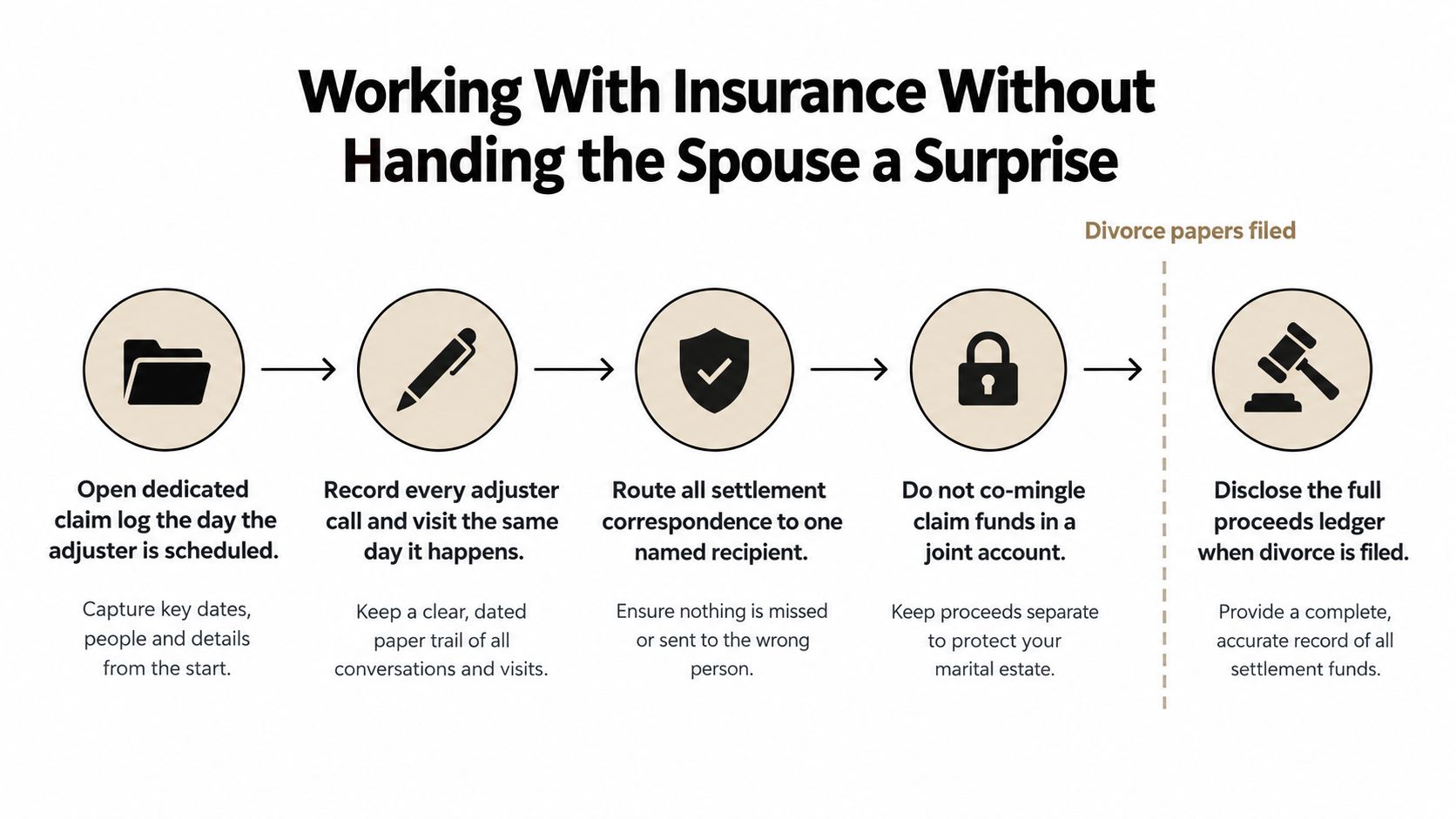
Don't sign a release or accept a partial actual cash value payment without understanding what claim rights may be affected. A deposit into a joint account isn't automatically improper, but it can make tracing harder and create conflict about who controlled the money. Notify counsel before making a decision that could change the marital estate or the condition of the home.
Build the proceeds ledger
The ledger should show:
- Payment source: Identify whether money came from flood insurance, another insurance policy, FEMA assistance, a mortgage escrow, or personal funds.
- Payment date and amount: Attach the check, electronic confirmation, or carrier statement.
- Purpose: State whether the money covered mitigation, contents, demolition, temporary housing, or reconstruction.
- Spending trail: Match each payment to a paid invoice, receipt, contractor draw, or other supporting record.
- Remaining balance: Reconcile the account regularly and explain any transfer.
For a focused explanation of how insurance proceeds may affect a Texas divorce, review flood insurance proceeds and community or separate property. The important point is simple: neither spouse should learn about a payment for the first time during mediation or testimony.
What Just and Right Division Looks Like for a Flooded Home
Texas doesn't require a mechanical 50/50 division of every community asset. Texas Family Code Section 7.001 requires a court to divide the community estate in a manner that is just and right, with due regard for the rights of each spouse and any children of the marriage. The Texas statute on just and right division is the starting point for analyzing a Forest Cove home.
A home acquired during marriage is generally presumed to be community property, even if only one spouse appears on the deed. The Texas community-property explanation for divorce describes that presumption and why title alone doesn't resolve the division issue.
Factors that affect the result
A judge may examine who paid repair costs, whether a spouse used separate funds, whether insurance covered the work, whether one spouse kept the property during separation, and whether the proposed buyout reflects the home's current condition. The court also has to account for related debt, including the mortgage and obligations connected to repairs.
| Just and Right Factor | Typical Evidence | Effect on 50/50 Split |
|---|---|---|
| Repair responsibility | Invoices, bank records, insurance payments | May support a credit or adjustment for documented contributions |
| Separate funds | Tracing records and account statements | Can support a reimbursement claim if legally established |
| Current condition | Appraisal, photographs, inspection report | Changes the equity available for division |
| Retention of the home | Buyout proposal, refinancing evidence, debt capacity | Tests whether one spouse can realistically keep the property |
| Habitability and use | Temporary housing records and occupancy evidence | Helps show the practical burden created by the flood |
| Remaining debt | Mortgage statement, repair obligations, escrow records | Reduces the net estate and affects the overall division |
Section 7.007 may provide a basis for reimbursement claims, but reimbursement is not the same as demanding an automatic dollar-for-dollar adjustment. The court considers the broader estate and the overall fairness of the division. A spouse who paid for repairs may have a strong documentation position, but that payment still needs to be traced and placed in the context of all assets and debts.
The valuation date also matters. Texas appellate authority recognizes that courts generally look to value near the time of divorce or property division, while allowing trial-court discretion when those events occur at different times. That flexibility can matter when a Forest Cove home changes condition during remediation or when the local market shifts before trial.
Settlement or Court How Kingwood Couples Decide
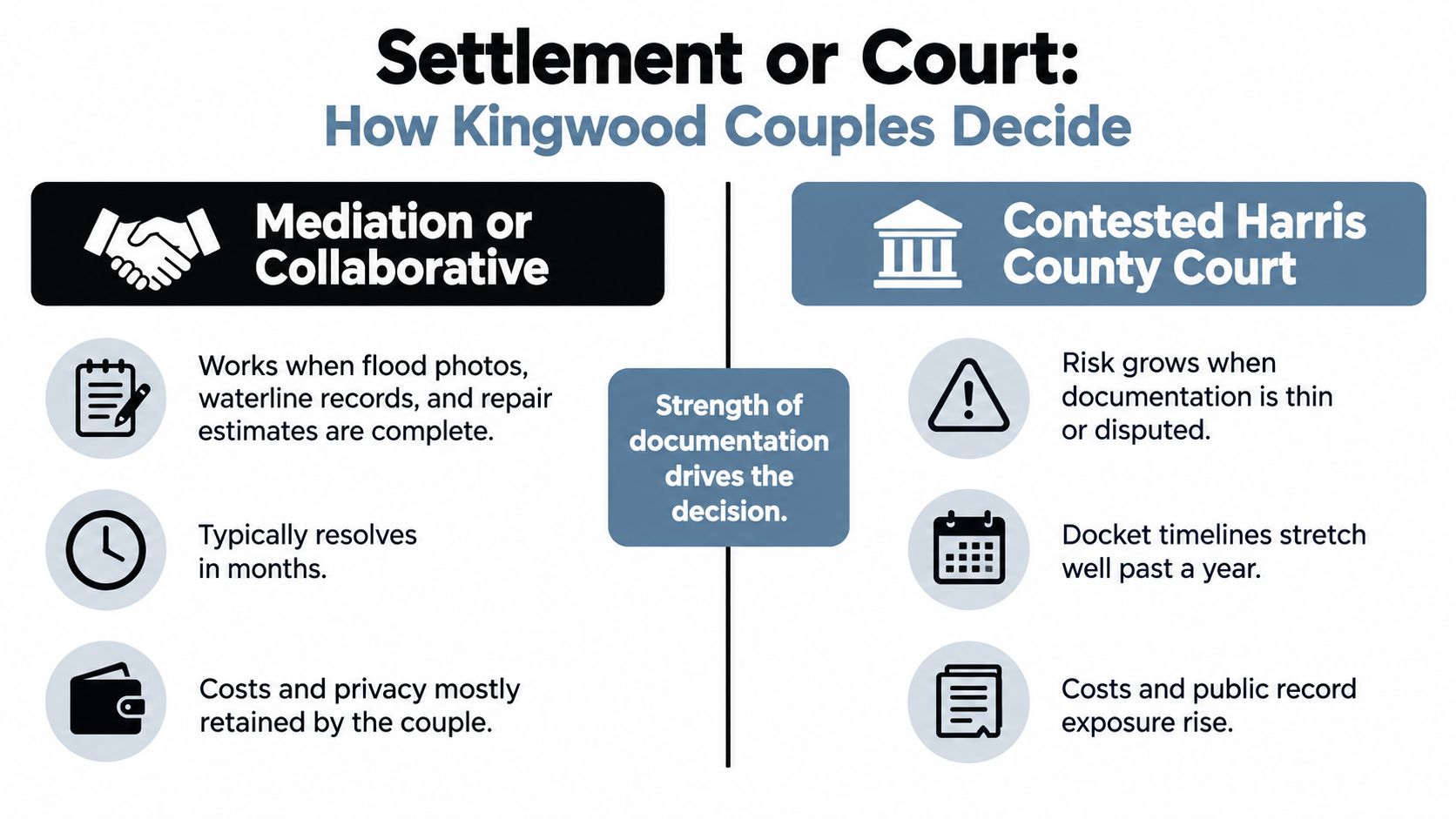
Mediation works best when the spouses disagree about the outcome but share reliable information. A complete flood file gives both attorneys a common foundation, which makes it easier to negotiate a buyout, sale, repair credit, or allocation of insurance proceeds.
A collaborative process can also help when both spouses want privacy and control over the repair timeline. The parties can ask an appraiser, contractor, insurance professional, or financial specialist to address a narrow question without turning every disagreement into a courtroom fight.
Use the evidence to choose the path
| Mediation or Collaborative Divorce | Contested Harris County Court |
|---|---|
| Better suited to complete photographs, repair records, and appraisals | Necessary when records are withheld or valuation remains sharply disputed |
| Lets the couple create a sale, buyout, or repair agreement | Gives the judge authority to resolve disputed property and debt issues |
| Keeps more decisions in the couple's hands | Brings formal discovery, testimony, and expert evidence |
| Can address insurance proceeds and repair timing in one agreement | May require separate rulings on valuation, reimbursement, and possession |
My decision rule is practical. If both attorneys can agree on the pre-flood value, post-flood value, and remaining repair ledger within five percent, mediation is usually the sensible first move. If they can't reach that level of agreement because the records are incomplete or the appraisers used incompatible assumptions, prepare the file as if it may go to trial.
A court may ultimately provide a binding answer, but litigation doesn't make weak evidence stronger. Before choosing that route, Kingwood spouses should identify the exact disputed fact, the witness who can prove it, and the document or appraisal that supports the position.
For issues involving a flood-control acquisition or buyout, review the Harris County Flood Control buyout and divorce decree resource. A buyout or demolition status can change the property analysis and should be addressed directly in the decree.
Your Next 30 Days in Kingwood Humble and Northeast Houston
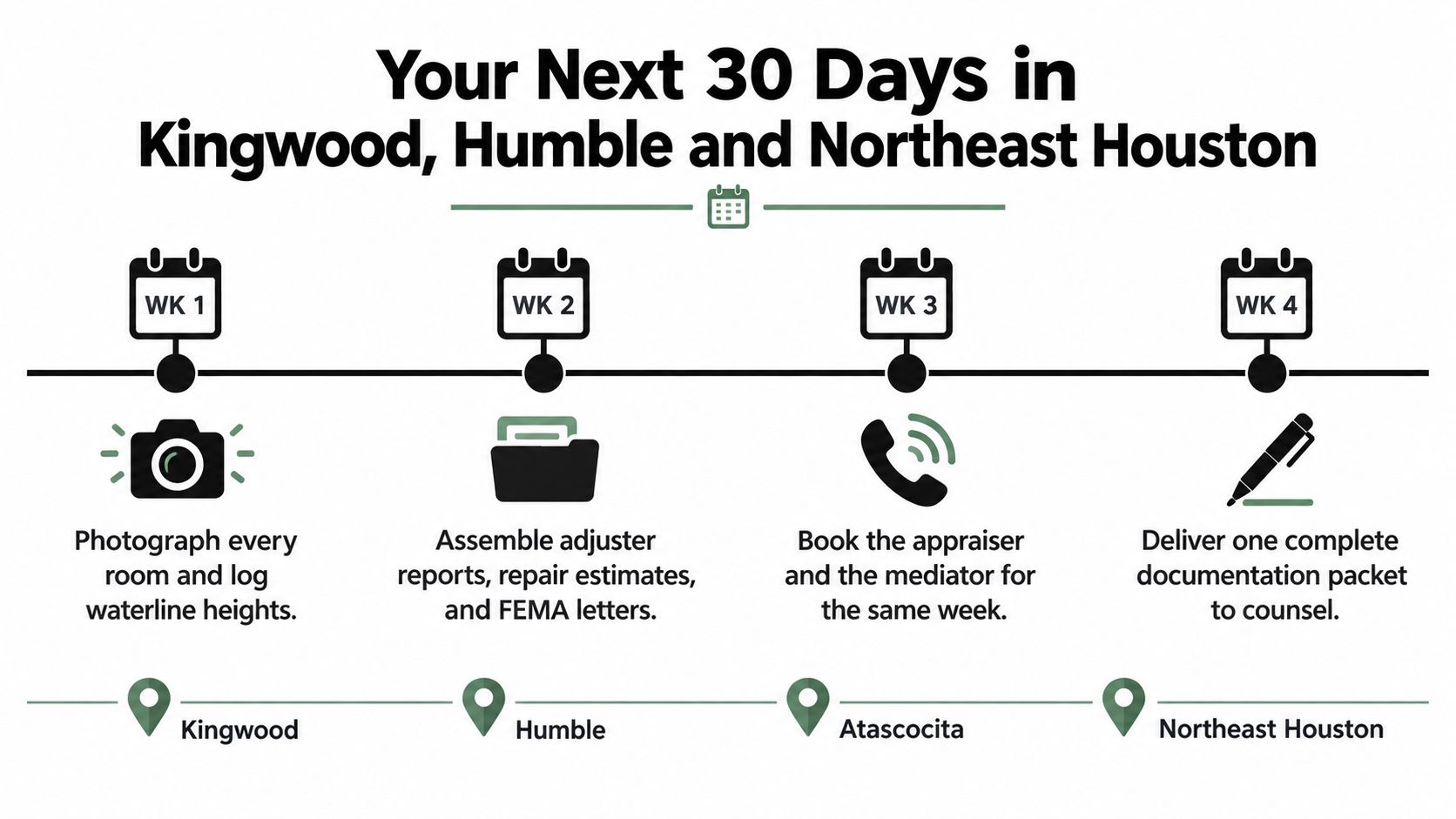
Treat the next month as a preparation window, not an indefinite waiting period. A dated plan reduces emotional decisions and gives your attorney, appraiser, and mediator the same factual record.
Week one
Photograph every room, preserve video, record visible waterlines, and save the FEMA and insurance correspondence. Pull the declarations page, adjuster reports, elevation documents, and mortgage statements. Don't throw away damaged materials until an appropriate professional confirms that doing so won't undermine the evidence.
Week two
Request independent appraisals from professionals who have inspected flood-affected properties in Kingwood. Ask each appraiser to explain whether the assignment concerns as-is value, as-repaired value, or another defined purpose. If rental use, business use, or disputed cash contributions affect the property, ask whether a forensic accountant is needed.
Week three
Schedule a mediation conversation after the core records are assembled. Your attorney can also review recent local market evidence from Forest Cove, Bear Branch Village, and nearby Kingwood communities to test whether the proposed value reflects the buyer pool in the relevant area. Comparable sales should be adjusted for condition, flood history, elevation, repairs, and remaining risk.
Week four
Prepare one settlement packet. Include the appraisal, photographs, repair ledger, insurance payments, mortgage information, proposed credits, and a clear buyout or sale plan. If one spouse wants to keep the home, require a realistic plan for refinancing, repairs, insurance, and future maintenance rather than accepting an unsupported promise.
Kingwood, Humble, Atascocita, and Northeast Houston residents don't need to solve the entire divorce in one meeting. They do need to preserve evidence before memories fade and financial decisions become harder to trace. The Law Office of Bryan Fagan – Kingwood TX Lawyers offers local representation for divorce and property division, along with legal services involving family, estate, criminal, and civil matters, and can help organize a flood-damage valuation issue for a free consultation. Visit Law Office of Bryan Fagan – Kingwood TX Lawyers to discuss the Forest Cove property, the insurance records, and the next step before the valuation dispute grows more expensive.