Under Texas Family Code Chapter 6, an annulment targets a voidable marriage and requires a court order, while a void marriage is already invalid by operation of law. The first question for any Kingwood resident is which category the marriage falls into.
You may be sitting in your Kingwood home with a marriage certificate, a short relationship, and a growing suspicion that something was legally wrong from the beginning. Maybe your spouse concealed a prior divorce. Maybe the ceremony happened while one of you was intoxicated, under pressure, or unable to understand what was happening. Or perhaps you learned that your spouse was still married to someone else.
People often call all of these situations “annulment” cases. Texas law doesn't. The difference between annulment vs void marriage in Kingwood, TX affects what you must prove, whether a court order is necessary, whether Texas can hear the case, and what happens if a spouse dies before anyone files.
This guide applies the Texas framework to residents of Kingwood, Humble, Porter, and Northeast Houston. It also gives you a practical decision path. Don't start by asking whether you regret the marriage. Start by identifying whether Texas classifies it as voidable or void.
Why Kingwood Residents Confuse Annulment and Void Marriage
A Humble resident might marry quickly after a military move, discover troubling facts soon afterward, and assume the marriage can be erased. That assumption can create serious problems if the person stops treating the marriage as legally significant before confirming the correct remedy.
Texas Family Code Chapter 6 separates these cases into two categories. A voidable marriage is treated as legally valid unless and until a court grants an annulment. A void marriage was never legally valid under the statute, although a court declaration may still be useful to establish a clear public record.
The distinction is stated plainly in Texas legal guidance on Texas annulment requirements and void marriages. An annulment targets a voidable marriage, while a suit to declare marriage void addresses a marriage that is already invalid under law.
Ask the classification question first
Before discussing property, children, or moving forward with another relationship, identify the legal category:
- What happened at or before the ceremony? Look for fraud, force, duress, intoxication, incapacity, age-related issues, or a concealed divorce.
- Did the marriage fall into an automatically invalid category? Bigamy, incest, and certain underage marriages may be void from the start.
- Did either spouse voluntarily live together after learning the relevant facts? That conduct can affect eligibility for some annulment grounds.
- Can Texas hear the case? The marriage location and a spouse's domicile matter.
This isn't a technical label with no practical effect. A voidable case asks a judge to set aside a marriage after proof of a statutory ground. A void-marriage case asks the court to recognize that the law never treated the relationship as valid.
For Kingwood clients, the right filing may also involve custody, property, probate, or enforcement issues. If an existing Harris County divorce decree or custody order needs implementation, Enforcement of Court Orders in Kingwood addresses enforcement of those provisions rather than the classification of a new marriage.
Statutory Grounds for an Annulment in Texas
Whether your circumstances qualify depends on the specific facts, not on how badly you want the marriage erased. Texas annulment law requires a recognized statutory basis, and a painful relationship, brief marriage, or ordinary regret generally does not meet that standard. The evidence must fit a listed ground, along with any additional requirements that apply.
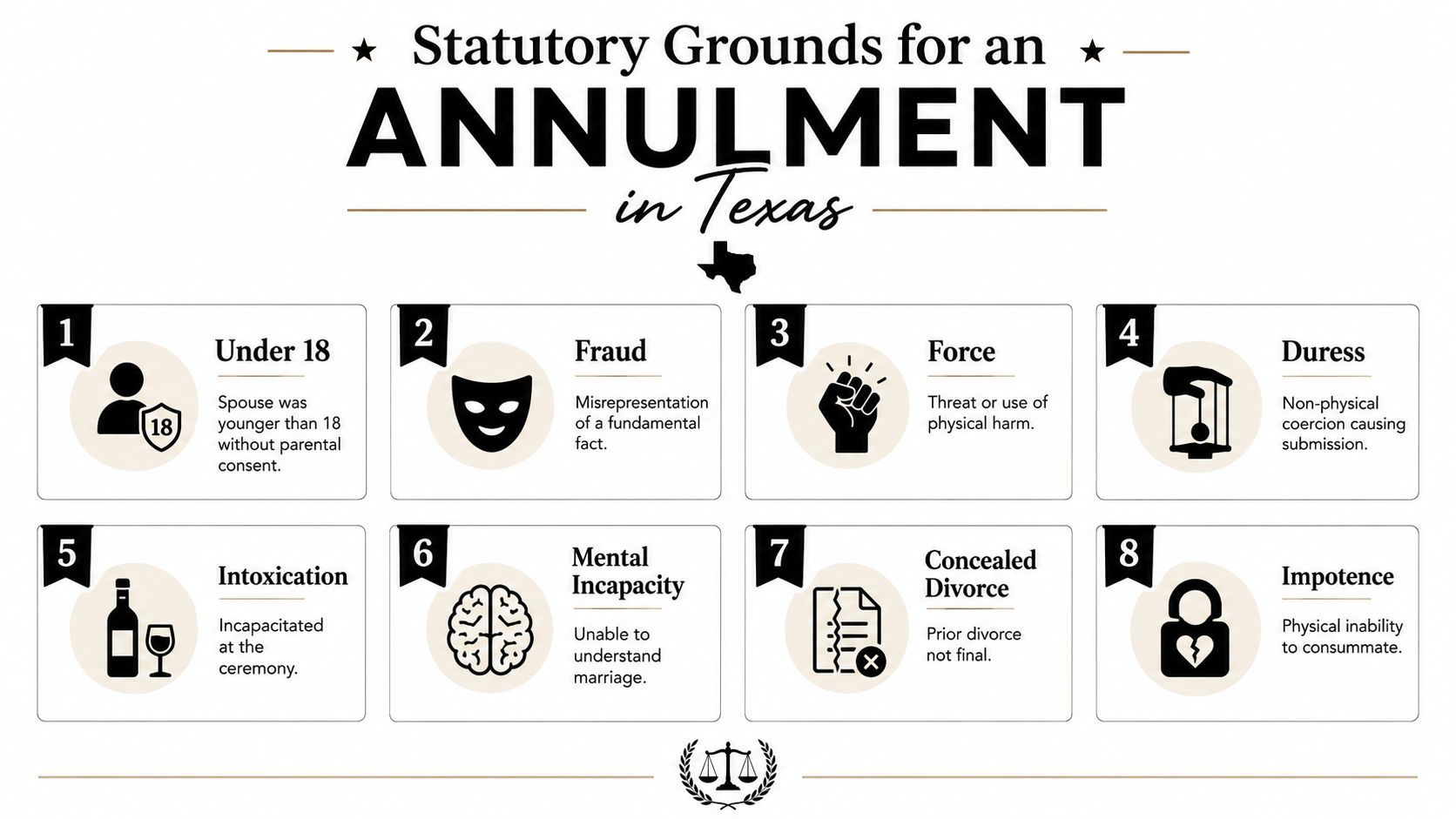
Common grounds include being under eighteen, fraud, force, duress, intoxication, mental incapacity, a concealed divorce, and a ceremony held within seventy-two hours after the marriage license was issued. Texas practice also treats impotence as a fact-specific ground. Our Texas annulment of marriage service information provides additional detail on each ground. Use it to organize the facts, then have an attorney assess whether the evidence supports filing.
The grounds in plain English
- Under eighteen: Age, consent, and the circumstances surrounding the ceremony all matter. The marriage certificate alone does not resolve the statutory requirements.
- Fraud: The deception must involve a material fact connected to the marriage. An unpleasant personality trait or a promise that later proved unrealistic usually is not enough. Preserve messages, financial records, and statements made before the ceremony.
- Force: Physical threats or the use of physical harm can defeat genuine consent. The evidence must connect that conduct to the decision to marry.
- Duress: Coercion can be nonphysical. Threats involving family, finances, housing, immigration-related pressure, or other serious consequences require close review of the surrounding facts.
- Intoxication: If someone could not understand the nature of marriage at the ceremony because of intoxication, timing and proof of impairment become central.
- Mental incapacity: The question is whether the person understood the marriage and its consequences at the relevant time. Medical records may help, but the legal inquiry focuses on the ceremony and nearby events.
- Concealed divorce: One spouse may have hidden a prior divorce or its status. A Porter resident who discovers that fact should obtain the prior decree and avoid voluntary cohabitation until receiving legal advice.
- The seventy-two-hour license rule: A ceremony within seventy-two hours after issuance of the marriage license may create a statutory issue. Verify the license date, ceremony date, and any applicable exception.
- Impotence: Permanent physical inability to consummate the marriage can be relevant under Texas law. Handle this allegation privately because the evidence is sensitive and medical details should not be shared casually.
Why cohabitation changes the analysis
Several grounds require the petitioner to show that they did not voluntarily cohabit with the spouse after learning the relevant fact. Conduct after discovery can therefore affect eligibility as much as the original deception or condition.
A Northeast Houston couple married during a blackout may have different options based on what happened afterward. The same concern applies to a Porter spouse who learned about a concealed divorce and continued living together. Staying in the home, sharing finances, or presenting yourselves as married may carry legal consequences.
These grounds operate as eligibility tests. A strong gut feeling deserves attention, but it cannot replace proof of the required statutory facts. Gather the timeline, preserve the records, and address venue, domicile, and any post-death limitations before choosing an annulment filing.
What Makes a Marriage Void From the Start
A marriage that Texas law declares void does not disappear on its own. Without a court order, the legal status can remain unclear, and that uncertainty may surface during remarriage, a property dispute, or probate.
Texas treats a void marriage as invalid from the beginning. The principal examples include bigamy, incest, and certain underage marriages without a qualifying court order. The legal issue is not whether a valid marriage should later be undone. The law treats the relationship as one that never became a valid marriage.
A Kingwood spouse may discover that the other person was already married. A family dispute may involve a prohibited relationship or an underage marriage without the required authorization. A court proceeding may still be necessary, but its purpose is generally to establish or confirm the legal status, not to create the invalidity.
Why a declaration still matters
“Automatically void” does not mean “ignore the paperwork.” A certified court order can help someone remarry, correct records, respond to an employer or insurer, resolve a property dispute, or address probate questions.
The issue becomes especially urgent after a death. A surviving person may claim spousal rights while children or other heirs challenge that status. The marriage's classification can affect estate administration, inheritance claims, and the authority of a personal representative. A Humble family facing those questions should not rely on an informal conclusion that the marriage was “obviously” invalid.
Texas common-law relationships create a separate question: whether a legally established marriage existed at all. Readers examining that issue can review the firm's explanation of Texas common-law marriage requirements.
The key practical difference
A void-marriage case requires different proof from an annulment. An annulment petitioner must prove a qualifying ground and overcome any applicable defenses. In a void-marriage suit, the central question is whether the relationship falls within an automatically invalid statutory category.
That distinction does not make a void case simple. Records may be missing, a prior marriage may have occurred outside Texas, and relatives may disagree about the facts. The proper filing also depends on procedural details, including venue, domicile, and whether a party has died. If the evidence supports a void-marriage declaration, filing an annulment petition points the case toward the wrong remedy.
Annulment vs Void Marriage Side by Side
The cleanest way to compare the remedies is to focus on the court's role. An annulment asks a judge to set aside a marriage that is legally recognized unless the petitioner proves a statutory reason. A void-marriage suit asks a judge to declare the legal status of a relationship that Texas law already treats as invalid.
| Dimension | Annulment, Voidable | Void Marriage |
|---|---|---|
| Legal status before judgment | Generally treated as valid until annulled | Invalid by operation of law |
| Typical grounds | Fraud, force, duress, intoxication, incapacity, age-related grounds, concealed divorce, the seventy-two-hour issue, and other fact-specific statutory grounds | Bigamy, incest, and certain underage marriages |
| What the petitioner must prove | A recognized statutory ground, plus any required timing or cohabitation facts | That the marriage falls within a category Texas law declares void |
| Court's role | Grants an order setting aside the voidable marriage | Confirms or declares the marriage's invalid status |
| Filing posture | Petition for annulment | Suit to declare marriage void |
| Main practical concern | A valid marriage remains on the parties' legal record unless a court acts | A declaration may be needed to resolve records, remarriage, property, or probate disputes |
| Effect of later conduct | Voluntary cohabitation after learning certain facts may defeat a claim | The legal category remains the focus, although related facts and defenses still require analysis |
| Death of a spouse | Special restrictions can apply to later challenges | The available procedural path may differ and can require estate-law analysis |
Practical rule: If the marriage is voidable, obtain the court order before treating it as dissolved. If it's void, determine whether a declaration is needed to protect your records and legal position.
Two distinctions clients often miss
First, an annulment isn't a private cancellation. Until the court grants relief, the voidable marriage is generally treated as valid. That can affect remarriage decisions, benefits, taxes, property transactions, and estate planning.
Second, the same broad fact can lead to different classifications. “Underage marriage” doesn't automatically answer the question. The parties' ages, consent, court authorization, and statutory circumstances can determine whether the marriage is void or voidable.
The decision lens: Ask whether Texas needs to undo a marriage that became legally valid, or recognize that the law never allowed the marriage to become valid.
Texas defines a dissolution suit broadly enough to include divorce, annulment, and a suit to declare marriage void. The label on the petition still matters because each remedy carries different proof requirements and consequences.
Filing Procedure and Timing in Texas
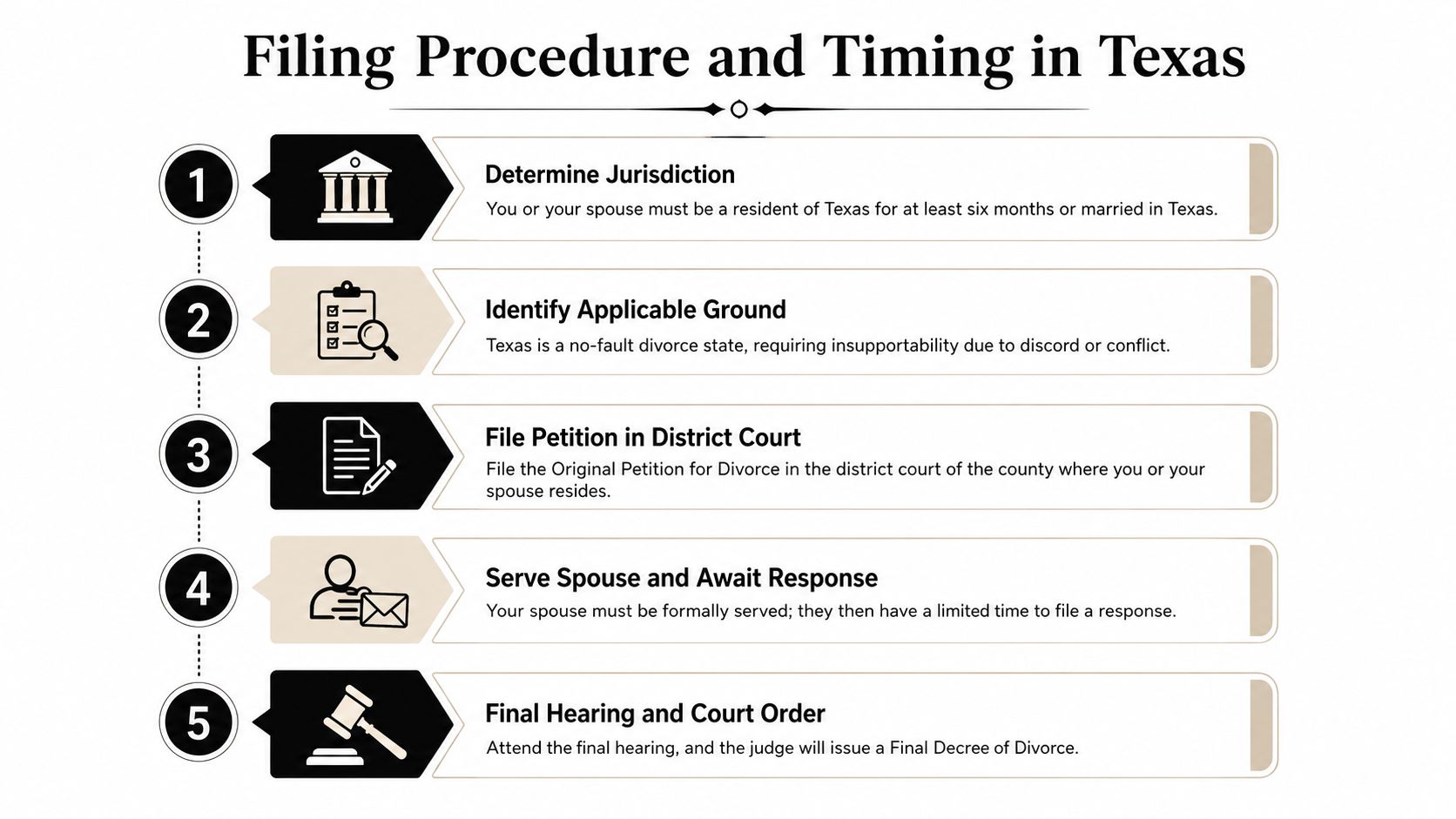
Procedure can decide a case before the merits are reached. For a Texas annulment, the parties must have married in Texas or at least one spouse must be domiciled here. A current address does not always establish domicile, particularly after a move from Kingwood or Northeast Houston.
Texas treats an annulment proceeding as a suit in rem affecting marital status. The court is deciding the legal status of the marriage, not just a personal claim for money. Proper jurisdiction, venue, service, and evidence supporting the statutory ground must all be in place.
The filing sequence
- Confirm jurisdiction and venue: Establish that the marriage occurred in Texas or that one spouse is domiciled here, then identify the proper county court.
- Choose the legal remedy: Determine whether the facts support an annulment or a declaration that the marriage is void.
- File the petition: File in the appropriate Texas district court and address county-specific filing requirements at the start.
- Serve the other spouse: The respondent must receive legally sufficient notice and an opportunity to respond.
- Prepare for the final hearing: Organize documents, testimony, and other admissible evidence so the judge can enter the proper order.
Kingwood cases commonly involve Harris County courts, but a preferred courthouse does not determine venue. If one spouse moved to another state, domicile may require careful review. An out-of-state spouse can also affect service, scheduling, and the proof needed at the hearing.
Death, probate, and timing
Texas Family Code Section 6.111 generally bars a challenge to an annulment-eligible marriage after either spouse dies, subject to exceptions under the Estates Code. That restriction matters when the dispute involves probate, inheritance, or whether someone qualifies as a surviving spouse. It also matters before remarriage. Delaying a family-law filing can leave the parties dealing with a more complicated estate proceeding.
A suit to declare a marriage void rests on a different legal theory, but it still requires a properly prepared case. The court must receive proof showing that the marriage falls within the void category. If a declaration may protect a party's records or legal position, address that need before a later dispute forces the issue into court.
How Each Remedy Affects Property and Children
An annulment or void-marriage declaration doesn't make the practical consequences disappear. People may still have a shared home, bank accounts, vehicles, debts, health coverage issues, and children who need stable arrangements.
Property analysis is fact-specific. Courts may still address ownership, reimbursement, equitable claims, and obligations when a relationship is unwound. The legal label matters, but it doesn't answer every question about who paid for the home, who incurred a debt, or who contributed to an asset.
A Humble parent may need custody and support orders even if the marriage is declared void. Texas law protects children of void or voidable marriages, and the court can address custody, possession, and support based on the children's needs and the applicable Family Code standards.
Property requires separate tracing
A Porter couple with a shared residence shouldn't assume that a void-marriage declaration automatically determines title. Gather deeds, closing documents, loan statements, payment records, account statements, and evidence of separate contributions. If the relationship is legally treated as a marriage for some purposes, community-property questions may arise. If it isn't, equitable and ownership theories may become more important.
The firm's resource on property division in a Kingwood divorce can help readers understand the kinds of records lawyers examine, although an annulment or void-marriage case requires a specific analysis.
Children remain a separate priority
A parent's custody rights don't vanish because the marriage status is challenged. Courts can enter orders addressing conservatorship, possession, medical decisions, and financial support. Don't delay a custody filing while waiting for the annulment or declaration issue to finish if a child needs immediate structure or protection.
Divorce may offer a more familiar framework for dividing community property and resolving marital obligations. That doesn't mean divorce is always the correct remedy. It means a client should compare the legal and practical consequences instead of choosing annulment because it sounds cleaner.
Which Remedy Fits Your Situation in Kingwood
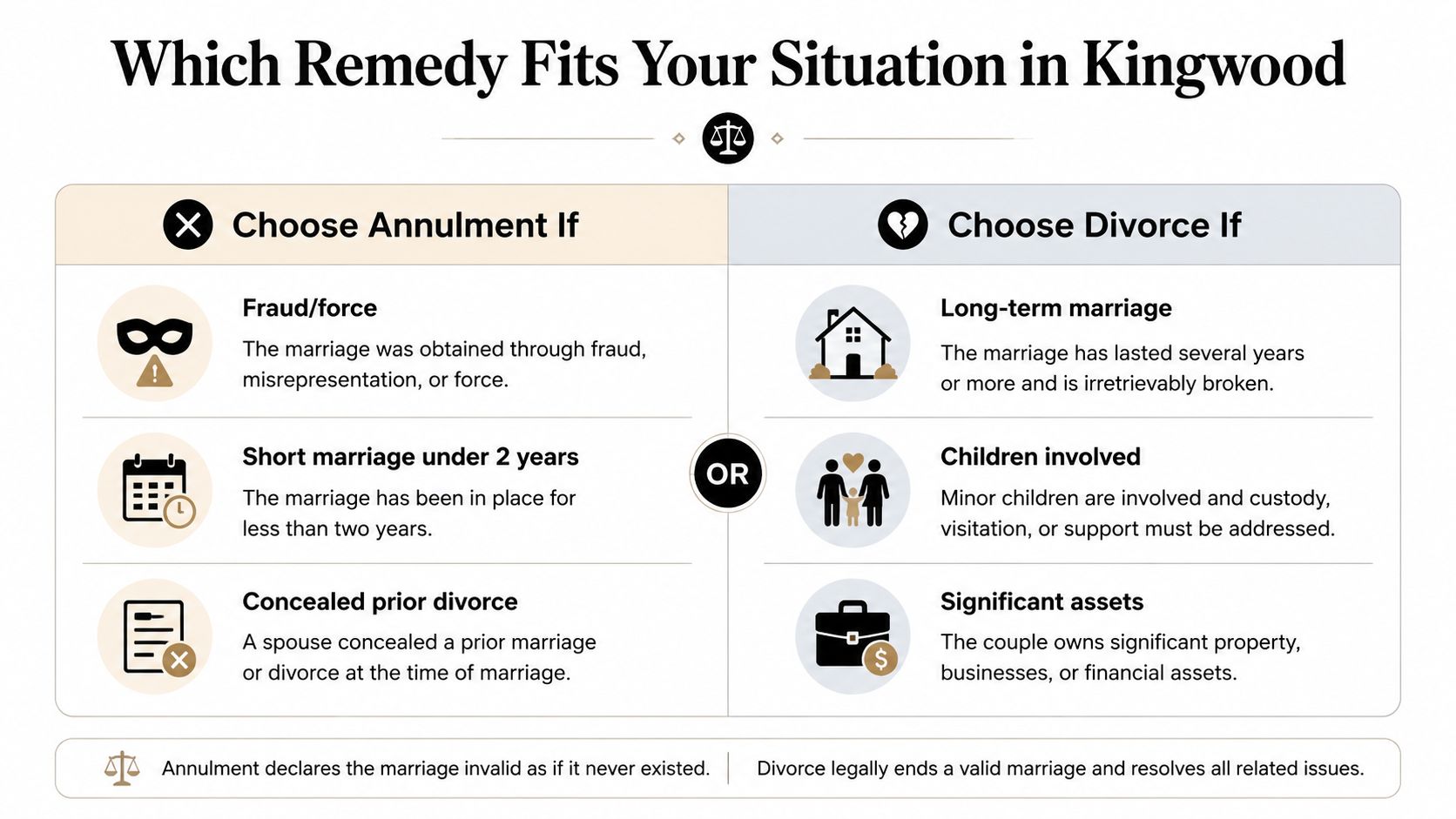
The right remedy turns on the facts, not the marriage's length or a desire to erase it. Classify the situation first, then have a Texas family law attorney verify the category, available venue, and filing strategy before you file.
Choose annulment when a statutory ground fits
Annulment fits when a recognized statutory ground affected consent or the marriage ceremony. A concealed prior divorce may support an annulment if the evidence satisfies the statute and the petitioner addresses cohabitation and timing. Force, pressure, intoxication, or an inability to understand the ceremony may also create an annulment path, but the petitioner must prove the relevant facts.
A short marriage does not establish a ground. People often raise annulment while considering remarriage, yet duration alone cannot support the petition. If no statutory basis applies, divorce is usually the correct remedy.
Seek a void-marriage declaration for automatic invalidity
Bigamy and incest generally call for a suit to declare the marriage void. Certain underage-marriage circumstances may qualify as well, depending on the statute and the specific facts. If a Kingwood resident learns that a spouse was already married, obtain certified records and avoid making legal or financial decisions based on an unverified assumption.
A spouse's death changes the analysis. If someone is asserting inheritance or spousal rights, the case may require marriage-status analysis alongside Estates Code advice. Post-death timing and probate procedure can limit what a court can decide, so an informal family agreement should not replace legal review.
Choose divorce when the marriage was valid and the issue is regret
If the marriage was valid and the relationship failed, annulment is not a shortcut. Divorce addresses the end of a valid marriage and can establish orders for property, children, support, and other obligations. It often fits Kingwood couples with a longer relationship, children, or substantial shared assets.
Texas treats divorce, annulment, and a suit to declare marriage void as dissolution proceedings, but each has a different legal test. The firm serving Kingwood, Humble, Porter, and Northeast Houston can match the petition to the facts, including venue and domicile requirements, instead of forcing an unhappy marriage into an annulment theory.
Practical Next Steps and Local Kingwood Resources
Bring organized records to your first consultation. Start with:
- Marriage license: Obtain a certified copy and confirm the ceremony date.
- Separation date: Write down when you stopped living as a couple and what happened afterward.
- Grounds evidence: Preserve messages, emails, medical records, witness names, photographs, and other documents connected to the alleged ground.
- Prior decrees: Collect any prior divorce decrees or records that may show bigamy or a concealed divorce.
- Financial records: Gather deeds, account statements, loan documents, tax records, and major debt information.
- Death and estate documents: If a spouse died, bring the death certificate, will, probate filings, and notices you've received.
Ask the attorney four direct questions: Can Texas hear this case? Is the marriage voidable or void? Did post-discovery cohabitation affect an annulment claim? Does Section 6.111 or the Estates Code create a timing problem?
Readers who want a broader example of how family law matters are documented can review these real law firm case studies, then bring questions about their own facts to a local consultation. The Law Office of Bryan Fagan serves the full family-law spectrum, including divorce, custody, child support, and property division, so you won't be left without a practical option if annulment turns out not to fit.
The Law Office of Bryan Fagan, Kingwood TX Lawyers, can review whether your marriage is voidable, void, or better addressed through divorce, while also protecting your interests involving children, property, probate, or related civil matters. Schedule a free consultation by visiting Law Office of Bryan Fagan – Kingwood TX Lawyers, and get direct guidance from a local team serving Kingwood, Humble, Porter, and Northeast Houston.