You've talked with your spouse, agreed that the marriage should end, and want to avoid a courtroom fight. Maybe you live in Kingwood while your spouse is in Humble, Porter, or somewhere outside Texas. The case may feel simple, but Harris County still requires the right venue, forms, notice, timing, and final approval.
Use this Kingwood uncontested divorce filing checklist for Harris County as a screening tool, not just a stack of forms. It will help you identify whether your case fits the Texas Supreme Court's simplified process or needs expanded pleadings because of children, real estate, retirement accounts, prior orders, or service problems.
Confirming Residency Before You File
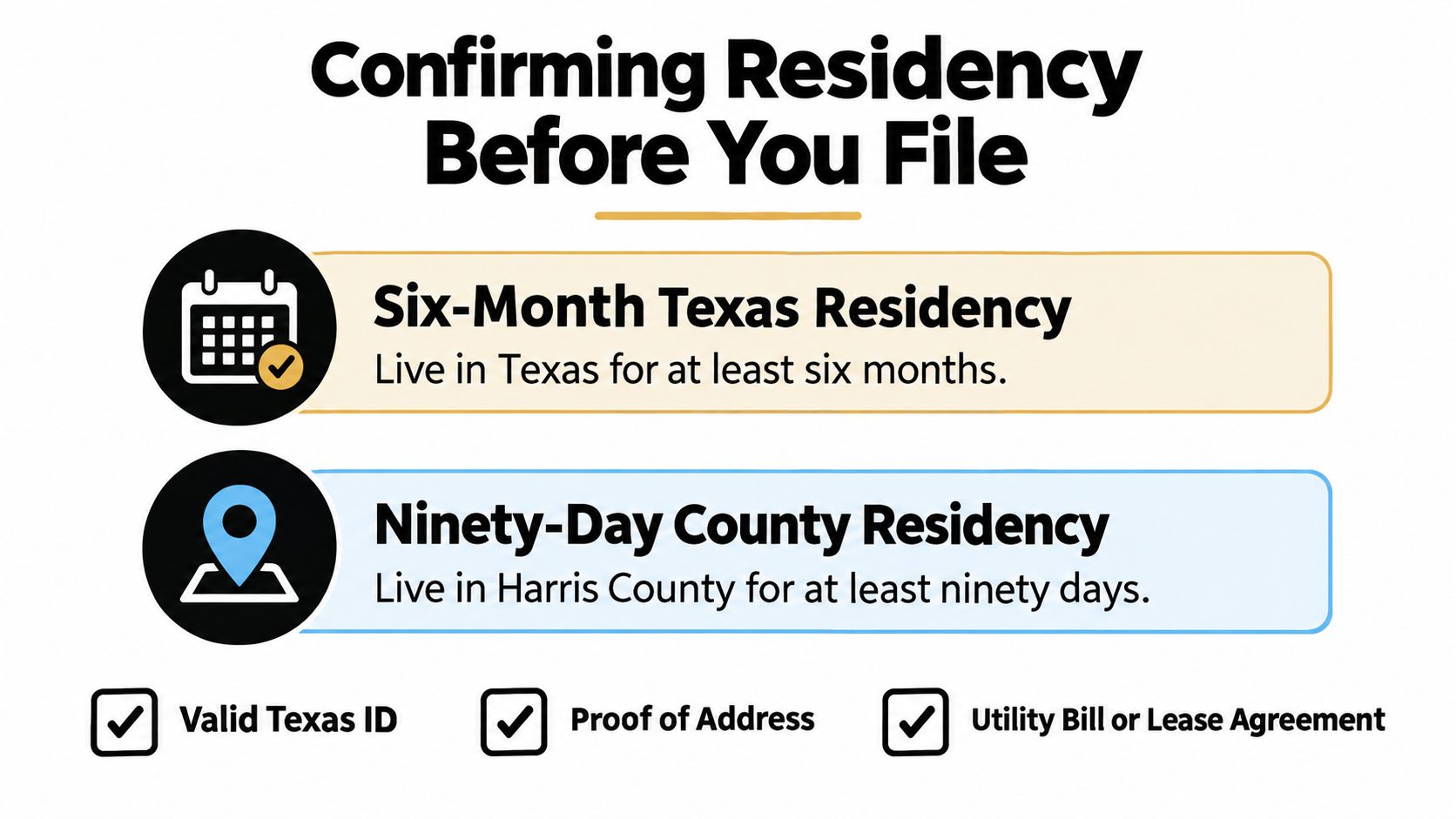
If you're ready to file from Kingwood, don't begin by downloading a petition. Begin by confirming that Harris County is legally available for your case. Texas law requires at least one spouse to have lived in Texas for the preceding six months and in the county where the divorce is filed for at least 90 days before a court can grant the divorce. The Harris County District Clerk's residency guidance confirms both gates.
Your spouse doesn't have to live in Harris County. For example, you may satisfy the requirements through your own Texas and Harris County residency even if your spouse lives in Humble, Porter, another Texas county, or another state. What matters is proving the correct residency facts and filing in the county that meets the venue requirement.
Apply the two residency gates
Use this order:
- Texas gate: Confirm that either you or your spouse has lived in Texas for the preceding six months.
- County gate: Confirm that either spouse has lived in Harris County for at least 90 days.
- Venue decision: If Harris County doesn't satisfy the county requirement, determine whether another Texas county does before preparing the petition.
Write down the addresses, move dates, and county history you'll use in the Original Petition for Divorce. Keep documents that support the timeline, such as lease records, utility records, driver's license information, voter registration, or other ordinary residency records. You may not need every item at filing, but guessing at dates creates avoidable problems.
The petition must state facts supporting Texas and county residency. A wrong county allegation can undermine every later step, including the waiting-period calculation and the final hearing. If you're unsure which court handles a Kingwood case, review this guide to which court handles divorce in Kingwood.
Family violence can affect the ordinary waiting-period analysis, but it doesn't make residency irrelevant. If violence, threats, coercion, or immediate safety concerns exist, treat safety and legal advice as the first priority rather than trying to force the case into an ordinary uncontested timeline.
Matching Your Case to the Right Filing Path
An agreement doesn't automatically make your divorce a simplified case. The Texas Supreme Court's approved packet applies only to an agreed divorce with no minor children and no real property. Cases involving children, real estate, or retirement require expanded pleadings and a more detailed Final Decree, as shown in the Texas Supreme Court's approved divorce forms.
Start with a blunt screening question: What must the final decree address? If the answer includes anything beyond the basic marriage and personal-property issues covered by the simplified packet, stop using the basic forms until you confirm the correct filing path.

Use this decision tree
- No minor children and no real property: The simplified agreed-divorce packet may fit, assuming every issue is settled and no additional complication changes the case.
- Minor children: Expect expanded pleadings and a decree addressing conservatorship, possession, child support, and medical support.
- Real property: A home, land, or another real-estate interest requires accurate property descriptions and provisions addressing transfer, sale, ownership, debt, and related obligations.
- Retirement accounts: Retirement interests may require expanded drafting and separate transfer documents. Don't assume a general property paragraph divides an account correctly.
- Prior custody or support orders: Locate and review the existing orders before drafting new terms. The new decree must fit with the orders or clearly address what changes.
- Military status or an absent spouse: These facts can affect notice, timing, and required protections. Obtain legal guidance before relying on a standard waiver.
A divorce is agreed only when the spouses have resolved every issue addressed by the case. That includes property, debts, conservatorship, possession, support, insurance, and any other relief requested. Agreement on the divorce itself, or agreement on most property, isn't enough if one unresolved issue remains.
Practical rule: Choose forms based on the facts in your marriage, not on how friendly the conversation has been.
Before drafting, create a written issue list. Include bank accounts, vehicles, debts, retirement accounts, real property, personal property, insurance, names, children's information, and any requested support. If you can't explain how each item will appear in the decree, the case isn't ready for a simplified filing.
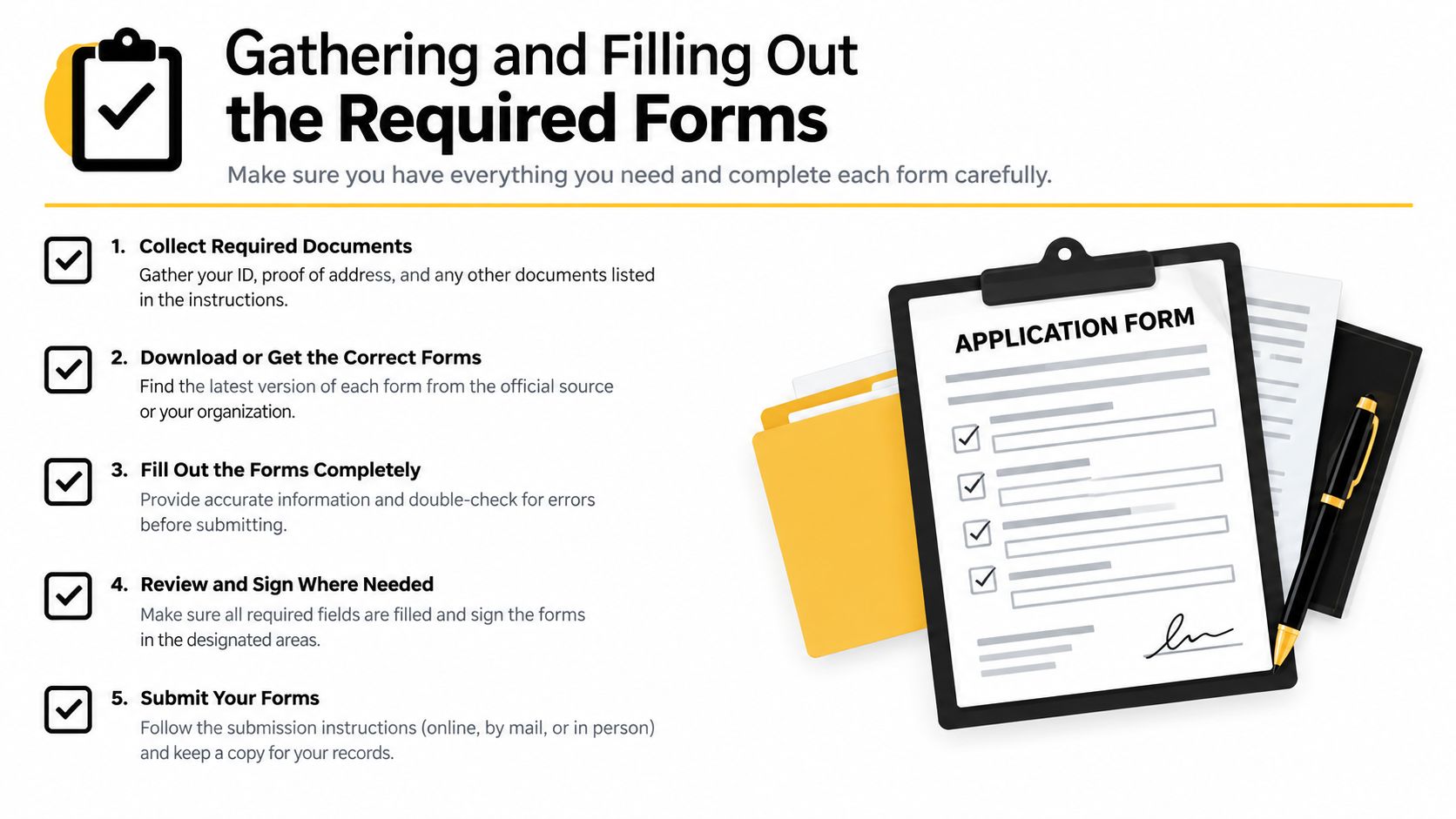
Gathering and Filling Out the Required Forms
Forms work together. The petition opens the case, the information sheets help the clerk route and record it, and the decree creates the enforceable result. Treating them as separate documents is how names, dates, addresses, and property terms drift apart.
Match each document to its job
The Original Petition for Divorce starts the case. It identifies the spouses, marriage, residency facts, children, property issues, and relief requested. The petition must plead enough information to support the orders you later want the judge to sign.
The civil-information sheet gives the court administrative information used to identify and process the case. The BVS information form supplies information connected with Texas vital records. Missing or inconsistent information can create filing and finalization problems even when both spouses agree.
The Final Decree of Divorce is the document that ends the marriage and states the parties' enforceable obligations. It must address the issues raised in the petition and include complete terms for property, debts, children, support, possession, insurance, and transfers when those subjects apply.
Pull current materials from the Harris County divorce filing resources and the applicable Texas Supreme Court form list. A legal document assistant or other administrative resource, including hire virtual paralegals, may help organize paperwork, but administrative assistance isn't a substitute for legal advice about rights, property, children, or enforceability.
Audit the details before filing
Compare every document line by line:
- Legal names: Use the names shown in official records, and state any requested name restoration consistently.
- Marriage information: Confirm the marriage date and place.
- Residency facts: Make sure county and Texas residency statements match the actual timeline.
- Addresses: Check current mailing and physical addresses for both spouses.
- Children: Verify names, birth information, and the requested conservatorship and possession terms.
- Assets and debts: Reconcile account descriptions, vehicle information, retirement interests, property addresses, and debt responsibility.
- Signatures: Confirm that each required signature, verification, waiver, and attachment is present.
Don't leave blanks in a final decree. If a provision doesn't apply, use the form's appropriate “not applicable” treatment rather than leaving the judge to guess. Also compare the petition with the decree. A decree that awards relief never requested in the petition may require amended pleadings or another court step.
Filing With the Harris County District Clerk
Kingwood residents generally deal with the Harris County District Clerk for a Harris County divorce. The clerk identifies the family-court filing location at 201 Caroline Street in Houston, Texas, and directs filers to the current Family Fee Schedule for charges through its public materials.
You have two practical filing routes. Electronic filing through Texas eFile is usually more convenient when the documents are properly prepared and you're comfortable monitoring electronic notices. In-person filing at 201 Caroline lets you present documents directly, but it requires travel from Kingwood, Humble, or Northeast Houston and careful attention to courthouse procedures.
Compare the filing options
| Filing route | What you do | What to preserve |
|---|---|---|
| Electronic filing | Submit the petition and required starting documents through Texas eFile | Submission notices, accepted-file notices, filed-stamped copies, and the cause number |
| In person | Take the filing package to the District Clerk's family-court location | Filed-stamped copies, payment confirmation, and the assigned cause number |
A filing fee is usually required. If you can't afford court costs, submit a Statement of Inability to Afford Payment of Court Costs rather than abandoning the filing altogether. The Harris County District Clerk's materials and Texas filing guidance explain the available process.
Acceptance matters more than delivery. Keep the file-stamped petition and every clerk notice. The cause number identifies your case and should appear on later filings, proposed orders, waivers, and correspondence. If the clerk rejects a document, read the rejection reason carefully and correct the specific problem before resubmitting.
The District Clerk's office also provides current local information about family-court procedures. Don't assume that filing automatically schedules a final hearing. Harris County's uncontested docket and submission process should be confirmed with the clerk when your case is eligible.
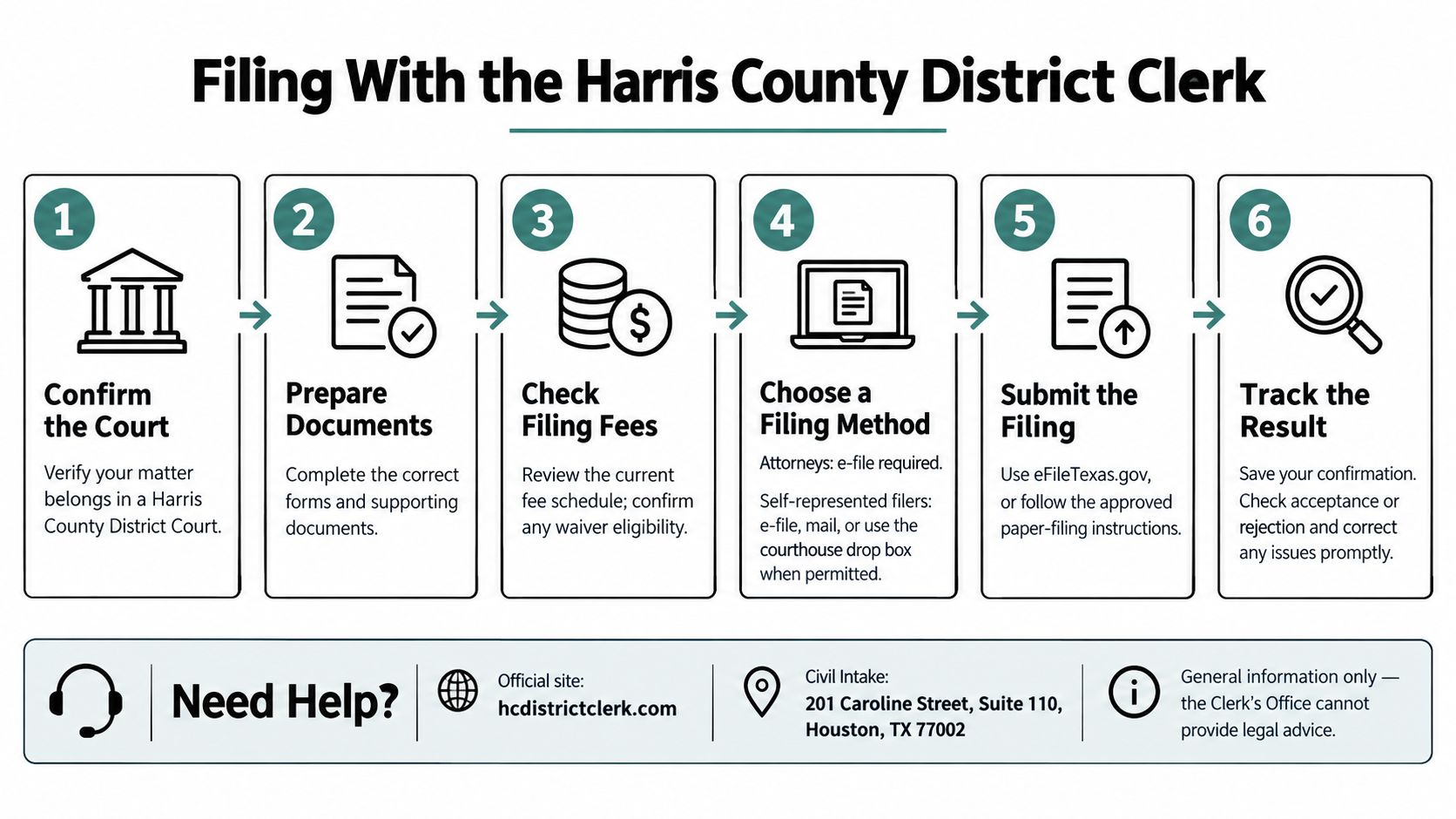
For a visual overview of the filing process, review the following resource:
Notice, Waivers, and Service of Process
Filing the petition doesn't give the judge authority to finalize the divorce by itself. The responding spouse must receive legally sufficient notice or execute a valid waiver. This is a separate legal gate from the residency requirements and the waiting period.
In an agreed case, the respondent may sign a waiver of service after the case begins. The waiver must be executed correctly and should clearly identify the case. A spouse who signs a defective waiver, signs at the wrong time, or fails to complete required formalities can leave the court without reliable proof of notice.
Choose the correct notice path
A waiver fits a cooperative respondent who understands the case and is willing to sign the required document. It can avoid formal citation, but it doesn't eliminate the need for a complete petition, final decree, and court approval.
Formal service is used when the spouse won't sign, can't be located through ordinary contact, or needs to be notified through an official process. Service may involve a constable or another authorized method. Publication or posting may become relevant when the spouse cannot be located, but those procedures require careful compliance and shouldn't be treated as shortcuts.
The timeline changes when formal service is used. The responding spouse generally has until the first Monday after 20 days to answer, and the return of service must be on file for at least 10 days before a default prove-up hearing, according to the Texas Family Code service and answer provisions.
A signed agreement and a default case are not the same case. The judge needs different proof depending on whether the respondent agreed or simply failed to answer after proper notice.
At the final stage, an agreed case typically relies on the waiver, signed agreement, and testimony confirming consent. A default case requires proof that service was completed correctly and that the response period and return-of-service requirements were satisfied. If your spouse is silent, don't label the case agreed just because there's no argument.
The 60-Day Clock and the Final Hearing in Harris County
A Kingwood spouse files the Original Petition for Divorce on a particular date. That filing date starts the statutory waiting-period calculation. The clock doesn't begin when the spouses reach an agreement, when the respondent signs a waiver, or when the final decree is drafted.
Texas Family Code § 6.702 generally prohibits a court from granting a divorce before the 60th day after the petition is filed, with a narrow family-violence exception, as provided in the Texas statute governing the divorce waiting period. TexasLawHelp explains that weekends and holidays count. If day 60 falls on a weekend or holiday, the parties should proceed on the next business day.
Build the calendar around the filing date
During the waiting period, use the time productively:
- Confirm that the respondent's waiver or service record is valid.
- Finish the Final Decree and all applicable child, property, or support attachments.
- Check that the decree matches the petition and the parties' agreement.
- Prepare the testimony for the prove-up.
- Keep the 60th day visible on the case calendar.
- Contact the District Clerk for current Harris County hearing or submission instructions.
A Harris County uncontested case may conclude through a live prove-up hearing, or the court may permit submission of a properly prepared decree under its current procedures. Don't assume one method applies to every judge or docket. The district clerk's current instructions control scheduling and submission logistics.
At prove-up, one spouse generally confirms the residency facts, the marriage, the agreement, the absence of unresolved issues, and the requested relief. The judge reviews the decree and may ask questions, especially where children, property, support, or unusual provisions are involved. Testimony must match the filed documents. If the petition says one thing and the decree says another, the judge may require correction before signing.
For a focused explanation of the timeline, review the information on the Texas divorce waiting period.
Common Filing Mistakes and How to Avoid Them
Most preventable delays come from treating an uncontested divorce like a casual paperwork exchange. Harris County still needs a legally sufficient case, a complete decree, valid notice, and documents that agree with one another.
Run this pre-filing error check
- Blank fields in the decree: Complete every applicable field. A blank term can leave property, debt, possession, or support unresolved.
- Petition and decree mismatch: Compare requested relief with the final orders. If the decree includes a provision that wasn't pleaded, correct the pleadings before the prove-up.
- Missing BVS information: Include the BVS information form with the required packet. Don't assume the clerk can complete it from the petition.
- Defective waiver: Confirm that the waiver identifies the case and satisfies the required execution formalities. A friendly text message isn't a waiver.
- Wrong form set: Don't use the simplified packet when minor children, real property, or retirement interests require expanded pleadings.
- Incomplete child-related terms: Address conservatorship, possession, support, medical support, and insurance when children are involved.
- Unclear property descriptions: Identify homes, land, vehicles, accounts, and retirement interests precisely enough for the decree to operate.
- Unresolved disagreement: If either spouse still disputes an asset, debt, parenting term, support obligation, or insurance responsibility, the case may not be uncontested.
The most dangerous mistake is assuming that cooperation eliminates legal review. A spouse may agree today but still need a decree that can be enforced later. Debt allocation, retirement transfers, property conveyances, and parenting terms deserve the same precision whether the spouses are cordial or angry.
A second warning sign is pressure. If one spouse controls the finances, refuses to disclose assets, threatens the other, or insists on signing immediately, stop and get advice. An uncontested label shouldn't be used to disguise coercion or an uninformed agreement.
This checklist gives Kingwood, Humble, and Northeast Houston residents a workable starting point. It also shows where the simplified path stops being simple: minor children, real property, retirement accounts, prior orders, military status, missing spouses, and formal service all deserve focused review. The Law Office of Bryan Fagan – Kingwood TX Lawyers can assess the filing path, review the Harris County paperwork, and help prepare a decree that reflects the agreement without overlooking the details that matter later.
The Law Office of Bryan Fagan – Kingwood TX Lawyers helps Kingwood, Humble, Porter, and Northeast Houston residents evaluate uncontested divorce filings, prepare Harris County documents, and address complications involving children, real property, retirement, prior orders, or service. Schedule a confidential, no-pressure free consultation at the Kingwood office so you can move forward with a checklist built around your actual case.