DUI and DWI aren't automatically the same, because Texas generally charges adults with DWI and uses DUI in a narrower under-21 context. The two words often describe similar impaired driving in everyday conversation, but the name on your charging papers controls what happens next.
You'll often hear advice to treat one label as serious and the other as minor. That shortcut can mislead a worried driver in Kingwood, Humble, Porter, or Northeast Houston. The better starting point is the statute named in the paperwork, your age, and whether a separate license notice came with the arrest.
Is DUI and DWI the Same in Texas
The common assumption is simple. Many people think DWI means a driver was very drunk, while DUI means the driver was only a little impaired. In Texas, that isn't the right way to sort the words.
Both labels generally describe operating a vehicle while impaired by alcohol, drugs, or both. The problem is that each state chooses its own name and definition. A word that works as a general label in one state may not match the charge written by a Texas officer or prosecutor.
Where the Texas Split Happens
Texas generally uses DWI for adults under Penal Code Section 49.04, covering intoxication from alcohol, drugs, medication, or other substances, while DUI appears in a narrower under-21 context where any detectable alcohol can constitute an offense, as Cornell Law's overview of driving while intoxicated explains. In many jurisdictions the terms are synonyms. In Texas they can refer to legally different offenses based primarily on the driver's age and the statute used.
That distinction answers the question, is DUI and DWI the same, more accurately than a national one-size rule. Friends may use DUI as a nickname for any impaired-driving arrest. Court papers can't be that casual.
If you searched online for a DUI lawyer after an arrest near Kingwood, that search doesn't prove you were charged with a Texas DUI. You may have an adult DWI charge even if everyone at home is calling it a DUI. The opposite can matter too, especially when a younger driver is involved.
A useful first check: read the offense name on the charging document before you decide what the case is about. The label people use in conversation isn't the law.
By the end of this guide, you should be able to do three practical things. You'll know how to identify the charge name, how to separate a blood-alcohol number from an impairment claim, and how to spot a license deadline running beside the criminal case. Those three skills matter much more than winning an argument about vocabulary.
How Texas Defines Intoxication
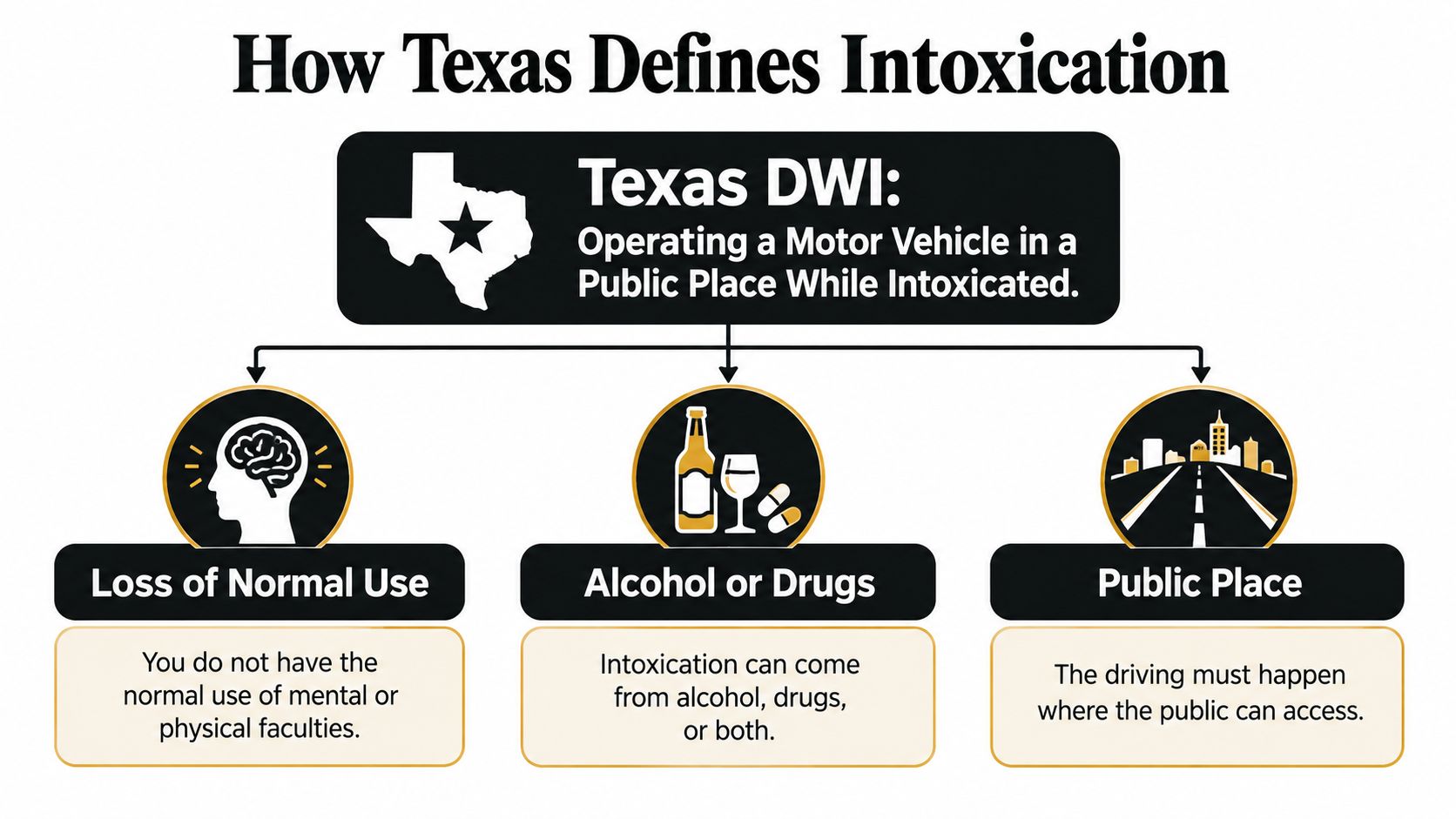
The label alone doesn't prove the offense. For an adult in Texas, the state points to a specific set of elements. A person commits DWI by operating a motor vehicle in a public place while intoxicated.
The visual below maps that definition into its moving parts.
Two Ways Intoxication Can Be Alleged
Texas treats intoxicated as having two independently sufficient meanings. Under the NHTSA digest of impaired-driving laws, intoxication means either loss of the normal use of mental or physical faculties because of alcohol, drugs, or another substance, or an alcohol concentration of at least 0.08. A prosecution doesn't depend exclusively on a chemical result.
That structure creates two different kinds of cases. One case may rest on what an officer says about your driving, balance, speech, or ability to follow instructions. Another may rest on a breath or blood number.
Here's a plain example. A Kingwood driver drifts across a lane line, struggles during field tests, and admits taking medication that can cause drowsiness. The state may argue that normal faculties were lost, even if there's no alcohol result at 0.08.
Now consider the reverse. A driver appears steady on video, but a chemical test is reported at or above 0.08. The state may pursue the alcohol-concentration theory while visible impairment remains disputed.
- Loss of normal use: the focus is mental or physical ability affected by a substance.
- Alcohol concentration: the focus is the 0.08 statutory threshold.
- Either path can be enough: the state doesn't always need both.
Readers often get confused here. They hear 0.08 described as the legal limit and assume a lower number ends the case. Texas law doesn't work that neatly, because impairment can be alleged before that threshold if alcohol or drugs have affected driving ability.
Don't reduce a Texas DWI to one number. Ask which definition of intoxication the state is using.
Every U.S. jurisdiction uses 0.08 g/dL as the per se threshold for alcohol-impaired driving, so that number is nationally familiar. Familiar doesn't mean interchangeable, though. Texas still applies its own wording about operating a vehicle, a public place, and loss of normal faculties.
When you review an arrest, separate the pieces in that order. Was there driving or operating? Was it in a public place? Is the state claiming lost faculties, a 0.08 result, or both? That sequence turns a confusing label into a set of questions you can examine.
Comparing Adult DWI and Under-21 DUI
A side-by-side view helps because the Texas distinction isn't about which word sounds worse. It's about who was charged and which rule the state used. Your paperwork, not your search history, tells you which column applies.
Texas Adult DWI and Under-21 DUI
| Question | Adult DWI | Under-21 DUI |
|---|---|---|
| Who is charged? | Generally an adult driver | A driver under 21 |
| What is the controlling idea? | Operating a motor vehicle in a public place while intoxicated | Driving with detectable alcohol in the narrower under-21 setting |
| What alcohol level matters? | 0.08 can support an alcohol-concentration theory | Any detectable alcohol can constitute the offense in Texas |
| Can drugs or medication matter? | Yes, intoxication can involve alcohol, drugs, medication, or other substances | The Texas under-21 DUI discussion centers on detectable alcohol |
| What should you check first? | The charge name and whether the theory is impairment, 0.08, or both | The driver's age and the exact offense named |
Texas Penal Code Section 49.01 defines intoxicated as loss of normal faculties from alcohol, a controlled substance, a drug, a dangerous drug, a combination, or another substance, or an alcohol concentration of 0.08 or more, as shown in the Texas Penal Code Chapter 49 text. NHTSA describes 0.08 as an illegal per se threshold, meaning the state generally doesn't have to prove additional impairment once the applicable statutory concentration is established.
That same framework identifies 0.15 as a high-BAC level that may trigger enhanced sanctions under state law. It also describes zero-tolerance policies for drivers under 21, commonly beginning at 0.02 or another measurable amount depending on state law. In Texas, the under-21 point is more direct for this comparison, because any detectable alcohol can be an offense.
DWI is not automatically the harsher twin of DUI. In Texas, the age and statute may be the real dividing line.
This confusion shows up in practical ways. A parent in Humble may call about a child's DUI and expect the same adult analysis. An adult in Northeast Houston may search for DUI help, then discover the complaint says DWI.
Neither reaction is unusual, and neither person has made a mistake just by using the everyday word. The mistake would be stopping there. You need the exact charge before you can judge the evidence, court process, or next deadline.
What to Look for on the Paperwork
- Exact offense name: confirm whether it says DWI or DUI.
- Driver's age: check whether the under-21 rule could explain the label.
- Theory of intoxication: look for lost faculties, an alcohol concentration, or both.
- Substance involved: note whether alcohol, drugs, medication, or a combination is alleged.
Once those boxes are clear, the question becomes less abstract. You're no longer asking whether two acronyms match across the country. You're asking what Texas has accused this driver of doing.
Local Arrest Examples and What the Charge Means
Examples make the distinction easier to spot in real life. The following situations aren't case outcomes, and they don't predict how a prosecutor will act. They show how different facts can point to different labels and different evidence.
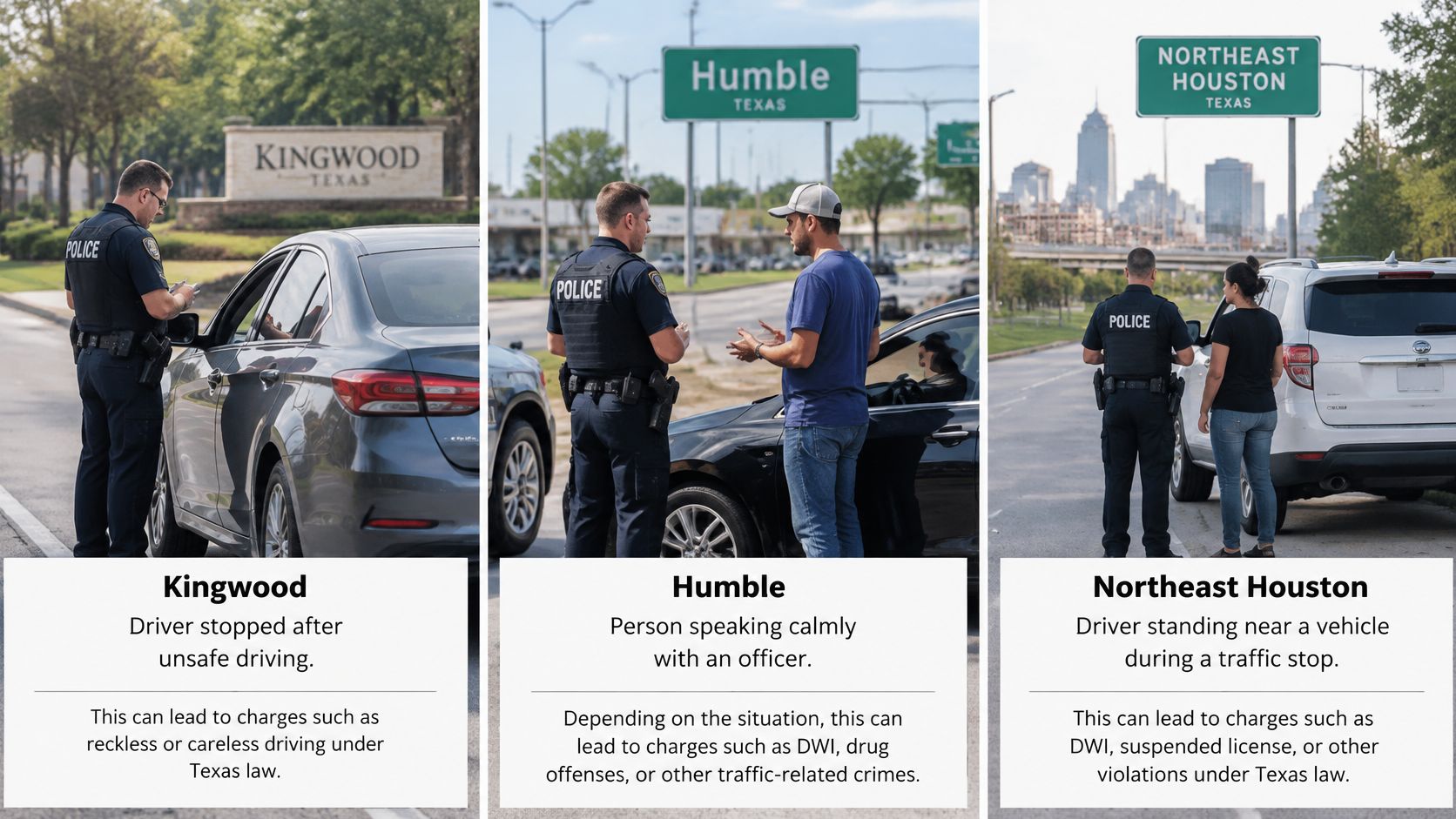
Three Situations Kingwood Drivers Recognize
An adult in Kingwood is stopped after unsafe driving, but no chemical result exists yet. The officer writes about lane movement, delayed responses, and field-sobriety performance. Even without a breath or blood number, the dispute may center on whether normal mental or physical faculties were lost.
An adult in Humble provides a result reported at or above 0.08. The state may emphasize the alcohol concentration itself. The review then shifts toward testing procedures, timing, records, and whether the result can be trusted, while also checking what the video and stop show.
A driver under 21 in Northeast Houston has detectable alcohol. The age issue moves to the front. The case may be described as a DUI in the narrower Texas under-21 context, even if family members expected every impaired-driving arrest to be called DWI.
Evidence Worth Separating From the Nickname
The NHTSA drug-impaired driving resources page reflects the same state-based point that impaired-driving offenses may be called driving while intoxicated, driving under the influence, or a similar term. What matters locally is the evidence behind the Texas label.
- The traffic stop: what driving or other reason led to the stop?
- Field-sobriety testing: what instructions were given, and what did the driver do?
- Statements: what did the driver say about drinking, medication, fatigue, or where the trip began?
- Chemical-test procedures: how was a specimen requested, collected, handled, and documented?
- Video: does the recording support or weaken the written description?
One sentence to remember: a low or missing alcohol number doesn't answer a drug or medication impairment claim.
Suppose the alcohol result is low, but the officer claims a prescription drug affected balance and attention. That isn't a vocabulary problem. It's an impairment allegation that must be reviewed on its own facts.
The same is true when friends insist you're fine because you "only got a DUI." They're using a nickname, not reading the complaint. Match your situation to the charge theory, impairment, a 0.08 allegation, or an under-21 alcohol issue, and the next questions become much clearer.
Why the Name Does Not Shrink the Risk
DUI and DWI may sound like interchangeable labels, but a familiar acronym does not make an impaired-driving allegation less serious. The law addresses the conduct and evidence behind the charge, not how casually someone names it.
The national toll shows why the distinction matters beyond the person arrested.
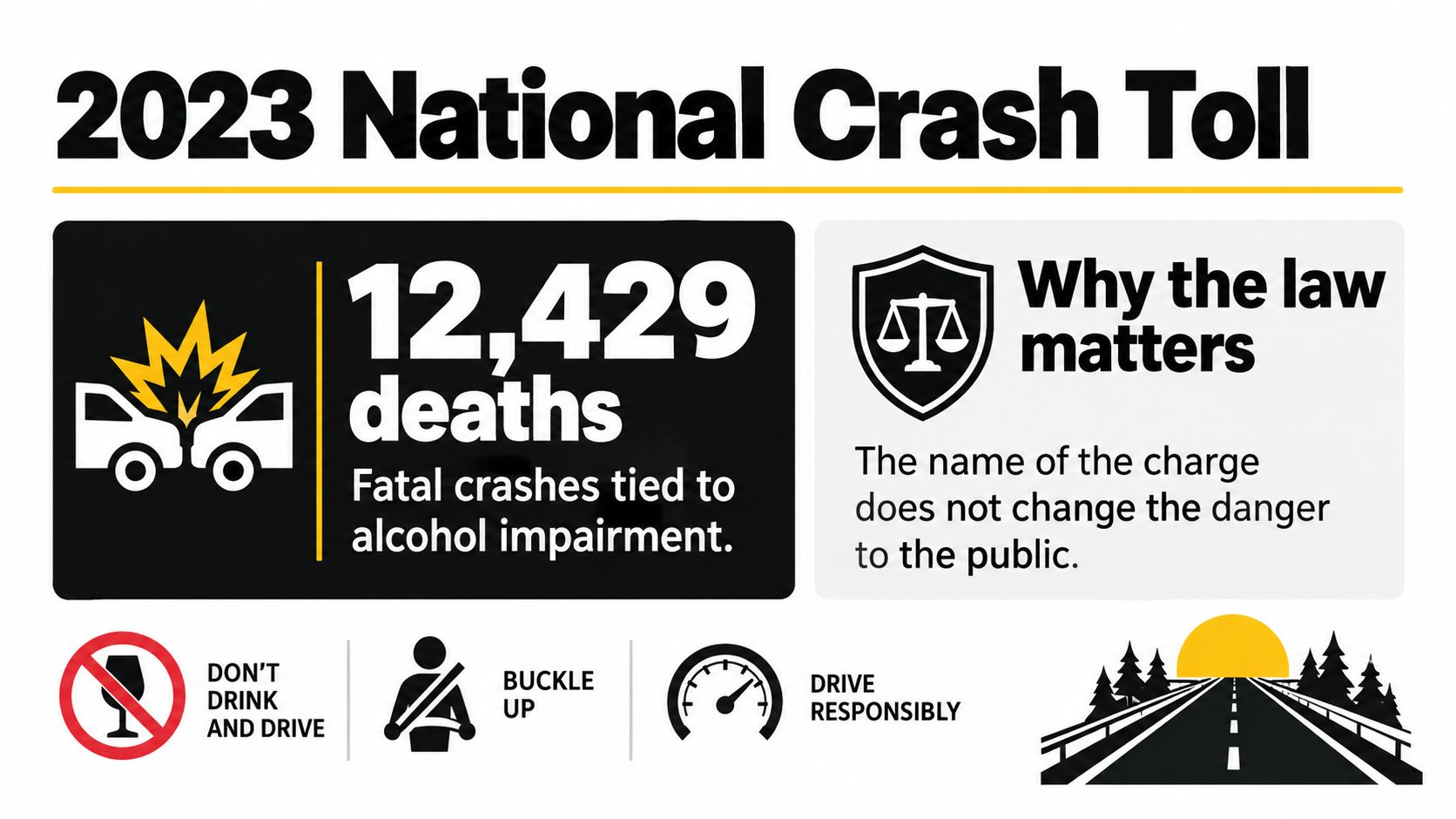
The NHTSA 2023 alcohol-impaired driving traffic safety fact sheet reports 12,429 deaths in crashes involving an alcohol-impaired driver that year. That was 30 percent of traffic fatalities, or about one death every 42 minutes. The total was 7.6 percent lower than the 13,458 deaths recorded in 2022.
A decline is welcome, but it does not make the remaining loss small. In 8,272 of the 2023 deaths, or 67 percent, at least one driver had a BAC of 0.15 or higher, nearly twice the standard 0.08 threshold.
For drivers in Kingwood, Humble, and Northeast Houston, the local concern is concrete: an impaired driver shares the road with neighbors on everyday trips. The national figures describe alcohol-related crashes, not the outcome of any one arrest.
The video below provides a brief visual break.
Those figures do not cover every drug-impaired incident or every arrest that ends without a crash. Texas allegations can involve medication or drugs, even when alcohol is not the central issue. In that respect, crash totals are a warning about public safety, not a measurement of every kind of impairment.
They also cannot establish whether a particular driver was impaired. A prosecutor must rely on the specific stop and evidence in that case. The defense examines those same details, rather than treating broad national numbers as proof.
For a local overview of possible consequences after conviction, see this guide to DWI penalties in Texas. The label may change from one conversation to another. The conduct and evidence behind a Texas charge are what determine its significance.
License Suspension After a Texas Arrest
For many Texas drivers, the most urgent comparison isn't DUI versus DWI. It's the criminal case versus the license case. They can move at the same time, and one doesn't wait politely for the other to finish.
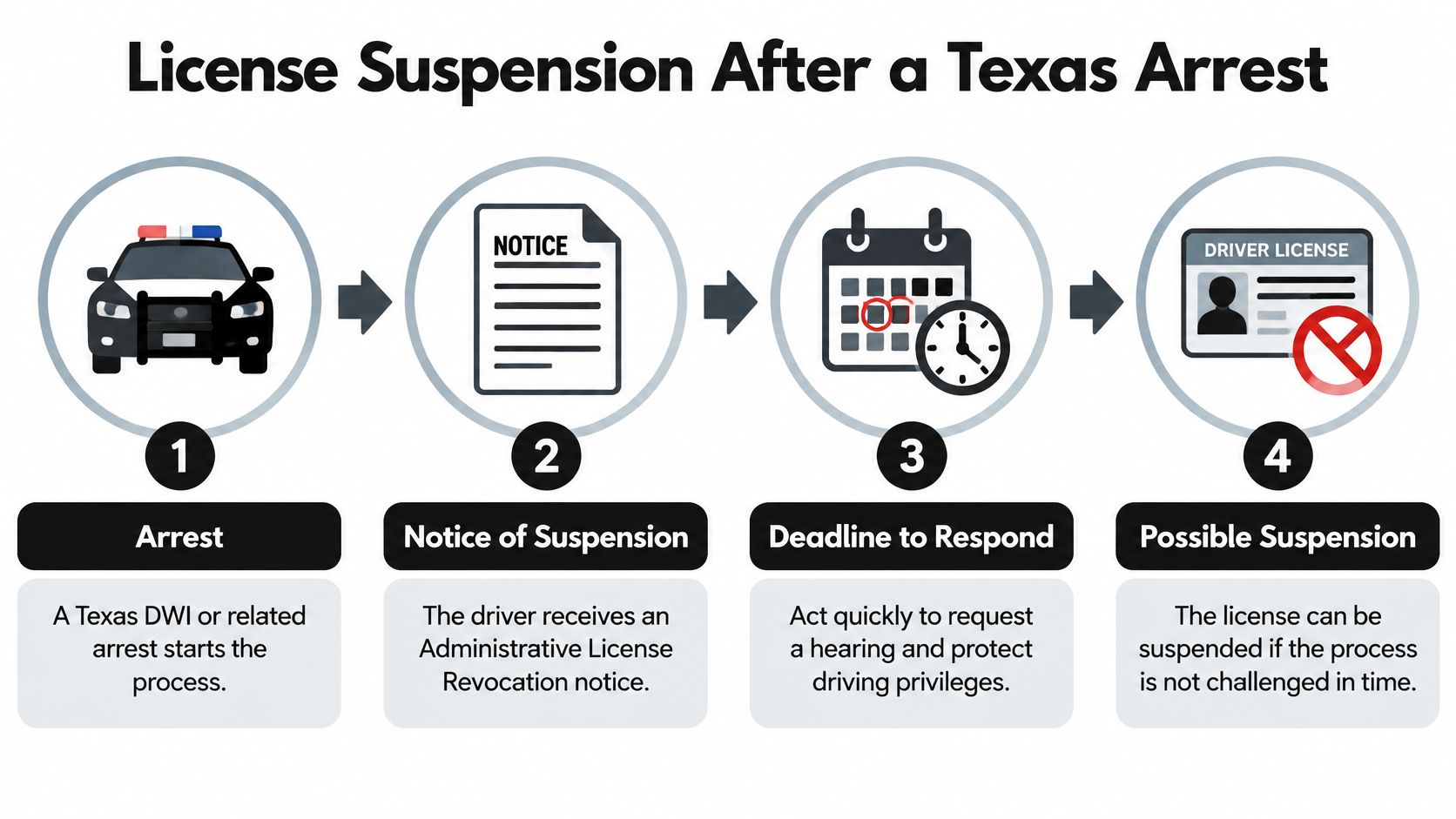
The process graphic below shows why the paperwork you receive at arrest deserves immediate attention.
The ALR Clock Runs Separately
The license process is called Administrative License Revocation, or ALR. Texas DPS may pursue an administrative suspension when an adult refuses or fails a breath or blood test, or provides 0.08 or higher in a noncommercial vehicle, according to the Texas DPS Administrative License Revocation program page.
The driver generally has 15 days from service of notice to request a hearing. If no hearing is requested, the suspension takes effect on the 40th day. DPS identifies a first-offense suspension of 180 days for refusing a specimen and 90 days for providing a specimen showing at least 0.08, with longer periods for certain prior suspensions or convictions.
That independence surprises many people. A negotiated or dismissed criminal charge doesn't automatically eliminate every administrative license consequence. You can be focused on a future court date while the shorter ALR deadline passes without notice.
Calendar rule: find the notice date first, then count the 15 days. Don't assume your first court setting is the first deadline.
A Practical Sequence After Release
- Identify the offense name: read whether the criminal paperwork says DWI or a different offense.
- Find the ALR notice: confirm whether a notice of suspension was served.
- Count from service: mark the 15-day hearing request deadline on a calendar you check daily.
- Separate the evidence review: examine the stop, testing, statements, and video for the criminal case.
- Plan for driving needs: if a suspension may affect work or family duties, learn about an occupational driver's license after a DWI in Kingwood before the problem becomes urgent.
A Kingwood driver who waits for reassurance may lose options that depended on a timely request. A Humble commuter may also discover that getting to work requires planning, not guesswork. Treat the license notice as its own case file from day one.
Choosing Help and Your Next Step in Kingwood
A good first consultation shouldn't begin with the acronym your family has been using. It should begin with your paperwork. The lawyer needs to see what Texas charged, what theory the state is using, and whether a license clock is already running.
What a Local Review Should Check
- Exact charge: is the offense listed as adult DWI, under-21 DUI, or something else?
- Impairment or number: is the state claiming lost normal faculties, an alcohol concentration of 0.08 or more, or both?
- Age: does an under-21 alcohol rule explain why DUI appears?
- ALR notice: was notice served, and how much time remains within the 15-day window?
- Evidence set: what do the stop, field tests, statements, chemical procedures, and video show?
That review turns a frightening pile of papers into a sequence of decisions. You can discuss what needs attention now, what belongs in the criminal court file, and what belongs in the separate license process. You also avoid building a plan around a nickname that may not appear anywhere in the complaint.
Delay matters because a first conviction can carry serious consequences. Texas Department of Transportation guidance lists a first DWI conviction as carrying up to a $2,000 fine, up to 180 days in jail with at least 3 mandatory days, and a driver-license suspension of up to 1 year, as the TxDOT impaired-driving laws page states.
The Law Office of Bryan Fagan is a Kingwood firm that defends DWI and DUI allegations along with other misdemeanor and felony cases. For drivers who need a local starting point, a DWI lawyer in Kingwood can review the exact charge and evidence with familiarity with nearby courts and clear communication about next steps.
That local support sits alongside the firm's other work for area families. For example, a CPS Defense Attorney in Kingwood provides defense against CPS investigations for Kingwood families.
No lawyer can promise a result from an article, and no online explanation can replace a review of your own stop and test records. What you can do now is bring every document you received, including any license notice, and schedule a free consultation at the Kingwood office. For a driver in Kingwood, Humble, Porter, or Northeast Houston, that first careful reading often answers the question that caused the anxiety in the first place.
If you're trying to tell an adult Texas DWI from an under-21 DUI, or you're worried that an ALR deadline is already moving, bring your charging papers and license notice to Law Office of Bryan Fagan – Kingwood TX Lawyers for a free consultation. Our Kingwood team can explain the charge in plain language, separate the criminal case from the license process, and help you plan your next step close to home.