Legal parental rights in Texas aren't absolute. They're shaped by statutes, court orders, and the child's best interest, so Kingwood parents need to understand how their rights are established, limited, and enforced.
A separation can turn everyday decisions into urgent questions: Who decides where a child goes to school? Can a parent change the pickup schedule? What happens if a parent's name isn't on a court order? For families in Kingwood, Humble, Porter, and Northeast Houston, the answers depend on the parent-child relationship and any applicable court orders, not just what seems fair between adults.
What Are Legal Parental Rights in Texas
A Kingwood parent going through a breakup may assume that being a child's parent automatically answers questions about custody, decision-making, and parenting time. Then the other parent proposes a schedule, a school choice, or a change to medical care, and it becomes clear that legal rights and practical arrangements aren't always the same thing.
In plain language, legal parental rights are the rights and duties Texas law recognizes between a parent and child. They include the right to physical possession of and access to the child, and the responsibility to care for, control, protect, and reasonably discipline the child. Parents also have a duty to provide financial support. Texas law describes these rights and duties, while recognizing that orders and other legal circumstances can affect how they operate. (Texas Family Code provisions on parent-child rights and duties)
Think of parental rights as a framework for making decisions and meeting responsibilities. The framework doesn't, by itself, tell you which parent has the child on a particular weekend or who has authority over every decision. A court order can set those terms, and a parent's rights can also be affected by an affidavit relinquishing parental rights or a valid designation of another managing conservator.
Practical point: Being a legal parent matters, but it doesn't give either parent permission to disregard an existing court order.
For a parent in Humble or Porter, that distinction can matter when the family's informal routine changes. A parent who wants a different schedule should avoid relying on a handshake arrangement if a court order already sets possession and access. Gather school, medical, childcare, and communication records, then get advice before making a significant change to the existing arrangement.
Support duties also don't necessarily end when a child turns eighteen. Texas law allows support to continue in certain circumstances when a child remains enrolled in a qualifying secondary-school program and meets attendance requirements. A person who provides necessities for a child may also have a claim against a parent who fails to provide support. The practical lesson is that parental rights and responsibilities are connected, but they must be understood in the context of the family's actual legal arrangements.
The Legal Foundation of Parental Rights
Parental decision-making has constitutional protection, but that protection operates alongside Texas laws that guide custody decisions. A useful analogy is a house: constitutional precedent provides part of the foundation, while Texas law supplies the blueprint courts use to resolve specific family disputes. The child's welfare remains central to how that blueprint is applied.
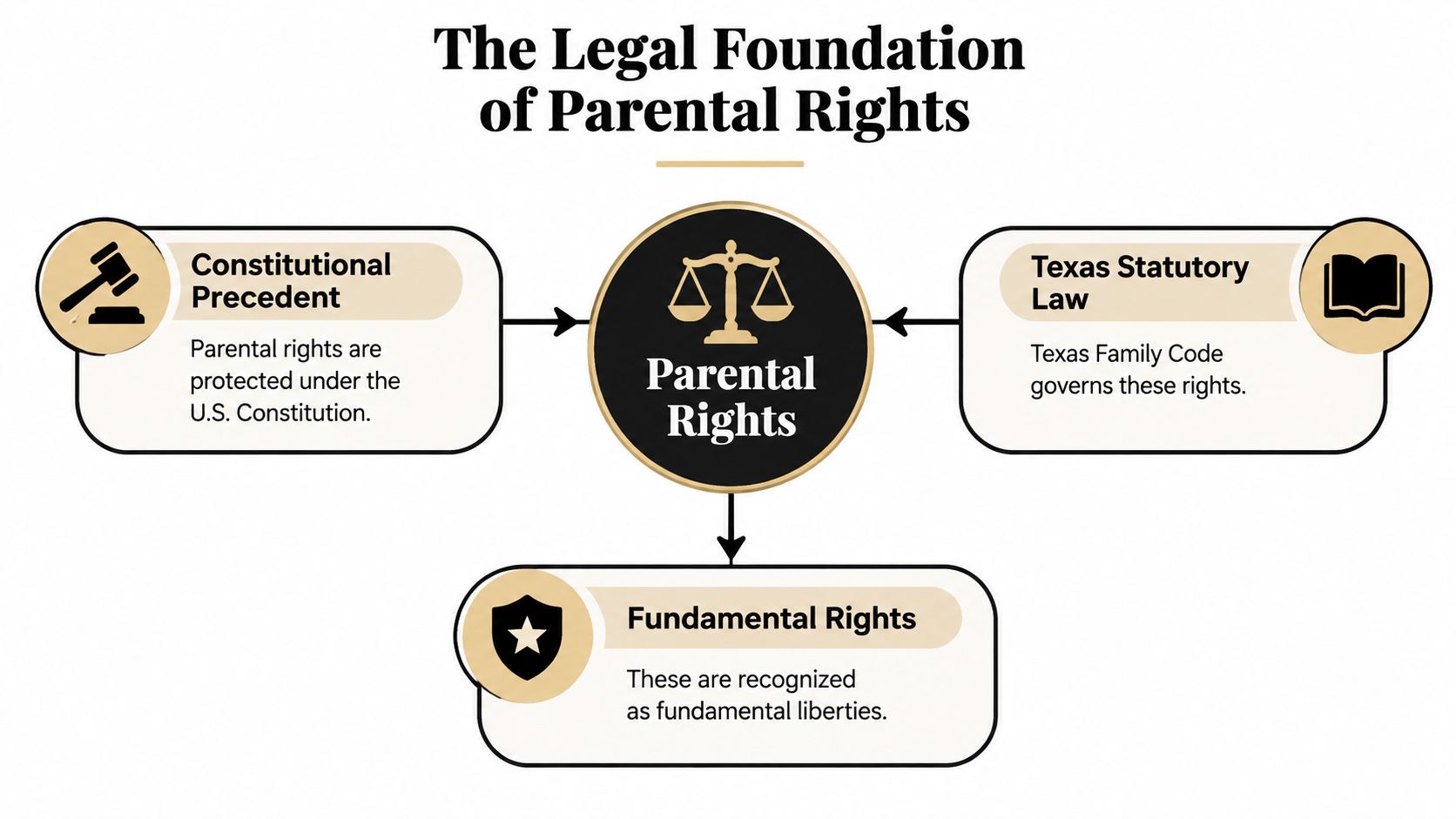
The U.S. Supreme Court's decisions in Meyer v. Nebraska and Pierce v. Society of Sisters recognized important limits on government interference with parental choices about raising and educating children. In Troxel v. Granville, decided June 5, 2000, the Court held in a 6–3 decision that applying Washington's broad grandparent-visitation law violated a fit parent's constitutional liberty interest in the care, custody, and control of children. The dispute concerned a mother who objected to court-ordered visits by the paternal grandparents after the children's father died. The Court cautioned against a judge substituting a preferred child-rearing choice for that of a fit parent. (The Supreme Court's decision in Troxel v. Granville)
That constitutional protection doesn't make parental authority unlimited. Courts may intervene under applicable law when evidence establishes concerns such as abuse, neglect, incapacity, or a child's safety. Nor does a parent's constitutional interest decide every question about a possession schedule or legal decision-making authority.
Texas courts apply the best interest of the child standard as their primary consideration when deciding conservatorship, possession, and access. They look at concrete welfare factors, including the child's stated desires, emotional and physical needs, potential dangers, each parent's abilities and plans, household stability, available support programs, and conduct affecting the parent-child relationship. (Texas law on the best interest of the child)
This means a parent's preparation should answer the questions a judge must evaluate. Instead of relying only on a broad claim of being a fit parent, organize records showing caregiving, school and medical involvement, safe housing, a workable schedule, and constructive communication. For Northeast Houston families, those details can help turn an abstract dispute into a clearer picture of what arrangement supports the child.
How Parental Rights Are Established
Before parents negotiate a schedule, they need to know whether each adult is legally recognized as a parent. A close relationship with a child can be meaningful, but it doesn't automatically resolve the legal question of parentage. If parentage is uncertain, address it before assuming that custody or access rights are settled.
Identify the legal basis for parentage
Start by locating documents that establish or affect the parent-child relationship. Depending on the family's circumstances, relevant records may include court orders, parentage documents, or adoption records. A court order may also change how rights operate, so read its wording rather than relying on a memory of what was agreed.
For an unmarried father whose legal parentage hasn't been established, the next step is to find out which legal process applies. Texas law provides formal routes for establishing paternity, and the right route depends on the facts. A parent can learn more about the process through this guide to establishing paternity in Texas.
Gather records and get advice before changing the routine
Collect documents that help clarify parentage and the child's day-to-day needs. School, medical, childcare, and communication records can help a parent explain the existing caregiving arrangement and the decisions the family needs to make. Keep copies organized and preserve communications in their original form.
A parentage question can overlap with a custody dispute. If so, separate the issues: first determine who is legally recognized as a parent, then identify what orders or requested orders would address conservatorship, possession, and access. A Child Custody Lawyer in Kingwood, TX handles custody and conservatorship representation for Kingwood families.
Legal rights also come with responsibilities. A parent generally remains responsible for supporting a child while the child is an unemancipated minor, and support may continue after age eighteen in qualifying secondary-school circumstances. Parents considering divorce, litigation, or a change to an existing arrangement should get advice before treating an informal agreement as a replacement for a court order.
Custody, Possession, and Visitation Under Texas Law
Texas custody language can sound like one issue, but it covers different parts of parenting. Conservatorship addresses legal rights and duties. Possession describes when a child is physically with each parent. Access, often called visitation in everyday conversation, concerns a parent's time with the child under the order.
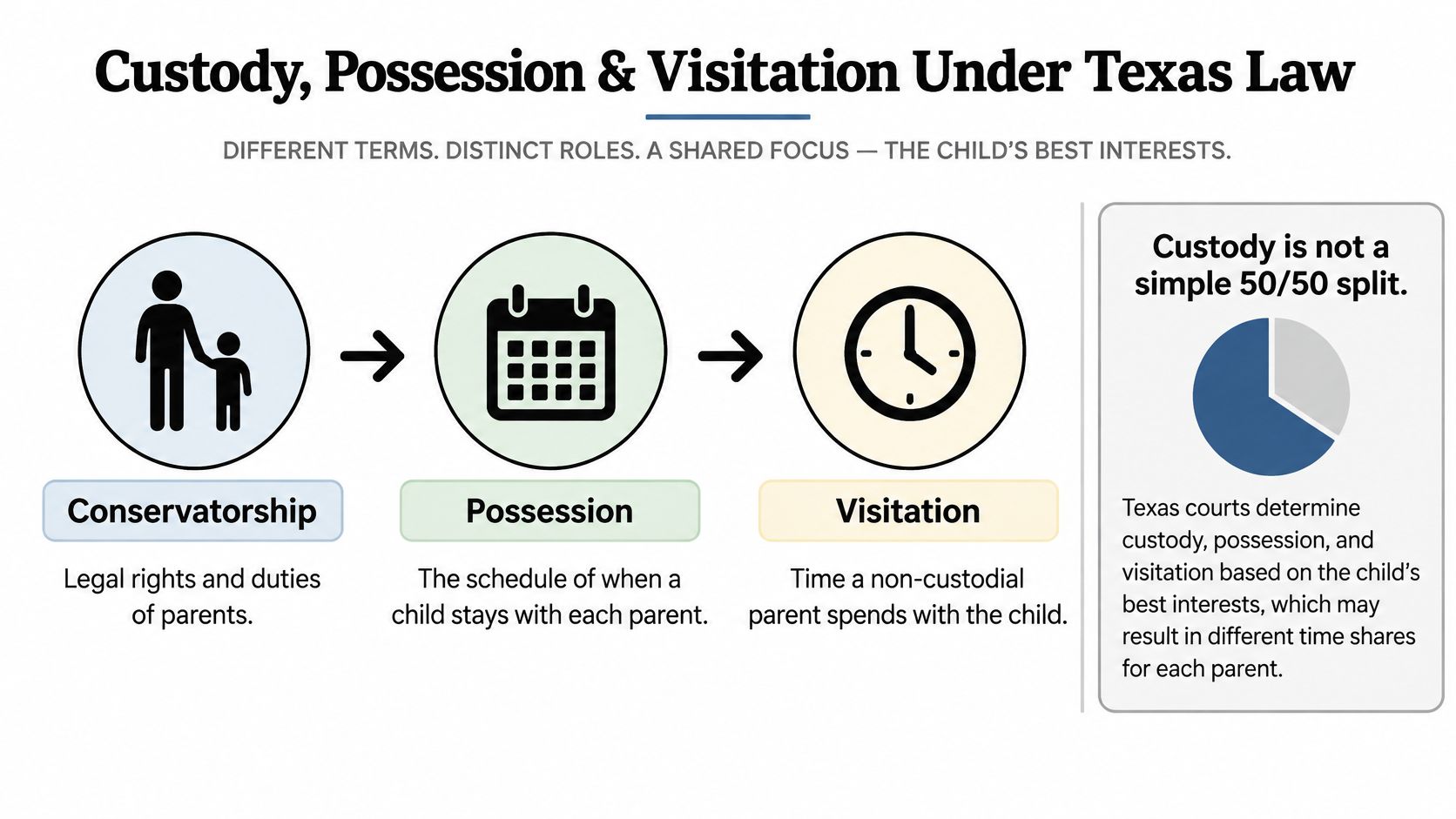
The distinction matters because shared legal decision-making doesn't automatically mean equal physical time. Texas generally presumes that divorcing parents should be appointed joint managing conservators unless evidence supports a different arrangement. That presumption concerns conservatorship and decision-making. It doesn't guarantee a 50/50 possession schedule or identical authority over every issue. (Texas child custody and support guidance)
What the standard schedule can provide
When parents live within 100 miles of one another, the standard possession framework offers a starting point unless a different agreement or court order applies. During the school year, the nonprimary parent generally has possession on the first, third, and fifth weekends. Depending on the options in the order, weekends begin at school dismissal or 6:00 p.m. and end when school resumes Monday or at 6:00 p.m. Sunday.
The standard framework also allows a 30-day summer possession period if the parent gives written notice by April 1 specifying the requested period or periods. Those details can make a big difference for parents in Kingwood, Humble, and Porter, especially when school calendars, work hours, transportation, and extracurricular activities don't line up neatly. (Texas standard possession order details)
A default schedule is a starting point, not a promise that the same plan works for every family. A parent who works nontraditional hours, manages a child's therapies, or lives near Kingwood but faces difficult exchanges may need to ask for terms suited to the family. When preparing, identify who handles transportation, school communications, medications, activities, and makeup time. A clear proposed schedule can help the court assess whether the plan serves the child.
Parents can review how the Texas standard possession order works, then compare its practical details with their child's school routine and the terms of any existing order. The important question isn't only how much time each parent receives. It's whether the full arrangement supports the child's needs and can be followed consistently.
When Parental Rights Are Terminated or Limited
A parent's rights can be limited without being terminated, and the distinction is important. A court order may assign decision-making authority differently or set conditions on possession and access. Termination, by contrast, is a serious legal step that ends the parent-child relationship for legal purposes. Neither a difficult co-parenting relationship nor a disagreement with an investigator, by itself, tells you what outcome a court will reach.

In a termination proceeding, the governing standard is clear and convincing evidence. That standard is different from the thresholds that may apply at earlier stages of an investigation. It's also possible for a court to reach different outcomes for different parents in the same family, depending on the evidence relating to each parent.
Responding to CPS contact
If a CPS investigator contacts you, distinguish a request for cooperation from a court order or an emergency action. Texas requires investigators to give parents a written warning that they may have an attorney present and may refuse an interview. The state's 2025 reforms narrowed the neglect standard requiring intervention from “substantial risk” to “immediate harm” and restricted removals based solely on one DFPS-contracted medical expert's opinion. Those changes don't eliminate emergency state authority or guarantee reunification. (Reporting on Texas parental-rights and CPS reforms)
If you're approached, preserve messages and records, read any paperwork carefully, and document what you agree to. Ask whether a request is voluntary or legally required, and don't ignore a court order or deadline. If there's an emergency, a safety plan, a subpoena, or a threat of termination, seek case-specific legal advice promptly. The details can change what options are available, and informal assumptions can create avoidable problems.
A stronger understanding of constitutional rights is helpful, but it isn't a substitute for responding carefully to the facts of a CPS investigation. Parents should focus on accurate records, compliance with court orders, and avoiding conduct that could be characterized as endangering the child.
How to Enforce or Modify Parental Rights
When a parenting order no longer fits a family's circumstances, the safest route is usually to ask the court to change it. Texas courts retain continuing, exclusive jurisdiction over many existing orders involving conservatorship, possession, access, and child support, which generally allows the court that issued an order to modify it. Federal interstate-support rules can limit modification of a Texas support order in some cases. (Texas law on continuing, exclusive jurisdiction)
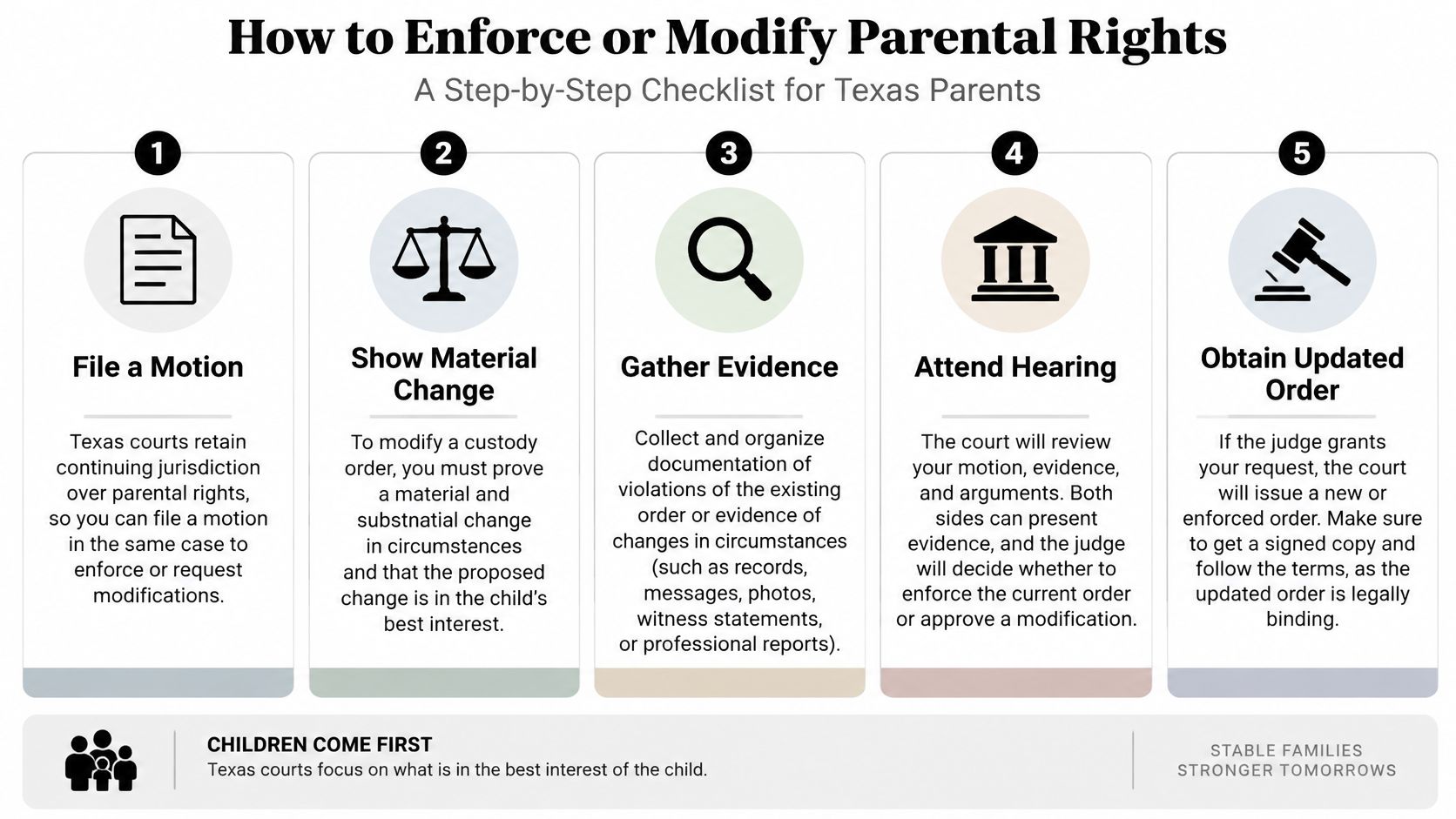
A practical sequence for a requested change
-
Find the existing case. Locate the court and cause number shown on the current order. This helps you identify where a request should be directed.
-
Describe what has changed. Write down the change affecting the child or a parent, such as a different living arrangement or changed income. Keep the explanation specific and tied to the child's circumstances.
-
Preserve the evidence. Keep records of relevant communications, changed circumstances, missed visits, or support issues. Organized records are easier to explain than a collection of scattered messages.
-
Use the court process. File the appropriate request and follow the court's instructions. If jurisdiction is transferred to another Texas court, the transferring court must also direct future support payments to the new court's local registry or, when applicable, the state disbursement unit.
-
Follow the updated order. Continue following the current order unless the court changes it. A parent who unilaterally withholds visitation or stops support can create enforcement problems, even when the underlying circumstances have changed.
For Kingwood parents, the step to avoid is replacing a court order with a private decision. If the other parent misses exchanges or doesn't follow an order, document what happened and consider asking the court to enforce it. A family may also need to request a modification when a significant change makes the current arrangement unsuitable.
A parent considering a change can review the process for custody modification in Kingwood. This video provides additional context about enforcing or modifying parental rights:
Common Legal Issues for Kingwood Families
A parent in Kingwood may be asked to follow a possession schedule that doesn't fit a child's school or therapy needs. Another parent in Humble may be trying to establish legal parentage before seeking a custody order. The facts differ, but the starting point is similar: identify the legal issue, check for an existing order, and gather records that show how a proposed arrangement would work for the child.
When the default schedule doesn't fit
Texas's 2025 changes reportedly made the Expanded Standard Possession Order the starting point when parents live within 50 miles. They also reportedly allow courts to give one parent exclusive authority over school enrollment and voucher decisions, and made custody evaluations more demanding, including specialized training requirements for evaluators handling children with intellectual or developmental disabilities. (Overview of Texas family-law changes)
For a Kingwood parent whose child needs regular therapies, a schedule should account for who coordinates appointments, handles transportation, communicates with school, and manages medication. A parent with rotating shifts may need to explain why a default exchange time is unreliable. Equal or expanded possession doesn't automatically mean equal legal decision-making, and a short drive between homes doesn't guarantee that every schedule is practical. Gather calendars, care records, and a specific alternative plan.
When a relative seeks time with a child
A child's grandparents or other relatives may have a close bond with the child, but that relationship alone doesn't decide whether a court can order visitation. A parent facing a request should understand the legal standing and evidence requirements that apply to the specific dispute. The constitutional protection described earlier also helps explain why a court can't replace a fit parent's decision with its own preference. Families looking for a local overview can read about grandparents' rights in Kingwood.
Parents in Porter or Northeast Houston may also need to coordinate school calendars and travel between households. Keep a written record of proposed exchanges, missed visits, and efforts to resolve scheduling conflicts. Clear, child-focused documentation can help distinguish a genuine logistical problem from a disagreement over parenting choices.
The Law Office of Bryan Fagan – Kingwood TX Lawyers provides family-law guidance on custody, support, and parental-rights disputes for Kingwood and nearby families. If you're weighing a new schedule, responding to CPS, or considering a court modification, Law Office of Bryan Fagan – Kingwood TX Lawyers invites you to schedule a free consultation at the Kingwood office.