If you're an unmarried father in Texas, you generally must establish paternity before a court will order visitation, and most Kingwood cases begin with the Standard Possession Order unless a judge finds good cause to deviate. For a parent living within 100 miles of the child, that baseline usually includes first, third, and fifth weekends, Thursday evenings during the school term, holidays, and summer possession. TexasLawHelp explains the Standard Possession Order framework.
You may be sitting in your Kingwood home with missed calls, unanswered messages, and no clear answer about when you'll see your child again. Maybe you're a father who was involved every day before a breakup or move. Maybe you're a mother whose former partner is blocking contact, and you need a safe, enforceable schedule rather than another argument by text.
Texas uses the word possession for what most parents call visitation. Conservatorship addresses decision-making authority, while possession and access describe the time each parent spends with the child. The court's focus is the child's best interest, not which parent tells the more emotional story.
The practical path is straightforward, even when the conflict isn't. Establish paternity when necessary, file the correct case in Harris County, request a specific schedule, support your request with organized evidence, and obtain an order that can be enforced. Kingwood, Humble, Porter, and Northeast Houston parents also need to understand how the 50-mile rule and Harris County's supervised visitation program can change the result.
What Visitation Rights Look Like for Kingwood Parents
A father in Kingwood may have fed his child, handled school pickups, attended medical appointments, and paid household expenses, yet still lack a court order guaranteeing parenting time. The same problem can affect a mother whose former partner refuses to follow an informal schedule. Without an order, each parent may believe the other is violating an agreement, but neither has a clear possession schedule a judge can enforce.
Texas calls parenting time possession and access, not just visitation. The parent who has the child most of the time may be described as the primary conservator, while the other parent may be a possessory conservator. Those labels don't automatically decide whether a parent can maintain a meaningful relationship with the child. The order should state the actual dates, times, exchanges, holidays, and conditions.
Paternity comes before possession for many fathers
An unmarried biological father generally needs to establish legal paternity before a Harris County court will sign an order granting possession. Being listed informally as the father, having held the child out as your own, or having spent substantial time caregiving may help explain the relationship, but those facts don't replace a legal paternity determination.
A married parent usually starts from a different legal position because Texas law generally presumes the husband is the father when a child is born during the marriage. An unmarried father should address paternity immediately, then seek an order that turns the relationship into enforceable parenting time.
The local default is structured
When parents can't agree, Texas generally starts with the Standard Possession Order, subject to the child's age, distance between homes, and best-interest findings. Texas law requires orders to specify exact possession and access terms unless a party shows good cause that detailed terms would not serve the child's best interest. Texas Family Code Chapter 153 reflects why a final Kingwood order should identify precise exchanges rather than promise only “reasonable visitation.”
Practical rule: Ask for a schedule you can follow every week, not a vague promise that leaves the next exchange open to another dispute.
The roadmap is paternity, filing, a workable schedule, credible evidence, and enforcement. That sequence applies whether your case begins after a divorce, a breakup, a relocation, or a parent's refusal to honor an informal arrangement.
Who Can Ask the Court for Visitation in Texas
Texas courts don't begin with the schedule. They first ask whether the person requesting possession has the legal right to bring the request. This is called standing, which means you're legally recognized as someone who may ask the court for relief.
The clearest routes belong to parents. A presumed father may have standing because he was married to the mother at the child's birth or because the law recognizes his parental status. An acknowledged father may establish paternity through a valid acknowledgment. An adjudicated father obtains that status through a court order. A parent already named as a managing or possessory conservator can request possession under an existing order or seek a change to it.
Unmarried fathers must establish legal paternity
Texas recognizes several ways to establish paternity:
- Acknowledgment of paternity: The parents may complete the legally recognized acknowledgment process, commonly associated with Form 1611 or Form 1615.
- Administrative order: The Texas Office of the Attorney General may establish paternity through an administrative process.
- Court adjudication: A parent may ask a court to determine paternity, including through genetic testing when paternity is disputed.
Signing a birth certificate can be important, but it isn't a substitute for reviewing whether a legally effective acknowledgment or court order exists. A Kingwood father who has acted as a parent should still confirm that his legal status is documented before asking a Harris County judge for possession.
Third-party requests face a narrower path
Grandparents, stepparents, siblings, and other relatives don't generally receive the same automatic position as a legal parent. Texas law places significant limits on third-party requests, including requirements under Section 153.432 and related provisions. The facts may involve statutory conditions concerning the child's relationship with the person, the child's residence, parental conduct, or harm to the child's welfare.
That means a grandparent shouldn't assume that being loving or involved automatically creates a visitation right. The procedural posture matters, and the child's welfare remains central. For a focused explanation of the issue, review grandparent visitation rights in Texas.
For parents in Humble, Porter, or Northeast Houston, the practical lesson is simple. Establish your legal relationship first. If you're not a parent, determine whether a statute gives you standing before spending time and money on a request the court may not hear.
Filing the Right Case in Harris County Family Court
A Kingwood parent who wants enforceable visitation must file the case that matches the current court record. Check whether a final order already controls possession before preparing paperwork. The wrong pleading can delay a workable schedule and create confusion about what the judge may change.
Select the correct pleading
A parent without an existing conservatorship and possession order commonly files a Suit Affecting the Parent-Child Relationship, or SAPCR. This often applies to never-married parents who need the court to establish custody rights and a schedule. If a final order exists and circumstances have changed, file a modification action. If the other parent is violating an existing order, an enforcement motion may be the proper request.
Harris County Family Law Intake may require documents such as:
- Original Petition: The SAPCR or modification petition asking the court to enter or change orders.
- Standing Order: The local order governing conduct while the case is pending.
- Disclosure Statement: Information required by the court or applicable procedure.
- Income Withholding for Support: Used when child support attaches to the case and withholding is ordered.
- Certificate of Attendance at the Parenting Class: Proof of required parenting education when applicable.
State the schedule you want in workable terms. Request specific possession periods, exchange locations, transportation duties, telephone contact, holidays, and summer time. “Whenever the parents agree” does not give you a dependable, enforceable plan.
Choose agreement or litigation
If both parents agree, they can prepare agreed orders and present them to the court. Once signed, the agreement can become an enforceable court order without a trial. Use a parenting plan that matches the proposed order word for word. An agreement works only when both parents will follow it.
If the case is contested, the other parent must answer after proper service. You can request temporary orders, attend mediation, and proceed to a final hearing if negotiations fail. Ask for temporary possession based on the Texas Standard Possession Order when it fits your circumstances. If safety concerns require supervision, identify that issue in the pleadings and ask about Harris County's supervised visitation program rather than requesting vague restrictions.
Prepare the Harris County file
Service generally occurs through personal delivery or a valid waiver. Keep the filed petition, service receipt, waiver, standing order, certificates, proposed parenting plan, and every court notice together. Do not treat an informal text agreement as a substitute for a signed order after filing.
Harris County Family Courts at the Bayou Building in downtown Houston handle family-law filings for Kingwood residents. Cases may proceed through the 309th, 310th, 311th, or 312th District Courts. Harris County Family Courts: A Kingwood Resident's Guide provides a local overview of how family-law cases proceed in the courts serving Kingwood.
Uncontested matters may move in 20 to 45 days, while contested litigation may run 6 to 18 months, depending on the case and court. These are practical estimates, not promises. File carefully, serve correctly, and bring complete paperwork to the first hearing. A precise request tied to the Standard Possession Order, the 50-mile rule, and any supervised-visitation need gives the judge a clear local roadmap.
How the Standard Possession Order Shapes Your Schedule
Texas Family Code Chapter 153 gives Kingwood parents a clear starting schedule when they cannot agree. The Standard Possession Order generally applies to a child age three or older. For younger children, the court may use age-specific possession terms instead of the ordinary overnight schedule.
For parents living within 100 miles of the child, the standard schedule generally includes possession on the first, third, and fifth weekends of each month, a Thursday evening during the school term, alternating holidays, and summer possession. Texas law also includes a 50-mile rule for cases filed on or after September 1, 2021. That distance can determine which extended possession options are available.
Kingwood, Humble, and nearby Northeast Houston families often live close enough for regular exchanges. The signed order still controls. Check the filing date, the distance between homes, the child's age, and the exact wording before assuming a general schedule applies.
Schedule comparison
| Scenario | Weekend Possession | Weekday Evening | Holidays | Summer |
|---|---|---|---|---|
| Parent within 50 miles | Standard weekends with the applicable extended options | Thursday evening or other statutory weekday period | Alternates under the order | Statutory summer period |
| Parent within 100 miles | First, third, and fifth weekends generally apply | Thursday evening during the school term | Alternating holiday schedule | Summer possession under the order |
| Child under age three | Often daytime possession without an overnight under age-specific terms | Age-appropriate periods | Adjusted for the child's developmental needs | Gradual or age-adjusted periods may apply |
| Agreed alternative | Whatever specific schedule the parents sign and the court approves | As written in the parenting plan | As written | As written |
The 50-mile distinction matters because extended standard possession options depend on the parents' distance from each other. The order may also provide birthday possession from 6 p.m. to 8 p.m. when the nonpossessory parent is not otherwise scheduled to have the child that day. Christmas possession alternates by even and odd years under the statutory rules. The Texas Family Code holiday provisions shows why the signed order deserves a close reading.
For a child under three, do not assume an overnight schedule applies. Age-specific provisions may provide weekend possession from 9 a.m. to 6 p.m. without an overnight. A Harris County judge can depart from the standard framework for good cause, including family violence, substance abuse, documented instability, or extraordinary travel distance. Support that request with evidence tied to the child's safety and welfare, not just a preference for different weekends.
Use the Standard Possession Order for Kingwood parents to compare your proposed schedule with the Texas framework before filing or negotiating. Read every exchange time, holiday rotation, transportation term, and distance provision. Small wording differences can determine when possession begins and ends.
Mediation, Hearings, and Supervised Visitation Options
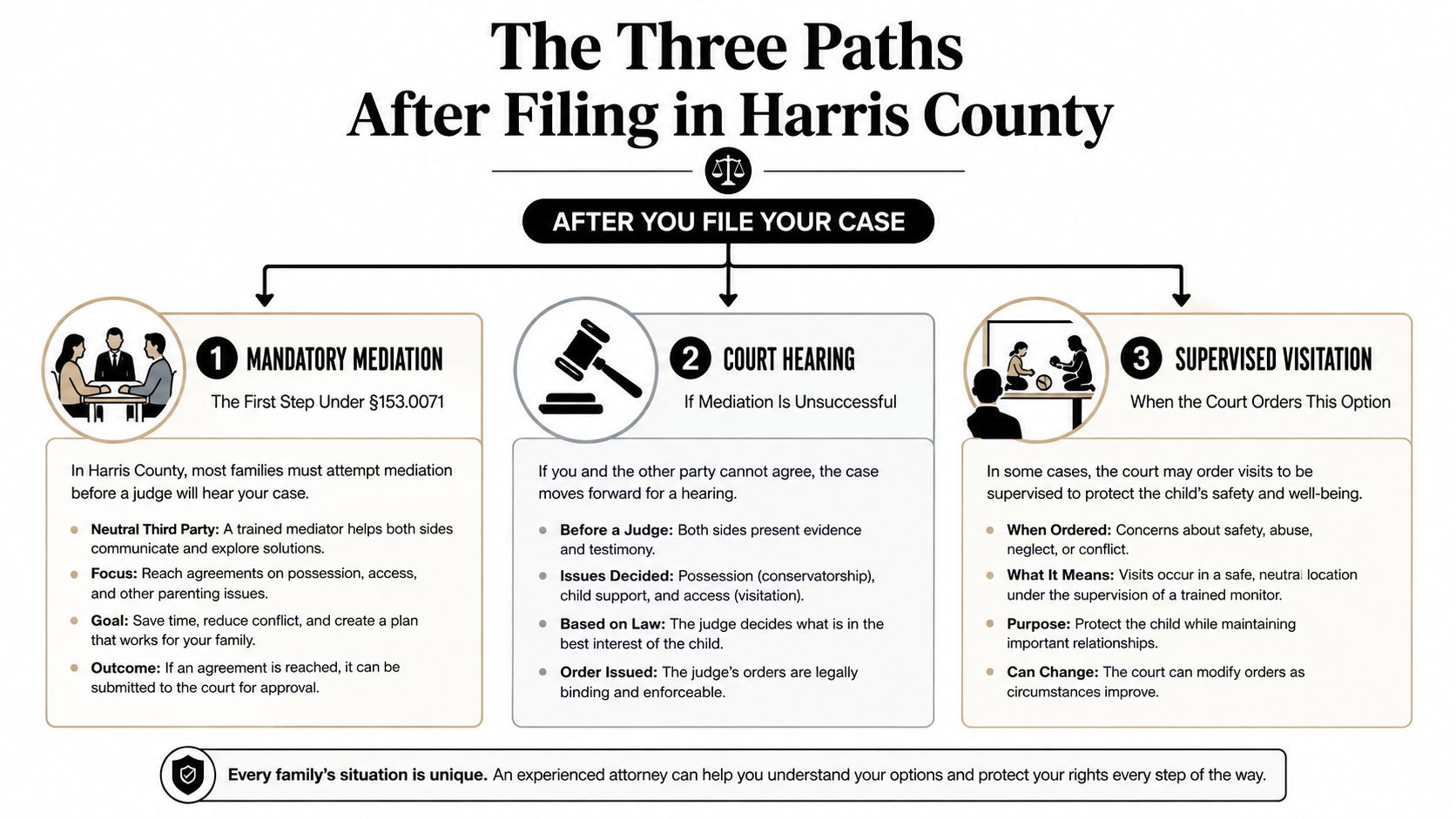
After filing a Kingwood SAPCR, the case usually turns on three questions: Can the parents reach a workable agreement, do they dispute important facts, and does the child need protected contact? Your answer to those questions should guide the next step.
Mediation should be your first practical option
Harris County may refer a contested possession dispute to mediation before a judge decides the schedule. Mediation gives both parents a structured setting to address exchange locations, transportation, school routines, holidays, electronic contact, and safety conditions. The mediator does not decide the case. The parents negotiate, and a signed mediated settlement can become an agreed court order.
Bring a proposed parenting plan, a calendar showing work and school demands, and a clear list of safety requirements. Ground the proposal in the Texas Standard Possession Order and the 50-mile rule. If the parents live within the distance covered by the standard provisions, explain which regular, weekend, holiday, and summer periods you request. If they live farther apart, address transportation and extended possession directly rather than leaving those terms vague.
A hearing resolves what negotiation cannot
If mediation fails, the case continues through pretrial requirements and may proceed to a contested hearing or trial. An associate judge, district judge, or visiting judge may hear the matter, depending on the assignment and proceeding. Each parent presents documents, testimony, and a proposed schedule tied to the child's best interest.
Review what happens at a family court hearing in Kingwood before appearing. Arrive ready to explain the exact times, exchange arrangements, transportation plan, and safeguards you want. A request for “reasonable visitation” leaves too much room for the next dispute. Ask for terms the court can enforce.
Supervised visitation can preserve contact safely
Supervised possession may fit a case involving credible concerns about family violence, substance abuse, untreated mental-health issues, or a long interruption in parent-child contact. It does not automatically end the relationship. It creates a controlled setting while the parent addresses the concerns identified in the case.
Harris County's Domestic Relations Office operates a supervised visitation system through its Visitation Center in Houston. The county identifies a fee of $10 for every 15 minutes, charged to the custodial parent, and a court order may require supervised possession under Section 153.014. Harris County's supervised visitation program explains how this local monitored-contact system works.
Virtual contact may supplement in-person possession when distance, conflict, or safety conditions interfere. Ask for specific video-call times, notice requirements, and technology terms if consistency would support the child's relationship with the parent. Materials discussing virtual visitation address this scheduling option.
Texas access resources through the Office of the Attorney General may help eligible families understand procedural steps and access problems. These services do not replace a court order. For a Kingwood parent, the practical roadmap is clear: propose a Standard Possession Order schedule, account for the 50-mile rule, use mediation when safe, and request Harris County supervision when ordinary possession would place the child at risk.
Evidence and Affidavits That Move a Texas Judge
A judge doesn't decide possession based on which parent feels more hurt. Under Texas Family Code Section 153.002, the question is what arrangement serves the child's best interest. Your evidence should answer practical questions about caregiving, safety, stability, and your ability to follow a schedule.
Build evidence around the child's ordinary life
A sworn account of your caretaking history can be valuable when supported by records. Gather school pickup logs, pediatrician records, daycare attendance, activity schedules, and a parenting-time journal. Your journal should record dates, attempted exchanges, completed visits, school events, medical involvement, and communications without editorial insults.
Financial and household stability also matter. Pay stubs, a lease or mortgage document in Kingwood or Humble, and photographs or other proof of suitable sleeping space help establish that your proposed schedule is realistic. The judge isn't looking for luxury. The judge is looking for a safe home and a routine the child can follow.
Use conduct evidence carefully. A clean criminal background, completed parenting classes, drug-test results, and treatment records showing sustained sobriety can address safety questions. If the other parent raises an allegation, answer it with admissible documentation rather than a long emotional response.
Expert input may help in a complicated case. A guardian ad litem, child custody evaluator, or licensed counselor may provide information about the child's needs, the parent-child relationship, or appropriate safeguards. Do not seek an expert just to create a favorable label. Use one when the facts require professional assessment.
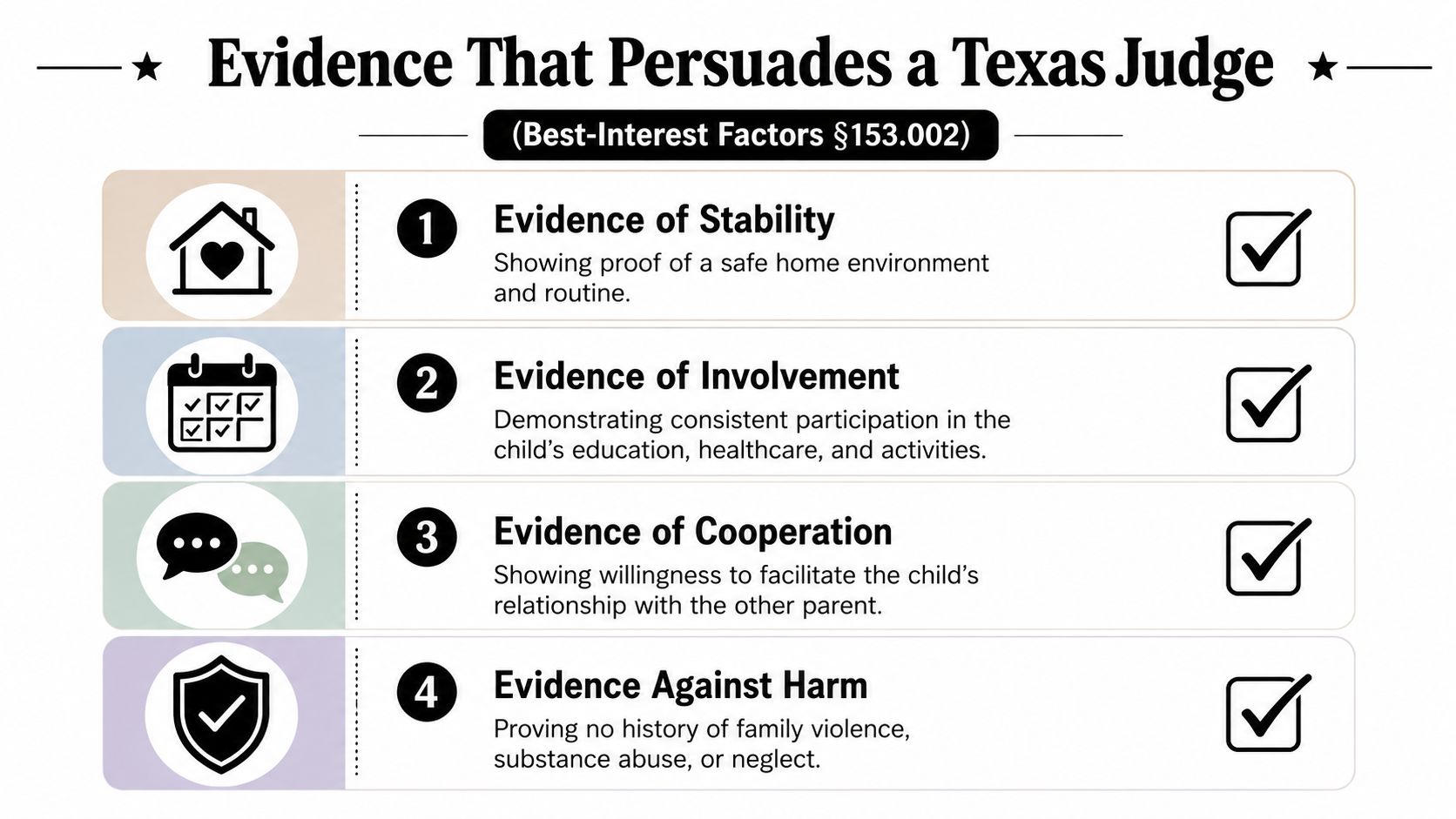
Evidence principle: A calm calendar showing reliable involvement usually helps more than a stack of angry messages.
Affidavits should be factual, specific, and properly sworn. Parents often prepare a notarized statement under penalty of perjury, attach a Texas-specific verification, and serve materials according to the applicable rules and hearing requirements. Don't assume an affidavit alone will prove every disputed fact. Preserve original records and be prepared to explain who created them, when, and why they accurately reflect the event.
For a short visual explanation of the four evidence categories, watch this overview:
Enforcing, Modifying, and Taking the Next Step
An order matters because it replaces uncertainty with enforceable terms. If the other parent denies a court-ordered visit, document the date, scheduled time, messages, exchange location, and what happened. A minor adjustment made by agreement isn't the same as a repeated or material violation.
Enforcement requires a specific record
When the denial is serious or recurring, you may file an enforcement motion in Harris County family court. Depending on the facts and the wording of the order, the court may consider makeup time under Texas Family Code Section 157.133, contempt, and attorney's fees. Don't threaten contempt in every scheduling disagreement. Compare the conduct to the exact language of the order and preserve proof before filing.
Modification is different. You generally seek a modification when circumstances have materially and substantially changed, such as a relocation beyond the applicable 50-mile framework, a child's changing needs, or a safety concern. The filing is a Petition to Modify, and Texas generally applies a one-year waiting rule for conservatorship changes unless extraordinary circumstances justify earlier action.
Your Kingwood action list
- Collect the existing order: Mark every possession term, exchange requirement, holiday provision, and condition.
- Record missed time: Keep dates, texts, emails, call logs, and neutral notes about each denied or changed visit.
- Prepare a proposed plan: Include school routines, transportation, exchanges, holidays, summer periods, and virtual contact.
- Separate support from possession: Child support and parenting time are separate legal issues. Don't withhold a visit because of a payment dispute, and don't assume support payments create automatic possession.
- Get legal guidance: Bring your documents to a consultation before filing an enforcement or modification action.
The Law Office of Bryan Fagan – Kingwood TX Lawyers handles Texas family-law matters involving divorce, child custody, child support, and parenting-time disputes, while also serving local clients with criminal defense, estate planning, probate, and civil litigation. The firm's Kingwood office serves Kingwood, Humble, Porter, and Northeast Houston families who need a local review of their court order, evidence, and proposed schedule.
The Law Office of Bryan Fagan – Kingwood TX Lawyers can review your paternity status, existing possession order, missed-visit documentation, and proposed parenting plan. Schedule a free consultation at the Kingwood office so you can leave with a clear Texas-specific strategy for obtaining, enforcing, or modifying visitation rights.