A collision on Northpark Drive can turn an ordinary trip home into a confusing series of calls, medical appointments, repair decisions, and insurance questions. You may feel fine at the scene, then wake up with neck pain, headaches, or difficulty working. Meanwhile, an insurance adjuster may ask for a recorded statement before you understand what happened or what evidence still exists.
For Kingwood, Humble, Porter, and Northeast Houston drivers, the most important decisions often happen before anyone discusses a settlement. Preserving evidence, identifying every applicable coverage source, documenting medical care, and protecting the filing deadline can affect what options remain. Texas recorded 618,706 reported traffic crashes in 2025, with 3,814 fatalities and 17,975 serious injuries, according to reported Texas crash statistics. Those figures provide the broader setting for local claims, but your case will turn on its own evidence, injuries, insurance policies, and deadlines.
What to Do After a Kingwood Car Accident
A driver leaving Kingwood on Northpark Drive is rear-ended while traffic is slowing near an entrance ramp. The vehicles are damaged, one passenger feels shaken, and everyone wants to get home. In that moment, a few practical choices can protect both health and legal options.

First, move to a safe location if you can do so without worsening an injury. Call 911 when anyone may be hurt, traffic remains dangerous, or the collision needs an official response. Ask for medical evaluation even if pain hasn't fully developed. Adrenaline can make symptoms difficult to recognize immediately, and a timely medical record can help connect later complaints to the crash.
Build a clear scene record
Exchange names, phone numbers, driver's license information, license plates, vehicle descriptions, and insurance details. Photograph the vehicles from several angles, including damage that may not appear dramatic. Also photograph lane markings, traffic signals, debris, weather or road conditions, nearby businesses, and anything that may help show how the collision occurred.
If witnesses saw the impact, ask for their contact information before they leave. Don't argue about fault or say that you caused the crash. A polite statement such as “I'm glad no one appears seriously hurt” isn't the same as admitting liability, but even casual comments can later be taken out of context.
Notify your own insurer as required by your policy, but be careful with recorded statements. You don't have to guess about fault, minimize symptoms, or provide a broad medical history before receiving legal advice. A Kingwood car accident lawyer can help you communicate accurately while preserving your rights.
Take symptoms seriously
Follow the treatment plan and attend follow-up appointments. Tell providers about every symptom, including pain, sleep disruption, anxiety, dizziness, or difficulty performing ordinary tasks. Keep instructions and appointment records. People dealing with domestic violence or family safety matters may separately need information about Protective Orders in Kingwood, but a traffic collision claim still requires its own medical and accident documentation.
How a Car Accident Lawyer Builds Your Claim
A car accident lawyer does more than forward a demand letter. The lawyer develops a factual record, identifies coverage, organizes medical proof, and creates a plan for resolving the claim or taking it to court.

Start with evidence preservation
Footage from a dashcam, nearby business, apartment complex, or traffic-facing camera may be overwritten through routine system practices. A lawyer can identify likely sources and send preservation requests before the recording disappears. If a commercial vehicle, delivery fleet, or rideshare driver was involved, the lawyer may send a spoliation letter seeking preservation of available vehicle data, driver records, dispatch information, and electronic logs.
The investigation also includes obtaining the Texas Peace Officer's crash report, locating witnesses, examining vehicle damage, and comparing physical evidence with each driver's account. A report matters, but it isn't automatically the final word on liability. Independent evidence can clarify disputed turns, lane changes, visibility, braking, or road conditions.
Connect injuries to the collision
Medical records and billing records need to tell a consistent story. The attorney communicates with treating providers, gathers diagnostic reports, tracks referrals, and identifies whether the client may need additional care. This process is especially important when symptoms are delayed or treatment continues over time.
The damages analysis includes more than invoices. It may consider lost wages, reduced earning capacity, out-of-pocket expenses, pain, mental anguish, and loss of enjoyment of life when supported by the facts. A lawyer also reviews liability insurance, uninsured or underinsured motorist coverage, and other available payment sources.
Practical rule: A claim's value depends on proof of responsibility, proof of harm, and a realistic path to payment.
Handle the insurer and venue
The lawyer prepares a demand package with liability evidence, medical summaries, wage documentation, and a damages calculation. The lawyer then handles adjuster communications, responds to counteroffers, and explains release language before the client signs away rights.
If negotiations stall, the case may proceed in Harris County, Montgomery County, or another proper venue. The lawyer can prepare pleadings, written discovery, depositions, mediation, and trial strategy. Family matters can require different analysis, such as Grandparents' Rights in Kingwood, which concerns custody and visitation rights for grandparents in Harris County.
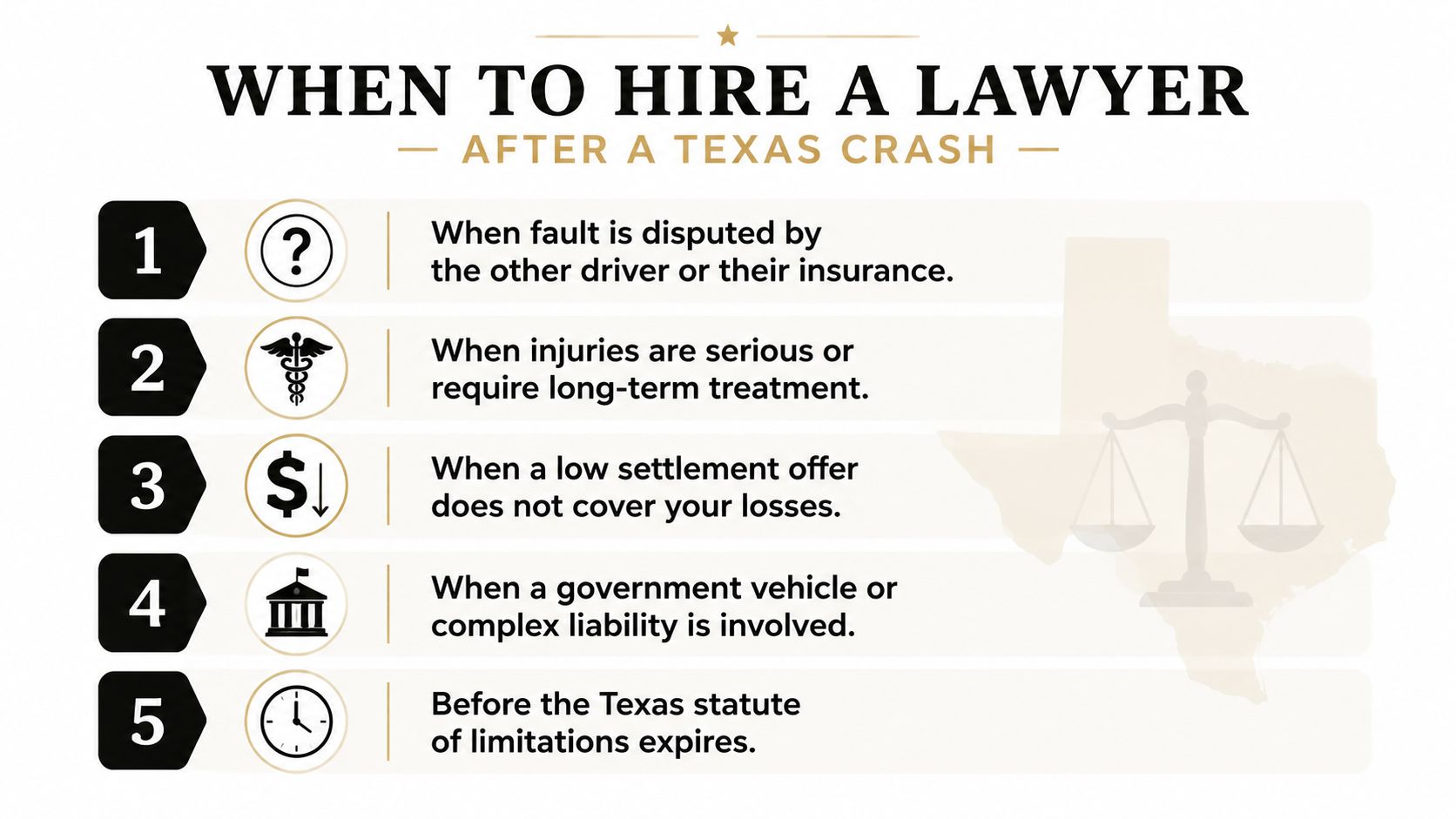
When to Hire a Lawyer After a Texas Crash
Not every minor property-only collision requires a lawyer. If nobody is injured, fault is clear, the damage is limited, and the insurer handles the property claim fairly, a person may be able to manage the matter independently.
The calculation changes when the claim contains uncertainty or long-term consequences. Consider legal guidance early if:
- Fault is disputed: The other driver or insurer blames you, assigns shared responsibility, or gives a version of events that conflicts with the scene.
- Treatment is ongoing: You need specialists, therapy, diagnostic testing, or continuing care, or your symptoms interfere with work and family responsibilities.
- Coverage is complicated: The crash involves a commercial vehicle, rideshare driver, uninsured motorist, underinsured motorist, or multiple potentially responsible parties.
- The damage looks minor: Vehicle damage may be limited while neck, back, nerve, or concussion symptoms appear later.
- The insurer applies pressure: An adjuster requests a recorded statement, denies the claim, or offers a quick settlement before your medical picture is clear.
The Texas civil-law framework includes personal injury disputes, and readers can review the firm's civil law practice information for broader context. For a separate checklist on evaluating counsel, the SnapClaim attorney selection guide offers questions about experience, communication, fees, and case handling.
An early consultation usually lets you understand deadlines, evidence risks, coverage questions, and potential conflicts before making an irreversible decision. It doesn't mean you must file suit or hire that lawyer. The greater risk often comes from making recorded statements, signing releases, or allowing evidence to disappear without understanding the consequences.
How a Texas Car Accident Claim Proceeds
A Kingwood auto claim usually develops in stages, although the order and length can change with the injury, evidence, and insurer conduct.
Investigation and treatment
The opening phase focuses on the crash report, photographs, witness accounts, vehicle condition, and available vehicle or video data. The lawyer also identifies every person or business that may have relevant information. At the same time, the client receives medical care and follows provider recommendations.
Treatment records help establish what happened after the collision. They can show the first reported symptoms, diagnostic findings, restrictions, referrals, bills, and the effect on ordinary activities. Lost-wage proof may include employer records, pay documentation, or information about missed work.
Coverage and the demand package
The at-fault carrier receives notice of the claim. The attorney reviews the client's own policy for MedPay, PIP, and UM/UIM benefits, then considers how those benefits interact with liability coverage and medical billing. Coverage must be analyzed from the actual policy language, not from assumptions about what an adjuster says is available.
A demand package brings the case into one organized presentation. It generally includes:
- Liability evidence, such as the crash report, photographs, witness information, and scene analysis.
- Medical documentation, including records, bills, diagnoses, treatment, and anticipated care when supported.
- Financial loss evidence, such as wage loss and necessary out-of-pocket expenses.
- A damages explanation, connecting the collision to the client's physical, emotional, and financial losses.
Readers seeking a broader overview can review how to file a personal injury claim, while remembering that every claim depends on its own facts.
Negotiation and litigation
Pre-suit negotiation commonly involves offers, counteroffers, supporting records, and release language. A settlement is voluntary, and no outcome is guaranteed. The client should understand what claims the release covers, how medical balances will be addressed, and what amount may remain after fees and expenses.
If the insurer refuses a fair resolution, filing suit may be appropriate. Litigation can involve pleadings, written discovery, depositions, mediation, expert review, and trial preparation in the proper Harris or Montgomery County venue. Injury severity, treatment length, evidence disputes, and insurer cooperation all affect timing.

Deadlines, Fault, and Insurance Limits
Texas law creates two separate pressures after a collision. The first is the filing deadline. The second is the amount of responsibility and insurance available to pay a claim.
A Texas personal injury lawsuit, including an auto-collision claim, generally must be filed within two years under Texas Civil Practice and Remedies Code Section 16.003(a), as described in Texas limitations guidance for car accidents. Waiting can also weaken evidence. Video may be deleted, vehicles may be repaired, skid marks may disappear, and witnesses may forget details long before the deadline arrives.
Claims involving a governmental entity can involve a shorter notice requirement. UM or UIM claims may also involve policy-specific notice and procedural requirements. Those rules aren't interchangeable, so a lawyer should review the responsible party and insurance policy early.
Texas uses modified comparative negligence, commonly called the 51% bar. Under this rule, an injured person may recover when they are 50% or less at fault, but the recovery is reduced according to the assigned fault. If the injured person is 51% or more at fault, recovery is barred, as summarized in this Texas comparative negligence explanation.
The coverage question
Texas minimum auto liability coverage follows the 30/60/25 standard, meaning $30,000 for bodily injury per person, $60,000 for bodily injury per accident, and $25,000 for property damage per accident, according to this Texas auto insurance coverage summary. Minimum limits may not cover serious injuries, extended treatment, or multiple injured people.
A lawyer checks the at-fault policy, the client's own UM/UIM coverage, MedPay or PIP benefits, possible commercial policies, and any applicable umbrella coverage. Policy wording controls. A commercial collision on U.S. 59 or Loop 494 may require a more detailed coverage investigation than a straightforward two-car crash.
| Item | Rule or Timeframe | Why It Matters |
|---|---|---|
| Personal injury lawsuit | Generally two years from the crash | Missing the limitations deadline can bar recovery. |
| Government-related claim | May require shorter notice | Notice rules can apply before a lawsuit deadline. |
| Comparative negligence | Recovery requires fault of 50% or less | Evidence can affect whether recovery remains available and how much it is reduced. |
| Texas minimum liability coverage | 30/60/25 | Available policy limits may constrain payment in serious claims. |
| UM/UIM and other benefits | Controlled by policy terms and notice requirements | Delayed notice or an overlooked coverage layer can limit options. |
Evidence to Preserve After a Kingwood Collision
Evidence is easiest to lose during the first days after a crash. Use this checklist for collisions on Northpark Drive, Kingwood Drive, U.S. Highway 59, and nearby roads.
- Photograph the scene: Capture vehicle positions when safe, damage, license plates, lane markings, traffic signals, signs, debris, lighting, weather, and visible injuries.
- Collect contact details: Save the other driver's information, insurance details, vehicle information, and every witness's name and contact information.
- Record the report information: Request the official crash report number from the Harris County Sheriff's Office or Texas DPS, depending on the responding agency.
- Preserve digital footage: Download dashcam files immediately. Ask nearby businesses, apartments, homes, or facilities whether cameras captured the collision. Ring and business security systems may overwrite footage through routine operation.
- Protect the vehicles: Don't authorize repairs, discard damaged parts, or move damaged property into storage without photographs and an opportunity for inspection.
- Track medical effects: Keep a symptom journal that records pain, sleep problems, mobility limits, medication effects, and missed activities. Attend follow-up care and describe symptoms accurately to providers.
- Save financial records: Keep prescription receipts, mileage records for medical visits, out-of-pocket expenses, work schedules, pay stubs, and employer communications about missed work.
- Control communications: Save insurer messages, but don't provide a recorded statement or sign a release before understanding its scope. Avoid social-media posts that could be presented as evidence that you weren't injured or restricted.
Your lawyer may send preservation letters to insurers, commercial operators, property owners, and other custodians of evidence. A letter can't guarantee that a third party retained every recording, but it creates a clear request and helps identify evidence that requires immediate attention.
A damaged vehicle, a missing video file, or an undocumented symptom can leave a gap that an insurer may use to challenge the claim.
Damages, Medical Bills, and Legal Fees
A settlement headline doesn't tell you what reaches a client's bank account. The gross amount must be analyzed alongside medical payment sources, provider balances, liens, case expenses, and the fee agreement.
Economic damages can include reasonable medical expenses, future medical care supported by the evidence, lost wages, diminished earning capacity, property damage, and necessary out-of-pocket costs. Non-economic damages can include pain, mental anguish, and loss of enjoyment of life when the facts and proof support them. Exemplary damages involve a separate legal analysis and aren't automatically available after a collision.
Payment sources and balances
Health insurance may pay providers while the liability claim is pending. MedPay or PIP benefits may also help with covered medical expenses, depending on the policy. A hospital lien, health-plan reimbursement claim, workers' compensation subrogation interest, or provider balance may need to be addressed before the client receives final proceeds.
The attorney reviews who paid the bills, who claims reimbursement, and whether reductions can be negotiated. The gross medical charges aren't always the same as the amount ultimately owed, and a settlement can require careful coordination among the client, providers, insurers, and lienholders.
Fees and the net result
A contingency agreement should explain the fee calculation, litigation expenses, record costs, filing costs, expert expenses, and responsibility for charges if the case doesn't resolve as expected. The agreement may calculate the fee before or after expenses, so clients should ask for a plain-language explanation.
A neutral example makes the distinction clear without predicting an outcome. Suppose an insurer offers a lump-sum amount, the client has medical balances, a health insurer seeks reimbursement, and the contract requires a legal fee plus case expenses. The amount available to the client will be less than the offer after those deductions, and negotiating the balances may matter as much as negotiating the offer itself.
| Component | Typical Range or Effect |
|---|---|
| Medical bills | Reduce net recovery when unpaid balances remain, although payment history and reductions require review. |
| Health insurance reimbursement | May create a claim against settlement proceeds, subject to plan terms and applicable law. |
| MedPay or PIP | Can help pay covered expenses, but policy language and coordination rules matter. |
| Hospital or provider liens | May require resolution before distribution of settlement funds. |
| Attorney fee | Deducted under the written contingency agreement. |
| Case expenses | May include records, filing, investigation, experts, and other litigation-related costs. |
| Gross settlement | The negotiated headline amount, not the final take-home amount. |
| Net recovery | The amount remaining after authorized fees, expenses, liens, reimbursements, and balances. |
Kingwood Accident Claims and Your Next Steps
A minor property-only crash may not require an attorney when fault is clear, nobody is injured, and the insurer pays the documented vehicle damage fairly. If symptoms appear later, liability changes, or the insurer asks for a recorded statement, reassess quickly.
There isn't one timeline for every Texas case. A claim may move more quickly when the injury resolves and evidence is straightforward, while continuing treatment, disputed fault, multiple insurers, or litigation can extend the process. No lawyer can guarantee a result or promise a particular settlement.
If the at-fault driver has no insurance, your own UM coverage may become important. If you share some fault, Texas law doesn't automatically bar recovery, but recovery can be reduced and the 51% bar remains significant. Bring the crash report information, photographs, insurance correspondence, medical records and bills, wage-loss documents, witness details, and your insurance policy if you have them.
Kingwood and Humble clients may also need to consider whether Harris, Montgomery, or Liberty County is the proper venue. A local attorney can help organize that analysis and identify decisions that shouldn't wait. The Kingwood accident lawyer resource can serve as a starting point for reviewing accident-related legal information.
After a collision, seek medical care, preserve evidence, avoid recorded statements until you understand the request, and speak with counsel before signing a release. The Law Office of Bryan Fagan can provide a free Kingwood consultation to help an injured driver understand available coverage, deadlines, evidence concerns, and whether legal representation makes sense.
The Law Office of Bryan Fagan – Kingwood TX Lawyers offers local guidance for car accident claims involving injuries, disputed fault, insurance coverage, medical bills, and deadlines. Visit Law Office of Bryan Fagan – Kingwood TX Lawyers to schedule a free consultation at the Kingwood office and discuss your next step.