Skip to content

You can be finishing a shift on the road, in the station, or in the unit, then driving home to a house where the next hard conversation is already waiting. For a police officer, firefighter, or medic in Kingwood, Humble, or Northeast Houston, divorce rarely fits neatly around the job, and the job doesn't pause just because family life is changing. The pressure usually starts with three questions at once, what happens to the pension, how do the kids' schedules work, and how do you keep the case from colliding with rotating shifts and overtime.
A divorce lawyer for Kingwood first responders has to look at more than filing papers and dividing a bank account. In these cases, the job itself shapes the case, from duty rosters and mandatory callouts to retirement benefits and parenting time. Even in a community like Kingwood, where people know the local fire station, patrol beats, and hospital routes, the legal work still has to fit Harris County procedure and Texas property rules.
Why a First Responder Divorce in Kingwood Is a Different Case
A firefighter comes off a 24/48 rotation, checks a message from home, and realizes the divorce conversation can't wait another week. A deputy is on call, an EMT has back-to-back shifts, and both are trying to think clearly about children, money, and the pension they've built over years of public service. That mix is exactly why first responder divorces in Kingwood, Humble, and Northeast Houston feel different from a standard family-law file.
The hardest part usually isn't the paperwork. It's the way the job keeps moving while the family is trying to divide everything else. Overtime, second-job restrictions, late calls, and public visibility all complicate choices that look simple on a generic divorce checklist.
Practical rule: If the job affects your paycheck, your sleep, or your pension, it affects the divorce too.
There's also the emotional reality of serving a small community. In Kingwood, people notice when a responder is missing from a shift, and they notice when a family is going through a split. That doesn't change the law, but it changes how carefully the case has to be managed, especially when privacy, reputation, and safety are all part of the picture.
For some first responders, the best outside reference point is a technical industry like Thermal Stop industry applications, where the work environment shapes every decision. Divorce works the same way for responders, because the schedule, the pension, and the public-facing nature of the job all change what a lawyer needs to prove and protect.
The practical takeaway is simple. A first responder divorce is not just “family law plus overtime.” It's a case where the career is one of the central legal facts. That's why the next step is understanding how Texas treats property, support, and court procedure in Harris County.
How Texas Community Property and Divorce Law Apply Locally
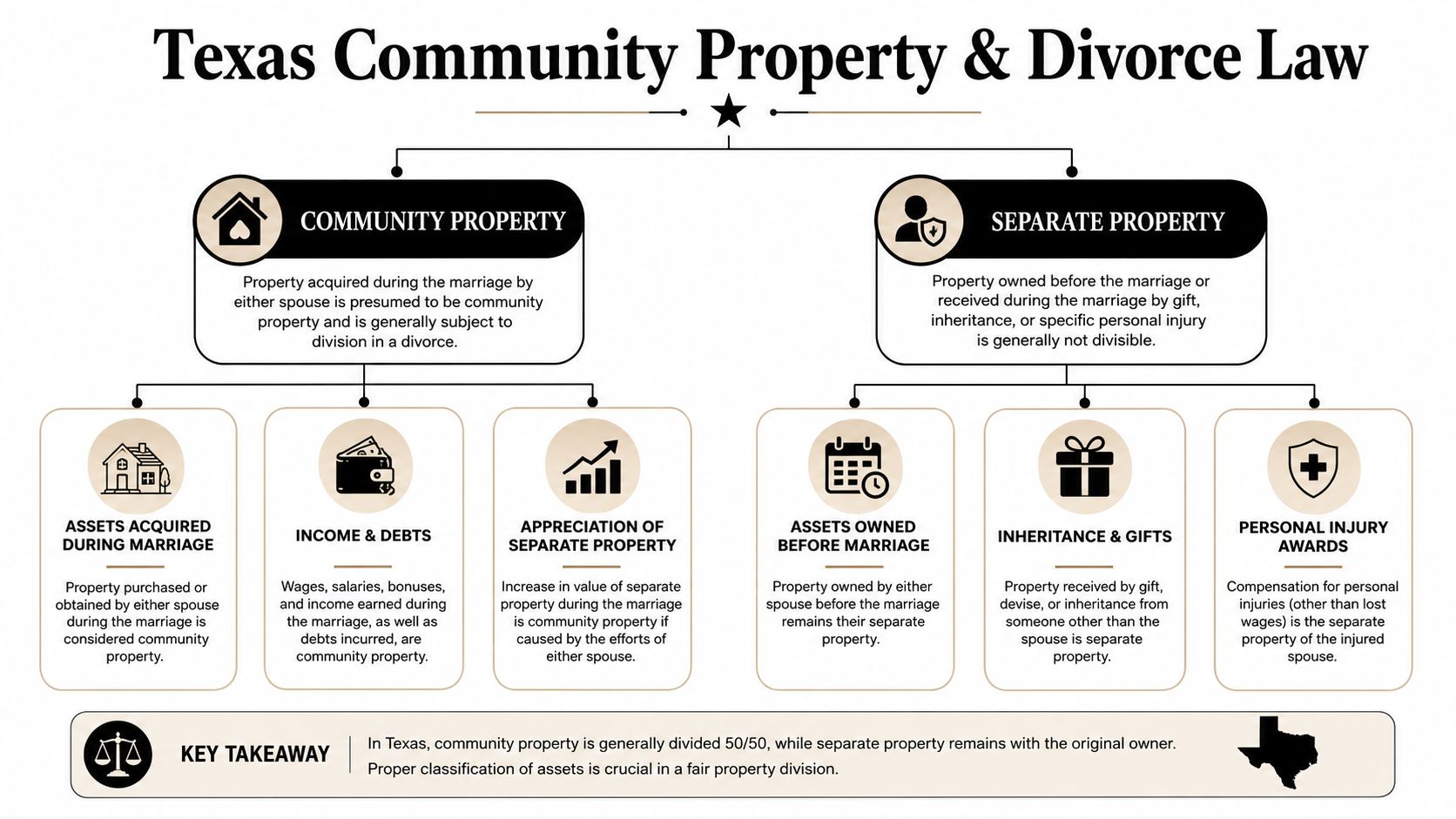
Texas starts from a community-property framework, which means the court has to sort property into community property and separate property before deciding how to divide it. For Kingwood families, that classification often turns on dates, not feelings. The date of marriage, the date of separation, and the vesting timeline for retirement benefits all matter because they draw the legal line between what was built together and what stayed separate.
What the court looks at first
In plain English, property acquired during the marriage is often presumed to be community property, while assets owned before marriage, inheritances, and gifts can remain separate. For first responders, that rule matters most when the marriage overlapped with a pension, deferred compensation, or pay increases tied to service time. The court doesn't just ask what the account balance looks like today, it asks when each part of it was earned.
The local court setting matters too. Divorce cases filed for Kingwood residents are handled in Harris County, which has ten dedicated family courts, including the 245th, 246th, 247th, 257th, 308th, 309th, 310th, 311th, 312th, and 507th Judicial District Courts (Harris County family courts). In a large county system like that, local procedure and timely evidence matter as much as the legal theory.
Why the timeline matters
A benefit can start as separate property and later grow into a community claim, or it can reflect a mix of both. That's why the marriage date, separation date, and plan records need to line up. If you're a responder in Kingwood, the goal is to identify which part of the asset was earned while you were married, not just assume the whole benefit is divisible.
The court won't guess at pension history. If the records are incomplete, the result can be distorted.
For that reason, lawyers handling first responder divorces often use plan documents, payroll history, and marriage records together rather than relying on a quick estimate. In a Harris County divorce, that evidence has to be organized early because the judge will rely on the submitted valuation model, not on a broad idea that “half is fair.”
The best way to think about Texas divorce law is this, the law supplies the framework, but your records supply the outcome. For Kingwood, Humble, and Northeast Houston families, that means the stronger the paper trail, the better the court can separate community property from separate property without overreaching.
Pension Division and Deferred Compensation for First Responders
The pension is often the part of the divorce that first responders underestimate and spouses overestimate. In a patrol, fire, or EMS household, retirement benefits can represent a major share of long-term wealth, so the debate isn't just “who gets what,” it's how much of the benefit was earned during the marriage and what that benefit will pay in the future.
What gets divided and what doesn't
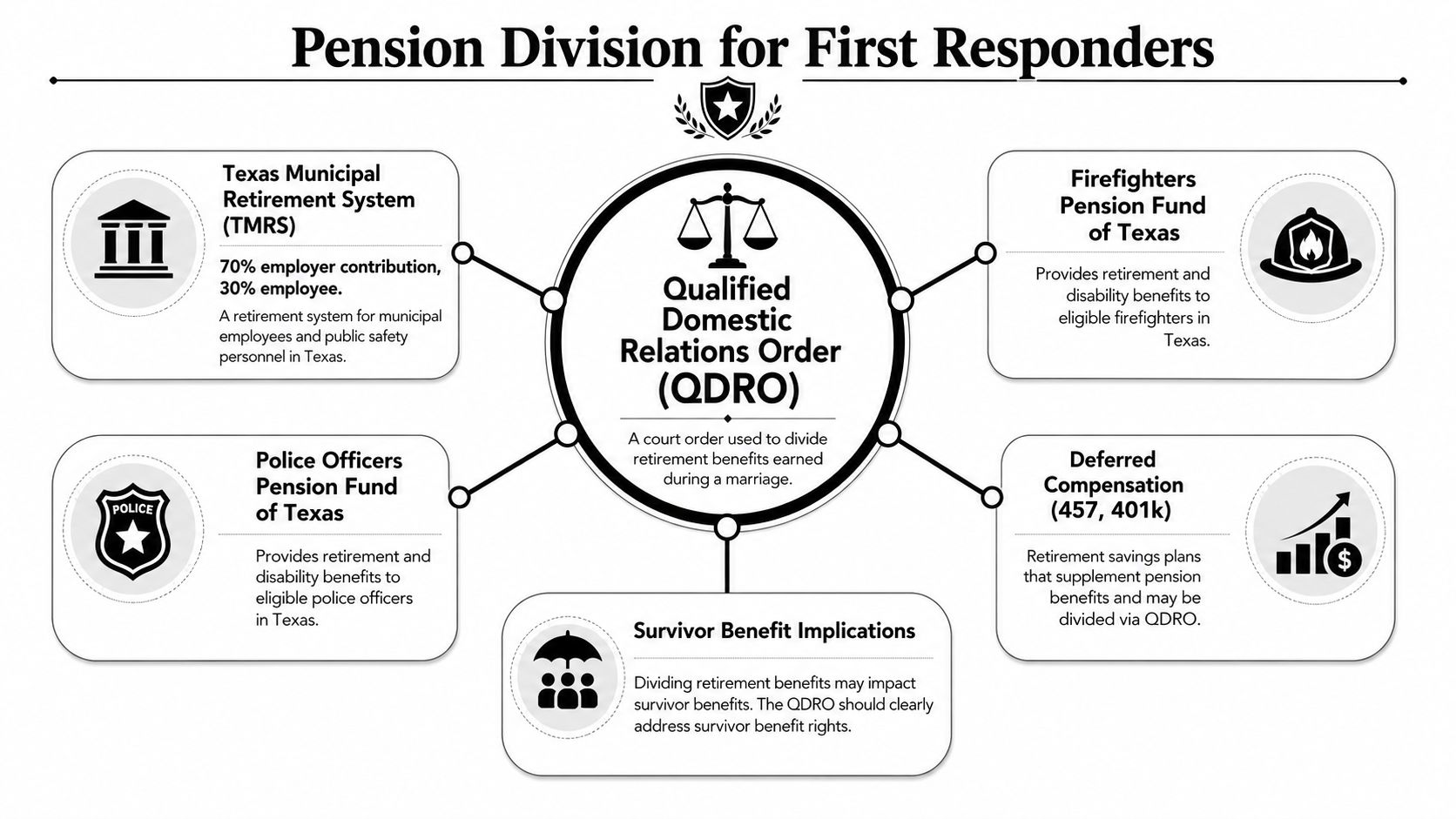
Texas divides only the portion of retirement benefits earned during the marriage as community property; benefits accrued before marriage or after separation may remain separate property (Fritz & Phillips). That sounds clean on paper, but in practice it means a lawyer has to reconstruct the benefit timeline using plan records, payroll history, and marriage dates. For a firefighter, police officer, or EMS provider, that timeline can affect the final award more than the headline salary number ever will.
Deferred compensation and DROP-style structures add another layer. These benefits aren't handled like a basic savings account because they can depend on service credits, retirement elections, survivor options, and the way the plan calculates final benefit value. A plan that looks similar from the outside can produce a very different result once the court enters the order and the plan administrator starts applying the rules.
The first question is usually whether to trade pension rights for equity in the house or keep the retirement stream and give up something else. There's no universal answer. If the house is liquid and the pension is still years away, one trade-off may fit. If the benefit is already close to vesting or the survivor options are important, the pension side can be more valuable than it looks on the page.
Why valuation has to be precise
Harris County family courts are not likely to work from a generic percentage split when a pension is on the table. They rely on the valuation model and the documents submitted. That's why service time, vesting, COLA terms, survivor benefits, and any increased value from overtime or special duty have to be handled carefully.
If you're comparing strategies, the retirement-division resource at Dividing Retirement Accounts in Kingwood Divorce is a useful related page to review before you sit down for a consult. It helps frame the difference between a simple account split and the more technical job of dividing a responder pension.
The important point is this. A first responder pension isn't just another asset. It's a long-tail financial issue tied to service, salary history, and plan rules. In Kingwood divorces, that usually makes it one of the most important parts of the whole case.
Overtime, Hazard Pay, and How Child Support Really Gets Calculated
A responder divorce often gets messy at the paycheck. Base salary is only part of the picture, because the cash flow can also include shift differentials, overtime, hazard pay, callback pay, holiday pay, and special assignment stipends. Texas child support is generally calculated from a parent's net resources, so if those items are counted the wrong way, the support figure can come out distorted (Bryan Fagan Kingwood).
How attorneys usually build the number
The first step is separating recurring income from unusual spikes. A firefighter who picked up extra calls during a severe stretch of weather is not automatically earning that pattern every month. A deputy's overtime during a temporary assignment may not tell the full story either. The attorney has to review a representative period and decide what reflects a steady earning pattern.
For parents in Kingwood, Humble, and Northeast Houston, that analysis affects child support and spousal support arguments. If the paycheck changes by rotation or assignment, the court needs a clear explanation of what is normal and what is not. That matters even more if one parent is also limiting second jobs because of department rules or schedule conflicts.
| Pay Component | Treatment in Net Resources | Notes for Responders |
|---|---|---|
| Base pay | Usually included | Forms the core of the support calculation |
| Shift differentials | Often included | Important when nights or weekends are routine |
| Overtime | May be included if recurring | Needs a realistic pattern, not a one-off spike |
| Hazard pay | May be included | Depends on whether it is part of regular pay history |
| Callback pay | May be included | Best handled by reviewing actual pay records |
| Holiday pay | May be included | Often relevant in public-safety schedules |
| Special assignment stipends | May be included | Needs documentation tied to the assignment |
The local child-support page, Child Support Attorney in Kingwood, is a practical reference for families dealing with establishing, modifying, and enforcing child support in Harris County. The related guide on how child support is calculated in Kingwood is also useful because the same financial records that support a fair order can also help prevent enforcement problems later.
What helps and what hurts
Bring the pay records, not just the last stub.
That means stubs across multiple pay periods, overtime logs, and any document that shows whether the extra hours repeat. If a responder's schedule includes 24/48 rotations or mandatory holdovers, the court needs to see that structure before making an order that is hard to follow. A support order that ignores the work pattern can create a payment problem from the start.
The strongest case is the one where the attorney can show a steady baseline and explain every variable. That is the level of detail Harris County judges usually need when the income comes from public safety work instead of a straight salary.
Shift Work, Custody Schedules, and Possession Orders That Fit the Job
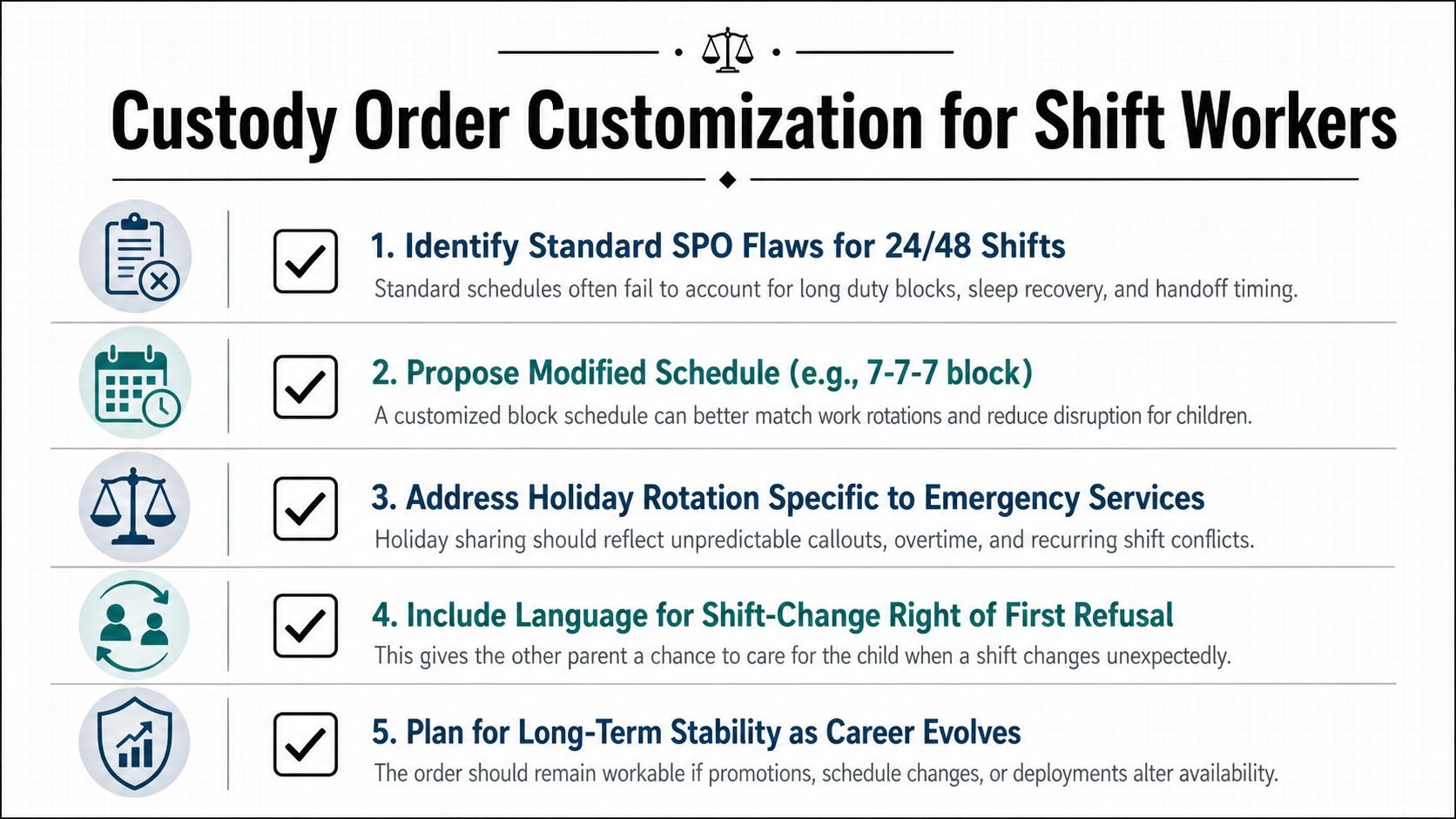
Standard possession orders are built around ordinary workweeks, and first responders don't live in ordinary workweeks. A firefighter on a 24/48 schedule, a deputy on rotating nights, or an EMT bouncing between overtime and callouts can't always follow a calendar that assumes every weekend and weekday looks the same. That's where custody and possession orders have to be customized to the job instead of forcing the job to fit a rigid calendar.
What needs to be documented
The first step is proving the actual schedule. Shift rosters, duty calendars, mandatory overtime notices, and on-call records help the court see when the parent is available. In many Kingwood cases, that documentation matters more than a vague promise to “work around the kids.”
The next step is proposing exchanges that fit public-safety work. Some parents use station or substation handoffs because they're predictable and easier to manage around shift changes. Others build possession windows around sleep recovery so the parent who just worked nights isn't forced into a pickup that guarantees conflict.
A possession order works only if both parents can follow it on a bad week, not just a good one.
That's why temporary orders hearings also matter so much. If a responder can't miss a shift without consequences, the temporary schedule has to account for that reality from the beginning. In that context, the local custody resource at Custody Schedule for Working Parents in Kingwood, Texas is worth reviewing because it addresses the practical problem of matching possession to a working parent's life.
How to keep the schedule stable
A good order doesn't just solve the first month. It should anticipate changes in rank, assignment, and long-term career patterns. That's why it helps to include language that survives schedule changes rather than locking everyone into a plan that fails the moment overtime or duty coverage shifts.
If the order later needs enforcement, the related Kingwood service page for Enforcement of Court Orders in Kingwood fits the same family-law issue because custody schedules only work when the decree has teeth. The primary goal is to reduce conflict before it turns into repeated motion practice.
For first responders, the best custody order is usually the one that respects the job, protects the children's routine, and leaves as little ambiguity as possible. In Harris County, that's often the difference between a plan that lasts and one that collapses after the first unexpected callout.
The video below offers a useful visual on custody planning for working parents.
Your First 30 Days Documents Checklist and Protective Order Considerations
The first month after deciding to divorce should be spent building the file, not arguing by text. For a responder in Kingwood or Northeast Houston, that means pulling together the records that show income, retirement, parenting, and safety issues before the case gets traction in Harris County court. The stronger the first packet, the easier it is for a lawyer to spot the issues that need immediate attention.
What to gather right away
Start with financial records. Bring recent pay stubs, prior W-2s, pension plan summaries, vesting letters, payroll history, and any document that explains special pay or retirement elections. Add shift schedules for the past year, records of special-duty assignments, and anything that shows whether overtime is recurring or unusual.
Then gather the family documents. School records, medical information, insurance information, and the children's usual schedule matter because temporary orders and custody proposals should be built around actual routines. If you already have a list of household assets, include pre-marriage records too, because those help separate community property from separate property later.
Safety and court protection issues
Some households need more than property and custody orders. If there are safety concerns, or if a firearm is kept on the premises and the situation is escalating, a temporary restraining order or protective order may become relevant. Those orders have serious consequences, so the facts need to be documented carefully before anyone asks the court to act.
A practical first-month checklist can look like this:
- Collect pay records: Gather multiple recent pay stubs so the full earnings pattern is visible.
- Save schedule proof: Keep rosters, calendar screenshots, and any notice of mandatory overtime or callouts.
- Pull retirement documents: Find pension summaries, plan handbooks, and any vesting or service-credit material.
- Organize family records: Put school, medical, and insurance documents in one folder.
- Document safety concerns: Save messages, notes, or incident details if protective relief may be needed.
If you only bring one folder to a consultation, make it the one with pay history, pension records, and the children's schedule.
That single packet gives a lawyer enough to start identifying whether the case is about support, property division, custody, or safety first. It also makes the first meeting more productive if you're trying to compare options with a local attorney in Kingwood, Humble, or Porter.
Timelines, Hearings, and Common Outcomes in Harris County
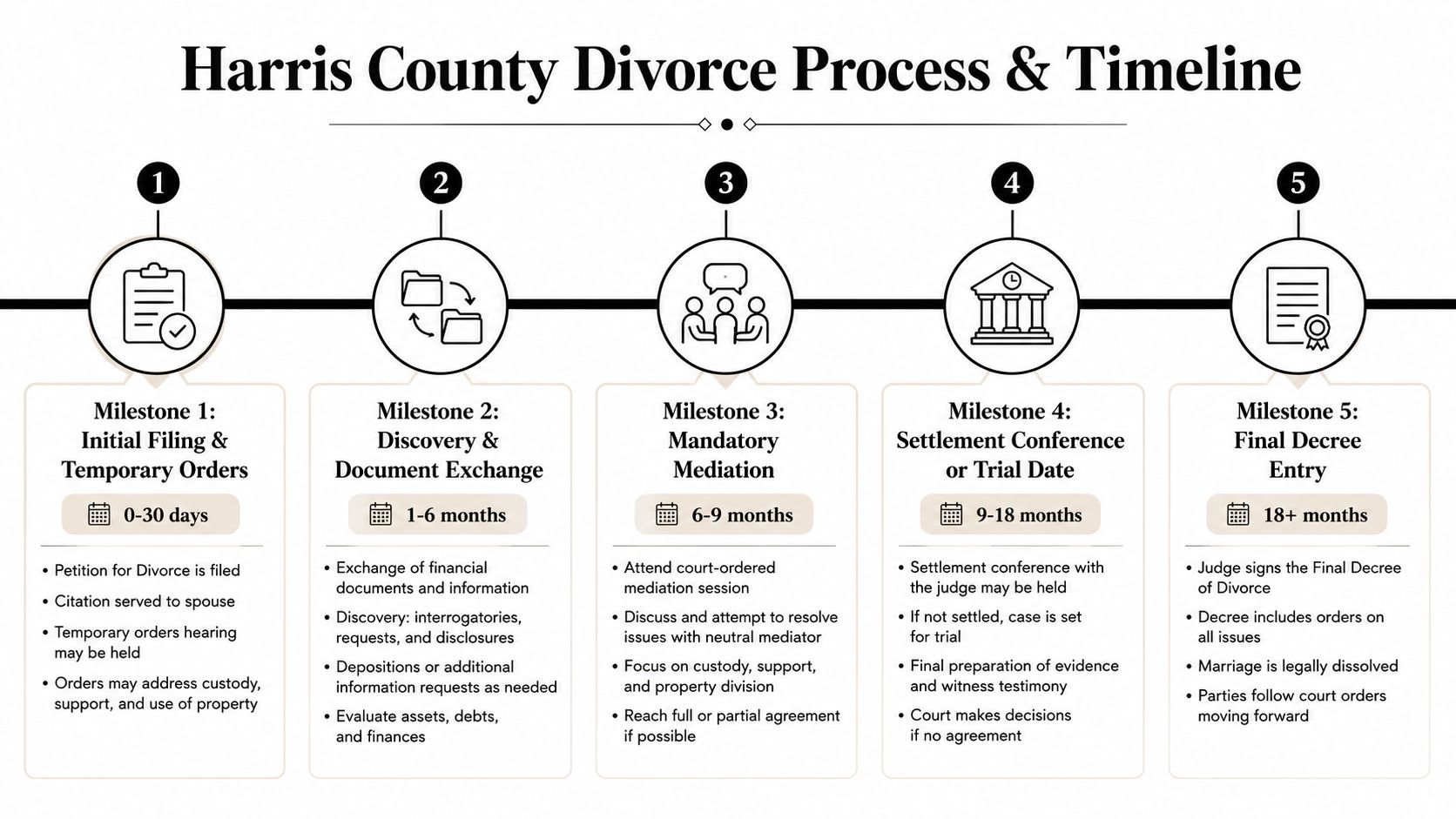
A first responder divorce in Harris County rarely moves in a straight line. Filing starts the case, temporary orders come next, then discovery, mediation, and finally the decree if the matter settles or goes to trial. For responder families, the delay usually comes from custody disputes, pension valuation work, and the normal crowding of a large-county docket.
What usually drives the pace
Temporary orders hearings tend to move first because parents need a working schedule and financial structure while the case is pending. Discovery follows when the parties exchange records on income, retirement, and property. Mediation often becomes the turning point, especially if the pension and custody issues have been documented well enough for real negotiation.
Settlement is common when both sides can trust the numbers. Trial becomes more likely when one side disputes the pension division, questions overtime income, or wants a parenting schedule that doesn't match the job. In either path, Harris County procedure rewards preparation.
Common outcomes in these cases tend to fall into a few broad patterns. The house may be kept, sold, or offset against retirement value. Parenting plans are often adjusted to fit shift work. Retirement is usually divided with much more care than a regular savings account, because the structure of the benefit matters more than a rough balance.
The most realistic expectation is that a contested case takes time and coordination. Friends may talk about quick divorces, but a responder case with pension issues and shift-based custody almost never stays simple for long. The better question is not how fast it can be filed, but how cleanly it can be resolved without losing track of the long-term financial picture.
Fees, Free Consultations, and Working With a Kingwood Divorce Lawyer
People often wait too long to ask about cost. That's understandable, because divorce already feels expensive before anyone mentions retainers, hourly billing, or expert work on a pension. In the Kingwood market, a useful first conversation should cover the scope of the case, the likely work ahead, and what records will help the lawyer give a realistic estimate.
What fee structure usually means
An hourly arrangement fits cases where the facts are still unfolding and the pension, support, or custody issues may need substantial negotiation. A limited-scope arrangement may work for a narrower task, like reviewing a decree or helping prepare documents. A retainer is usually the money the lawyer uses to start work, and the details should be explained clearly before anything is signed.
A free consultation should not just be a sales pitch. It should help you understand whether the lawyer has handled pensions, overtime-based support, and shift-work custody issues before, and whether the office can explain the plan in plain English. If you're comparing local options, that first meeting is the right time to ask about Harris County family court experience, retirement division strategy, and how communication works when your schedule changes on short notice.
For another local service example, a family dentist in Kingwood is the kind of nearby professional many families already rely on for routine planning. Divorce law is different, but the same principle applies, you want a local office that knows the community and can work around your schedule without making the process harder.
What to bring to the consult
Bring the pay records, pension paperwork, and any schedule documents you already have. If the case involves custody, bring the children's school calendar and any notes about exchange logistics. If there are safety concerns, say that plainly at the start so the lawyer can tell you whether temporary protection is part of the first filing strategy.
The Law Office of Bryan Fagan – Kingwood TX Lawyers handles divorce, child custody, child support, property division, estate planning, probate, and civil matters for Kingwood and nearby communities, so the office can look at the family-law case in context rather than in isolation. That local perspective matters when the issue is not just who files, but how a responder keeps working while the case is active.
If you're a first responder in Kingwood, Humble, Porter, or Northeast Houston and you're trying to protect your pension, your parenting time, and your peace of mind, schedule a free consultation with Law Office of Bryan Fagan – Kingwood TX Lawyers. We help local families sort through divorce, custody, support, and property division with a practical plan that fits the realities of shift work and Harris County court practice.